
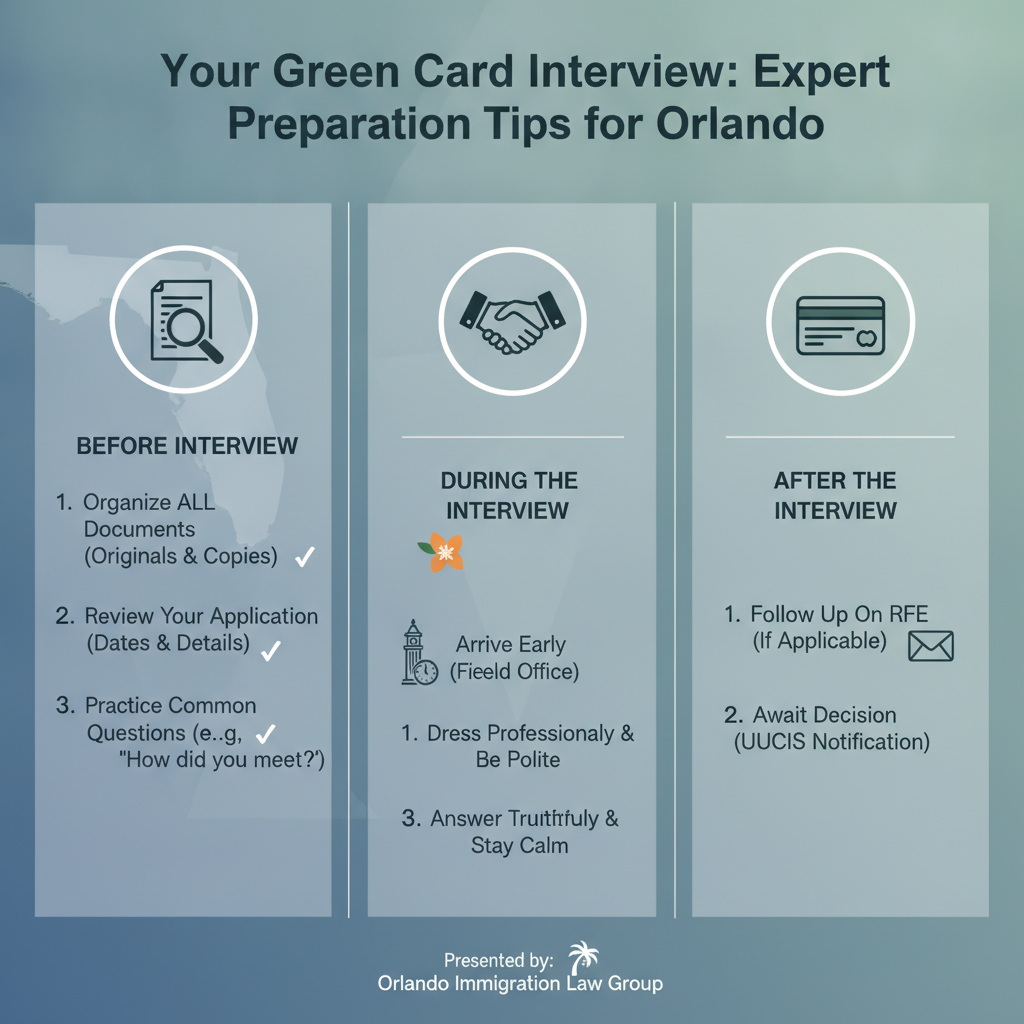
Your Green Card Interview: Expert Preparation Tips for Orlando
Prepare for your green card interview with Imigrar's comprehensive guide. Learn requirements, gather documents, and know what to expect for a successful outcome in Orlando and beyond.

Securing a Green Card is a pivotal moment in the immigration journey for countless individuals and families. It represents the opportunity for permanent residency in the United States, offering stability, security, and the promise of a brighter future. While the path to this milestone often involves numerous forms, filings, and waiting periods, one of the most crucial steps is undoubtedly the Green Card interview. This interview, conducted by a U.S. Citizenship and Immigration Services (USCIS) officer, is your opportunity to demonstrate your eligibility and provide clarity on your application.
For many, the prospect of an interview with a government official can be daunting. Questions about what to expect, what documents to bring, and how to present oneself are common and valid. At Imigrar, an immigration law firm based in Orlando, Florida, we understand these concerns deeply. Our mission is to "Keep Families Together," and a successful Green Card interview is often a critical step in achieving that goal. This comprehensive guide is designed to equip you with the knowledge, strategies, and confidence needed to navigate your Green Card interview successfully, whether you are in Orlando, across Florida, or anywhere in the nation.
Need Expert Guidance for Your Green Card Interview? Don't face your interview unprepared. Our experienced Orlando immigration team at Imigrar is here to help you every step of the way. Call +1 786-791-3106 for a free consultation, or message us online. Se Habla Español.
NEWS SOURCE REFERENCE SECTION
The reporting that sparked this guide: Green Card Interview Preparation Tips (Immigration Law)
What This News Means for Immigrants in Orlando and Across Florida
Why this news is showing up now
The topic of Green Card interview preparation is not new; in fact, it’s a perpetually trending subject within immigration law circles. Each year, hundreds of thousands of individuals apply for Green Cards through various avenues, such as family sponsorship, employment, or asylum. For nearly all of these applicants, an interview with USCIS or a Consular Officer is a mandatory step. The constant influx of new applicants means there’s an ongoing, critical demand for clear, accurate, and actionable advice on how to successfully navigate this crucial stage.
Furthermore, immigration policies and processing procedures can evolve, albeit slowly, requiring applicants to stay informed about best practices. The high stakes involved – the difference between permanent residency and potential denial – naturally keep this topic at the forefront of discussions for immigrants, their families, and legal professionals. News outlets and legal resources frequently highlight the importance of proper preparation because it remains one of the most common points where an application can face scrutiny or denial if not handled correctly. This consistent relevance ensures that "Green Card Interview Preparation Tips" is always a timely and essential topic, reflecting the continuous journey of immigrants nationwide.
How it can affect Florida residents
Florida, particularly Central Florida and the Orlando metropolitan area, is home to a vibrant and diverse immigrant population. The state boasts a significant number of individuals and families pursuing Green Cards through various categories, including family-based petitions, employment-based visas, and asylum claims. For these residents, the Green Card interview is a very real and often imminent step in their immigration process.
Specifically, for those undergoing Adjustment of Status (applying for a Green Card from within the U.S.), their interviews will typically be scheduled at a local USCIS Field Office. For many in Central Florida, this means the Orlando USCIS Field Office. Understanding interview protocols, required documentation, and potential questions is directly applicable and vital for residents in Orange County and surrounding areas along the I-4 corridor. A well-prepared applicant can significantly reduce stress, avoid delays, and increase their chances of a positive outcome, impacting their ability to live and work legally in Florida and "Keep Families Together." Without proper guidance, the complexities of the interview process can lead to unnecessary anxiety, potential missteps, and even adverse decisions, directly affecting their lives and futures in the Sunshine State.
What Green Card Interview Preparation Is (and Why It Matters)
A plain-English definition
A Green Card interview is a formal meeting with an immigration officer where you, and often your sponsoring family member or employer, discuss your application for permanent residency in the United States. Think of it as a final check-in point where USCIS (or a U.S. Consular Officer if you're applying from abroad) verifies all the information you've provided in your application forms and confirms your eligibility for a Green Card. The officer will ask questions to ensure that your relationship (if family-based), your qualifications (if employment-based), and your background meet all U.S. immigration laws. It's a crucial step designed to prevent fraud, confirm identities, and ensure that only eligible individuals receive permanent resident status.
Key terms you need to know
- Green Card: The common name for a U.S. Permanent Resident Card, which allows foreign nationals to live and work permanently in the United States.
- USCIS (U.S. Citizenship and Immigration Services): The government agency responsible for administering immigration and naturalization benefits, including Green Cards, within the United States.
- Adjustment of Status (AOS): The process of applying for a Green Card while physically present in the United States. The interview for AOS typically occurs at a USCIS Field Office.
- Consular Processing: The process of applying for a Green Card through a U.S. consulate or embassy in your home country (or another country if you are outside the U.S.). The interview occurs abroad.
- Sponsor: The U.S. citizen or lawful permanent resident (LPR) who files a petition on behalf of an immigrant, typically for family-based Green Cards (e.g., spouse, parent, child).
- Beneficiary: The immigrant who is seeking a Green Card based on a petition filed by a sponsor.
- Form I-130, Petition for Alien Relative: The initial form filed by a U.S. citizen or LPR to establish a qualifying relationship with an immigrant relative.
- Form I-485, Application to Register Permanent Residence or Adjust Status: The primary form filed by an immigrant to apply for a Green Card while inside the U.S. (for Adjustment of Status).
- Form I-864, Affidavit of Support: A legally binding document submitted by the sponsor to show they can financially support the immigrant and that the immigrant will not become a public charge.
- Priority Date: The date USCIS receives your immigration petition (e.g., Form I-130). This date determines your place in the Green Card line for certain categories, especially those subject to annual numerical limits.
- Inadmissibility: Grounds under immigration law that can make an individual ineligible for a Green Card (e.g., certain criminal offenses, health issues, immigration violations).
Understanding these terms is fundamental to comprehending the Green Card process and preparing effectively for your interview. It allows you to speak the same language as the immigration officer and understand the legal framework surrounding your application.
Current Immigration Law: The Foundation
The Green Card interview process is deeply rooted in U.S. immigration law, primarily the Immigration and Nationality Act (INA). The purpose of the interview is to ensure that applicants meet all statutory and regulatory requirements for permanent residency and are not subject to any grounds of inadmissibility. For those pursuing a Green Card through Adjustment of Status within the U.S., the primary legal provision is Section 245 of the INA, which outlines eligibility criteria. For family-based petitions, Section 204 of the INA establishes the framework for how U.S. citizens and lawful permanent residents can petition for their relatives.
Federal requirements
The federal government, through USCIS and the Department of State, sets the overarching requirements for Green Card eligibility. These typically include:
- Lawful Entry and Status: Generally, for Adjustment of Status, you must have entered the U.S. lawfully and maintained your non-immigrant status, or be an immediate relative of a U.S. citizen who may be exempt from certain bars.
- Valid Petition: An approved underlying petition, such as Form I-130, Petition for Alien Relative (for family-based immigration) or Form I-140, Immigrant Petition for Alien Worker (for employment-based immigration), must be in place.
- Admissibility: You must be "admissible" to the U.S. This means you must not fall under any grounds of inadmissibility, such as certain criminal convictions, health-related issues, past immigration violations, or being likely to become a "public charge." If you are inadmissible, you may need to apply for a waiver, such as Form I-601, Application for Waiver of Grounds of Inadmissibility.
- Financial Support: For most family-based Green Cards and some employment-based categories, your sponsor must demonstrate the financial ability to support you by filing Form I-864, Affidavit of Support, ensuring you will not become a public charge.
- Medical Examination: You must undergo a medical examination by a USCIS-approved civil surgeon (for Adjustment of Status) or panel physician (for Consular Processing) to ensure you meet health-related standards. The results are submitted on Form I-693, Report of Medical Examination and Vaccination Record.
- Interview: Almost all Green Card applicants are required to attend an interview, which serves as a final verification of all information provided in their applications.
All official forms and detailed instructions can be found on the USCIS official website. It is imperative to always refer to the latest versions of forms and instructions, as they can be updated regularly. You can access all forms directly via USCIS Forms.
Florida-specific considerations
While immigration law is federal, the practical application often involves local USCIS Field Offices. For individuals residing in Florida, particularly Central Florida, the Green Card interview for Adjustment of Status will likely be conducted at the Orlando USCIS Field Office. While the legal requirements remain the same nationwide, understanding the local context is helpful:
- Orlando USCIS Field Office: Familiarize yourself with the location and general procedures of this specific office. Planning your transportation and arrival time is crucial.
- Diverse Community: Florida, and Orlando specifically, serves a highly diverse immigrant population. USCIS officers are accustomed to interviewing individuals from various cultural backgrounds and may use interpreters if needed (though it's often best to bring your own attorney who can also interpret if fluent).
- Local Legal Support: Having an immigration attorney based in Orlando, like Imigrar, means they are familiar with the local office's practices, which can be an advantage in preparing you for your specific interview.
Reminder: State laws do not directly govern Green Card eligibility or interviews. However, any criminal history in Florida, or other states, will be scrutinized under federal inadmissibility grounds during your interview. It is critical to disclose all such information to your attorney for proper preparation and strategy.
How to Prepare for Your Green Card Interview: A Complete Step-by-Step Guide
The Green Card interview is the culmination of months, sometimes years, of preparation. Approaching it with diligence and a clear strategy can make all the difference. Here’s a detailed, step-by-step guide to ensure you are fully prepared.
1) Understand Your Interview Type and Purpose
Before diving into document gathering, confirm whether you are undergoing Adjustment of Status (interview in the U.S.) or Consular Processing (interview abroad). The underlying purpose remains the same: to verify your eligibility and the veracity of your application. However, the specific procedures, required forms, and local office dynamics can differ. For those in Orlando, you are most likely preparing for an Adjustment of Status interview at the local USCIS Field Office.
- For Marriage-Based Green Cards: The officer's primary goal is to determine if your marriage is bona fide (entered into in good faith, not solely for immigration benefits). They will look for evidence of commingling of finances, shared life, and genuine affection.
- For Employment-Based Green Cards: The interview focuses on verifying your qualifications for the sponsored position, the legitimacy of the petitioning employer, and your intent to work in that role.
- For Other Categories (e.g., Asylum, VAWA): The interview will delve into the specific grounds for your application, requiring detailed recounting of personal experiences and supporting evidence.
2) Gather and Organize ALL Required Documents Thoroughly
This is arguably the most critical step. You must bring all original documents you submitted, plus any new evidence, to your interview. Organize them neatly in a binder with tabs for easy access. Make sure you have at least one copy of every document, including your submitted application forms. Here’s a comprehensive list:
- Interview Notice: The official letter from USCIS scheduling your interview.
- Identification:
- Valid Passport (and any expired passports used for entry)
- Driver's License or State ID (especially for Florida residents)
- Form I-94 Arrival/Departure Record
- Application Forms:
- Originals of your submitted Form I-485, Form I-130 (if applicable), Form I-765 (EAD application), Form I-131 (Advance Parole application), Form I-864, and any other forms filed.
- All supporting documents submitted with these forms.
- Personal Documents:
- Original Birth Certificate (for both applicant and sponsor, if applicable)
- Original Marriage Certificate (if marriage-based)
- Original Divorce Decrees or Death Certificates for all prior marriages (for both applicant and sponsor, if applicable)
- Translations of any foreign language documents, certified by a competent translator.
- Financial Documents (for sponsor):
- Form I-864, Affidavit of Support (original signed copy)
- Most recent three years of federal income tax returns (IRS transcripts preferred)
- W-2s, 1099s, and pay stubs for the current year
- Employment verification letter
- Bank statements, property deeds, or other asset evidence (if needed to meet income requirements)
- Relationship Evidence (for marriage-based petitions – be exhaustive):
- Joint bank account statements
- Joint lease agreements or mortgage statements (showing shared residence)
- Joint utility bills (electricity, water, internet)
- Joint health, auto, or life insurance policies
- Joint credit card statements
- Photos together (dating from before marriage, wedding, family events, vacations)
- Affidavits from friends and family testifying to the bona fides of the marriage
- Children's birth certificates (if applicable)
- Correspondence (emails, texts, social media posts) showing ongoing relationship
- Travel itineraries showing joint trips
- Any other evidence proving you share a life together.
- Medical Examination:
- Your sealed Form I-693, Report of Medical Examination and Vaccination Record, if not already submitted. If you submitted it unsealed, bring the copy.
- Criminal and Immigration History Documents:
- Certified court dispositions for any arrests or convictions, even minor ones.
- Police clearances from any country lived in for more than six months since age 16.
- Any documents related to previous immigration applications or denials.
- Attorney Representation:
- Your attorney should bring a copy of Form G-28, Notice of Entry of Appearance as Attorney or Accredited Representative.
Important: Do not bring original documents unless specifically instructed by USCIS to do so, or if you only have the original. Always bring copies as well. If you have new evidence since filing, bring the originals and copies. For Orlando residents, organize everything well before your scheduled interview at the Orlando USCIS Field Office.
3) Review Your Submitted Application Forms Thoroughly
You must be intimately familiar with every piece of information you submitted to USCIS. The interviewing officer will compare your verbal answers to the written information in your file. Any inconsistencies, even minor ones, can raise red flags. Read through your Form I-485, Form I-130, and all supporting documents multiple times. Pay close attention to dates, addresses, employment history, and answers to "yes/no" questions regarding criminal history or immigration violations.
- Memorize key dates: entry dates, marriage date, birth dates, employment start/end dates.
- Understand how you answered all questions, especially those related to inadmissibility.
- Be prepared to explain any discrepancies or changes since your initial filing.
Feeling Overwhelmed by Document Preparation? Imigrar takes the stress out of your Green Card application process. Our team ensures all your documents are perfectly organized and ready for your interview. Contact us at +1 786-791-3106 for tailored assistance. Se Habla Español.
4) Prepare for Common Interview Questions
While questions vary based on your Green Card category, some themes are universal. Practice answering these questions truthfully and concisely. Remember, honesty is paramount.
- Personal Background: Name, date of birth, place of birth, parents' names, previous addresses, education, employment history.
- Immigration History: How and when you entered the U.S., previous visas, any past immigration applications or issues.
- Relationship (for marriage-based):
- How and when did you meet your spouse?
- When did you get married?
- What does your spouse do for a living?
- Do you live together? Describe your home.
- What are your daily routines together?
- Who pays the bills?
- Have you met each other's families?
- What did you do for your last anniversary/holiday?
- (Warning: Be prepared for very personal questions about your relationship, even if uncomfortable, as the officer is trying to determine its authenticity.)
- Sponsor's Information: Questions about your sponsor's income, employment, and family.
- Inadmissibility Questions: The officer will go through the "yes/no" questions from Form I-485 again regarding criminal history, health issues, and past immigration violations. Answer truthfully, even if you previously disclosed the information.
5) Practice Your Responses and Communication
It's not just what you say, but how you say it. Practice articulating your answers clearly and confidently. If you have an attorney, they can conduct mock interviews.
- Be Truthful: Never lie or embellish. If you don't know an answer, say so. If you need clarification, ask.
- Be Concise: Answer the question asked, without volunteering unnecessary information.
- Be Respectful: Maintain a polite and cooperative demeanor.
- Language: If English is not your first language and you are not fluent, you may request an interpreter. However, having an attorney who is fluent in both English and Spanish (like at Imigrar) can be an immense asset.
- Your Attorney's Role: Your attorney is there to represent you, clarify questions, ensure fairness, and object to inappropriate questions. They cannot answer for you but can advise you.
6) Dress Appropriately and Plan Your Logistics
First impressions matter. Treat this like a professional meeting or a job interview.
- Attire: Dress in business casual or professional attire. It conveys respect for the process.
- Arrival Time: Plan to arrive at the Orlando USCIS Field Office at least 30 minutes before your scheduled appointment. Traffic in Orlando, especially along the I-4 corridor, can be unpredictable.
- Transportation: Know how you will get to the office and where to park.
- Security: Be prepared for airport-style security checks. Leave prohibited items at home.
- Food/Drink: Bring water if needed, but avoid bringing large bags or anything that might delay security.
7) Understand the Role of Your Attorney
While you can attend a Green Card interview alone, having an experienced immigration attorney by your side offers significant advantages. Your attorney will:
- Review your application and documents before the interview.
- Prepare you for potential questions and scenarios.
- Represent you at the interview, ensuring your rights are protected.
- Clarify questions from the officer and help you provide accurate answers.
- Address any issues or concerns that may arise during the interview.
- Help you respond to any Requests for Evidence (RFEs) or follow-up actions.
For Central Florida residents, having an Imigrar attorney who is familiar with the Orlando USCIS Field Office procedures provides an invaluable layer of support and expertise.
Practical Steps You Can Take Today
Don't wait until the last minute to prepare for your Green Card interview. Here’s an actionable checklist to start today:
- Consult an Attorney: Schedule a free consultation with Imigrar today. An expert can review your case and provide personalized advice.
- Locate All Original Documents: Start gathering every original document listed in Step 2. If you don't have an original, determine how to obtain one.
- Make Copies: Create at least two sets of copies for every document, including your submitted forms. One set for your attorney, one for your own reference, and originals to bring.
- Review Your Application: Read through every page of your Form I-485, Form I-130, and all supporting documents. Highlight any areas you need to clarify or remember.
- Organize Your Evidence: Purchase a binder, dividers, and tabs. Start organizing your documents logically (e.g., personal, financial, relationship).
- Gather New Evidence: If your Green Card is marriage-based, continuously collect new joint documents (bills, photos, travel tickets) to demonstrate the ongoing bona fides of your marriage.
- Practice Answering Questions: Have a trusted friend or family member (or your attorney) ask you common interview questions.
- Check USCIS Processing Times: While interviews are scheduled, you can monitor general processing times for your application type via USCIS Processing Times to get an idea of the waiting period.
Document preparation guidance
Proper document preparation is a cornerstone of a successful interview. Here are some tips:
- Create a Master Checklist: Use this guide’s document list and your attorney’s advice to create a personalized checklist.
- Tab and Label: Use clear tabs for each section (e.g., "Identification," "Marriage Docs," "Financial"). This makes it easy for you and the officer to find specific documents.
- Chronological Order: Within each section, arrange documents in chronological order, with the most recent on top.
- Keep Originals Safe: Bring originals but do not hand them over unless specifically requested. The officer will typically review them and return them immediately.
- Certified Translations: Ensure all foreign language documents are accompanied by a complete English translation and a certification from the translator stating their competence and the accuracy of the translation.
Timeline expectations
The timeline from filing your application to the interview can vary significantly depending on your Green Card category, the USCIS Field Office workload (like the Orlando office), and current processing times. However, some general expectations include:
- Filing to Interview Notice: For Adjustment of Status, after filing Form I-485 and other concurrent forms, you typically receive a biometrics appointment notice within a few weeks to a few months. The interview notice usually follows several months later, often 6-18 months after filing, but can be longer.
- Interview to Decision: In many cases, the officer will give you an immediate decision or indicate that a decision will be mailed. However, some cases require further review, leading to a Request for Evidence (RFE) or a notice of intent to deny. A decision is usually mailed within a few weeks to a few months after the interview.
- Green Card Mailing: Once approved, your physical Green Card is typically mailed within a few weeks.
Reminder: These are general timelines. Always check the USCIS Processing Times for the most current estimates specific to your form and field office.

How Imigrar Helps Immigrants in Orlando
At Imigrar, we
Related Topics
Need Legal Assistance?
Our experienced immigration attorneys are here to help with your case. Contact Imigrar today for a free consultation and let us guide you through the legal process with confidence.
📍 Orlando, Florida • Serving clients nationwide
📧 info@imigrar.com