
H-1B Visa Lottery Changes FY2027: New Rules & Your Future
Discover the crucial H-1B visa lottery changes for FY2027. Imigrar explains new rules, eligibility, and how to navigate the updated process for your future in the U.S.

Navigating the complex world of U.S. immigration law can be challenging, especially when significant changes are announced. For skilled foreign workers and their employers, the H-1B visa program is a critical pathway to employment in the United States. As we approach the registration period for Fiscal Year 2027 (FY2027), the United States Citizenship and Immigration Services (USCIS) has introduced important modifications to the H-1B lottery process. These changes aim to enhance fairness, reduce fraud, and streamline the selection process, but they also require careful attention from all prospective applicants.
Considering an H-1B visa? The new FY2027 rules are complex. Our experienced immigration team in Orlando is here to guide you. Call +1 786-791-3106 for a free consultation, or message us online. Se Habla Español.
At Imigrar, an immigration law firm based in Orlando, Florida, we are committed to keeping families together and helping skilled individuals achieve their American dreams. This comprehensive guide will break down the latest H-1B visa lottery changes for FY2027, explaining what they mean for you, the step-by-step process, and how our expertise can make a difference.
The reporting that sparked this guide:
H-1B Visa Lottery Changes for FY2027 (Legal News)
What This News Means for Immigrants in Orlando and Across Florida
The H-1B visa program is vital for many industries, particularly in technology, engineering, medicine, and other specialty occupations. Florida, with its burgeoning tech sector, growing healthcare industry, and diverse economy, relies heavily on skilled foreign talent to fill critical gaps. The recent changes to the H-1B lottery process for FY2027 directly impact employers and prospective H-1B beneficiaries across the state, from the innovation hubs of Orlando and Tampa to the bustling markets of Miami.
Why this news is showing up now
Immigration regulations are constantly evolving. The H-1B visa lottery process, in particular, has seen several adjustments in recent years as USCIS seeks to improve efficiency and combat widespread fraud. The changes for FY2027 are a continuation of these efforts, building on lessons learned from previous lottery cycles. Historically, discussions and proposals for rule modifications often begin well in advance of the actual lottery registration period. For FY2027, which typically has a lottery registration in March 2026 for an October 1, 2026 start date, news about impending changes would surface in late 2025 or early 2026, allowing time for implementation and public awareness. This proactive communication from USCIS aims to give employers and beneficiaries ample time to understand and adapt to the new requirements before the next registration window opens.
How it can affect Florida residents
For individuals residing in Florida, especially those pursuing higher education at institutions like the University of Central Florida (UCF), the University of Florida (UF), or Florida International University (FIU), these changes are particularly relevant. Many international students hope to transition from F-1 student status to H-1B status post-graduation. Similarly, Florida-based companies along the I-4 corridor and in major metropolitan areas are heavily invested in securing top talent through the H-1B program.
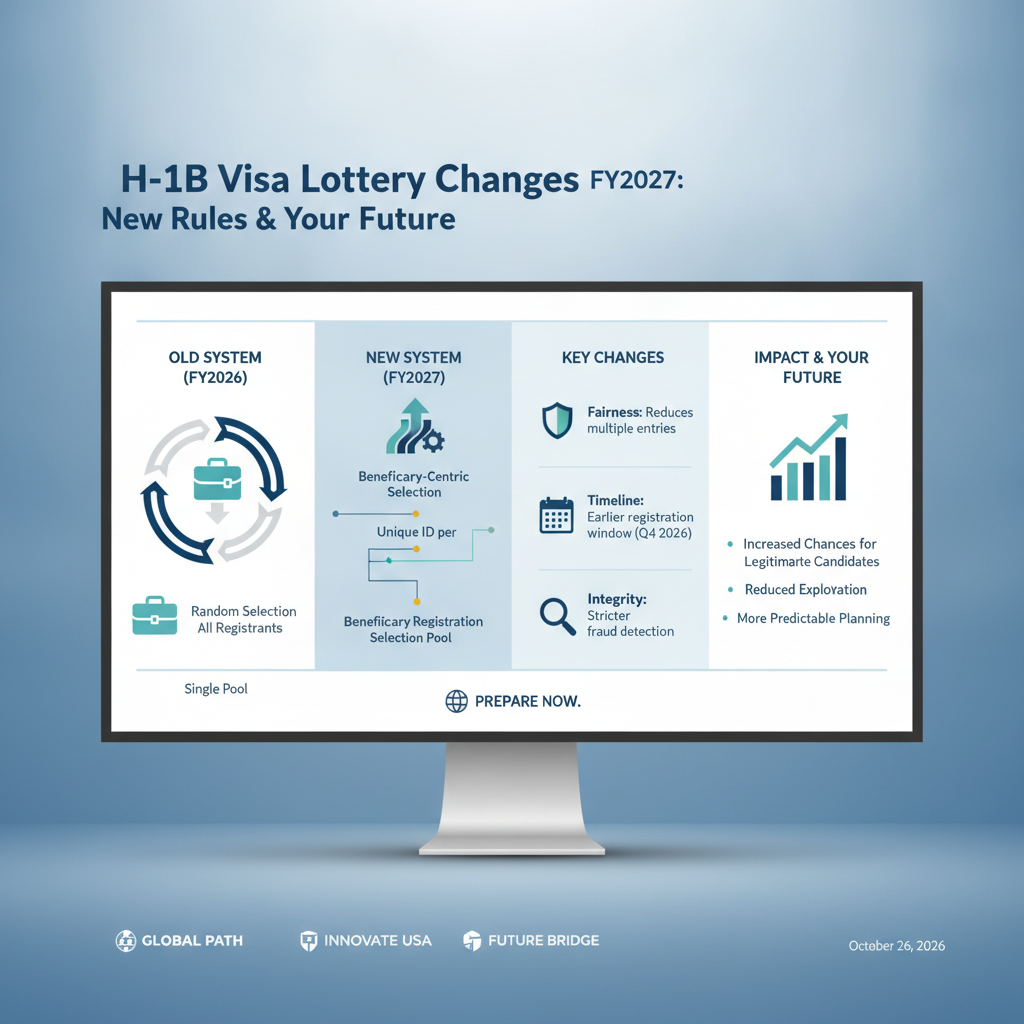
- Increased Fairness: The most significant change focuses on a beneficiary-centric selection process. This means that each unique beneficiary will be entered into the lottery only once, regardless of how many employers register them. This change is designed to prevent bad actors from submitting multiple registrations for the same individual to inflate their chances, a practice that previously disadvantaged legitimate applicants. For Florida residents, this could lead to a more level playing field.
- Reduced Fraud: Stronger anti-fraud measures mean greater scrutiny on employer registrations. Companies in Florida must ensure their registrations are legitimate and fully compliant, with genuine job offers.
- Potential for Fee Adjustments: While not definitively confirmed for FY2027, USCIS has often adjusted fees. Any increase in the H-1B registration fee or petition filing fees could impact smaller Florida businesses and startups.
- Strategic Planning: Both employers and prospective H-1B workers in Florida need to understand these new rules to strategize effectively. This includes ensuring all documentation is impeccable and that employer-employee relationships are clearly defined and legitimate from the outset.
The Orlando USCIS Field Office and immigration courts serve a diverse population. Understanding these federal changes is critical for anyone in Central Florida navigating their immigration journey.
What H-1B Visa Lottery Changes for FY2027 Is (and Why It Matters)
The H-1B visa program allows U.S. employers to temporarily employ foreign workers in specialty occupations. These occupations generally require a bachelor's degree or higher in a specific field. Due to high demand, USCIS conducts a lottery each fiscal year to select petitions from the pool of eligible registrations.
A plain-English definition
Imagine a highly competitive job market where there are far more qualified applicants than available positions. To decide who gets an interview, a lottery is held. The H-1B visa lottery is similar: because the number of H-1B visas available each year (the "cap") is much lower than the number of petitions employers want to file, USCIS uses a lottery system to randomly select which employers can proceed with filing a full H-1B petition. The "changes for FY2027" refer to new rules put in place for how this lottery will be conducted, primarily to make it fairer and prevent fraud.
The core of the FY2027 H-1B lottery changes is a shift towards a beneficiary-centric selection process. Previously, an employer could submit a registration for a prospective employee, and that same employee could have multiple registrations submitted on their behalf by different employers. While an employee could only ultimately work for one H-1B employer, this system sometimes allowed unscrupulous entities to flood the lottery with multiple registrations for the same individual, artificially inflating their chances of selection and reducing the odds for others. The new rule ensures that each unique individual (beneficiary) is entered into the lottery only once, regardless of how many employers register them. If a beneficiary is selected, all employers who registered that beneficiary will receive a selection notice, and any of those employers can then proceed to file a petition on behalf of that beneficiary.
This change matters because it aims to make the lottery more equitable, giving every eligible individual the same fair chance at selection, irrespective of how many employers are willing to sponsor them. It also strengthens USCIS's ability to detect and deter fraud related to multiple registrations.
Key terms you need to know
- H-1B Visa: A nonimmigrant visa that allows U.S. employers to temporarily employ foreign workers in specialty occupations.
- Specialty Occupation: An occupation that requires theoretical and practical application of a body of highly specialized knowledge, and a bachelor's or higher degree in the specific specialty (or its equivalent) as a minimum for entry into the occupation in the United States.
- H-1B Cap: The annual numerical limit on the number of H-1B visas issued. The regular cap is 65,000, with an additional 20,000 visas reserved for those with a U.S. master's degree or higher (the "Master's Cap").
- Cap-Subject: Refers to H-1B petitions that are subject to the annual numerical limits. Certain petitions, such as those filed by universities or non-profit research organizations, are "cap-exempt."
- Beneficiary: The foreign national worker for whom the H-1B visa is sought.
- Petitioner: The U.S. employer filing the H-1B petition on behalf of the beneficiary.
- H-1B Registration Period: A designated window, typically in March, during which prospective petitioners (employers) must electronically register beneficiaries for the lottery. A non-refundable fee is required for each registration.
- Selection Rate: The percentage of registered beneficiaries who are selected in the lottery to proceed with filing a full H-1B petition. This rate varies significantly each year based on demand.
- USCIS: United States Citizenship and Immigration Services, the federal agency that administers immigration benefits.
- FY (Fiscal Year): The U.S. government's fiscal year runs from October 1 to September 30. H-1B visas are allocated for a specific fiscal year (e.g., FY2027 begins October 1, 2026).
- Beneficiary-Centric Selection: The new rule for FY2027 where the lottery selection is based on unique beneficiaries, ensuring each individual has only one chance, regardless of how many employers register them. This is a critical change for fairness and fraud prevention.
Current Immigration Law: The Foundation
The H-1B visa program is governed primarily by the Immigration and Nationality Act (INA), specifically Section 101(a)(15)(H)(i)(b) and Section 214(g). These sections define the H-1B category, establish the annual cap, and outline eligibility criteria. The regulations further detail the application process, employer responsibilities, and beneficiary qualifications.
Federal requirements
To qualify for an H-1B visa, both the employer and the prospective employee (beneficiary) must meet specific federal requirements:
- For the Beneficiary:
- Hold a bachelor's degree or its equivalent, or a higher degree, or possess a license in a specialty occupation field, or have work experience equivalent to a bachelor's degree.
- The degree or equivalent must be directly related to the specialty occupation.
- If currently in the U.S., they must maintain valid immigration status.
- For the Employer (Petitioner):
- The employer must offer a job in a "specialty occupation."
- The employer must agree to pay the beneficiary at least the prevailing wage for the occupation in the area of intended employment, or the actual wage paid to other employees with similar experience and qualifications, whichever is higher.
- The employer must file a Labor Condition Application (LCA) with the Department of Labor, certifying compliance with wage and working condition requirements.
- The employer must have an Employer Identification Number (EIN).
The annual H-1B cap is set at 65,000, with an additional 20,000 visas for those who have earned a U.S. master's degree or higher. This means that competition is incredibly fierce, often leading to selection rates as low as 10-15% in recent years.
Key USCIS forms involved in the H-1B process include:
- Form I-129, Petition for a Nonimmigrant Worker: This is the primary form filed by the employer on behalf of the beneficiary once selected in the lottery.
- Form I-797, Notice of Action: Used by USCIS to communicate various actions, including receipt notices, selection notices, Requests for Evidence (RFEs), and approval notices.
- Form I-907, Request for Premium Processing Service: An optional form to expedite the processing of Form I-129 for an additional fee.
For official information and to download forms, always refer to the USCIS official website.
Florida-specific considerations
While H-1B laws are federal, their impact is felt locally. Florida's economy benefits immensely from skilled foreign workers. Companies in Orlando, Tampa, and Miami often petition for H-1B visas in sectors such as:
- Information Technology: Software developers, data scientists, cybersecurity analysts.
- Healthcare: Physicians, nurses, medical researchers (often cap-exempt if affiliated with non-profit hospitals or universities).
- Engineering: Civil, electrical, mechanical engineers for Florida's infrastructure and aerospace industries.
- Hospitality and Tourism: Specialized roles requiring unique skills, particularly in management or technology, though less common for H-1B.
The presence of major universities like UCF, UF, and FIU, which attract a significant number of international students, means a large pool of potential H-1B beneficiaries right here in Florida. These graduates are often sought after by local companies looking to grow. Understanding the local job market and prevailing wage rates for specific positions in Orange County or other Florida regions is crucial for employers to ensure compliance with H-1B requirements.
How to Navigate the H-1B Lottery Changes for FY2027: A Complete Step-by-Step Guide
The H-1B lottery process is intricate, and the FY2027 changes add another layer of complexity. Here's a detailed step-by-step guide to help both employers and beneficiaries prepare and proceed.
1) Understand the New Rules & Confirm Eligibility (Beneficiary & Employer)
Before anything else, both the prospective H-1B worker (beneficiary) and the sponsoring employer (petitioner) must fully grasp the beneficiary-centric selection process and ensure they meet all fundamental eligibility criteria.
- For Beneficiaries:
- Degree Requirement: Ensure you possess a U.S. bachelor's degree (or foreign equivalent), or a U.S. master's degree (or higher). If your degree is foreign, secure a professional evaluation confirming its U.S. equivalency.
- Specialty Occupation Match: Confirm your educational background aligns directly with the specialty occupation offered by the employer.
- Maintain Status: If you are currently in the U.S. (e.g., on an F-1 OPT visa), ensure you maintain your legal immigration status.
- One Registration Per Person: Understand that for FY2027, you will only have one entry in the lottery, even if multiple employers register you. USCIS will identify you by your passport or travel document information.
- For Employers:
- Specialty Occupation: The job offered must clearly qualify as a specialty occupation. This means it typically requires a bachelor's degree or higher in a specific field.
- Wage Compliance: Be prepared to pay the beneficiary the prevailing wage for the occupation in the specific geographic area (e.g., Orlando, FL) or the actual wage, whichever is higher.
- Genuine Job Offer: USCIS is increasing scrutiny on the legitimacy of job offers. Ensure there is a real employer-employee relationship and a bona fide need for the H-1B worker.
- E-Verify Requirement: While not a new rule for FY2027, employers must be enrolled in E-Verify if they wish to sponsor certain F-1 OPT STEM extension students.
Required Documents (Initial Assessment):
- Beneficiary: Resume/CV, academic transcripts, degree certificates, foreign degree evaluations (if applicable), passport copy, I-94 record (if in U.S.).
- Employer: Company EIN, job description, proposed salary, organizational chart.
2) Employer H-1B Registration Process
The first official step for cap-subject H-1B petitions is the electronic registration process, typically occurring in March. This is where the beneficiary-centric selection rule comes into play.
- Create/Access USCIS Online Account: The employer (or their authorized representative, like Imigrar) must have a "registrant" account with USCIS.
- Submit Beneficiary Information: For each prospective H-1B worker, the employer must submit basic identifying information, including the beneficiary's full legal name, date of birth, country of birth, country of citizenship, gender, and passport number or other valid travel document number. This unique identifier is crucial for the beneficiary-centric selection.
- Pay the Registration Fee: A non-refundable fee (e.g., $10 per registration in previous cycles) must be paid for each beneficiary registered.
- Registration Window: The registration period usually lasts for a specific window, typically two to three weeks in March (e.g., March 1 to March 17). Important: Missing this deadline means waiting another year.
- Multiple Registrations (Employer Perspective): An employer can register multiple beneficiaries. However, they can only register a single beneficiary once. If multiple employers register the same beneficiary, USCIS will still only count one entry for that beneficiary in the lottery.
Required Documents (Registration):
- Beneficiary: Passport/travel document number (critical for unique identification), full legal name, date of birth, country of birth/citizenship, gender.
- Employer: EIN, legal business name, mailing address, authorized signatory information.
3) Lottery Selection and Petition Preparation & Filing
Once the registration period closes, USCIS conducts the lottery. Notifications are typically issued by the end of March.
- Selection Notification: If a beneficiary is selected, all employers who registered that beneficiary will receive a "Selection Notice" (Form I-797C). This notice will include a unique receipt number and indicate the filing period during which the full H-1B petition can be submitted.
- Petitioner's Choice: If multiple employers registered the same selected beneficiary, the beneficiary must decide which employer they wish to proceed with. Only one employer can file a petition for that selected registration.
- Labor Condition Application (LCA) Filing: The chosen employer must file and obtain a certified LCA from the Department of Labor (DOL). This step must be completed before filing Form I-129.
- Form I-129 Filing: Within the designated filing period (typically 90 days from the selection date), the employer must prepare and mail the complete Form I-129, Petition for a Nonimmigrant Worker, along with all supporting documentation and filing fees, to USCIS.
Required Documents (Petition Filing - Post-Selection):
- Certified LCA (Form ETA-9035).
- Completed Form I-129 with all required supplements (e.g., H-1B Data Collection and Filing Fee Exemption Supplement).
- Copy of the H-1B Lottery Selection Notice (Form I-797C).
- Beneficiary's academic credentials (transcripts, degree certificates, foreign evaluations).
- Beneficiary's resume/CV.
- Evidence of beneficiary's current immigration status (if in U.S.): I-20, OPT EAD card, I-94.
- Employer's supporting documents: Company profile, articles of incorporation, financial statements, business licenses, client contracts (if applicable), organizational charts, detailed job description, offer letter.
- Petitioner's letter explaining the specialty occupation, the beneficiary's qualifications, and the terms of employment.
- Applicable filing fees (base fee, ACWIA fee, fraud prevention and detection fee, public law 114-113 fee).
4) Responding to Requests for Evidence (RFEs) & Approvals
After filing, USCIS may issue an RFE or approve the petition.
- Request for Evidence (RFE): USCIS may send an RFE if they require additional information or clarification to make a decision. This is common and can pertain to the specialty occupation nature of the job, the beneficiary's qualifications, or the employer's ability to pay the prevailing wage. A robust, well-documented response is critical.
- Premium Processing (Optional): If the employer opts for Form I-907, Request for Premium Processing Service, USCIS guarantees a response (approval, denial, or RFE) within 15 calendar days for an additional fee. This can significantly speed up the initial processing time.
- Approval (Form I-797A/B): If the petition is approved, USCIS will send an approval notice (Form I-797A if the beneficiary is in the U.S. and their status is changed/extended, or Form I-797B if the beneficiary needs to apply for a visa at a U.S. consulate abroad).
Required Documents (RFE Response):
- Specific documents requested by USCIS, often including expert opinion letters, additional evidence of specialty occupation, detailed project plans, or further proof of employer-employee relationship.
5) Visa Interview and Status Change (if applicable)
Depending on whether the beneficiary is inside or outside the U.S. when the H-1B petition is approved, the next steps vary.
- Consular Processing (Outside U.S.): If the beneficiary is outside the U.S., they will need to attend a visa interview at a U.S. embassy or consulate in their home country. They will need to present their approval notice (Form I-797B) and other supporting documents. If successful, an H-1B visa stamp will be placed in their passport, allowing them to enter the U.S.
- Change of Status/Extension of Stay (Inside U.S.): If the beneficiary is already in the U.S. and the Form I-129 included a request for a change of status (e.g., from F-1 to H-1B) or an extension of stay, and it was approved, their status automatically changes on October 1st of the fiscal year (e.g., October 1, 2026, for FY2027). They will receive an Form I-797A with a new I-94 record.
Required Documents (Visa Interview/Status Change):
- Valid passport.
- Form DS-160 confirmation page.
- Interview appointment confirmation.
- Original Form I-797A/B (H-1B approval notice).
- LCA copy.
- Employer's support letter.
- Academic documents, resume, previous employment letters.
- Marriage certificate and birth certificates for dependents (H-4 visa applicants).
6) Maintaining H-1B Status
Once H-1B status is granted, beneficiaries must comply with all regulations to maintain it.
- Work for Sponsoring Employer: You can only work for the H-1B sponsoring employer and in the position specified in the petition.
- Amendments for Material Changes: If there are significant changes to the job duties, work location, or terms of employment, the employer may need to file an H-1B amendment.
- Extensions: H-1B status is generally granted for up to three years and can be extended for a maximum total of six years. Further extensions beyond six years are possible under specific circumstances (e.g., approved I-140 petition).
- Compliance: Both employer and employee must adhere to all H-1B regulations to avoid issues.
Overwhelmed by the H-1B process? Let Imigrar simplify it for you. Our Orlando immigration attorneys are experts in H-1B visas and the latest regulatory changes. Call us today at +1 786-791-3106 for a free consultation. ¡Se Habla Español!

Practical Steps You Can Take Today to Prepare
The H-1B lottery is highly competitive, and preparation is key. Here’s an actionable checklist to help you get ready for the FY2027 cycle.
Actionable Checklist:
- Consult an Experienced Immigration Attorney: This is the most crucial step. An attorney can assess eligibility, guide through documentation, and ensure compliance with the new beneficiary-centric rules.
- Gather All Personal & Academic Documents:
- Original and certified copies of all degrees and transcripts.
- Foreign degree evaluations (if applicable).
- Professional licenses (if required for the occupation).
- Updated resume/CV.
Related Topics
Need Legal Assistance?
Our experienced immigration attorneys are here to help with your case. Contact Imigrar today for a free consultation and let us guide you through the legal process with confidence.
📍 Orlando, Florida • Serving clients nationwide
📧 info@imigrar.com