
H-1B Lottery Shake-Up: Navigating New Rules for FY2027 & Beyond
Understand the critical H-1B visa lottery changes for FY2027 and how these new rules impact your immigration journey. Imigrar guides you through.
The reporting that sparked this guide: H-1B Visa Lottery Changes for FY2027 (Legal News)
Navigating complex H-1B changes? Our Orlando immigration team is ready to assist. Call +1 786-791-3106 for a free consultation, or message us online. Se Habla Español.
What This News Means for Immigrants in Orlando and Across Florida
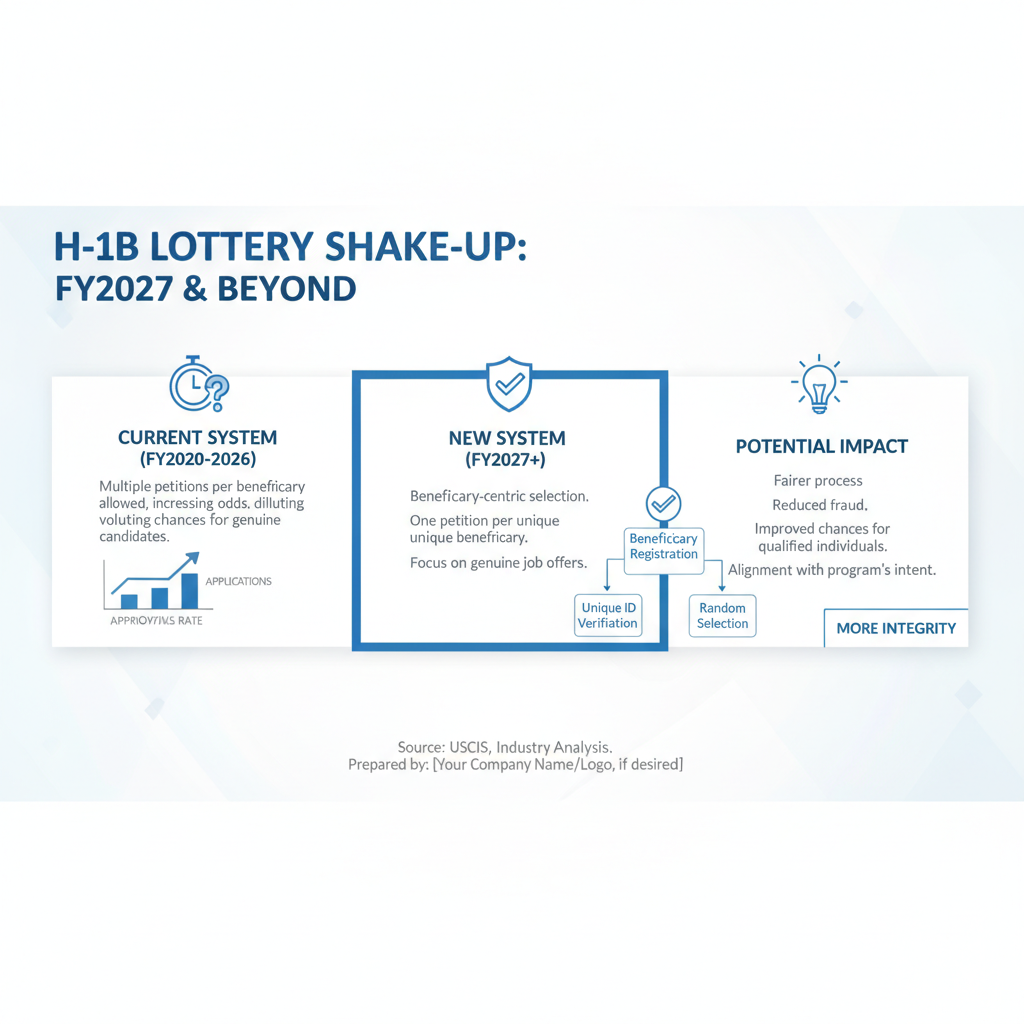
The landscape of U.S. immigration law is constantly evolving, and few areas see as much change and scrutiny as the H-1B visa program. As of October 1, 2026, the discussion around H-1B visa lottery changes, particularly those that were cemented for Fiscal Year 2027 (FY2027), continues to be a central point of concern and planning for employers and prospective employees nationwide, including here in Orlando and throughout Florida.
Why this news is showing up now
While the H-1B lottery for FY2027 concluded its registration phase in March 2026 and selections were made shortly thereafter, the implications of the rule changes implemented for that cycle are still very much "trending news." These changes, primarily shifting to a beneficiary-centric registration system, represented a significant overhaul designed to curb fraud and enhance fairness. Now, several months after the FY2027 lottery, legal experts, employers, and immigration advocates are analyzing the outcomes, identifying best practices, and preparing for the next cap season (FY2028, with registration expected in March 2027) under these established new rules.
The discussion intensifies as businesses and individuals reflect on the FY2027 results and anticipate the upcoming registration period. The new system fundamentally alters how employers approach H-1B sponsorship, requiring meticulous planning and adherence to updated regulations. For many, the full impact of these changes is only now becoming clear as petitions are adjudicated and the market adjusts. This ongoing analysis ensures that all stakeholders are well-prepared for future H-1B cap seasons, making the topic highly relevant today, October 1, 2026.
How it can affect Florida residents
Florida, with its booming tech industry, growing healthcare sector, robust tourism and hospitality, and diverse academic institutions, is a major hub for H-1B visa holders. Cities like Orlando, Miami, Tampa, and Jacksonville attract a substantial number of skilled foreign workers, particularly in IT, engineering, finance, and specialized medical fields. For Central Florida residents and businesses, these H-1B changes have profound effects:
- Increased Certainty for Employers: While the lottery remains unpredictable, the new beneficiary-centric system aims to reduce the likelihood of multiple registrations for the same individual, which could lead to a more level playing field and potentially reduce overall lottery fraud. This is good news for legitimate employers in Orlando looking to sponsor talent.
- Fairer Chances for Beneficiaries: For individuals in Florida hoping to secure an H-1B visa, the new system means that each eligible beneficiary now has only one chance in the lottery, regardless of how many employers register them. This prevents a single individual from inflating their odds through multiple employer submissions, theoretically distributing the limited visa numbers more equitably.
- Strategic Planning is Paramount: Florida-based companies, from startups along the I-4 corridor to established corporations, must now refine their H-1B strategies. The focus shifts entirely to the individual beneficiary's qualifications and the legitimate job offer, requiring earlier and more thorough vetting processes.
- Impact on Local Economy: A stable and predictable H-1B program is crucial for Florida's economic growth, allowing companies to fill critical skill gaps and remain competitive. The success of the new rules in ensuring fairness directly translates to the state's ability to attract and retain top global talent.
Understanding these changes is not just about compliance; it's about strategic advantage and ensuring that Florida continues to thrive as a magnet for innovation and skilled professionals.
Confused by H-1B rule changes? Don't risk your future. Call Imigrar at +1 786-791-3106 for expert guidance. Our Orlando office serves clients nationwide. Se Habla Español.
What H-1B Visa Lottery Changes for FY2027 Is (and Why It Matters)
The H-1B visa program is a cornerstone of U.S. immigration for skilled foreign workers. The "H-1B Visa Lottery Changes for FY2027" refers to significant regulatory adjustments made by U.S. Citizenship and Immigration Services (USCIS) to the annual H-1B cap registration process. These changes were officially implemented for the FY2025 cap season and solidified for subsequent years, including the FY2027 lottery, to address integrity concerns and improve the fairness of the lottery system.
A plain-English definition
At its core, the H-1B visa is a nonimmigrant visa that allows U.S. employers to temporarily employ foreign workers in specialty occupations. These occupations generally require a bachelor's degree or higher in a specific field. Because demand far exceeds the annual limit (or "cap") on H-1B visas, USCIS uses a lottery system to select eligible registrations when the number of registrations surpasses the available visas. The "changes for FY2027" refer to new rules that dictate how individuals are entered into this lottery. Previously, an individual could have multiple entries if multiple employers registered them. Now, each individual (beneficiary) gets only one entry into the lottery, regardless of how many employers submit registrations on their behalf. This is called the beneficiary-centric selection process.
Why it matters: This shift is crucial because it aims to prevent fraud where some employers would submit numerous registrations for the same individual, artificially inflating their chances. By ensuring only one lottery entry per unique beneficiary, USCIS hopes to create a more equitable system, giving every eligible individual a fairer shot at selection. For employers, it means less incentive to participate in multiple registrations and a renewed focus on identifying truly committed candidates.
Key terms you need to know
- H-1B Visa: A nonimmigrant visa that permits U.S. employers to temporarily employ foreign workers in specialty occupations.
- Specialty Occupation: An occupation that requires a theoretical and practical application of a body of highly specialized knowledge and a bachelor's or higher degree in the specific specialty (or its equivalent) as a minimum for entry into the occupation in the United States.
- Annual Cap: The legal limit on the number of H-1B visas issued each fiscal year. The current annual cap is 65,000, with an additional 20,000 visas reserved for those holding a U.S. master's degree or higher (the "master's cap").
- Beneficiary: The foreign national who will be employed in the H-1B specialty occupation.
- Petitioner: The U.S. employer who files the H-1B petition on behalf of the beneficiary.
- H-1B Registration: An electronic process where prospective petitioners (employers) submit basic information about the company and the prospective H-1B worker (beneficiary) to USCIS during a designated period. This is the first step before the lottery.
- Lottery System: If the number of H-1B registrations exceeds the annual cap, USCIS conducts a random selection process, first for the master's cap and then for the regular cap.
- LCA (Labor Condition Application): Form ETA-9035. A document filed with the U.S. Department of Labor (DOL) by the employer, attesting that they will pay the H-1B worker the prevailing wage or actual wage (whichever is higher) and provide working conditions that will not adversely affect other workers. This must be certified before filing the H-1B petition.
- Prevailing Wage: The average wage paid to similarly employed workers in a specific occupation in the area of intended employment.
- Cap-Subject: Refers to H-1B petitions that are subject to the annual numerical limit. Certain employers (e.g., universities, non-profit research organizations) are "cap-exempt."
- FY (Fiscal Year): The U.S. government's fiscal year runs from October 1 to September 30. H-1B visas typically become available on October 1st of the fiscal year for which they are requested.
Understanding these terms is fundamental to navigating the H-1B process, especially with the recent changes emphasizing a fair and transparent selection process.
Current Immigration Law: The Foundation
The H-1B visa program is governed primarily by the Immigration and Nationality Act (INA), specifically Section 101(a)(15)(H)(i)(b) and Section 214(g). These statutes establish the legal framework for the visa, its annual numerical limitations, and the requirements for eligibility. The regulations implementing these statutes are found in the Code of Federal Regulations (8 CFR Part 214.2(h)).
Federal requirements
To qualify for an H-1B visa, both the employer (petitioner) and the foreign worker (beneficiary) must meet specific federal criteria:
- Specialty Occupation: The job must qualify as a specialty occupation, meaning it requires theoretical and practical application of a body of highly specialized knowledge, and a bachelor's degree or higher in a specific specialty (or its equivalent) is normally the minimum requirement for entry into the occupation.
- Educational/Experiential Requirements: The beneficiary must possess at least a U.S. bachelor's degree (or its foreign equivalent), an unrestricted state license, or work experience equivalent to a bachelor's degree in the specialty occupation.
- Employer-Employee Relationship: A valid employer-employee relationship must exist between the petitioning U.S. employer and the H-1B beneficiary.
- Labor Condition Application (LCA): The employer must file and obtain a certified Form ETA-9035, Labor Condition Application, from the U.S. Department of Labor (DOL) before filing the H-1B petition. The LCA attests that the employer will pay the H-1B worker the prevailing wage for the occupation in the area of employment and that working conditions will not adversely affect U.S. workers.
- Annual Cap: As mentioned, there is an annual numerical cap of 65,000 H-1B visas, with an additional 20,000 visas reserved for those with a U.S. master's degree or higher. Most H-1B petitions are subject to this cap, necessitating the lottery system when demand exceeds availability.
- Period of Stay: An H-1B visa is initially granted for up to three years and can be extended for a maximum total of six years. Exceptions exist for individuals with approved I-140 petitions or those whose green card process has begun.
All H-1B petitions are filed with USCIS using Form I-129, Petition for a Nonimmigrant Worker. This form is central to the H-1B application process.
For the most up-to-date information on H-1B regulations and forms, always refer to the USCIS official website.
Florida-specific considerations
While federal law governs the H-1B program, its implementation has unique implications for states like Florida. Orlando, in particular, has seen significant growth in sectors that heavily rely on H-1B talent:
- Tech Hub Growth: Central Florida, especially the Orlando and Tampa Bay areas, is a burgeoning tech hub. Companies in software development, simulation, aerospace, and digital media frequently sponsor H-1B visas. The competition for H-1B talent in these sectors is fierce, making understanding the lottery changes crucial for local businesses.
- Healthcare Industry: Florida's rapidly expanding healthcare sector, including hospitals, clinics, and research institutions across Orange County and beyond, frequently utilizes H-1B visas for specialized medical professionals, researchers, and IT support staff.
- Tourism & Hospitality Technology: Orlando's world-renowned theme parks and hospitality industry also require specialized IT professionals, data analysts, and engineers, many of whom are H-1B visa holders.
- Educational Institutions: Universities like the University of Central Florida (UCF) are H-1B cap-exempt employers, but their graduates often seek H-1B sponsorship from private companies within Florida, emphasizing the importance of a fair lottery system.
For Central Florida residents and employers, staying informed about the H-1B cap and lottery changes is not just a regulatory necessity but a strategic imperative for workforce planning and career development. The Orlando USCIS Field Office may handle certain local inquiries, though H-1B petitions are processed centrally by USCIS service centers.
How to Navigate the New H-1B Visa Lottery System: A Complete Step-by-Step Guide
The shift to a beneficiary-centric H-1B lottery system, solidified for FY2027 and continuing for future cap seasons, requires careful navigation. This guide outlines the essential steps for employers and prospective employees.
1) Determine Eligibility and Secure a Job Offer
Before any registration can occur, the employer and prospective employee must establish eligibility. The employer must have a legitimate job offer in a specialty occupation in the U.S.
- Employer's Role:
- Ensure the offered position meets the definition of a specialty occupation.
- Verify the company has a valid Employer Identification Number (EIN).
- Confirm a genuine employer-employee relationship will exist.
- Beneficiary's Role:
- Possess a bachelor's degree or its equivalent in a field related to the specialty occupation.
- If claiming the master's cap, hold a U.S. master's or higher degree from an accredited institution.
- Gather academic transcripts, diplomas, and any professional licenses or certifications.
Important: Early preparation is key. Employers in Orlando and across Florida should begin this assessment well in advance of the H-1B registration period, typically in late fall/early winter for the following spring's lottery.
2) Employer Files Labor Condition Application (LCA)
Once eligibility is confirmed, the employer must file a Labor Condition Application (LCA), Form ETA-9035, with the U.S. Department of Labor (DOL). This step is critical because a certified LCA is required before an H-1B petition can be filed with USCIS, though not before the initial registration.
- Required Documents/Information:
- Employer's name and address.
- Beneficiary's job title and description.
- Prevailing wage for the occupation in the area of intended employment (e.g., Orlando, FL).
- Attestations regarding wages, working conditions, and absence of strike/lockout.
The DOL processing time for an LCA is usually 7 business days, but delays can occur. Plan accordingly.
3) H-1B Lottery Registration Process (The New System)
This is where the FY2027 changes are most evident. The employer submits an electronic registration for each prospective H-1B beneficiary through the USCIS online registration system.
- Key Changes and Requirements:
- One Registration Per Beneficiary: Each unique beneficiary can only have ONE registration submitted on their behalf. If multiple employers wish to sponsor the same beneficiary, only one of those registrations will be considered valid by USCIS. The system now uses the beneficiary's passport or travel document information to identify unique individuals.
- Employer's Responsibility: Each employer wishing to sponsor a beneficiary must submit their own registration.
- Registration Fee: A non-refundable fee (e.g., $10 for FY2027, potentially higher for FY2028) must be paid for each registration.
- Information Required: Basic information about the employer (name, EIN, address) and the beneficiary (name, date of birth, country of birth, country of citizenship, passport number, highest degree, U.S. master's degree status).
The registration window typically opens in early March and lasts for about two weeks. USCIS then conducts the lottery if registrations exceed the cap.
4) If Selected: Prepare and File Form I-129 Petition
If a beneficiary's registration is selected in the lottery, USCIS notifies the employer. The employer then has a specific window (usually 90 days) to prepare and file the full H-1B petition.
- Required Documents for Form I-129:
- Certified Form ETA-9035, Labor Condition Application.
- Form I-129, Petition for a Nonimmigrant Worker, and H-1B supplement.
- Employer's supporting letter detailing the specialty occupation, job duties, and why the beneficiary is qualified.
- Beneficiary's academic credentials (diplomas, transcripts, evaluations of foreign degrees).
- Beneficiary's resume and letters of experience.
- Evidence of employer's ability to pay the prevailing wage.
- Copies of beneficiary's passport, visa, and I-94 (if applicable).
- Organizational charts, client letters, and other evidence of a valid employer-employee relationship.
- All applicable filing fees.
Warning: Filing an incomplete or inaccurate petition can lead to Requests for Evidence (RFEs) or denial. It is crucial to be thorough and precise. Our Orlando immigration lawyers at Imigrar are experts in preparing robust H-1B petitions.
5) Premium Processing (Optional)
Employers can elect for Premium Processing by filing Form I-907, Request for Premium Processing Service, along with the Form I-129. This expedites USCIS processing to 15 calendar days for an additional fee.
- Benefits: Faster adjudication, quicker RFE responses.
- Considerations: High cost, not always available at the outset of the filing period.
6) Adjudication and Approval
USCIS reviews the filed petition. If approved, an Approval Notice (Form I-797) is issued. If the beneficiary is already in the U.S. and eligible for a Change of Status, their status automatically changes to H-1B on October 1st of the fiscal year.
- Potential Outcomes:
- Approval: The petition is granted.
- Request for Evidence (RFE): USCIS requests additional information. A timely and comprehensive response is vital.
- Denial: The petition is denied. This can be appealed or refiled, depending on the reason.
7) Visa Stamping (for Beneficiaries Outside the U.S.)
For beneficiaries outside the U.S., the approval notice allows them to apply for an H-1B visa stamp at a U.S. embassy or consulate abroad. This involves an interview and security checks.
- Required for Visa Interview:
- Original Form I-797 Approval Notice.
- Valid passport.
- Form DS-160, Online Nonimmigrant Visa Application confirmation page.
- Appointment confirmation page.
- Passport-style photographs.
- Employer's letter and other supporting documents provided with Form I-129.
After a successful interview, the visa is stamped in the passport, allowing entry to the U.S. in H-1B status.

Practical Steps You Can Take Today
The H-1B lottery is highly competitive, and the new rules demand meticulous planning. Here are practical steps you can take now, in October 2026, to prepare for the upcoming FY2028 H-1B cap season and beyond:
Actionable Checklist (for Employers and Beneficiaries):
- Verify Eligibility (Immediately): Employers, assess your job positions. Beneficiaries, ensure your degree and experience align with specialty occupation requirements. If you have a foreign degree, consider getting an official evaluation now.
- Identify Potential Sponsors Early: Beneficiaries, begin networking and securing job offers from potential H-1B sponsoring employers in Orlando, Florida, or nationwide. Employers, start your recruitment and candidate vetting process earlier than ever.
- Gather All Necessary Documents: Don't wait until selection. Start compiling academic records, professional licenses, resumes, experience letters, and passport information. For employers, ensure all company registration, financial, and business documents are readily available.
- Understand the Beneficiary-Centric Rule: For beneficiaries, understand that you get only one lottery chance, regardless of multiple employer registrations. For employers, focus on securing a strong, legitimate job offer and submitting one accurate registration per candidate.
- Consult with an Experienced Immigration Attorney: This is perhaps the most crucial step. An attorney can assess eligibility, advise on strategy, prepare the LCA and I-129 petition, and respond to RFEs.
- Monitor USCIS Updates: Stay informed about official announcements regarding registration dates, fees, and any further clarifications to the H-1B program. The USCIS official website is your primary source.
Document Preparation Guidance
Having your documents organized and ready can save crucial time, especially if your registration is selected and you face a tight 90-day filing window.
- For Beneficiaries:
- Original/certified copies of all academic degrees and transcripts.
- Foreign degree evaluations (if applicable).
- Detailed resume showcasing relevant experience.
- Letters from previous employers confirming job duties and duration.
- Valid passport and any previous U.S. visa stamps/I-94 records.
- For Employers:
- Company incorporation documents, business licenses.
- Financial statements, tax returns to prove ability to pay.
- Detailed job description matching specialty occupation requirements.
- Organizational charts showing the beneficiary's place in the company.
- Client letters or contracts (if the beneficiary will work at a client site).
Timeline Expectations
While specific dates vary, here's a general timeline for the H-1B cap season (e.g., for FY2028, which registers in Spring 2027):
- November - February: Employer and beneficiary preparation
Related Topics
Need Legal Assistance?
Our experienced immigration attorneys are here to help with your case. Contact Imigrar today for a free consultation and let us guide you through the legal process with confidence.
📍 Orlando, Florida • Serving clients nationwide
📧 info@imigrar.com