
H-1B Lottery Changes FY2027: A New Era for U.S. Immigration
Understand the significant H-1B visa lottery changes for FY2027, focusing on the new beneficiary-centric selection process. Imigrar guides you through the updates, requirements, and how to navigate this crucial period.

The reporting that sparked this guide: H-1B Visa Lottery Changes for FY2027 (Legal News)
The H-1B visa program is a cornerstone of U.S. immigration, enabling American companies to hire highly skilled foreign workers in specialty occupations. Each year, hundreds of thousands of hopeful professionals and their prospective employers participate in a high-stakes lottery for a limited number of visas. For Fiscal Year 2027 (FY2027), which begins on October 1, 2026, the rules of this critical lottery have undergone significant changes, marking a new era for how we approach this vital program. At Imigrar, your trusted immigration law firm in Orlando, Florida, we are committed to keeping you informed and prepared for these pivotal updates.
What This News Means for Immigrants in Orlando and Across Florida
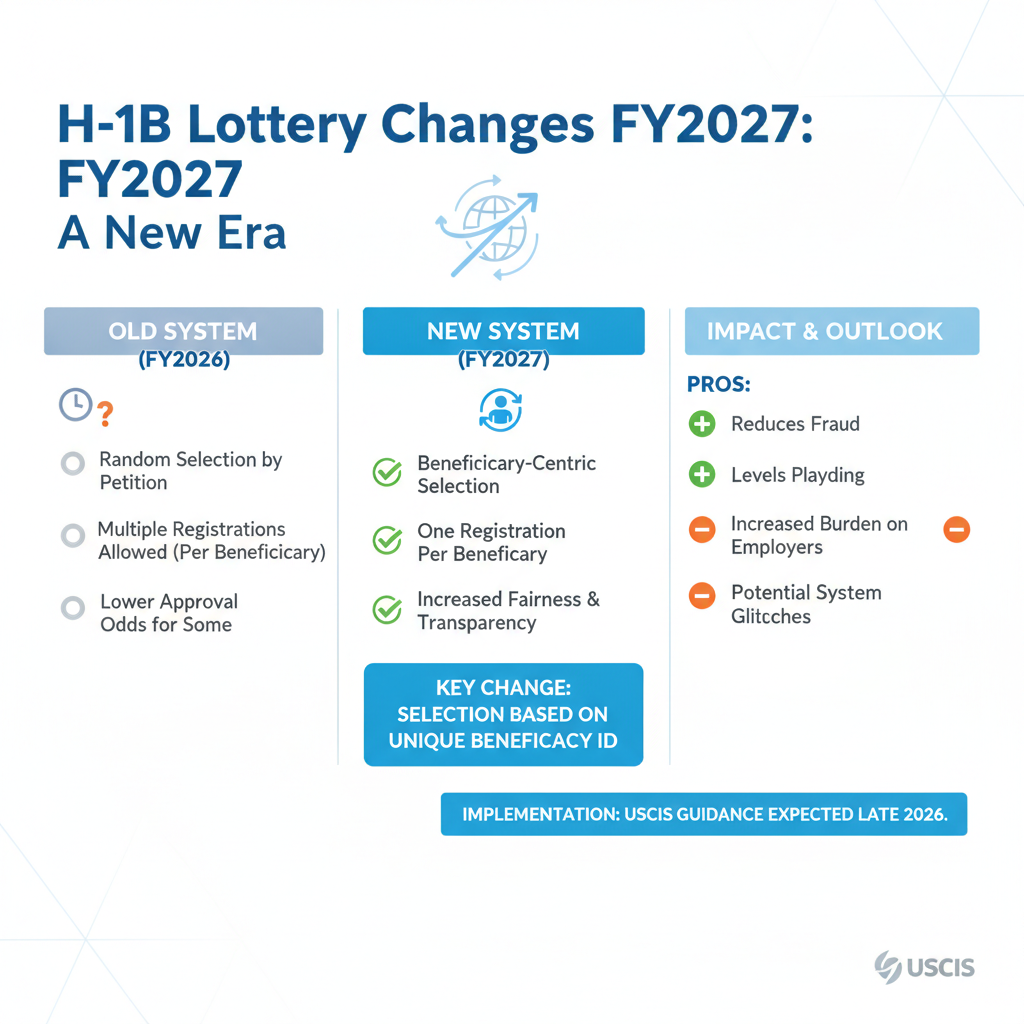
The recent announcement of changes to the H-1B visa lottery process for FY2027 is not just a procedural tweak; it represents a fundamental shift designed to enhance fairness and reduce fraud. For immigrants, their families, and employers across Orlando and the entire state of Florida, these updates carry profound implications. Understanding these changes is crucial for anyone planning to participate in the upcoming H-1B cap season.
Why this news is showing up now
The H-1B visa program has long been plagued by concerns over its integrity, particularly regarding the lottery system. In recent years, U.S. Citizenship and Immigration Services (USCIS) has observed a concerning trend: multiple registrations submitted on behalf of the same beneficiary by different employers. While the regulations permitted employers to submit registrations for the same beneficiary, some entities exploited this by creating shell companies or colluding to submit numerous registrations for a single individual, artificially inflating their chances of selection. This practice undermined the lottery's fairness, disadvantaging legitimate employers and beneficiaries who adhered to the spirit of the law.
Responding to these integrity concerns, USCIS announced new regulations aimed at reforming the H-1B cap registration process. These changes, formally introduced to be effective for the FY2027 cap season, are the culmination of years of observation, public feedback, and a clear directive to crack down on fraud. The goal is to ensure that each beneficiary has an equal chance of selection, regardless of how many employers register them.
The effective date of these changes means that the H-1B registration period, which typically opens in early March of each year for the fiscal year starting in October, will operate under these new rules for the upcoming cycle. This proactive announcement provides ample time for employers and prospective H-1B beneficiaries to understand and adapt to the new requirements before the FY2027 registration window opens.
How it can affect Florida residents
Florida, particularly the I-4 corridor encompassing cities like Orlando, Tampa, and Daytona, is a hub for innovation, tourism, healthcare, and technology. Companies across the Sunshine State, from major theme parks to burgeoning tech startups in Research Park near the University of Central Florida (UCF), rely heavily on the H-1B program to fill critical talent gaps in specialty occupations. Universities like UCF, the University of Florida, and Florida International University also sponsor H-1B visas for researchers and professors.
For prospective H-1B beneficiaries residing in Florida, including international students graduating from Florida universities on Optional Practical Training (OPT) or those working on other nonimmigrant visas, these changes are incredibly significant. The new "beneficiary-centric" selection process means:
- Fairer Chances: If you are a highly skilled professional, you now have a genuinely equal chance of selection as any other eligible beneficiary. The system will no longer favor those who had multiple employers register on their behalf. This levels the playing field, which is particularly beneficial for individuals whose employers operate ethically and do not engage in dubious registration practices.
- Reduced Fraud: The crackdown on fraudulent multiple registrations protects the integrity of the H-1B program. This means fewer legitimate petitions may be denied or delayed due to the actions of bad actors, potentially streamlining the process for honest applicants.
- Employer Scrutiny: Florida employers, especially those who previously participated in the lottery with multiple registrations for the same individual, must now adjust their strategies. Those who relied on volume will need to focus on genuine job offers and ensuring their registrations are compliant with the new rules. This could lead to a more competitive, but fairer, environment for job seekers.
- Increased Compliance Focus: USCIS has also enhanced its ability to detect and investigate fraud. For Florida residents, this underscores the importance of working with reputable employers and experienced legal counsel like Imigrar to ensure all aspects of their H-1B application are legitimate and meticulously prepared.
In essence, these changes aim to return the H-1B lottery to its intended purpose: a fair system for selecting the best and brightest to contribute to the U.S. economy. For Florida's diverse immigrant population and its dynamic industries, this means a renewed emphasis on merit and authenticity in the pursuit of an H-1B visa.
Need Help Navigating H-1B Changes? Our Orlando immigration team at Imigrar is ready to assist. We specialize in business immigration and can guide both employers and beneficiaries through the new H-1B lottery rules. Call +1 786-791-3106 for a free consultation, or message us online. Se Habla Español.
What H-1B Visa Lottery Changes for FY2027 Is (and Why It Matters)
The H-1B visa program is a nonimmigrant visa that allows U.S. employers to temporarily employ foreign workers in specialty occupations. These occupations generally require a bachelor's degree or higher in a specific field. Due to high demand, the number of H-1B petitions often exceeds the annual cap set by Congress, necessitating a lottery system to select eligible registrations. The "H-1B Visa Lottery Changes for FY2027" refers to the new regulations implemented by USCIS to modify how beneficiaries are selected in this lottery.
A plain-English definition
Imagine a lottery where everyone used to be able to buy multiple tickets under the same name, or have friends buy tickets for them, significantly increasing their chances. The new H-1B changes are like saying: "From now on, no matter how many friends buy tickets for you, your name will only be entered into the drawing ONCE. We will select names, not tickets."
Specifically, for FY2027, USCIS will select H-1B registrations based on each unique beneficiary, rather than on each registration submitted. If a beneficiary has multiple registrations submitted on their behalf by different employers, they will still only be counted once in the lottery pool. If that beneficiary is selected, USCIS will then notify all employers who submitted a registration for that individual that their registration has been selected, and any of those employers may then proceed to file an H-1B petition on behalf of that beneficiary.
This is a fundamental shift from the previous system, where each valid registration had an equal chance of selection, regardless of whether multiple registrations were submitted for the same individual. The change is designed to combat fraud and ensure that every eligible beneficiary has a truly equal chance of being selected in the lottery.
Key terms you need to know
Navigating the H-1B process requires familiarity with specific terminology. Here are some key terms, especially in light of the new changes:
- H-1B Visa: A nonimmigrant visa that allows U.S. employers to temporarily employ foreign workers in specialty occupations.
- Specialty Occupation: An occupation that requires theoretical and practical application of a body of highly specialized knowledge, and a bachelor's or higher degree in the specific specialty (or its equivalent) as a minimum for entry into the occupation in the United States.
- H-1B Cap: The annual numerical limit on the number of H-1B visas issued. Congress currently sets the regular cap at 65,000 and an additional 20,000 for those with a U.S. master's degree or higher (the "master's cap").
- Cap-Subject: Refers to H-1B petitions that are subject to the annual numerical limit. Most H-1B petitions fall into this category.
- Cap-Exempt: Certain employers are exempt from the annual cap, such as institutions of higher education, non-profit organizations affiliated with higher education, and government research organizations.
- Beneficiary: The foreign worker who is the subject of the H-1B petition.
- Petitioner: The U.S. employer who files the H-1B petition on behalf of the foreign worker.
- H-1B Registration: The electronic process through which prospective petitioners (employers) submit basic information about the company and the beneficiary to USCIS during a designated registration period. This is the first step to entering the lottery.
- Beneficiary-Centric Selection: The core of the new FY2027 rules. Instead of selecting registrations, USCIS will select unique beneficiaries. If a beneficiary is selected, all employers who registered for that beneficiary will be notified.
- Registration Period: The specific window of time (typically in March) during which employers can submit H-1B registrations. For FY2027, this period is critical for the new rules.
- Selection Notification: The official communication from USCIS informing petitioners whether their registration (or rather, their beneficiary's registration) has been selected in the lottery.
- Petition Filing Window: The period during which selected petitioners can file the full H-1B petition (Form I-129) with USCIS.
- Duplicate Registrations: In the past, this referred to multiple registrations for the same beneficiary. Under the new rules, this practice is still allowed by different employers, but it no longer provides an advantage in the lottery selection. Fraudulent multiple registrations by related entities, however, are explicitly targeted.
- Labor Condition Application (LCA): Form ETA-9035. An application that employers must file with the Department of Labor (DOL) before filing an H-1B petition. It attests that the employer will pay the H-1B worker the prevailing wage or the actual wage, whichever is higher, and will provide working conditions that will not adversely affect other workers.
- Form I-129, Petition for a Nonimmigrant Worker: The primary form used by employers to petition for H-1B workers. This form is filed only after a registration has been selected in the lottery.
- Request for Evidence (RFE): A notice from USCIS asking for additional documentation or information to support an H-1B petition.
- Notice of Intent to Deny (NOID): A notice from USCIS indicating their intention to deny a petition, offering the petitioner a final opportunity to provide evidence to overcome the denial.
Understanding these terms is paramount to comprehending the new H-1B landscape and successfully navigating the process. The shift to a beneficiary-centric model is the most critical change, impacting how both employers and prospective employees approach the H-1B lottery for FY2027 and beyond.
Current Immigration Law: The Foundation
The H-1B visa program operates under a complex framework of U.S. immigration laws and regulations. The recent changes to the lottery process for FY2027 are procedural modifications within this existing legal structure, not a complete overhaul of the H-1B visa itself. It’s essential to understand the underlying legal foundation to appreciate the significance of these updates.
The authority for the H-1B visa program stems primarily from the Immigration and Nationality Act (INA), specifically Section 101(a)(15)(H)(i)(b), which defines the H-1B nonimmigrant classification. Further detailed regulations are found in Title 8 of the Code of Federal Regulations (CFR), particularly 8 CFR Part 214.2(h).
Federal requirements
To qualify for an H-1B visa, both the employer and the prospective employee (beneficiary) must meet specific federal requirements:
- Specialty Occupation Requirement: The job offered must qualify as a specialty occupation. This means it requires a bachelor's degree or its equivalent in a specific field as a minimum entry requirement. The employer must demonstrate that the duties of the position are sufficiently complex to warrant a specialized degree.
- Educational/Experiential Requirements for Beneficiary: The beneficiary must possess at least a bachelor's degree or its equivalent, or hold an unrestricted state license if required for the occupation, or have work experience equivalent to a bachelor's degree.
- Employer-Employee Relationship: USCIS requires a valid employer-employee relationship to exist, meaning the petitioner must have the right to control the beneficiary's work. This is a common area of scrutiny, especially for third-party placement models.
- Wage Requirements: Employers must pay the H-1B worker at least the prevailing wage for the occupation in the area of employment or the actual wage paid to other employees with similar experience and qualifications, whichever is higher. This is attested to in the Labor Condition Application (LCA) (Form ETA-9035), which is certified by the Department of Labor (DOL) before the H-1B petition can be filed.
- Numerical Cap: As discussed, the H-1B program is subject to an annual cap of 65,000 visas, with an additional 20,000 for those with a U.S. master's degree or higher. These caps are statutory and are often met very quickly, necessitating the lottery.
- Non-immigrant Intent: Although H-1B is a "dual intent" visa, meaning beneficiaries can intend to seek permanent residency, the initial petition is for temporary employment.
The new changes for FY2027 primarily affect the selection mechanism for cap-subject H-1B petitions during the registration phase. They do not alter the fundamental eligibility criteria or the requirements for the H-1B petition itself once selected.
Important: All H-1B filings, whether initial registrations or full petitions, must be truthful and accurate. USCIS has explicitly stated that it will investigate and potentially deny petitions where fraud or misrepresentation is found, imposing penalties on those who attempt to subvert the process.
For official information, forms, and further details on H-1B requirements, always refer to the USCIS official website.
Florida-specific considerations
While immigration law is federal, its impact is felt locally. For Florida residents and businesses, several factors come into play:
- Tech and Tourism Hubs: Central Florida, particularly Orlando, is a growing tech hub with companies seeking talent in software development, engineering, and IT. The tourism and hospitality industries, while less common for H-1B, also have specialty occupation needs in areas like finance, marketing, and advanced management. The new rules mean that these companies, whether large corporations or emerging startups in Orange County, must ensure their H-1B strategies are compliant and ethical.
- University Graduates: Florida's robust university system, including UCF, UF, USF, and FIU, produces thousands of international graduates each year, many of whom are on Optional Practical Training (OPT) and seek H-1B sponsorship to continue working in the U.S. The new beneficiary-centric lottery system means these graduates, if sponsored by multiple employers, will not gain an unfair advantage, promoting a fairer system for all.
- Local Economy Impact: A fair H-1B system helps ensure that Florida's employers can access the talent they genuinely need, fostering innovation and economic growth in sectors vital to the state's prosperity.
- Orlando USCIS Field Office: While H-1B petitions are processed at service centers, the Orlando USCIS Field Office (located at 5449 S Semoran Blvd, Orlando, FL 32812) handles other immigration matters. Understanding the broader immigration landscape and local resources is always beneficial for Central Florida residents.
Imigrar, based in Orlando, has extensive experience working with Florida businesses and individuals navigating the H-1B process, ensuring compliance with both federal regulations and local considerations. We understand the unique dynamics of the Florida job market and its implications for H-1B petitions.

How to Navigate the H-1B Visa Lottery Changes for FY2027: A Complete Step-by-Step Guide
Successfully navigating the H-1B visa lottery, especially with the new FY2027 changes, requires meticulous planning, strict adherence to deadlines, and a thorough understanding of the requirements. This step-by-step guide outlines the process for both employers and beneficiaries.
1) Understand the New Beneficiary-Centric Selection Process
This is the most critical change. For FY2027, USCIS will conduct the H-1B lottery based on unique beneficiaries, not on the number of registrations submitted. This means:
- One Chance Per Person: Regardless of how many different employers submit H-1B registrations on your behalf, your name will only be entered into the lottery pool once.
- Selection Notification: If your name (as the beneficiary) is selected, USCIS will notify all employers who submitted a valid registration for you. Any of those selected employers may then proceed to file an H-1B petition on your behalf.
- Combating Fraud: This change directly addresses the issue of multiple registrations by related entities to increase a beneficiary's chances. USCIS will actively investigate and potentially deny petitions where fraud is suspected, including those involving shell companies or collusive registrations.
Action for Beneficiaries: Inform all prospective employers about the new rule. Emphasize that while multiple registrations are still permitted by different, legitimate employers, it does not increase your individual chance of selection. Focus on securing a strong, legitimate job offer. If you are a foreign national in Orlando on an OPT or other nonimmigrant visa, ensure any employer registering for you is a bona fide entity with a genuine job opening.
Action for Employers: Focus on submitting legitimate registrations for genuine job offers. Do not engage in collusive practices or work with entities designed solely to submit multiple registrations for the same individual. Such actions could lead to severe penalties, including denial of petitions and potential legal action.
2) Employer Registration and Due Diligence
The H-1B cap season for FY2027 will begin with the electronic registration process, typically in early March 2026.
- Employer Identification: The petitioning employer must first create a USCIS online account if they don't already have one.
- Labor Condition Application (LCA): Before registering, the employer should begin the process of determining the prevailing wage and preparing to file a Form ETA-9035, Labor Condition Application, with the Department of Labor (DOL). While not required for registration, a certified LCA is mandatory before filing the full Form I-129 petition.
- Registration Information: During the designated registration period, the employer must submit accurate information for each beneficiary, including:
- Employer's legal name, address, and Employer Identification Number (EIN).
- Beneficiary's full legal name, date of birth, country of birth, country of citizenship, passport number, and gender.
- Beneficiary's highest level of education and whether they qualify for the U.S. master's cap.
- Employer's attorney or representative information (if applicable).
- Registration Fee: A non-refundable fee (currently $10 per registration) must be paid for each registration submitted.
Required Documents (for registration - primarily information gathering):
- Beneficiary's passport biographical page.
- Beneficiary's degree certificate and transcripts.
- Employer's EIN.
- Job title and description.
- Location of employment (e.g., Orlando, FL).
Reminder: Accuracy is paramount. Any errors or inconsistencies can lead to issues later in the process.
3) Lottery Selection and Notification
After the registration period closes, USCIS conducts the lottery. The new beneficiary-centric method will be applied here.
- Selection Process: USCIS will first conduct the master's cap lottery (for those with a U.S. master's degree or higher) and then the regular cap lottery, selecting from the unique pool of beneficiaries.
- Notification: USCIS will notify selected registrants (i.e., employers whose beneficiary was selected) through their online accounts. This typically happens by the end of March.
- What if Not Selected: If a beneficiary is not selected, their registration status will update accordingly. Employers and beneficiaries should then explore alternative visa options.
Timeline Expectation:
- Early March 2026: H-1B registration period opens.
- Mid-March 2026: H-1B registration period closes.
- Late March 2026: Selection notifications issued.
4) Preparing and Filing the H-1B Petition (Form I-129)
If a beneficiary is selected, the employer then has a specific window (usually 90 days) to file the full H-1B petition.
- Certified LCA: The employer must have a certified Form ETA-9035, Labor Condition Application from the DOL. This process can take 7-10 business days, so it should be initiated promptly after selection.
- Form I-129 Preparation: Complete Form I-129, Petition for a Nonimmigrant Worker, along with all necessary supplements and addenda. This form is detailed and requires extensive information about the employer, the beneficiary, and the proposed employment.
- Supporting Documentation: Gather all required supporting documents.
- Petition Filing: The complete petition package, including the certified LCA, Form I-129, supporting documents, and filing fees, must be mailed to the appropriate USCIS service center within the designated filing window.
Required Documents (for Form I-129 petition filing):
- Certified Form ETA-9035, Labor Condition Application (LCA).
- Completed and signed Form I-129, Petition for a Nonimmigrant Worker.
- Employer's letter of support describing the specialty occupation, the beneficiary's qualifications, and the terms of employment.
- Copies of beneficiary's educational degrees, transcripts, and any professional licenses.
- Foreign degree evaluations (if applicable).
- Beneficiary's resume/CV.
- Copies of beneficiary's passport, visa, and I-94 record.
- Evidence of employer's ability to pay the proffered wage.
- Organizational charts, business plans, and other company documentation (especially for smaller or newer companies).
- Proof of prior H-1B registration selection (printout from USCIS online account).
- Filing Fees: Check the USCIS forms and fees page for current amounts. These typically include the base filing fee, ACWIA fee, fraud prevention and detection fee, and Public Law 114-113 fee (if applicable).
Warning: The H-1B petition is a complex legal document. Errors or omissions can lead to delays, Requests for Evidence (RFEs), or even denial. Working with an experienced immigration attorney like Imigrar is highly recommended.
5) Responding to RFEs or NOIDs (If Applicable)
It is common for USCIS to issue a Request for Evidence (RFE) if they require more information or clarification on any aspect of the petition. Less commonly, a Notice of Intent to Deny (NOID) may be issued.
- Timely Response: Respond to an RFE or NOID within the specified timeframe. Missing the deadline will result in denial.
- Comprehensive Evidence: Provide all requested evidence clearly and concisely. Address each point raised by USCIS.
- Legal Guidance: An attorney can help analyze the RFE/NOID, strategize the best response, and prepare compelling arguments and evidence.
Important: An RFE is not a denial. It’s an opportunity to strengthen your case. Act quickly and strategically.
6) Visa Interview and Consular Processing (If Outside U.S.)
If the beneficiary is outside the U.S. when the H-1B petition is approved, they will undergo consular processing to obtain the H-1B visa stamp.
- DS-160 Form: Complete Form DS-160, Online Nonimmigrant Visa Application.
- Schedule Interview: Schedule a visa interview at a U.S. embassy or consulate in your home country.
- Gather Documents: Collect all necessary documents for the interview, including:
- Passport valid for at least six months beyond the period of stay.
- DS-160 confirmation page.
- Appointment confirmation page.
- One passport-style photograph.
- Original Form I-797, Approval Notice for the H-1B petition.
- LCA (Form ETA-9035).
- Letter from employer confirming employment.
- Educational documents (degrees, transcripts).
- Resume/CV.
- Evidence of ties to home country (if applicable).
- Any other documents requested by the embassy/consulate.
- Attend Interview: Be prepared to answer questions about your job, employer, qualifications, and intentions in the U.S.
Reminder: Consular officers have broad discretion. Be honest and prepared during your interview. For those already in the U.S. and seeking a change of status, this step may not be necessary.
7) Maintaining H-1B Status and Compliance
Once the H-1B visa is approved and the beneficiary enters the U.S. (or changes status), ongoing compliance is crucial.
- Start Date: H-1B status typically begins on October 1st of the fiscal year for which the petition was approved.
- Employment with Petitioning Employer: You must work for the H-1B petitioning employer in the specialty occupation stated in the petition.
- Amendments: Any significant changes to employment (e.g., job duties, work location outside the metropolitan statistical area, reduction in hours to part-time)
Related Topics
Need Legal Assistance?
Our experienced immigration attorneys are here to help with your case. Contact Imigrar today for a free consultation and let us guide you through the legal process with confidence.
📍 Orlando, Florida • Serving clients nationwide
📧 info@imigrar.com