
H-1B Lottery Changes for FY2027: A New Era for U.S. Specialty
Understand the crucial H-1B visa lottery changes for FY2027. Imigrar guides you through new rules, eligibility, and how to prepare for a successful application.

The landscape of U.S. immigration law is constantly evolving, and for skilled foreign workers and their prospective employers, few areas generate as much anticipation and anxiety as the H-1B visa program. As we stand in October 2026, looking ahead to the H-1B visa lottery for Fiscal Year 2027 (FY2027), significant changes are once again on the horizon. These aren't just minor adjustments; they represent a fundamental shift in how the lottery is conducted, designed to curb fraud and ensure a more equitable process. For anyone hoping to work in a specialty occupation in the United States, particularly those residing in or considering a move to Florida, understanding these new rules is paramount.
At Imigrar, we believe in empowering our clients with accurate, timely, and actionable information. Our mission is to "Keep Families Together," and a crucial part of that is helping individuals navigate complex immigration pathways like the H-1B visa. This comprehensive guide will break down the H-1B visa lottery changes for FY2027, explaining what they mean for you, the step-by-step process, and how our Orlando-based legal team can provide the expert assistance you need.
Navigating the New H-1B Rules? Don't go it alone. Our experienced Orlando immigration team at Imigrar is here to help you understand the FY2027 changes and optimize your application. Call +1 786-791-3106 for a free consultation, or message us online. Se Habla Español.
The reporting that sparked this guide:
H-1B Visa Lottery Changes for FY2027 (Legal News)
What This News Means for Immigrants in Orlando and Across Florida
The H-1B visa program is a lifeline for many highly skilled professionals seeking opportunities in the U.S., and for American companies seeking top talent. The recent announcements regarding the H-1B visa lottery for FY2027 are not just bureaucratic updates; they are critical changes that will directly impact the lives and careers of thousands of individuals and the operational strategies of businesses, particularly those in vibrant economic hubs like Florida.
Why this news is showing up now
Immigration regulations, especially those governing high-demand visa categories like the H-1B, are subject to periodic review and modification by the U.S. Citizenship and Immigration Services (USCIS) and other federal agencies. The H-1B lottery is an annual event, typically conducted in March for the fiscal year beginning on October 1st of that same calendar year. Therefore, for FY2027 (which starts October 1, 2026), the lottery would have already concluded in March 2026, and the subsequent petition filing period would be underway or recently closed. The "news" surfacing now, in October 2026, likely pertains to the detailed implementation of these new rules, the outcomes of the first lottery under this new regime, or perhaps further clarifications and guidance from USCIS based on initial feedback and observations. It could also refer to ongoing discussions or potential refinements for future lotteries based on the FY2027 experience.
Historically, significant changes to the H-1B lottery process often stem from efforts to combat widespread fraud, improve efficiency, and ensure that the program adheres to its intended purpose of bringing highly skilled workers to the U.S. The most recent major change, which we anticipate is the core of the FY2027 updates, shifted the lottery selection method from a per-registration basis to a per-beneficiary basis. This was a direct response to concerns about multiple registrations being submitted for the same individual by different employers, or even by related employers, artificially inflating selection odds and undermining the integrity of the lottery. By October 2026, the implications of this new beneficiary-centric approach would be well understood, and the legal news would be reflecting on its real-world impact and any subsequent adjustments or interpretations.
How it can affect Florida residents
Florida, particularly Central Florida and the Orlando metropolitan area, is a rapidly growing economic powerhouse with diverse industries that rely heavily on skilled foreign talent. Sectors such as technology, aerospace, healthcare, tourism, and engineering frequently utilize the H-1B visa program. For residents of Orlando, Kissimmee, Tampa, and other parts of the Sunshine State who are either H-1B beneficiaries or prospective applicants, these changes have profound implications:
- Increased Fairness for Beneficiaries: The shift to a beneficiary-centric lottery means that each unique individual, regardless of how many employers register them, will only have one chance in the lottery. This significantly levels the playing field, reducing the advantage previously gained by individuals with multiple employer registrations. For skilled professionals in Florida, this means a more genuine opportunity to be selected if they meet the criteria.
- Employer Strategy Adjustments: Florida-based employers, from tech startups in Orlando's "Medical City" to hospitality groups, will need to adapt their H-1B recruitment strategies. They can no longer rely on submitting multiple registrations for a single candidate to boost selection odds. The focus will shift even more towards identifying and sponsoring truly qualified candidates and ensuring their registration is flawless.
- Reduced Fraud and Enhanced Program Integrity: For the broader community, these changes aim to restore integrity to the H-1B program. By curbing fraudulent multiple registrations, USCIS hopes to ensure that the limited number of H-1B visas are allocated to legitimate specialty occupation workers, benefiting the U.S. economy as intended.
- Impact on Local Industries: Florida's vibrant economy thrives on innovation. Companies in the I-4 corridor, particularly around Orlando and Tampa, often seek H-1B workers for roles in IT, engineering, finance, and specialized healthcare. The new rules, while promoting fairness, might require employers to be even more strategic in their H-1B planning and consider alternative visa options if initial lottery attempts are unsuccessful.
- Heightened Importance of Legal Counsel: With complex new rules, the importance of experienced legal guidance becomes even more critical. Florida residents and employers navigating these changes will need expert advice to ensure compliance and maximize their chances of success.
The H-1B lottery changes for FY2027 are a game-changer. For those in Orlando and across Florida, this means a renewed focus on legitimate qualifications, meticulous preparation, and strategic planning. Imigrar is deeply rooted in the Florida community and understands these local impacts, offering tailored advice to our clients.
What H-1B Visa Lottery Changes for FY2027 Is (and Why It Matters)
The H-1B visa program is a cornerstone of U.S. immigration for skilled foreign workers. However, due to overwhelming demand, the annual cap often necessitates a lottery system. The changes for FY2027 are designed to fundamentally alter how this lottery operates, aiming for greater fairness and reduced abuse.
A plain-English definition
The H-1B visa is a nonimmigrant visa that allows U.S. employers to temporarily employ foreign workers in specialty occupations. These occupations generally require a bachelor's degree or higher in a specific field. Each year, Congress sets a limit, or "cap," on the number of H-1B visas issued. This cap is currently 65,000 visas, with an additional 20,000 visas reserved for those holding a U.S. master's degree or higher (the "master's cap"). Because demand consistently outstrips supply, USCIS conducts an electronic lottery to select which registrations can proceed to filing a full petition.
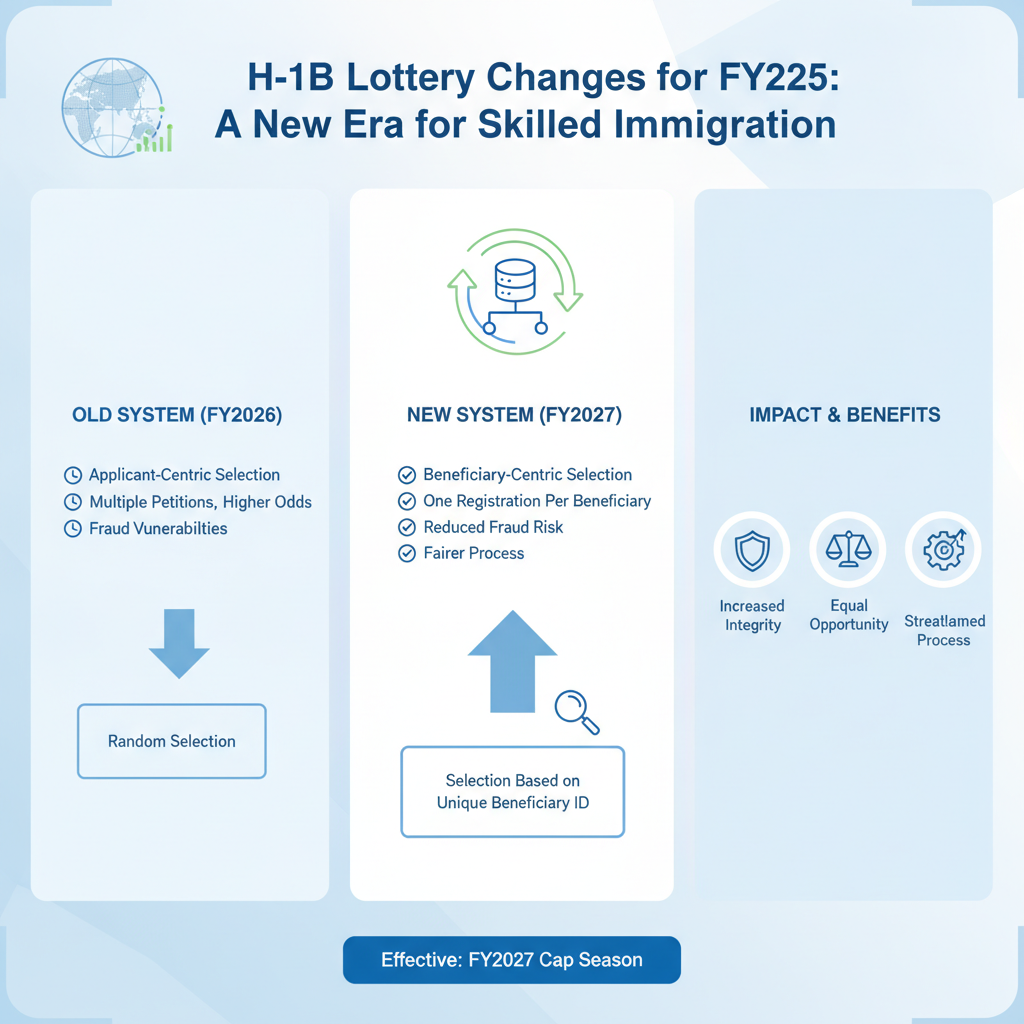
The "H-1B Visa Lottery Changes for FY2027" refers to new rules implemented by USCIS, primarily to combat widespread fraud seen in previous lottery cycles. Previously, the lottery was conducted on a "per-registration" basis. This meant that if multiple employers registered the same foreign national, that individual effectively had multiple entries, increasing their chances of selection. This led to a surge in registrations, many of which were deemed fraudulent or designed solely to exploit the system.
For FY2027, the lottery shifted to a "per-beneficiary" model. In simple terms, this means that each unique foreign national (the beneficiary) will only have one chance in the lottery, regardless of how many employers submit a registration on their behalf. USCIS identifies beneficiaries using their passport information or other unique identifiers. If a beneficiary is registered multiple times by different employers, they still only get one "ticket" in the lottery pool. If that ticket is selected, all employers who registered that beneficiary will be notified, and any of them can then proceed to file a petition on behalf of that selected beneficiary.
This change matters immensely because it creates a more equitable system. It aims to ensure that every qualified individual has a fair and equal shot at selection, rather than allowing those with multiple registrations to game the system. For legitimate employers and truly skilled foreign workers, this change is a welcome step towards restoring integrity to a vital immigration program.
Key terms you need to know
- H-1B Visa: A nonimmigrant visa category for temporary workers in specialty occupations.
- Specialty Occupation: An occupation that requires a theoretical and practical application of a body of highly specialized knowledge and a bachelor's or higher degree in the specific specialty (or its equivalent) as a minimum for entry into the occupation in the United States.
- Annual Cap: The congressionally mandated limit on the number of H-1B visas issued each fiscal year. Currently, 65,000 for the regular cap and an additional 20,000 for the U.S. master's cap.
- H-1B Lottery (or Selection Process): The electronic process USCIS uses to select registrations when the number of eligible registrations exceeds the annual cap.
- Beneficiary: The foreign national worker for whom the H-1B visa petition is being filed.
- Petitioner: The U.S. employer filing the H-1B visa petition on behalf of the beneficiary.
- H-1B Registration: The initial, streamlined electronic process where prospective petitioners (employers) submit basic information about the beneficiary and the proposed employment to USCIS during a designated registration period. This is what enters the lottery.
- Per-Beneficiary Selection: The new method for the FY2027 lottery where each unique beneficiary is entered into the lottery only once, regardless of the number of registrations submitted on their behalf. If selected, all registrants for that beneficiary are notified.
- LCA (Labor Condition Application): Form ETA-9035, certified by the U.S. Department of Labor (DOL), which attests that the employer will pay the H-1B worker at least the prevailing wage or the actual wage, whichever is higher, and will provide working conditions that will not adversely affect the working conditions of U.S. workers. This is a prerequisite for filing the H-1B petition.
- Form I-129 (Petition for a Nonimmigrant Worker): The primary form filed by the employer with USCIS after a registration is selected in the lottery.
- Premium Processing: An expedited processing service offered by USCIS for certain petition types, including H-1B, for an additional fee. It guarantees a response within 15 calendar days.
Understanding these terms is crucial for navigating the H-1B process effectively, especially with the new FY2027 changes. The shift to per-beneficiary selection is the most impactful new rule to internalize.
Current Immigration Law: The Foundation
The H-1B visa program is governed by a complex framework of federal immigration laws and regulations. To successfully navigate the H-1B lottery changes for FY2027, it's essential to understand the underlying legal statutes that dictate eligibility, process, and limitations.
The primary legal authority for the H-1B visa category is found in the Immigration and Nationality Act (INA), specifically Section 101(a)(15)(H)(i)(b), which defines the H-1B nonimmigrant classification, and Section 214(g), which establishes the annual cap. Further regulations are detailed in the Code of Federal Regulations, particularly 8 CFR Part 214.2(h), which outlines the specific requirements for H-1B petitions.
The recent changes to the H-1B lottery mechanism, specifically the shift to a beneficiary-centric selection process for FY2027, were implemented through a final rule published by USCIS, often under the authority granted by Congress to administer and interpret immigration laws. This rule updates how USCIS conducts the lottery while still operating within the existing statutory cap limitations set by the INA.
Federal requirements
To qualify for an H-1B visa, both the employer (petitioner) and the foreign worker (beneficiary) must meet specific federal requirements:
For the Employer (Petitioner):
- Bona Fide Job Offer: The employer must have a legitimate offer of employment for the beneficiary in a specialty occupation.
- LCA Certification: The employer must file and obtain certification of a Labor Condition Application (Form ETA-9035) from the U.S. Department of Labor (DOL) before filing the H-1B petition with USCIS. This certifies that the employer will pay the prevailing wage or actual wage, whichever is higher, and meet other working condition requirements.
- Employer Identification Number (EIN): The employer must have a valid EIN.
- Ability to Pay: The employer must demonstrate the financial ability to pay the offered wage.
For the Employee (Beneficiary):
- Specialty Occupation Qualification: The beneficiary must meet one of the following criteria:
- Hold a U.S. bachelor's or higher degree required by the specialty occupation from an accredited college or university.
- Hold a foreign degree that is determined to be equivalent to a U.S. bachelor's or higher degree required by the specialty occupation.
- Hold an unrestricted state license, registration, or certification which authorizes him or her to fully practice the specialty occupation and be engaged in that specialty occupation in the state of intended employment.
- Have work experience in the specialty occupation equivalent to a U.S. bachelor's or higher degree. (Generally, three years of progressive experience for every one year of college education lacking).
- Licensure (if applicable): If the occupation requires a state license (e.g., doctors, nurses, architects), the beneficiary must possess or be eligible to obtain that license.
The H-1B visa is subject to an annual cap of 65,000, with an additional 20,000 for those with a U.S. master's degree or higher. This is where the lottery comes into play. The new per-beneficiary selection method for FY2027 is a procedural change to how USCIS administers the selection process under this existing cap, not a change to the cap itself or the fundamental eligibility requirements for the visa.
Important USCIS forms related to the H-1B process include:
- Form ETA-9035: Labor Condition Application (filed with DOL).
- Form I-129: Petition for a Nonimmigrant Worker (filed with USCIS).
- Form I-797: Notice of Action (issued by USCIS for various actions, including lottery selection or petition approval).
- Form I-907: Request for Premium Processing Service (optional, filed with Form I-129).
For the most up-to-date information and official forms, always refer to the USCIS official website and USCIS Forms page.
Florida-specific considerations
While H-1B laws are federal, their application and impact can have state-specific nuances, particularly concerning economic demand and prevailing wages. For Florida residents and employers, several factors are worth noting:
- High Demand in Tech and Hospitality: Florida's booming technology sector (e.g., Orlando, Tampa, Miami) and its dominant tourism and hospitality industries create significant demand for H-1B workers. This means competition for H-1B visas in Florida can be particularly fierce.
- Prevailing Wage Determinations: The Department of Labor's prevailing wage determinations vary by geographic area. Employers in Orlando, for example, will have different prevailing wage requirements than those in Silicon Valley or New York City. Ensuring the offered wage meets or exceeds the prevailing wage for the specific occupation and geographic location (e.g., Orange County, FL) is critical.
- State Licensure: For certain professions in Florida (e.g., engineering, healthcare, architecture), state licensure is mandatory. H-1B beneficiaries in these fields must demonstrate that they either possess the required Florida license or are in the process of obtaining it and are authorized to work while it's pending.
- Local USCIS Offices: While H-1B petitions are centrally processed, if an H-1B worker needs to adjust their status or attend an interview for other immigration benefits, they might interact with local field offices, such as the Orlando USCIS Field Office. Understanding local procedures, even if indirectly related to the H-1B, is beneficial.
The new per-beneficiary selection system impacts all states equally in terms of lottery fairness. However, the underlying economic conditions and specific employer needs in Florida continue to shape the local demand and strategic importance of the H-1B program.
Confused by H-1B Regulations? Imigrar provides clarity and expert guidance for individuals and businesses in Orlando and across Florida. Schedule your free consultation today! Call +1 786-791-3106 or contact us online. Se Habla Español.
How to Navigate the New H-1B Lottery System: A Complete Step-by-Step Guide
The H-1B visa process, especially with the FY2027 changes, requires meticulous attention to detail and adherence to strict timelines. This step-by-step guide will walk you through the journey from understanding the new rules to commencing employment.
1) Understand the New Rules & Eligibility for FY2027
Before any action is taken, both the prospective employer and beneficiary must fully grasp the updated H-1B lottery system. The most critical change for FY2027 is the per-beneficiary selection model. This means that if multiple employers register the same individual, that individual still only gets one entry in the lottery. If selected, all employers who registered that beneficiary will receive a selection notice, and any one of them can then file the H-1B petition.
- Beneficiary Eligibility: Ensure the foreign national meets the minimum educational or experiential requirements for a specialty occupation. This typically means a U.S. bachelor's degree or its foreign equivalent, or a combination of education and work experience.
- Employer Eligibility: The U.S. employer must have a legitimate job offer in a specialty occupation and the financial capacity to pay the required wage.
- Job Requirements: The job itself must qualify as a specialty occupation, meaning it requires a bachelor's degree or higher in a specific field.
Required Documents (for initial assessment):
- Beneficiary's passport copy and educational credentials (diplomas, transcripts, foreign degree evaluations).
- Beneficiary's resume/CV detailing work experience.
- Detailed job description from the employer, including duties, responsibilities, and minimum requirements.
- Employer's basic information (company name, EIN, address).
2) Employer Registration & Lottery Submission (Electronic Registration)
This is the first formal step in the H-1B cap-subject process. The employer (petitioner) must register the beneficiary electronically with USCIS during the designated registration period, typically in March of the calendar year preceding the fiscal year (e.g., March 2026 for FY2027). The registration fee is minimal.
- Create USCIS Online Account: The employer or their authorized legal representative (like Imigrar) must create a registrant account on the USCIS H-1B Registration website.
- Submit Beneficiary Information: For each prospective H-1B worker, the employer provides basic information, including the beneficiary's full legal name, date of birth, country of birth, country of citizenship, passport number, and highest level of education.
- Submit Employer Information: Employer's legal name, EIN, mailing address, and authorized signatory's name and title.
- Pay Registration Fee: A small fee (e.g., $10) per registration is required.
- Important: Under the new rules, ensure the beneficiary's information, especially the passport number, is accurate and consistent across all registrations if multiple employers are registering the same individual. USCIS uses this information to identify unique beneficiaries.
Required Documents (for registration):
- Beneficiary's valid passport details.
- Employer's EIN.
3) If Selected: Prepare and File Form I-129 Petition
If the beneficiary's registration is selected in the lottery (usually announced by late March), USCIS will notify all employers who registered that beneficiary. Any one of the selected employers can then proceed to file a complete Form I-129, Petition for a Nonimmigrant Worker, along with supporting documentation, within the specified filing window (typically 90 days, from April 1st to June 30th). This is the most complex and document-intensive step.
- Labor Condition Application (LCA): The employer must first file Form ETA-9035 with the Department of Labor and receive certification. This process can take 7-10 business days.
- Assemble Petition Package: This includes the certified LCA, Form I-129, H-1B Data Collection and Filing Fee Exemption Supplement, supporting letters, educational documents, and evidence of the specialty occupation.
- Fees: Multiple fees are required, including the base filing fee, ACWIA fee, fraud prevention and detection fee, and potentially a public law 114-113 fee (for employers with 50+ employees and 50%+ H-1B/L-1 workers). Premium processing (Form I-907) is optional for an additional fee.
- File with USCIS: The complete petition package must be mailed to the correct USCIS service center within the designated filing window.
Required Documents (for I-129 petition):
- Certified Form ETA-9035 (LCA).
- Original Form I-129 and H-1B Data Collection Supplement.
- Letter of Support from the employer detailing the job offer, specialty occupation nature, and beneficiary's qualifications.
- Beneficiary's educational documents (diplomas, transcripts, foreign degree evaluations).
- Beneficiary's resume/CV.
- Evidence of beneficiary's professional experience (letters from previous employers, pay stubs).
- Copies of beneficiary's passport, visa, I-94 record (if already in the U.S.).
- Employer's financial documents (tax returns, annual reports, bank statements) to prove ability to pay.
- Organizational chart, company brochures, website printouts.
- Client letters/statements of work (if applicable for third-party placement).
- Copies of all required fee checks.
4) Respond to RFEs (if any)
After filing, USCIS may issue a Request for Evidence (RFE) if they need more information or clarification. This is a common occurrence and requires a timely and comprehensive response.
- Review RFE Carefully: Understand exactly what USCIS is asking for.
- Gather Requested Documents: Collect all additional evidence, which could include more detailed job descriptions, specialty occupation justifications, client letters, or proof of employer-employee relationship.
- Draft a Robust Response: Prepare a detailed legal argument addressing each point raised in the RFE, supported by the new evidence.
- Submit Timely: Ensure the response is sent before the RFE deadline, typically 60-90 days from the RFE date.
Required Documents (for RFE response):
- Specific documents requested by USCIS.
- New supporting letters, affidavits, or expert opinions as needed.
- Detailed cover letter addressing each RFE point.
5) Visa Interview (for those outside the U.S.) / Change of Status (for those inside)
If the H-1B petition is approved, the next step depends on the beneficiary's current location and immigration status.
- For Beneficiaries Outside the U.S. (Consular Processing): They will typically apply for an H-1B visa stamp at a U.S. consulate or embassy in their home country. This involves completing Form DS-160, paying fees, and attending an interview.
- For Beneficiaries Inside the U.S. (Change of Status): If the beneficiary is already in the U.S. in a valid nonimmigrant status (e.g., F-1 OPT, L-1, H-4), and the H-1B petition requested a "change of status," their status will automatically change to H-1B on October 1st (the start of the fiscal year), provided the petition was approved. No interview is typically required for the change of status itself, though they may need to travel internationally later to get a visa stamp for future re-entry.
Required Documents (for Consular Processing):
- Passport valid for at least six months beyond the intended period of stay.
- DS-160 confirmation page.
- Appointment confirmation.
- H-1B approval notice (Form I-797).
- LCA copy.
- Employer letter, job offer, and details of the position.
- Educational and professional qualification documents.
- Evidence of ties to home country (for non-immigrant intent).
6) Begin Employment
Upon approval and either obtaining the H-1B visa stamp (for those abroad) or the effective date of the change of status (for those in the U.S.), the beneficiary can begin working for the petitioning employer in the H-1B specialty occupation. The earliest start date is generally October 1st of the fiscal year for cap-subject H-1Bs.
- I-9 Verification: The employer must complete Form I-9, Employment Eligibility Verification, confirming the employee's authorization to work.
- Maintain Status: The H-1B worker must continuously maintain their H-1B status by working for the petitioning employer in the approved position and not violating any immigration laws.
- Transfers/Extensions: H-1B status can be transferred to a new employer or extended beyond the initial approval period (typically 3 years), up to a maximum of 6 years, with possibilities for further extensions under certain circumstances (e.g., pending green card).
Important: Always carry copies of your Form I-7
Related Topics
Need Legal Assistance?
Our experienced immigration attorneys are here to help with your case. Contact Imigrar today for a free consultation and let us guide you through the legal process with confidence.
📍 Orlando, Florida • Serving clients nationwide
📧 info@imigrar.com