
Family-Based Green Card: Your Comprehensive Petition Guide for
Navigating family-based immigration can be complex. This guide from Imigrar demystifies the process, covering Form I-130, Adjustment of Status, consular processing, and expert tips for families in Orlando and nationwide. Learn how to keep your family together.
At Imigrar, our mission is to Keep Families Together. We understand that for many, the dream of living legally in the United States begins with a family petition. The process can seem daunting, but with accurate information and expert guidance, it is entirely navigable. This comprehensive guide aims to demystify family-based immigration petitions, providing a clear, step-by-step roadmap for individuals and families in Orlando, across Florida, and nationwide.
Need Help? Our Orlando immigration team is ready to assist. Call +1 786-791-3106 for a free consultation, or message us online. Se Habla Español.
The reporting that sparked this guide:
In the evolving landscape of U.S. immigration, understanding the core pathways to legal residency is more important than ever. Recent discussions and updates highlighted by various news outlets underscore the continuous relevance and often complex nature of family-based petitions. This guide is inspired by the ongoing public interest and need for clear, actionable information on this vital topic, as seen in widespread Family-Based Immigration Petition Guide (Immigration) reporting.
What This News Means for Immigrants in Orlando and Across Florida
The continued focus on family-based immigration petitions in the news isn't just a headline; it's a reflection of the enduring importance of family unity in U.S. immigration policy. For countless individuals and families in Orlando, Central Florida, and throughout the nation, these petitions represent the primary pathway to a secure future together.
Why this news is showing up now
Family-based immigration is a cornerstone of the U.S. immigration system, and it's constantly subject to policy discussions, processing updates, and legislative proposals. The current emphasis in immigration news often stems from several factors: changing processing times at USCIS and consular offices, new administrative guidance, or public discourse surrounding immigration reform. These discussions highlight the consistent demand for family visas and the challenges many face in navigating the intricate process. As immigration policies are often debated, the fundamental framework for family reunification remains a critical, and often scrutinized, component.
How it can affect Florida residents
Florida, particularly Orlando and the I-4 corridor, is a vibrant hub for diverse immigrant communities. This means that a significant portion of our residents either have family members seeking to immigrate or are themselves beneficiaries of family petitions. Updates or changes in the family-based immigration landscape can have profound, direct impacts on thousands of Floridian families. For instance, longer processing times can mean extended periods of separation, while streamlined procedures could accelerate reunification. Understanding the current status and best practices for family petitions is crucial for residents of Orange County and beyond who are striving to keep their families together. Imigrar, located in Orlando, is uniquely positioned to assist our local community with these critical processes.
What a Family-Based Immigration Petition Is (and Why It Matters)
A family-based immigration petition is the bedrock of family reunification in the United States. It's the formal process by which a U.S. citizen or lawful permanent resident (Green Card holder) sponsors certain eligible family members to immigrate to the United States and obtain a Green Card (lawful permanent residency).
A plain-English definition
Think of a family petition as an official request to the U.S. government, specifically U.S. Citizenship and Immigration Services (USCIS), asking permission for a qualifying relative to come and live permanently in the U.S. Based on the family relationship, this petition, typically Form I-130, Petition for Alien Relative, is the first critical step towards helping a loved one get their Green Card. It's about demonstrating a legitimate family tie that allows the U.S. government to consider granting immigrant status.
Key terms you need to know
- Petitioner: The U.S. citizen or lawful permanent resident who files Form I-130 to sponsor a family member.
- Beneficiary: The foreign national relative who is being sponsored to immigrate to the U.S.
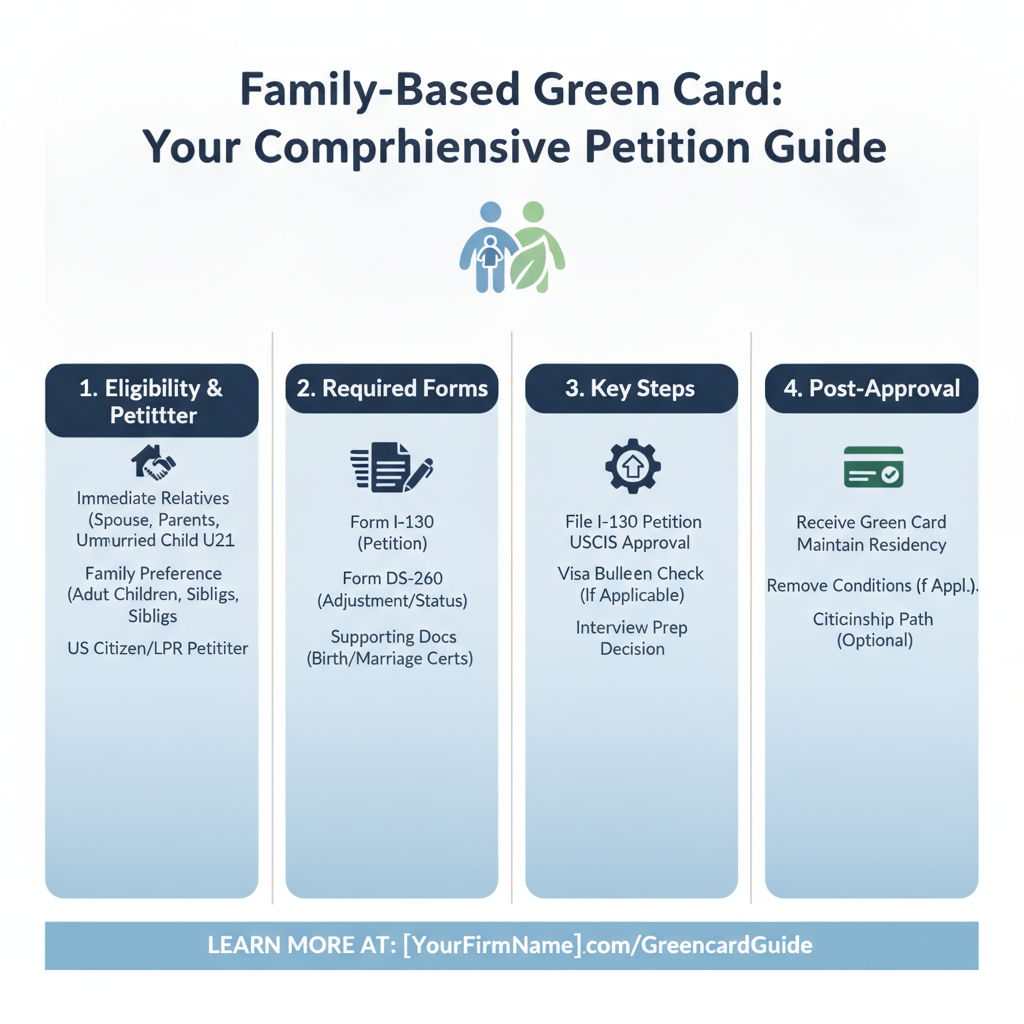
- Immediate Relative: This is a highly favorable category. It includes spouses of U.S. citizens, unmarried children under 21 of U.S. citizens, and parents of U.S. citizens (if the U.S. citizen is 21 or older). There are an unlimited number of visas available for Immediate Relatives, meaning they do not have to wait for a visa number to become available based on an annual quota, significantly speeding up their process.
- Family Preference Categories: For relatives who are not Immediate Relatives, immigration is subject to annual numerical limitations. These categories are:
- First Preference (F1): Unmarried sons and daughters (21 years of age or older) of U.S. citizens.
- Second Preference (F2A): Spouses and children (unmarried, under 21) of lawful permanent residents.
- Second Preference (F2B): Unmarried sons and daughters (21 years of age or older) of lawful permanent residents.
- Third Preference (F3): Married sons and daughters of U.S. citizens.
- Fourth Preference (F4): Brothers and sisters of U.S. citizens (if the U.S. citizen is 21 or older).
- Priority Date: This is the date USCIS receives your properly filed Form I-130 petition. For Family Preference categories, this date is crucial because it determines your place in the visa queue. You can only move forward with your Green Card application once your Priority Date becomes "current" according to the U.S. Department of State Visa Bulletin.
- Adjustment of Status: The process of applying for a Green Card while physically present in the United States. This is generally done by filing Form I-485, Application to Register Permanent Residence or Adjust Status.
- Consular Processing: The process of applying for an immigrant visa at a U.S. embassy or consulate in your home country (or another country where you have residency) if you are living outside the U.S.
Understanding these terms is the first step in successfully navigating your family's immigration journey. The path chosen (Adjustment of Status vs. Consular Processing) depends heavily on the beneficiary's current location and immigration status.
Current Immigration Law: The Foundation
Family-based immigration is governed by the Immigration and Nationality Act (INA), specifically sections related to immigrant visas for relatives. The INA defines who can petition whom, the different preference categories, and the requirements for both petitioners and beneficiaries.
Federal requirements
The core legal framework for family-based immigration is found in sections 201, 203, and 204 of the INA. These sections establish the categories of eligible relatives, the annual numerical limits for preference categories, and the petitioning process. Key federal requirements include:
- Valid Relationship: The petitioner must prove a legitimate family relationship with the beneficiary as defined by law (e.g., marriage certificate, birth certificate).
- Petitioner's Status: The petitioner must be either a U.S. citizen or a lawful permanent resident.
- Financial Sponsorship: The petitioner must demonstrate the financial ability to support the beneficiary at 125% above the federal poverty guidelines by filing Form I-864, Affidavit of Support. This ensures the immigrant will not become a "public charge."
- Admissibility: The beneficiary must be admissible to the U.S., meaning they must not have certain criminal records, serious health issues, or past immigration violations that would make them ineligible for a Green Card. Waivers may be available in some cases.
All applications are processed by USCIS official website, which is the federal agency overseeing lawful immigration to the United States. They are responsible for adjudicating petitions and applications according to federal law.
Florida-specific considerations
While immigration law is federal, certain aspects can have practical implications for Florida residents. For instance, if your case involves an Adjustment of Status application, you may interact with the Orlando USCIS Field Office for interviews or biometrics appointments. The local field office is an important point of contact for many Central Florida residents going through this process.
Additionally, Florida's diverse population means that many cases involve complex international documentation, requiring certified translations and specific procedures for foreign-issued documents. Imigrar's experience with the local community in Orlando and surrounding areas like Kissimmee and Sanford provides us with unique insights into regional challenges and best practices.
Confused by the forms or legal jargon? Let Imigrar guide you. Our Orlando-based lawyers specialize in family immigration. Call +1 786-791-3106 for a free consultation. Se Habla Español.
How to File a Family-Based Immigration Petition: A Complete Step-by-Step Guide
Filing a family-based immigration petition involves several crucial steps, each requiring careful attention to detail and accurate documentation. Here’s a comprehensive guide to help you navigate the process.
1) File Form I-130, Petition for Alien Relative
This is the foundational step. The U.S. citizen or lawful permanent resident petitioner initiates the process by filing Form I-130 with USCIS. This form establishes the qualifying relationship between the petitioner and the beneficiary.
- Who Files: The U.S. citizen or lawful permanent resident (the petitioner).
- What it Proves: The legitimate familial relationship.
- Required Documents for Form I-130 (examples, varies by relationship):
- Proof of U.S. Citizenship or Lawful Permanent Residency for the petitioner (e.g., U.S. birth certificate, naturalization certificate, U.S. passport, Green Card).
- Proof of relationship (e.g., marriage certificate for spouses, birth certificates for parents/children, adoption decrees).
- Proof of termination of prior marriages for both petitioner and beneficiary, if applicable (e.g., divorce decrees, death certificates).
- Passport-style photos of both petitioner and beneficiary.
- Form G-1145, E-Notification of Application/Petition Acceptance (optional, for email/text notifications).
- Filing fee (check USCIS Forms for current fees).
- Important: All foreign language documents must be accompanied by a certified English translation.
2) USCIS Processing and Priority Date Establishment
After USCIS receives your properly filed Form I-130, they will send you a Form I-797C, Notice of Action, confirming receipt. This notice will include your Priority Date. For Immediate Relatives, the Priority Date is less critical as visas are always available. For Family Preference categories, you must wait until your Priority Date becomes current on the Visa Bulletin before moving to the next stage.
- What Happens: USCIS reviews the petition to ensure the relationship is legitimate.
- Processing Times: These vary significantly based on the relationship category and the specific USCIS service center. You can check current USCIS Processing Times online.
- Reminder: Keep your Form I-797C safe, as it contains your receipt number and Priority Date.
3) National Visa Center (NVC) Processing (for Consular Processing) OR Concurrent Filing (for Adjustment of Status)
This step diverges depending on whether the beneficiary is applying for a Green Card from inside or outside the U.S.
Option A: Consular Processing (Beneficiary is outside the U.S.)
Once USCIS approves the Form I-130, the petition is sent to the National Visa Center (NVC) at the U.S. Department of State. The NVC collects required documents and fees before forwarding the case to a U.S. embassy or consulate abroad for an interview.
- NVC Steps:
- Pay immigrant visa fees (Affidavit of Support fee and Immigrant Visa Application Processing fee).
- Submit Form DS-260, Immigrant Visa Application, online for each beneficiary.
- Submit required civil documents (birth certificates, marriage certificates, police certificates, court records, etc.) to the NVC.
- Submit Form I-864, Affidavit of Support, by the petitioner and any joint sponsors.
- Required Documents for NVC Stage:
- Copies of all civil documents (birth certificates, marriage certificates, divorce decrees).
- Police certificates from all countries where the beneficiary lived for certain periods.
- Court and prison records (if applicable).
- Military records (if applicable).
- Passport-style photos.
- Copy of the beneficiary's passport biographic page.
- Financial documents for Form I-864 (tax returns, W-2s, employment verification letters, bank statements).
Option B: Adjustment of Status (Beneficiary is lawfully present in the U.S.)
If the beneficiary is in the U.S. and eligible to adjust their status (e.g., entered lawfully and maintained status, or is an Immediate Relative), they may file Form I-485, Application to Register Permanent Residence or Adjust Status. For Immediate Relatives, Form I-130 and Form I-485 can often be filed concurrently (at the same time).
- Required Documents for Form I-485 (examples):
- Form I-485, Application to Register Permanent Residence or Adjust Status.
- Form I-130 (if filing concurrently).
- Form I-864, Affidavit of Support.
- Form I-693, Report of Medical Examination and Vaccination Record (must be completed by a USCIS-approved civil surgeon).
- Form I-765, Application for Employment Authorization (optional, allows work permit while I-485 is pending).
- Form I-131, Application for Travel Document (optional, allows "Advance Parole" travel while I-485 is pending).
- Two passport-style photos.
- Copy of birth certificate.
- Copy of passport, visa, and I-94 arrival/departure record.
- Police and court records (if applicable).
- Filing fees for all forms.
- Warning: Traveling outside the U.S. without an approved Advance Parole document (Form I-131) while an I-485 is pending can lead to abandonment of the application.
4) Biometrics Appointment and Interview Scheduling
Whether through Consular Processing or Adjustment of Status, the next major step involves biometrics and an interview.
- Biometrics: USCIS will send a notice for a biometrics appointment at an Application Support Center (ASC). Here, fingerprints, photos, and a signature are collected for background checks. For Central Florida residents, this often takes place at an ASC in Orlando or a nearby city.
- Interview Scheduling:
- Consular Processing: The NVC schedules an interview at the designated U.S. embassy or consulate abroad once all documents are processed and the Priority Date is current (if applicable).
- Adjustment of Status: USCIS schedules an interview at a local field office (e.g., the Orlando USCIS Field Office) once the biometrics and initial reviews are complete. Both the petitioner and beneficiary are typically required to attend.
- Important: Prepare thoroughly for the interview. Gather all original documents submitted, plus any additional evidence of the relationship or financial support.
5) The Interview and Decision
The interview is a critical stage where an immigration officer or consular officer verifies the information provided in your petition and application. They will ask questions about your relationship, background, and intentions.
- What to Expect:
- Questions about how you met, your daily life, shared experiences (for spouses).
- Verification of documents and information provided.
- An opportunity to clarify any discrepancies or provide additional evidence.
- Decision: The officer may approve the petition on the spot, issue a request for additional evidence (RFE), or notify you of a decision later. If approved, the beneficiary is granted an immigrant visa (for consular processing) or Green Card (for adjustment of status).
- Reminder: Be truthful, calm, and bring all requested original documents.
6) Green Card Issuance and Arrival
If your petition and application are approved:
- Consular Processing: The beneficiary receives an immigrant visa stamp in their passport. They must enter the U.S. within the visa's validity period (usually six months). Upon entry, the Green Card is mailed to their U.S. address.
- Adjustment of Status: The Green Card is mailed to the beneficiary's address in the U.S.
- Conditional Green Card: If the marriage to a U.S. citizen is less than two years old at the time of Green Card approval, the beneficiary will receive a 2-year conditional Green Card. They will then need to file Form I-751, Petition to Remove Conditions on Residence, within the 90-day window before the card expires, to obtain a 10-year permanent Green Card.
Practical Steps You Can Take Today
Embarking on a family-based immigration journey requires careful planning and execution. Here are some actionable steps you can take to prepare.
Feeling overwhelmed? Imigrar has helped countless families in Orlando and Florida navigate these complex steps. Don't face it alone. Contact us today for a free consultation at +1 786-791-3106. Se Habla Español.
Actionable Checklist:
- Understand Your Eligibility: Confirm that you (the petitioner) are a U.S. citizen or LPR and that your relative (the beneficiary) falls into an eligible family category.
- Gather Core Documents: Start collecting birth certificates, marriage certificates, divorce decrees, passports, and proof of your status. Ensure all foreign documents are translated and certified.
- Assess Financial Sponsorship: Review your income and assets to determine if you meet the Form I-864 Affidavit of Support requirements. If not, consider a joint sponsor.
- Check Processing Times: Visit the USCIS Processing Times page regularly to set realistic expectations for your application.
- Consult an Immigration Attorney: This is a critical first step. An attorney can assess your specific situation, identify potential challenges, and guide you through the entire process, preventing costly mistakes.
Document Preparation Guidance:
- Originals and Copies: Always keep your original documents safe. USCIS typically requests copies but may ask for originals at an interview. Bring originals to all appointments.
- Translations: Any document not in English must be accompanied by a complete and accurate English translation, certified by the translator.
- Organization: Create a well-organized file for all your documents. Label sections clearly for easy reference.
- Evidence of Relationship: For spousal petitions, gather extensive evidence of a bona fide marriage, such as joint bank accounts, utility bills, leases, photos together, travel itineraries, and affidavits from friends/family.
Timeline Expectations:
The timeline for family-based petitions varies significantly:
- Immediate Relatives (Spouses, unmarried children under 21, parents of U.S. citizens): These cases generally have faster processing times because no visa quotas apply. It can range from 9 months to 2 years, depending on the service center and interview scheduling.
- Family Preference Categories: These involve much longer waits, as beneficiaries must wait for their Priority Date to become current on the Visa Bulletin. These waits can span several years, or even over a decade, depending on the category and the beneficiary's country of origin.
- Processing Times: Always check the USCIS Processing Times page for the most up-to-date estimates. Remember, these are estimates and can change.
How Imigrar Helps Immigrants in Orlando
Navigating the intricacies of family-based immigration requires a deep understanding of U.S. law, meticulous attention to detail, and a compassionate approach. At Imigrar, we embody these qualities, serving as a trusted partner for families in Orlando, Central Florida, and across the nation.
Our experience and expertise
Our team of dedicated immigration attorneys has extensive experience with all types of family-based petitions, from straightforward spousal visas to complex cases involving past immigration issues or waivers. We stay current on the latest USCIS policies, processing trends, and legal precedents to provide our clients with accurate and effective representation. We understand the unique needs of Orlando's diverse communities and are committed to delivering personalized legal strategies that prioritize family unity.
We guide you through every step: from preparing and filing Form I-130, managing NVC processing, preparing for your Adjustment of Status interview at the Orlando USCIS Field Office, or preparing for consular interviews abroad. Our goal is to make the process as smooth and stress-free as possible, ensuring all documentation is precise and every requirement is met.
Free consultation offer
We believe that every family deserves clear, accessible legal advice. That's why Imigrar offers a free consultation to discuss your family-based immigration needs. This no-obligation meeting allows us to understand your unique situation, explain your options, and outline the best path forward for your family. There's no better way to start your journey than with expert advice.
Se Habla Español. Our bilingual team is ready to serve our Spanish-speaking clients, ensuring clear communication and comfortable legal guidance throughout the entire process.

Frequently Asked Questions
Q: Who can I sponsor for a family-based Green Card?
A: As a U.S. citizen, you can sponsor your spouse, unmarried children under 21, unmarried sons and daughters over 21, married sons and daughters of any age, and your parents (if you are 21 or older), and your brothers and sisters (if you are 21 or older). As a lawful permanent resident (Green Card holder), you can sponsor your spouse and your unmarried children of any age. The relationship category significantly impacts the processing time and visa availability.
Q: How does my current immigration status impact my ability to adjust status in the U.S.?
A: Your current immigration status is crucial for Adjustment of Status. Generally, you must have entered the U.S. lawfully and maintained your nonimmigrant status. However, a significant exception exists for "Immediate Relatives" of U.S. citizens (spouses, unmarried children under 21, parents). If you are an Immediate Relative, you may still be eligible to adjust status even if you are out of status, provided you entered legally. For Family Preference categories, maintaining lawful status is usually a strict requirement. Consulting with an attorney is vital to determine your eligibility.
Q: What is the typical timeline for family-based petitions, and how can I track my case?
A: Timelines vary greatly. For Immediate Relatives, the process can take 9 months to 2 years. For Family Preference categories, it can range from a few years to over a decade, depending on the category and country of origin, due to annual visa limits. You can track your case status online using the receipt number from your Form I-797C on the USCIS Case Status Online tool. Additionally, for Family Preference cases, you must regularly check the U.S. Department of State Visa Bulletin to see when your Priority Date becomes current.
Q: What are the most important documents required for a family petition?
A: The most critical documents establish the petitioner's U.S. citizenship or LPR status, and the legitimate family relationship. This includes birth certificates, marriage certificates, and divorce decrees (if applicable). For the financial sponsorship, tax returns and proof of income for Form I-864 are paramount. Always
Related Topics
Need Legal Assistance?
Our experienced immigration attorneys are here to help with your case. Contact Imigrar today for a free consultation and let us guide you through the legal process with confidence.
📍 Orlando, Florida • Serving clients nationwide
📧 info@imigrar.com