
EAD Updates 2026: Your Guide to Work Permits & Processing
Navigate the latest USCIS updates on Employment Authorization Documents (EADs) and work permits. Imigrar provides a comprehensive guide for immigrants in Orlando, Florida, and nationwide, covering eligibility, application steps, and crucial processing changes. Keep working legally with expert advice.

Welcome to Imigrar, your trusted immigration law firm in Orlando, Florida. Today, we're diving deep into vital updates regarding Employment Authorization Documents (EADs), also known as work permits. Recent USCIS initiatives and ongoing policy adjustments are significantly impacting how these crucial documents are processed, and understanding these changes is paramount for immigrants seeking to live and work legally in the United States. Our goal is to provide you with a comprehensive, accurate, and actionable guide to navigate these waters with confidence.
At Imigrar, we believe in keeping families together and empowering individuals through informed legal guidance. This article is designed to be a lifeline, offering practical advice, official references, and a clear roadmap for anyone dealing with EAD applications or renewals. Se Habla Español.
The reporting that sparked this guide
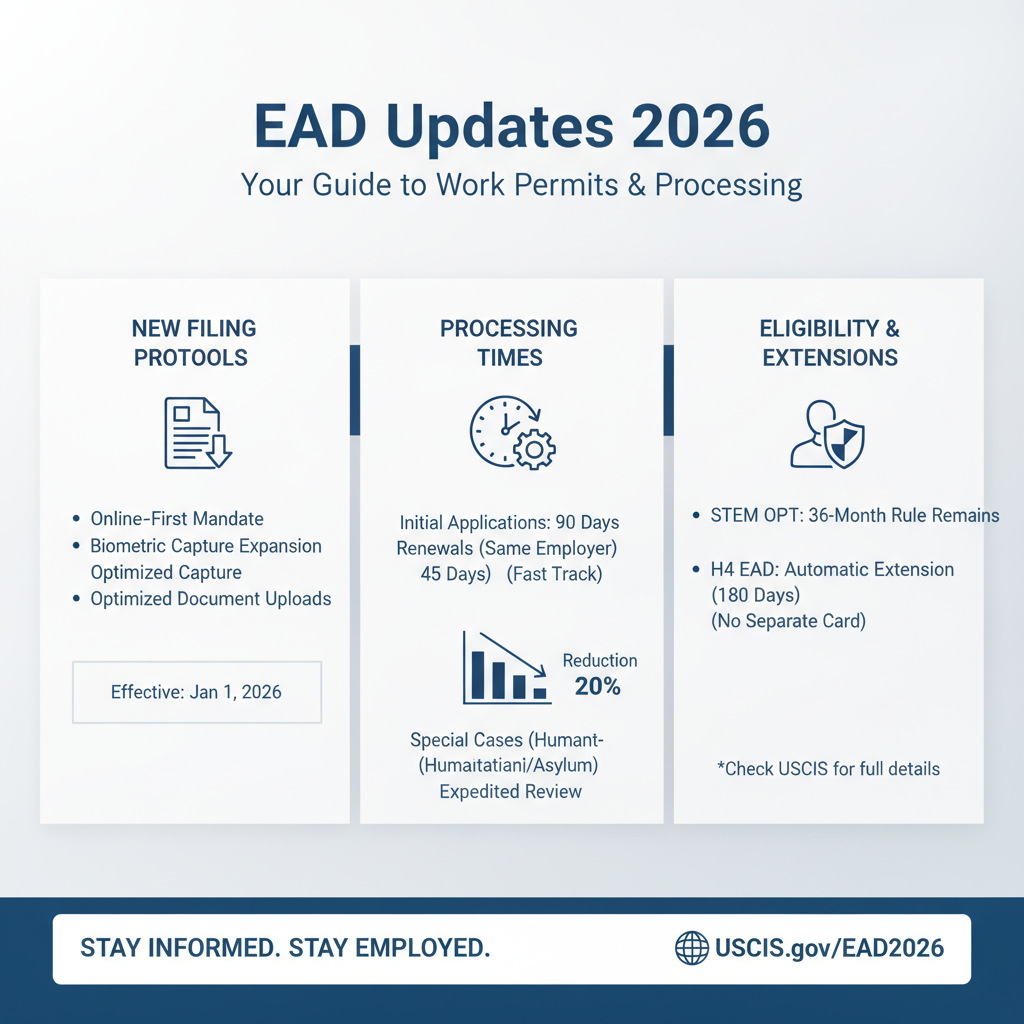
Recent discussions and policy adjustments within U.S. Citizenship and Immigration Services (USCIS) regarding processing times and efficiency for various immigration benefits, including Employment Authorization Documents, have been a consistent topic in immigration news. For the most up-to-date general information and policy changes affecting EADs, you can always refer to the official sources:
Employment Authorization Document Processing (USCIS)
What This News Means for Immigrants in Orlando and Across Florida
The landscape of immigration processing is constantly evolving, and recent trends from USCIS indicate a concerted effort to address backlogs and streamline operations. For immigrants and their families, especially those in bustling communities like Orlando and throughout Florida, these changes can have a profound impact on their ability to work and support themselves.
Why this news is showing up now
As of late 2026, USCIS has been under increasing pressure to improve efficiency and reduce the significant processing backlogs that accumulated over recent years, exacerbated by the COVID-19 pandemic and increased application volumes. The agency has implemented several strategies aimed at improving processing times for various forms, including Form I-765, Application for Employment Authorization. These strategies include:
- Temporary Final Rules: USCIS has, at various times, issued temporary final rules to extend the automatic validity period for certain renewing EADs, providing much-needed relief to applicants whose renewals were pending.
- Increased Staffing and Resource Allocation: Efforts have been made to hire more personnel and reallocate resources to high-volume processing centers.
- Technological Improvements: Investing in digital processing and online filing capabilities to reduce manual workload and speed up adjudication.
- Policy Adjustments: Reviewing and adjusting internal policies to streamline adjudication processes without compromising security.
This ongoing commitment to efficiency means that while processing times can still fluctuate, there's a continuous push to make the EAD application and renewal process more predictable and timely. For many, this isn't just about a document; it's about stability, income, and the ability to contribute to their communities.
How it can affect Florida residents
Florida is a vibrant hub for immigrants from across the globe, with a significant population in Central Florida, including Orlando and surrounding Orange County. For residents along the I-4 corridor and beyond, efficient EAD processing is critical:
- Employment Opportunities: Florida's diverse economy, spanning tourism, agriculture, healthcare, and technology, relies heavily on a robust workforce. Delays in EAD processing can mean lost job opportunities, financial hardship for families, and a disruption to local businesses.
- Economic Stability: An EAD allows individuals to work legally, pay taxes, and support their families, contributing to the local and state economy. Expedited processing means less time spent in limbo and more time contributing.
- Community Impact: Many immigrants are integral parts of their communities. The ability to work legally provides stability, allowing them to fully integrate and thrive without the constant stress of potential employment gaps.
- Orlando USCIS Field Office: While most EAD applications are processed by service centers, the Orlando USCIS Field Office handles interviews and other local matters related to underlying applications (like Adjustment of Status) that may grant EAD eligibility. Understanding national processing trends helps local residents manage expectations and plan accordingly.
Understanding these updates is not just about following the news; it's about protecting your livelihood and ensuring your family's future. Imigrar is here to help you navigate these changes, offering personalized advice tailored to your situation.
Need Help? Our Orlando immigration team is ready to assist. Call +1 786-791-3106 for a free consultation, or message us online. Se Habla Español.
What Employment Authorization Documents (EADs) Are (and Why They Matter)
For many immigrants, the ability to work legally in the United States is a cornerstone of their journey. The Employment Authorization Document (EAD), often called a "work permit," is the key to unlocking this opportunity. Understanding what it is and why it's so important is the first step toward securing your future.
A plain-English definition
An Employment Authorization Document (EAD) is a permit issued by U.S. Citizenship and Immigration Services (USCIS) that provides temporary authorization for certain non-citizens to work legally in the United States. It's a physical card, similar to a driver's license, that proves you are authorized to be employed in the U.S. for a specific period.
It's important to understand that an EAD is *not* a green card, nor does it grant permanent residency or a specific immigration status. Instead, it's a benefit tied to an underlying immigration status or application. For instance, if you have applied for Adjustment of Status to become a lawful permanent resident, you can often apply for an EAD while your green card application is pending.
Without an EAD, most non-citizens are not permitted to work in the U.S. legally. Working without authorization can have serious negative consequences for your current and future immigration status, including potential bars to future benefits.
Key terms you need to know
Navigating immigration processes involves a specific vocabulary. Here are some essential terms related to EADs:
- USCIS (U.S. Citizenship and Immigration Services): The government agency responsible for processing immigration petitions and applications, including EADs. You can find official information and forms on the USCIS official website.
- Form I-765, Application for Employment Authorization: This is the primary form you must file with USCIS to apply for or renew an EAD.
- Category Code: A specific code listed on your EAD card (e.g., C09, A05, C08) that indicates the particular immigration status or application under which you are authorized to work. Your eligibility for an EAD depends on fitting into one of these categories.
- Adjustment of Status (AOS): The process of applying for lawful permanent resident (green card) status while physically present in the United States. Applicants for AOS (typically filing Form I-485) are often eligible for an EAD.
- Derivative Beneficiary: A family member (spouse or unmarried child under 21) who derives immigration benefits from the principal applicant. For example, the spouse and children of an employment-based visa applicant might be derivative beneficiaries eligible for EADs.
- Automatic Extension: For certain EAD categories, if you file your renewal application (Form I-765) on time, your existing EAD may be automatically extended for a specific period (e.g., up to 540 days, as per recent temporary rules) while USCIS processes your new application. This prevents gaps in employment authorization.
- Biometrics Appointment: A scheduled appointment at a USCIS Application Support Center (ASC) where your fingerprints, photograph, and signature are collected for background checks. This is often a required step for EAD applicants.
- Request for Evidence (RFE): A letter from USCIS asking for additional information or documentation to support your application. Failing to respond to an RFE can lead to denial.
- Expedited Processing: In very specific, urgent circumstances, USCIS may agree to speed up the processing of an application. Strict criteria apply, such as severe financial loss, urgent humanitarian reasons, or national interest.
Understanding these terms will empower you to better comprehend the EAD process and communicate effectively with USCIS or your legal representative.
Current Immigration Law: The Foundation for EADs
Employment authorization in the United States is governed by federal immigration law, primarily the Immigration and Nationality Act (INA) and its implementing regulations found in the Code of Federal Regulations (CFR), specifically 8 CFR Part 274a. These laws define who is eligible for an EAD and under what conditions.
Federal requirements
The authority to grant employment authorization stems from the INA. Generally, individuals who are not U.S. citizens or lawful permanent residents require specific authorization to work. The regulations at 8 CFR § 274a.12 list the various categories of non-citizens who are eligible for employment authorization. These categories are diverse and include, but are not limited to:
- Asylum Seekers and Asylees: Individuals who have filed an application for asylum (after a certain waiting period) or who have been granted asylum.
- Refugees: Individuals granted refugee status.
- Applicants for Adjustment of Status: Those who have filed Form I-485 to obtain a green card based on family petitions (like Form I-130, Petition for Alien Relative), employment petitions, or other avenues.
- DACA (Deferred Action for Childhood Arrivals) Recipients: Individuals granted deferred action under the DACA policy.
- Certain Nonimmigrant Visa Holders: Spouses of certain visa holders (e.g., L-2 spouses of L-1 intracompany transferees, E spouses of E treaty traders/investors), and K-1 fiancé(e) visa holders.
- Temporary Protected Status (TPS) Beneficiaries: Individuals granted TPS due to conditions in their home country.
- Students with Specific Employment Needs: F-1 students seeking Optional Practical Training (OPT) or Curricular Practical Training (CPT) with proper authorization.
- Parolees: Individuals paroled into the U.S. for humanitarian reasons or significant public benefit.
Each category has specific requirements and may have a unique Category Code on the EAD. It's crucial to correctly identify your eligibility category when filing Form I-765. For detailed information on all categories, always consult the USCIS Forms section for Form I-765 instructions.
Florida-specific considerations
While EAD eligibility is determined by federal law, Florida's state laws and economic environment interact with federal immigration policy in practical ways. Florida does not have its own state-level work permit program; federal EADs are universally recognized across the state.
- E-Verify: Florida law mandates that certain public and private employers use E-Verify, an internet-based system operated by USCIS that allows enrolled employers to confirm the eligibility of their employees to work in the United States. An EAD is a primary document used to establish work authorization in the E-Verify system. For central Florida residents, particularly those working in larger companies or government sectors, understanding E-Verify's role is important.
- Professional Licensing: For many professions in Florida (e.g., healthcare, education, law), state licensing boards require proof of legal presence and work authorization. An EAD, coupled with other identity documents, typically satisfies this requirement.
- Local Economy: The robust job market in Orlando and surrounding areas means that a valid EAD is essential for many immigrants to secure and maintain employment, from theme park hospitality to the growing tech and medical sectors along the I-4 corridor.
Important: Always ensure your EAD is valid and unexpired. Working in Florida without proper authorization, even if your underlying immigration case is pending, can lead to serious legal consequences for both the individual and the employer.
Need Help? Our Orlando immigration team is ready to assist. Call +1 786-791-3106 for a free consultation, or message us online. Se Habla Español.
How to Apply for or Renew Your EAD: A Complete Step-by-Step Guide
Applying for or renewing an EAD can seem daunting, but breaking it down into manageable steps makes the process clearer. This guide will walk you through each stage, ensuring you have the information needed to submit a strong application.
1) Determine Your Eligibility and Category Code
Before you even fill out a form, you must confirm that you are eligible for an EAD and identify the correct Category Code that applies to your situation. This is the most critical first step. Your eligibility is directly tied to your current immigration status or a pending application.
- Review USCIS Guidelines: Carefully read the instructions for Form I-765, which list all eligible categories. You can find these on the USCIS official website for Form I-765.
- Common Categories:
- (c)(9): Applicants for Adjustment of Status (Form I-485 pending).
- (a)(5): Asylees.
- (c)(8): Asylum applicants (pending for 180 days or more).
- (c)(33): DACA recipients.
- (a)(12): Temporary Protected Status (TPS) grantees.
- (c)(26): Certain H-4 spouses.
- (c)(3)(i): F-1 students seeking Optional Practical Training (OPT).
- Consult an Attorney: If you are unsure about your eligibility or category, it is highly recommended to consult an experienced immigration attorney. An incorrect category can lead to delays or denial.
2) Gather Required Documents
Once you know your category, you'll need to collect specific supporting documents. The exact list varies by category, but common requirements include:
- Two Passport-Style Photos: Taken within the last 30 days, unmounted, full-face, white background.
- Copy of Government-Issued Photo ID: Such as a passport, national ID card, or driver's license.
- Copy of Your Last EAD Card (if renewing): Front and back.
- Copy of Form I-94, Arrival/Departure Record: If applicable, showing your lawful admission.
- Proof of Identity and Nationality: Copy of birth certificate, passport biographic page, or other national identity documents.
- Proof of Eligibility for Your Category:
- For (c)(9) (AOS applicants): Copy of Form I-485 receipt notice.
- For (c)(8) (Asylum applicants): Copy of Form I-589, Application for Asylum and for Withholding of Removal, receipt notice.
- For (c)(33) (DACA): Copy of Form I-821D, Consideration of Deferred Action for Childhood Arrivals, approval notice.
- For derivative beneficiaries: Copy of the principal applicant's approval notice (e.g., Form I-797 for L-1 or E visa), marriage certificate, and/or birth certificates to prove relationship.
- Proof of Previous EADs: If you've had EADs before, include copies of all previous cards.
- Marriage Certificate/Birth Certificates: If your eligibility depends on a family relationship.
Reminder: Always send copies, not original documents, unless USCIS specifically requests an original.
3) Complete Form I-765, Application for Employment Authorization
Fill out Form I-765 accurately and completely. You can download the latest version from the USCIS Forms page. Pay close attention to:
- Personal Information: Ensure your name, date of birth, and address match your other immigration documents exactly.
- Part 2, Item 27 (Eligibility Category): Enter the correct three-character code (e.g., (c)(9)).
- Signature: You must sign the form in blue or black ink. An unsigned form will be rejected.
- Fees: Check the USCIS website for Form I-765 for the current filing fee. Some categories are fee-exempt, and you may be eligible for a fee waiver (Form I-912).
Important: If applying for an EAD based on a pending Form I-485, you typically do not need to pay the Form I-765 filing fee, as it's included in the Form I-485 fee. However, always verify the current fee schedule.
4) Prepare Your Application Package
Organize your documents neatly. A well-organized package helps USCIS process your application efficiently.
- Cover Letter (Optional but Recommended): A brief letter listing the contents of your package and the purpose of your application.
- Payment: Include a check or money order payable to "U.S. Department of Homeland Security" for the correct filing fee, or Form I-912 if applying for a fee waiver. Write your A-number on the check/money order.
- Order of Documents: Place the check/money order on top, followed by Form I-765, then the supporting documents in a logical order (e.g., identity, photos, eligibility proof).
- Copies: Always keep a complete copy of your entire application package for your records.
5) File Your Application with USCIS
The correct filing address for Form I-765 depends on your eligibility category and whether you are filing it concurrently with another form (e.g., Form I-485). Refer to the "Where to File" section in the official Form I-765 instructions.
- USPS Certified Mail with Return Receipt: This provides proof that your application was delivered and received by USCIS.
- Online Filing: Some EAD categories are eligible for online filing. Check the USCIS website for current options. Online filing can sometimes be faster and allows for immediate receipt confirmation.
- Concurrent Filing: If filing an EAD based on a pending Adjustment of Status application (Form I-485), you can often file Form I-765 concurrently with Form I-485, or mail it separately to the same address where you filed your Form I-485.
You will receive a Form I-797C, Notice of Action, confirming receipt of your application. Keep this notice safe.
6) Attend Biometrics Appointment (If Required)
Most EAD applicants will receive a biometrics appointment notice (Form I-797C) from USCIS. This notice will schedule you for an appointment at a local Application Support Center (ASC), such as the one serving Orlando residents.
- What to Bring: Your appointment notice, a valid photo ID (e.g., passport, driver's license), and any other documents specified in the notice.
- Purpose: Your fingerprints, photograph, and signature will be collected for background and security checks.
- Rescheduling: If you cannot attend, follow the instructions on the notice to reschedule, but be aware that rescheduling can cause delays.
7) Monitor Your Case Status and Respond to RFEs
After filing, it's crucial to monitor your application's progress.
- USCIS Online Tools: Use the receipt number from your Form I-797C to check your case status online at USCIS Case Status Online. You can also sign up for email and text message notifications.
- Processing Times: Check the USCIS Processing Times page for an estimate of how long it might take for your specific form and service center.
- Request for Evidence (RFE) or Notice of Intent to Deny (NOID): If you receive an RFE or NOID, respond promptly and thoroughly with all requested information. Failure to do so will likely result in denial. An immigration attorney can be invaluable in preparing a robust response.
- Approval: If approved, USCIS will mail your EAD card to the address on file. Ensure your address is always up to date with USCIS.
Practical Steps You Can Take Today
Proactive preparation is key to a smoother EAD application process. Here are actionable steps you can take right now to set yourself up for success:
- Start Early: If your EAD is nearing expiration (typically within the 180-day to 90-day window before expiration), begin your renewal application immediately. Don't wait until the last minute, especially given potential processing fluctuations.
- Gather Core Documents: Even if you're not ready to file, start collecting essential documents like your passport, Form I-94, previous EADs, and marriage/birth certificates. Keep them organized in a secure place.
- Check USCIS Processing Times: Regularly visit the USCIS Processing Times page for the latest estimates for Form I-765 at
Related Topics
Need Legal Assistance?
Our experienced immigration attorneys are here to help with your case. Contact Imigrar today for a free consultation and let us guide you through the legal process with confidence.
📍 Orlando, Florida • Serving clients nationwide
📧 info@imigrar.com