
EAD Processing Updates: Your 2026 Guide to U.S. Work Permits
Navigating EAD processing updates is crucial for immigrants. This 2026 guide covers applications, renewals, eligibility, and expert advice to secure your U.S. work permit. Imigrar keeps families together.

As an immigrant navigating the complex U.S. immigration system, securing the legal right to work is often a top priority. An Employment Authorization Document (EAD), commonly known as a work permit, is your key to financial stability and building a life in the United States. At Imigrar, we understand the critical importance of these documents and the anxiety that can accompany their application and renewal processes.
Today, October 15, 2026, we're addressing the ongoing discussions and developments surrounding EAD processing by U.S. Citizenship and Immigration Services (USCIS). These updates frequently impact processing times, eligibility criteria, and the overall application experience, making it vital for applicants, particularly those in Orlando and across Florida, to stay informed.
The reporting that sparked this guide
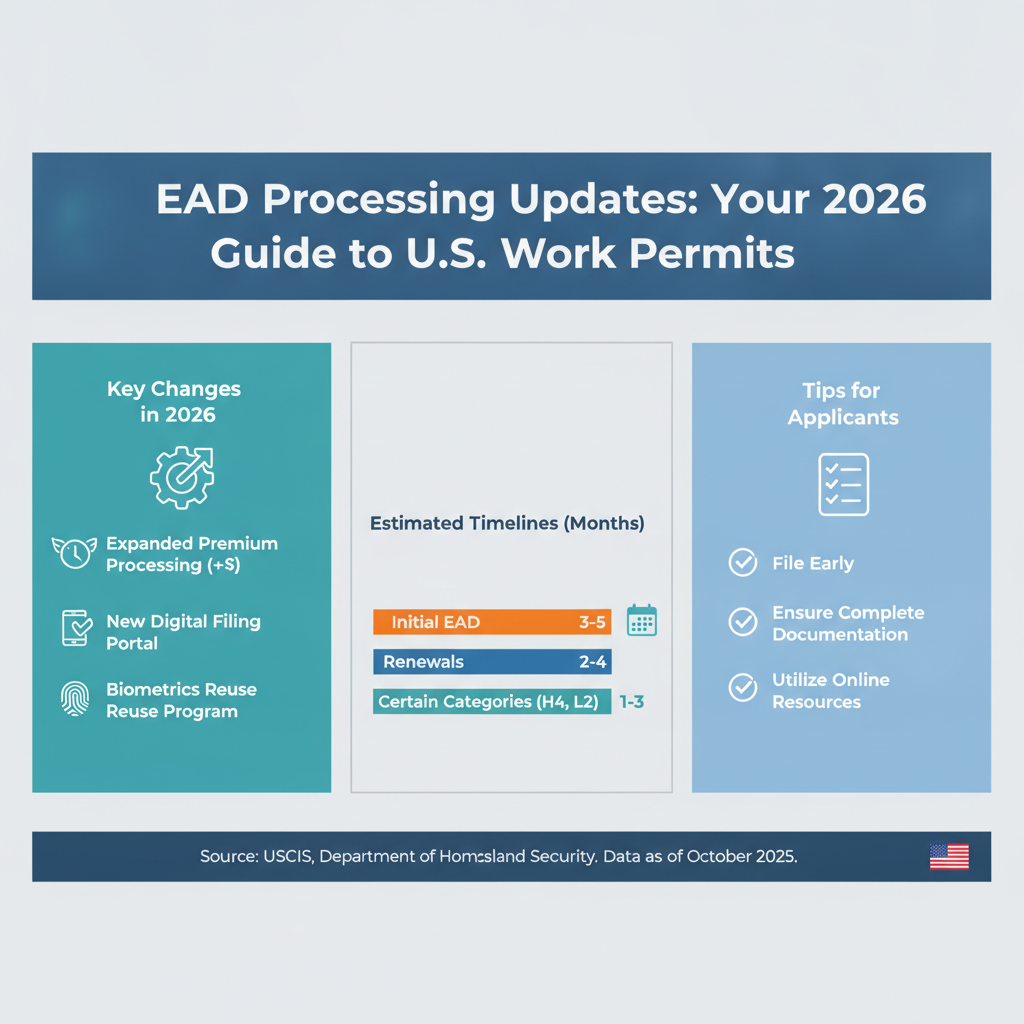
Our commitment to keeping families together and informed drives us to continuously monitor official sources and news outlets for developments that affect our clients. The recent focus on EAD processing from USCIS, highlighted through various discussions and announcements, reinforces the need for clear, actionable guidance.
You can track ongoing developments and broader immigration news through sources like: Employment Authorization Document Processing (USCIS)
What This News Means for Immigrants in Orlando and Across Florida
The landscape of immigration policy and processing is dynamic. USCIS frequently adjusts its procedures, often in response to application volumes, legislative changes, or operational efficiencies. For anyone seeking to live and work legally in the U.S., understanding these shifts is paramount.
Why this news is showing up now
USCIS, the federal agency responsible for processing immigration applications, faces the immense task of managing millions of filings annually. Over recent years, various factors—including increased application volumes, staffing challenges, and policy shifts—have led to fluctuating processing times and the implementation of new strategies to address backlogs. As of October 15, 2026, USCIS continues to refine its approach to EAD applications and renewals. These ongoing efforts often generate public discussion and policy adjustments, making EAD processing a perennial topic of interest for applicants, employers, and legal professionals alike. The agency is always looking for ways to streamline operations, which can mean new forms, new submission methods, or revised adjudication priorities. This continuous evolution is why "EAD processing" remains a trending topic.
How it can affect Florida residents
Florida is a vibrant hub for immigrants from all corners of the globe, with a significant population of individuals seeking or holding EADs. For Central Florida residents, particularly those in Orlando and surrounding Orange County, changes in USCIS EAD processing can have direct and profound impacts. Many individuals along the I-4 corridor rely on their EADs to maintain employment in critical sectors like tourism, hospitality, healthcare, and agriculture. Delays in processing can lead to job loss, financial hardship, and instability for families. Conversely, expedited processing or clearer guidelines can offer much-needed relief and certainty.
- Economic Impact: Delays can mean a lapse in employment authorization, forcing individuals to stop working and impacting local businesses that rely on their labor.
- Community Stability: EADs are often tied to underlying immigration processes like Adjustment of Status or asylum applications. Processing delays can prolong uncertainty for families seeking permanent residency.
- Local USCIS Field Office: While most EAD applications are processed at USCIS Service Centers, the Orlando USCIS Field Office handles interviews related to underlying petitions (like Form I-485 for Adjustment of Status) which can indirectly affect EAD timelines.
- Employer Compliance: Florida employers must ensure their workforce is legally authorized to work. Changes in EAD processing, especially regarding renewal timelines, impact how employers manage their E-Verify obligations and employee onboarding.
Need Help? Our Orlando immigration team is ready to assist. Navigating EAD applications can be complex, but you don't have to do it alone. Call +1 786-791-3106 for a free consultation, or message us online. Se Habla Español.
What Employment Authorization Documents (EADs) Are (and Why They Matter)
At its core, an Employment Authorization Document (EAD) is a permit that allows foreign nationals to legally work in the United States for a specific period. Often referred to simply as a "work permit," this document is issued by USCIS to individuals who are not U.S. citizens or lawful permanent residents (green card holders) but are authorized to be employed in the U.S. because of their particular immigration status or situation.
A plain-English definition
Imagine the EAD as your official permission slip from the U.S. government to get a job. It's a physical card, similar to a driver's license, that you present to employers to prove you're allowed to work. It's not a visa, nor is it a green card, but it's a crucial document for many immigrants on their path to permanent residency or during their temporary stay in the U.S.
Key terms you need to know
To fully understand EADs and their processing, it's helpful to be familiar with some key terminology:
- EAD (Employment Authorization Document): The official name for the work permit.
- Form I-765: This is the specific application form you must submit to USCIS to request an EAD.
- USCIS (U.S. Citizenship and Immigration Services): The government agency responsible for processing immigration benefits, including EAD applications. You can find more information on their USCIS official website.
- Adjustment of Status (AOS): The process of applying for a green card while physically present in the United States. Many individuals with pending Form I-485 (Application to Register Permanent Residence or Adjust Status) are eligible for an EAD.
- Nonimmigrant Status: A temporary visa status, such as H-1B, F-1 (student), L-1 (intra-company transfer), or H-4 (spouse of H-1B). Certain nonimmigrants, like H-4 spouses of H-1B holders with approved I-140 petitions, are eligible for EADs.
- Asylum Seeker: An individual who has applied for asylum in the U.S. and whose application has been pending for at least 180 days is often eligible for an EAD.
- Refugee: An individual granted refugee status in the U.S. is generally eligible for an EAD.
- DACA (Deferred Action for Childhood Arrivals): A program that provides eligible undocumented young people with deferred action from deportation and a renewable EAD.
- OPT (Optional Practical Training): A period during which F-1 student visa holders can work in their field of study, requiring an EAD.
- H-4 EAD: Specific EAD eligibility for certain H-4 dependent spouses of H-1B nonimmigrants.
- Processing Times: The estimated time it takes USCIS to process a particular application, which can vary significantly by form type and service center. You can check current times at USCIS Processing Times.
- Receipt Notice (Form I-797C): A notice from USCIS confirming they have received your application.
- Request for Evidence (RFE): A letter from USCIS asking for additional documents or information to support your application.
Understanding these terms is the first step in successfully navigating the EAD application process. An EAD is more than just a piece of plastic; it represents the opportunity to provide for yourself and your family, contribute to the U.S. economy, and build a stable future while pursuing your immigration goals. It is a vital bridge for many on their journey to permanent residency.
Current Immigration Law: The Foundation for EADs
The authority for Employment Authorization Documents stems from federal immigration law, primarily the Immigration and Nationality Act (INA) and its corresponding regulations found in the Code of Federal Regulations (CFR). Specifically, 8 CFR § 274a.12 outlines the various categories of foreign nationals who are eligible to apply for employment authorization. It's a complex framework, designed to address diverse situations from asylum seekers to spouses of certain visa holders.
Federal requirements
Eligibility for an EAD is not universal; it is tied to specific immigration statuses or pending applications. The federal requirements dictate who can apply and under what conditions. Some of the most common eligibility categories include:
- Applicants for Adjustment of Status (AOS): Individuals with a pending Form I-485 (Application to Register Permanent Residence or Adjust Status) are generally eligible for an EAD under category (c)(9). This allows them to work while their green card application is being processed, which can often take several years.
- Asylum Applicants: Individuals who have filed Form I-589 (Application for Asylum and for Withholding of Removal) and whose application has been pending for at least 180 days (without any delays caused by the applicant) are eligible for an EAD under category (c)(8). This includes those in removal proceedings before the Executive Office for Immigration Review (EOIR).
- Refugees and Asylees: Individuals granted refugee or asylum status are automatically authorized to work and can apply for an EAD under categories (a)(3) or (a)(5) respectively.
- Nonimmigrant Spouses: Certain nonimmigrant spouses, such as H-4 spouses of H-1B nonimmigrants who have an approved Form I-140 (Immigrant Petition for Alien Worker), are eligible for an EAD under category (c)(26). Similarly, L-2 spouses of L-1 visa holders are also work-authorized.
- F-1 Students with Optional Practical Training (OPT): F-1 students seeking to gain practical experience in their field of study can apply for an EAD for OPT (categories (c)(3)(A), (c)(3)(B), or (c)(3)(C)).
- DACA Recipients: Individuals granted Deferred Action for Childhood Arrivals are eligible for EADs under category (c)(33).
- Temporary Protected Status (TPS): Individuals granted TPS are eligible for an EAD under category (a)(12) or (c)(19).
- Parolees: Certain individuals granted parole into the U.S., such as Cuban or Haitian parolees, may be eligible for an EAD.
To apply, individuals must submit Form I-765, Application for Employment Authorization, along with supporting documentation proving their eligibility and identity. The specific requirements vary significantly by eligibility category, emphasizing the need for careful review of the form instructions and relevant regulations.
Florida-specific considerations
While EAD eligibility is determined by federal law, the practical implications and certain state-level considerations can affect EAD holders in Florida. Florida's robust economy, particularly in sectors like tourism, agriculture, and healthcare, relies on a diverse workforce that includes many EAD holders. For employers in Florida, compliance with federal and state employment laws is crucial, including verifying employment authorization through systems like E-Verify.
The Orlando USCIS Field Office, while not directly processing EAD applications (which are handled by Service Centers), plays a role in the overall immigration journey for many Central Florida residents. For instance, if your EAD is based on a pending Adjustment of Status application, you may have your green card interview at the Orlando office. Any issues or delays with your underlying green card application could indirectly affect your EAD's validity or renewal prospects. Furthermore, public awareness campaigns or state-level initiatives regarding legal employment can influence the local environment for EAD holders. It's always wise for Florida residents to stay informed about both federal immigration changes and any relevant state employment laws.
For the most accurate and up-to-date information on EADs and other immigration matters, always refer to the USCIS official website and consult with a qualified immigration attorney.

How to Apply for or Renew Your EAD: A Complete Step-by-Step Guide
Applying for or renewing your Employment Authorization Document (EAD) is a critical process that requires meticulous attention to detail. A single error or missing document can lead to significant delays or even a denial. This guide outlines the essential steps to help you navigate the process effectively. Remember, for the most personalized advice, consulting with an immigration attorney like Imigrar is always recommended.
1) Determine Your Eligibility Category
Before you even touch Form I-765, you must accurately identify your eligibility category. This is arguably the most crucial step, as selecting the wrong category will lead to denial. Your eligibility stems from your underlying immigration status or pending application.
- Common Categories:
- (c)(9): For applicants with a pending Form I-485 (Adjustment of Status).
- (c)(8): For asylum applicants whose Form I-589 has been pending for at least 180 days.
- (c)(33): For DACA recipients.
- (c)(26): For certain H-4 spouses of H-1B nonimmigrants.
- (c)(3)(A), (B), or (C): For F-1 students seeking Optional Practical Training (OPT).
- (a)(12) or (c)(19): For individuals with Temporary Protected Status (TPS).
- How to Confirm: Carefully review the instructions for Form I-765 available on the USCIS Forms page. Your immigration attorney can provide definitive guidance.
Required documents for this step: Proof of your underlying immigration status or application (e.g., I-485 receipt notice, I-797 approval notice for H-1B, I-589 filing receipt, DACA approval notice, F-1 visa and I-20). These aren't submitted yet but help confirm your category.
2) Gather Required Documents and Information
Once your eligibility category is confirmed, compile all necessary supporting documents. This list can vary based on your category, but general requirements include:
- Two identical passport-style photos: Taken within 30 days of filing, full frontal view, white background, unretouched. Write your name and A-number (if you have one) lightly on the back.
- Copy of your most recent EAD (if renewing): Front and back.
- Copy of your government-issued identification: Such as a passport biographical page, visa, or birth certificate (with certified translation if not in English).
- Copy of your Form I-94 Arrival/Departure Record: Print it from CBP's website.
- Proof of eligibility for the specific category:
- For (c)(9) AOS: Copy of your Form I-485 receipt notice (Form I-797C).
- For (c)(8) Asylum: Copy of your Form I-589 receipt notice and proof it's been pending for at least 180 days.
- For (c)(26) H-4 EAD: Copy of H-1B spouse's Form I-797 approval notice for I-140, H-4 visa stamp, marriage certificate.
- For (c)(3)(A) OPT: Copy of Form I-20 endorsed for OPT, academic transcript.
- Copy of your birth certificate (with certified translation if applicable).
- Copy of your marriage certificate (if applicable, with certified translation).
- Copy of your Social Security card (if you have one).
- Previous EAD cards (if applicable).
Important: Always provide copies, not originals, unless specifically requested by USCIS. Ensure all foreign language documents are accompanied by a certified English translation.
3) Complete Form I-765, Application for Employment Authorization
Fill out Form I-765 meticulously. You can download the latest version from the USCIS Forms page. Pay close attention to every section:
- Part 1: Reason for Applying: Indicate if it's an initial application, renewal, or replacement.
- Part 2: Information About You: Enter your full legal name, date of birth, country of birth, A-Number (if any), USCIS Online Account Number (if any), and U.S. mailing address.
- Part 2, Item 27 (Eligibility Category): This is where you enter the specific eligibility code (e.g., (c)(9), (c)(8)). Make sure it matches your determination from Step 1.
- Part 3: Applicant’s Statement, Contact Information, Declaration, and Signature: If you're filling it out yourself, select "I prepared this application myself." If an attorney or interpreter helped, they will complete their respective sections. Warning: Ensure your signature is original and within the designated box. An unsigned form will be rejected.
Reminder: USCIS often rejects forms with blank fields that should have "N/A" or "None." Follow instructions precisely.
4) Prepare Your Application Packet
Once you've completed Form I-765 and gathered all supporting documents, organize your packet. While not strictly required, a cover letter can be helpful, listing the contents of your submission. Arrange documents in the order listed on your cover letter or as recommended by USCIS instructions (e.g., photos on top, then fee, then form
Related Topics
Need Legal Assistance?
Our experienced immigration attorneys are here to help with your case. Contact Imigrar today for a free consultation and let us guide you through the legal process with confidence.
📍 Orlando, Florida • Serving clients nationwide
📧 info@imigrar.com