
Ace Your Green Card Interview: Orlando Immigration Guide
Prepare for your Green Card interview with expert tips from Imigrar. Learn requirements, common questions, and how to succeed in Orlando, Florida.

The journey to obtaining a Green Card, or lawful permanent residency, in the United States is a significant milestone for countless individuals and families. For many, the culminating step is the Green Card interview with a U.S. Citizenship and Immigration Services (USCIS) officer. This interview is a critical moment, designed to verify the information in your application and determine your eligibility for permanent residency. Understanding how to prepare thoroughly can make all the difference between a smooth approval and potential delays or even denial.
The reporting that sparked this guide
In the dynamic world of immigration law, staying informed is paramount. Recent discussions and ongoing guidance on best practices for immigration processes, particularly those involving direct interaction with government officials, consistently highlight the importance of diligent preparation. This guide is inspired by the continuous need for clear, actionable advice as seen in general reporting on Green Card Interview Preparation Tips (Immigration Law), underscoring that while the laws may evolve, the fundamental need for thorough preparation for your Green Card interview remains a constant and critical factor for success.
What This News Means for Immigrants in Orlando and Across Florida
The emphasis on Green Card interview preparation is not just a general guideline; it holds specific relevance for the vibrant immigrant communities in Orlando and throughout Florida. Our state is home to millions of immigrants from diverse backgrounds, each navigating their unique path to residency. For many, the interview is the final hurdle in a long and often complex process.
Why this news is showing up now
The topic of Green Card interview preparation is perennially relevant, but its prominence often fluctuates with processing times, policy changes, and increased public awareness campaigns by legal advocates. While there may not be a single new policy that specifically mandates more rigorous interview preparation, the continuous flow of information, success stories, and cautionary tales within the immigration law sphere naturally brings this crucial topic to the forefront. Furthermore, as USCIS streamlines its processes and aims for greater efficiency, the interview becomes an even more focused point of scrutiny, making preparation all the more critical for applicants. The consistent advice from immigration attorneys and advocates emphasizes that a well-prepared applicant helps USCIS make quicker, more informed decisions, benefiting both the applicant and the system.
How it can affect Florida residents
For individuals and families residing in Florida, particularly those in the greater Orlando area, the importance of interview preparation cannot be overstated. Florida hosts several USCIS field offices, including a prominent one in Orlando, which conducts a significant number of Green Card interviews annually. The local context includes:
- Diverse Caseloads: The Orlando USCIS Field Office, located strategically in Central Florida, handles a wide array of cases, from family-based petitions to employment-based adjustments of status. Each type of case has its unique set of requirements and potential interview questions.
- High Volume: Florida's large immigrant population means these offices process a high volume of applications. Officers are trained to efficiently assess cases, and a well-organized, articulate applicant can significantly aid this process.
- Specific Regional Concerns: While federal law applies nationwide, local offices might have specific procedural nuances or common issues they look for based on regional demographics or fraud trends. For example, marriage-based interviews in Florida often see officers keenly assessing the bona fides of relationships due to past instances of marriage fraud.
- Accessibility to Legal Help: Given the large immigrant population, there is also a robust legal community specializing in immigration law. This means Florida residents have access to experienced attorneys who understand the local USCIS office's practices and can provide tailored advice.
For Central Florida residents, understanding the specific expectations and potential challenges associated with an interview at the Orlando USCIS Field Office is a significant advantage. Proactive preparation ensures that you are not caught off guard and can confidently present your case, keeping your family together and moving forward with your American dream.
Need Help? Our Orlando immigration team is ready to assist. Call +1 786-791-3106 for a free consultation, or message us online. Se Habla Español.
What a Green Card Interview Is (and Why It Matters)
The Green Card interview is a pivotal moment in the immigration process, serving as the final in-person assessment of your eligibility for lawful permanent residency in the United States. It is a formal meeting with a USCIS officer (or a Consular Officer if processing abroad) who reviews your application, examines your supporting documents, and asks questions to verify the information you’ve provided and ensure you meet all legal requirements.
A plain-English definition
Think of the Green Card interview as your final exam for permanent residency. It’s a conversation where a government official confirms that everything you’ve stated in your application is true and that you genuinely qualify for a Green Card under U.S. immigration laws. It’s your opportunity to present your case clearly and answer any lingering questions the officer might have. This interview is crucial because it’s often the last step before a decision is made on your application. A positive outcome leads to your Green Card; a negative one can lead to delays, requests for more evidence, or even denial.
Key terms you need to know
Navigating the immigration process requires understanding specific terminology. Here are some key terms related to your Green Card interview:
- Green Card: Officially known as a Permanent Resident Card, it is an identification document that proves an individual has been granted lawful permanent residency in the United States.
- USCIS (U.S. Citizenship and Immigration Services): The government agency responsible for overseeing lawful immigration to the United States. They conduct Green Card interviews domestically.
- Consular Processing: The process of applying for an immigrant visa through a U.S. embassy or consulate abroad if you are outside the U.S. This involves an interview with a Consular Officer.
- Adjustment of Status (AOS): The process of applying for a Green Card while physically present in the United States. This typically involves an interview at a USCIS field office.
- Immigrant Visa: A visa issued to foreign nationals who intend to live permanently in the United States. For those undergoing Consular Processing, the immigrant visa is processed at the interview abroad, allowing entry to the U.S. as a permanent resident.
- Sponsor/Petitioner: The U.S. citizen or lawful permanent resident who files a petition on behalf of an immigrant (e.g., a spouse filing Form I-130 for their foreign national spouse).
- Beneficiary: The foreign national seeking immigration benefits (e.g., the spouse, child, or parent for whom the petition is filed).
- Interview Notice: The official document from USCIS or the Department of State informing you of the date, time, and location of your interview, along with a list of required documents.
- Bona Fide Marriage: A marriage entered into for love and companionship, not solely for immigration benefits. This is a critical concept in marriage-based Green Card interviews.
- Affidavit of Support (Form I-864): A legally binding document signed by a sponsor to accept financial responsibility for the intending immigrant.
- Priority Date: The date USCIS receives your immigrant petition (e.g., Form I-130). This date determines when an immigrant visa number becomes available for certain categories, especially for family-based and employment-based visas.
Understanding these terms will not only help you comprehend the process better but also enable you to communicate more effectively with your attorney and the interviewing officer.
Current Immigration Law: The Foundation
The Green Card interview process is governed by the Immigration and Nationality Act (INA) and its corresponding regulations. These laws establish who is eligible for a Green Card and the procedures for obtaining one. The interview is a mechanism for USCIS to ensure compliance with these federal requirements.
Federal requirements
The legal basis for Green Card eligibility is primarily found in the INA. Most Green Card applications fall under either family-based or employment-based categories, each with specific statutory requirements. For example:
- Family-Based Immigration: Governed by INA Sections 201, 203, and 204. These sections define who can petition for relatives (e.g., U.S. citizens can petition for spouses, children, parents, and siblings; LPRs can petition for spouses and unmarried children) and the various preference categories. The interview focuses on verifying the legitimacy of the relationship (e.g., a bona fide marriage for spousal petitions) and the sponsor's ability to financially support the applicant via Form I-864, Affidavit of Support.
- Employment-Based Immigration: Governed by INA Sections 203 and 204. These categories are for foreign nationals with specific job offers, skills, or investments. Interviews often delve into the applicant's qualifications, the job offer's legitimacy, and the employer's viability.
- Adjustment of Status (INA Section 245): This critical section allows eligible individuals already in the U.S. to apply for lawful permanent resident status without having to return to their home country for visa processing. The interview for AOS cases conducted at USCIS field offices primarily verifies eligibility, admissibility, and the facts presented in the application forms.
- Admissibility Standards (INA Section 212): A crucial aspect of the interview is determining if an applicant is "admissible" to the U.S. This involves checking for various grounds of inadmissibility, such as certain criminal records, past immigration violations, health-related issues, or security concerns. Officers will review your background thoroughly.
All applicants must demonstrate that they are not inadmissible to the United States under any of the grounds specified in INA Section 212. This includes, but is not limited to, health-related grounds, criminal grounds, security grounds, public charge grounds, and prior immigration violations. Waivers may be available for certain grounds of inadmissibility, but these are complex and require careful legal navigation.
USCIS forms central to the Green Card process and interview include:
- Form I-130, Petition for Alien Relative (filed by the U.S. citizen or LPR petitioner).
- Form I-485, Application to Register Permanent Residence or Adjust Status (filed by the beneficiary when seeking Adjustment of Status in the U.S.).
- Form I-864, Affidavit of Support Under Section 213A of the INA (filed by the financial sponsor).
- Form I-693, Report of Medical Examination and Vaccination Record (completed by a USCIS-approved civil surgeon).
- Form I-765, Application for Employment Authorization (often filed concurrently with Form I-485).
- Form I-131, Application for Travel Document (often filed concurrently with Form I-485 for Advance Parole).
You can find detailed information and download all necessary forms directly from the USCIS official website.
Florida-specific considerations
While federal law governs the fundamental requirements, the implementation of these laws can have localized nuances. For Florida residents:
- Orlando USCIS Field Office: If your case is in Orlando, your interview will likely take place at the Orlando USCIS Field Office. Familiarizing yourself with its location, parking, and general procedures can ease interview day stress.
- Volume and Wait Times: Florida's high population density and diverse immigrant communities mean that USCIS field offices in the state, including Orlando, often experience significant application volumes. This can sometimes affect processing times, which you can monitor at USCIS Processing Times.
- Marriage-Based Cases: Given the prevalence of marriage-based Green Card applications along the I-4 corridor and throughout Florida, officers are particularly diligent in verifying the authenticity of marriages. Providing ample evidence of a bona fide marriage is critical.
- Common Languages: With a significant Spanish-speaking population, the Orlando office often has Spanish-speaking officers or provides interpreters. However, if you are not fluent in English, bringing your own certified interpreter (not a family member or attorney) is a recommended practice unless USCIS provides one.
Important: Always refer to the most current instructions for each form on the USCIS Forms page, as requirements can change.
Need Expert Guidance? Navigating Green Card interviews can be complex. Imigrar offers comprehensive legal support for Orlando residents. Call +1 786-791-3106 today for your free consultation. Se Habla Español.
How to Ace Your Green Card Interview: A Complete Step-by-Step Guide
Preparing for your Green Card interview requires a methodical approach. Follow this comprehensive step-by-step guide to ensure you are fully ready for this critical appointment.
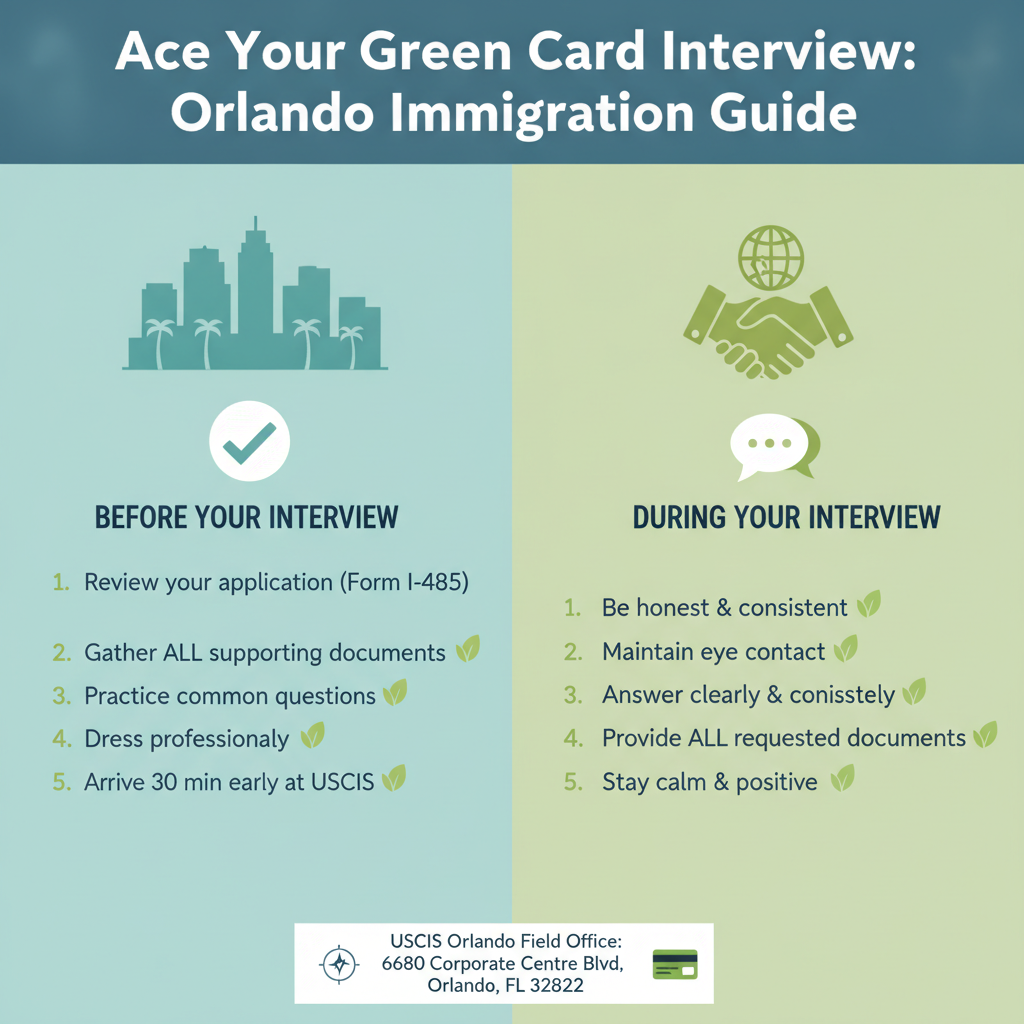
1) Understand Your Interview Notice and Case Type
The first step begins the moment you receive your interview notice, typically 3-6 weeks before the actual date. This document is not just a schedule; it's a vital instruction sheet.
- Review the Notice Immediately: Check the date, time, and location carefully. For Central Florida residents, this will likely be the Orlando USCIS Field Office.
- Identify Required Documents: The notice will include a list of original documents and copies you must bring. This list is specific to your case. Do not assume; read it thoroughly.
- Confirm Case Type: Understand if your interview is for a family-based Green Card (e.g., marriage, parent-child) or an employment-based one. This will dictate the primary focus of the questions.
- Check for Co-interviewees: If it's a marriage-based case, your U.S. citizen or LPR spouse will typically be required to attend with you. Ensure they are aware and prepared.
Required Documents to Identify from Notice:
- Original Interview Notice
- Government-issued photo identification (e.g., passport, driver's license)
- Any specific forms or documents requested in the notice (e.g., updated Form I-864, current pay stubs)
2) Gather and Organize All Necessary Documents
This is perhaps the most crucial preparatory step. The goal is to have every original document and a clear copy readily available and organized in an easily accessible manner.
- All Original Documents:
- Passports (current and expired)
- Birth Certificates (for all applicants and petitioner)
- Marriage Certificate (if applicable)
- Divorce Decrees or Death Certificates for all prior marriages (for both petitioner and beneficiary, if applicable)
- Medical Exam Results (Form I-693) in a sealed envelope (unless already submitted).
- Affidavit of Support (Form I-864) and all supporting financial documents (tax returns, W-2s, pay stubs, employment verification letter, bank statements) from the sponsor.
- Police Clearance Certificates (if required and not already submitted).
- Any criminal records, court dispositions, or arrest reports (even if charges were dropped or expunged).
- Proof of Legal Entry to the U.S. (e.g., visa, I-94 arrival record).
- Copies of Everything: Make a complete set of copies for every original document. USCIS will typically keep the copies and return your originals.
- Relationship Evidence (for Marriage-Based Cases): This is vital for proving a bona fide marriage.
- Joint bank accounts, credit card statements
- Joint utility bills, lease agreements, mortgage statements
- Photos together (over time, with family/friends, from wedding/honeymoon)
- Life insurance policies, wills, retirement accounts showing each other as beneficiaries
- Children's birth certificates (if applicable)
- Affidavits from friends/family attesting to the marriage
- Travel itineraries, plane tickets from trips together
- Correspondence (emails, texts, social media posts)
- Employment-Based Evidence:
- Original job offer letter
- Diplomas, transcripts, professional licenses
- Letters of experience from previous employers
- Employer's financial records (if self-petitioning or if requested)
- Organize Methodically: Use folders, binders, or dividers. Label each section clearly (e.g., "Originals," "Copies," "Marriage Evidence," "Financial Docs"). This organization demonstrates preparedness and makes it easy to retrieve documents quickly during the interview.
Reminder: Do not bring unnecessary items that could be perceived as clutter or a security risk. Focus on documents directly relevant to your application.
3) Review Your Entire Application Package
Before the interview, you and your attorney should review every single form and supporting document you submitted to USCIS. Your interview officer will have this exact package in front of them.
- Know Your Story: Be intimately familiar with the dates, addresses, employment history, and personal details you provided. Any inconsistencies, even minor ones, can raise red flags.
- Practice Answering Questions: Anticipate questions based on your application. For example, if there were gaps in employment, be ready to explain them. If there were errors on your initial forms, discuss how to address them with your attorney.
- Disclose Everything: Ensure you have disclosed all relevant information, especially regarding past arrests, immigration violations, or previous marriages. Hiding information can lead to severe consequences.
- Update Information: If anything has changed since you filed (e.g., new address, new job, new child), bring documentation to reflect these changes and be prepared to explain them.
4) Prepare for Common Interview Questions
While questions vary based on your case type, many themes are universal. Practice answering these questions clearly, concisely, and consistently with your application.
- General Questions:
- Confirming your identity and personal details (name, date of birth, address).
- Your immigration history (when and how you entered the U.S., any previous visas, travel history).
- Criminal history questions (even minor infractions).
- Inadmissibility questions (related to health, public charge, security).
- Marriage-Based Questions:
- How and when did you meet your spouse?
- Details of your wedding and honeymoon.
- Daily routines (what you do in the morning, who cooks, who pays bills).
- Names of family members, friends, and pets.
- Future plans together.
- Any prior relationships or marriages for either spouse.
- Employment-Based Questions:
- Details of your job offer (salary, duties, start date).
- Your qualifications and work experience.
- The employer's business and need for your position.
- Seek Legal Counsel: An experienced immigration attorney can conduct mock interviews, helping you anticipate specific questions related to your unique background and circumstances.
Warning: Never lie or intentionally mislead the officer. Honesty, even about past mistakes, is always the best policy, especially if you have an attorney to help explain the circumstances and any available waivers.
5) What to Do on Interview Day
The day of the interview can be nerve-wracking, but proper preparation will help you remain calm and composed.
- Dress Appropriately: Choose professional, conservative attire. This shows respect for the process and the officer.
- Arrive Early: Plan to arrive at the Orlando USCIS Field Office at least 30 minutes before your scheduled appointment to allow for security checks and finding your way.
- Be Polite and Respectful: Greet the officer respectfully. Answer questions clearly and directly. Maintain eye contact.
- Listen Carefully: Pay close attention to each question. If you don't understand, politely ask the officer to repeat or rephrase it. Do not guess.
- Answer Truthfully and Concisely: Answer only the question asked. Do not volunteer extra information unless it's directly relevant and helps clarify an answer.
- Bring an Attorney: Having an immigration attorney from Imigrar by your side can provide invaluable support. Your attorney cannot answer for you, but they can clarify questions, object to inappropriate ones, ensure your rights are protected, and help you present your case effectively.
- Review Documents When Asked: When the officer asks for a document, retrieve it calmly from your organized binder.
- Sign Documents as Instructed: You may be asked to sign new forms or affirm previous statements under oath.
Important: If you need an interpreter and USCIS does not provide one, ensure your chosen interpreter is certified, fluent in both English and your native language, and not a family member or witness to your case. Your attorney can help you arrange this.
6) Post-Interview Procedures and Follow-Up
The interview doesn't always end with an immediate decision. Understand the possible outcomes and next steps.
- Immediate Decision: Sometimes, the officer will approve your case on the spot, and you may receive a stamp in your passport (I-551 stamp) as temporary proof of permanent residency. Your physical Green Card will arrive later.
- Request for Evidence (RFE): If the officer needs more documents or clarification, they will issue an RFE, usually in writing, with a deadline (e.g., 87 days). Respond promptly and thoroughly with the help of your attorney.
- Further Review/Decision by Mail: Often, the officer will state they need to review your case further, and a decision will be mailed to you within a few weeks or months.
- Notice of Intent to Deny (NOID): If USCIS intends to deny your application, they will issue a NOID, explaining the reasons and giving you an opportunity to respond and submit additional evidence. This is a critical point where legal counsel is essential.
- Denial: If your application is denied, you will receive a written explanation. Depending on the reason, you may have options to appeal or refile.
Reminder: Keep track of your application status online via the USCIS website using your receipt number. If you don't hear back within the expected timeframe, your attorney can help you inquire with USCIS.
Practical Steps You Can Take Today
The best way to ensure a successful Green Card interview is to start preparing early. Here are actionable steps you can take right now:
- Consult with an Immigration Attorney: This is the single most important step. An attorney can assess your unique case, identify potential issues, help you gather documents, and prepare you for specific questions.
- Start Document Gathering Early: Don't wait for the interview notice. Begin collecting original birth certificates, marriage certificates, divorce decrees, passports, and any other foundational documents.
- Organize Your Records: Create a dedicated folder or binder for your immigration documents. Categorize them clearly (e.g., personal documents, financial evidence, relationship proof).
- Review Your Submitted Application: Obtain a copy of your entire application package. Read through every form and attachment to refresh your memory of the details you provided.
- Build a Strong Relationship File (if marriage-based): Continuously collect evidence of your bona fide marriage – photos, joint bills, shared leases, travel tickets, etc. The more evidence, the better.
- Maintain Good Records of Addresses and Employment: Be ready to list all addresses where you have lived and all places you have worked since your arrival in the U.S. (or for the last five years, whichever is longer).
- Get Your Medical Exam Done (if not already): Schedule an appointment with a USCIS-approved civil surgeon for your Form I-693. Ensure it's completed and sealed, ready for submission at the interview if needed.
- Check Your Background: Understand your criminal history, if any, and discuss it openly with your attorney. Obtain certified court dispositions for any arrests, even minor ones.
Document preparation guidance
When preparing documents, remember these pointers:
- Originals and Copies: Always bring both. Keep them separate but easily accessible.
- Translations: Any document not in English must be accompanied by a complete and certified English translation.
- Chronological Order: Arrange documents, especially financial and relationship evidence, in chronological order to show a clear timeline.
- Highlight Key Information: For complex documents, you might discreetly highlight key dates or names on copies (not originals) to quickly point them out to the officer if needed.
Timeline expectations
While specific timelines vary by USCIS field office and case type, here's a general idea for Adjustment of Status:
- Application Filing to Interview Notice: This can range from several months to over a year, depending on the visa category, USCIS workload, and whether your Priority Date is current. You can check average processing times for the Orlando Field Office at USCIS Processing Times.
- Interview Notice to Interview Date: Typically 3-6 weeks.
- Interview to Decision: Often, a decision is not made on the spot. It can take a few weeks to several months to receive a written decision or a Request for Evidence.
- Green Card Issuance: Once approved, the physical Green Card is usually mailed within 30 days.
Reminder: These are estimates. Individual cases can vary significantly. Consistent follow-up with your attorney and monitoring your case status online are recommended.

How Imigrar Helps Immigrants in Orlando
At Imigrar, we understand that the Green Card interview can be one of the most stressful parts of the immigration process. Our mission is to "Keep Families Together" by providing compassionate, expert legal guidance every step of the way.
Based in Orlando, Florida, our firm is deeply familiar with the nuances of the local USCIS Field Office and the specific needs of the Central Florida immigrant community. We serve clients nationwide, bringing our comprehensive expertise to every case.
Our experience and expertise:
- Personalized Case Assessment: We begin by thoroughly reviewing your entire immigration history and application package, identifying potential strengths and weaknesses.
- Comprehensive Document Preparation: We guide you through gathering and organizing all necessary documents, ensuring nothing is overlooked and everything is presented clearly.
- In-depth Interview Preparation: We conduct mock interviews, simulating the actual experience. We help you anticipate questions, practice your answers, and build confidence. We also prepare you for specific scenarios or potential challenges unique to your case.
- Legal Representation at the Interview: An Imigrar attorney can accompany you to your interview at the Orlando USCIS Field Office. While you must answer the questions, our presence ensures your rights are protected, questions are properly framed, and any legal issues are addressed immediately.
- Post-Interview Support: Whether it's responding to an RFE or appealing a denial, we stand by you through every stage until a final decision is reached.
We believe that no one should face the complexities of immigration law alone. Our team is dedicated to providing clear, actionable advice and strong advocacy for our clients.
Free Consultation Offer: We invite you to take advantage of a free, no-obligation consultation to discuss your Green Card interview preparation. Let us help you navigate this critical step with confidence.
Se Habla Español. Our bilingual team is ready to serve the Spanish-speaking community in Orlando and beyond, ensuring clear communication and understanding throughout your legal journey.
Related Topics
Need Legal Assistance?
Our experienced immigration attorneys are here to help with your case. Contact Imigrar today for a free consultation and let us guide you through the legal process with confidence.
📍 Orlando, Florida • Serving clients nationwide
📧 info@imigrar.com