
DACA Renewal 2026: Essential Updates for Immigrants in Florida
Stay informed on DACA renewal requirements and process. Imigrar provides critical updates, step-by-step guidance, and expert legal support for DACA recipients in Orlando and nationwide.

The landscape of immigration law is constantly shifting, and for hundreds of thousands of individuals across the United States, staying informed about programs like Deferred Action for Childhood Arrivals (DACA) is not just important – it's essential for their future. As an immigration law firm based in Orlando, Florida, Imigrar is dedicated to providing clear, actionable, and up-to-date information to help our community navigate these complex waters.
The reporting that sparked this guide
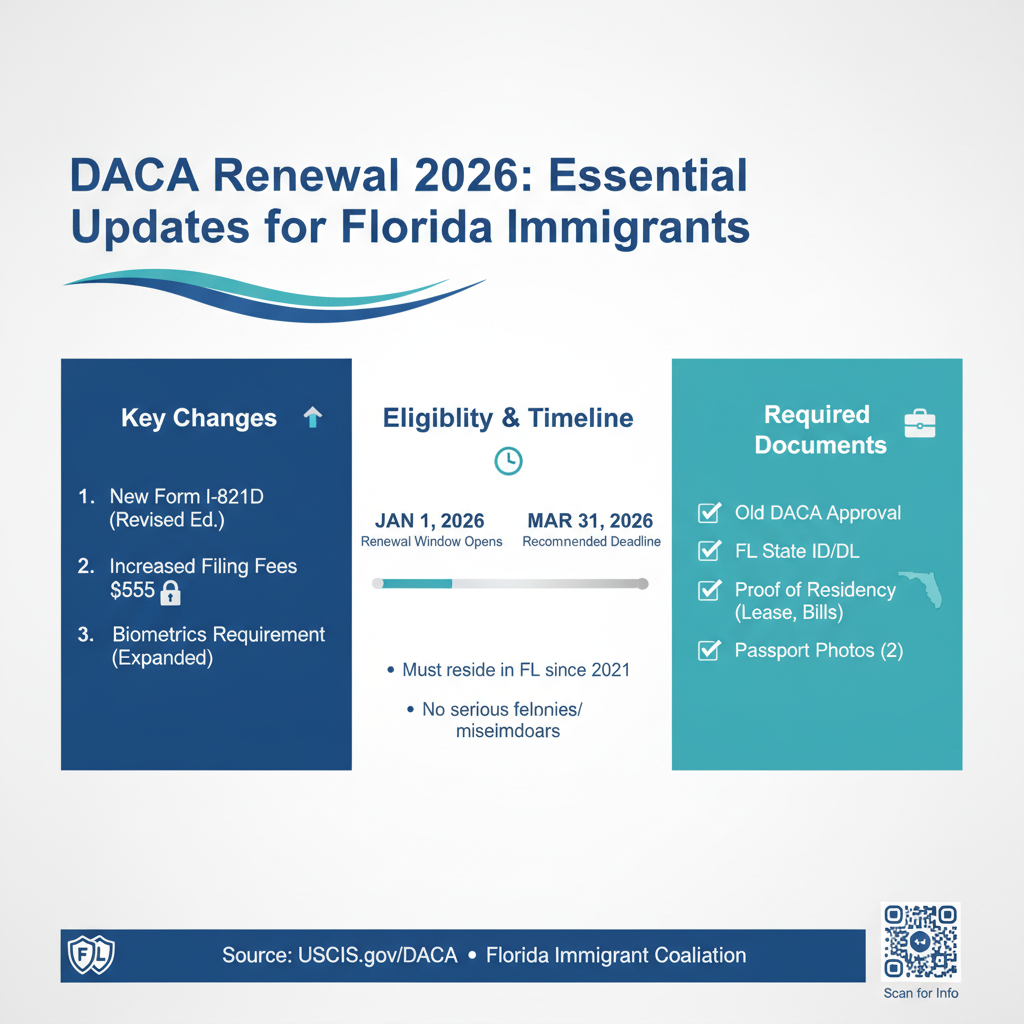
Recent activity and clarifications from the United States Citizenship and Immigration Services (USCIS) regarding the DACA program have again brought this vital policy into the spotlight. While the core tenets of DACA remain under legal scrutiny, USCIS has continued to process renewal applications and issue guidance, making it imperative for eligible individuals to understand the current requirements and procedures. This guide is built upon the latest information emanating from official USCIS communications, emphasizing the ongoing importance of timely and accurate renewals. For more details on the latest immigration news, you can refer to general updates on DACA Program Updates and Renewal Information (USCIS).
What This News Means for Immigrants in Orlando and Across Florida
For DACA recipients and their families, any news from USCIS concerning the program can be a source of both hope and anxiety. As of October 14, 2026, the DACA program continues to operate under existing federal court orders, meaning USCIS is accepting and processing DACA renewal requests. New initial DACA applications, however, generally remain on hold due to ongoing litigation. This distinction is critical for understanding what actions you can and cannot take right now.
Why this news is showing up now
The DACA program, first established in 2012, has faced numerous legal challenges and policy changes over the years. The "news" we are seeing now often stems from USCIS issuing updated policy guidance, reminding applicants of renewal procedures, or responding to court orders. These updates are a constant feature of DACA's operational environment, reflecting the program's unique position within U.S. immigration law. They serve as a crucial reminder for current DACA recipients to remain vigilant about their renewal deadlines and ensure continuous protection from deportation and work authorization.
How it can affect Florida residents
Florida is home to a significant population of DACA recipients, many of whom reside in and around the Orlando metropolitan area. For these individuals, the ability to renew their DACA status directly impacts their daily lives, including their capacity to work legally, pursue higher education, and obtain a driver's license. Without timely renewal, DACA recipients in Florida face the risk of losing their employment authorization, deferral of removal, and potentially their ability to drive legally. This can disrupt families, careers, and educational paths, underscoring the urgency of understanding and following the renewal process meticulously. For Central Florida residents, staying connected with local immigration resources and legal counsel is particularly vital to navigate these federal updates within a state-specific context.
Need Help? Our Orlando immigration team is ready to assist. Call +1 786-791-3106 for a free consultation, or message us online. Se Habla Español.
What DACA Is (and Why It Matters)
To truly understand the importance of DACA updates, it’s crucial to grasp what the program entails and its profound impact on individuals and communities.
A plain-English definition
DACA, or Deferred Action for Childhood Arrivals, is a U.S. immigration policy that allows certain undocumented immigrants who entered the country as minors to receive a renewable two-year period of deferred action from deportation and to be eligible for a work permit. It does not provide a path to lawful permanent residency (a "green card") or U.S. citizenship. Instead, it offers temporary protection from deportation and the ability to work legally in the U.S., allowing recipients to live, work, and contribute more fully to American society without constant fear of removal.
Key terms you need to know
- Deferred Action: This is a discretionary determination by USCIS to defer removal action against an individual. It does not confer lawful status, but it means the government agrees not to deport you for a specific period.
- DACA Recipient: An individual who has been granted Deferred Action for Childhood Arrivals.
- Employment Authorization Document (EAD): Often referred to as a "work permit," this card (Form I-766) allows DACA recipients to legally work in the United States for the period of their deferred action.
- Lawful Presence: While DACA does not grant lawful status, it does grant a period of lawful presence for immigration purposes, which can be relevant in certain contexts (e.g., for some state benefits or travel with advance parole).
- Advance Parole: A travel document (Form I-131) that allows certain non-citizens, including some DACA recipients, to travel abroad and return to the U.S. without jeopardizing their immigration status. Important: As of the latest court rulings, USCIS is generally not granting advance parole for DACA recipients except in very limited, humanitarian circumstances. Always consult an attorney before considering travel abroad.
- USCIS: United States Citizenship and Immigration Services, the federal agency responsible for administering the DACA program and other immigration benefits.
Understanding these terms is fundamental to navigating the DACA program and any related updates. For non-lawyers, the distinction between "lawful presence" and "lawful status" is particularly important; DACA provides the former but not the latter, meaning it is not a direct path to a green card.
Current Immigration Law: The Foundation for DACA
DACA operates within the broader framework of U.S. immigration law, primarily through executive discretion rather than specific legislation passed by Congress. This is why the program has been subject to continuous legal challenges and policy shifts.
The authority for DACA stems from the executive branch's inherent discretion to set enforcement priorities and grant "deferred action" on a case-by-case basis. This discretion is rooted in federal statutes like the Immigration and Nationality Act (INA), which grants the Secretary of Homeland Security broad authority to administer immigration laws. However, DACA itself is not a statute; it's a policy. This distinction is crucial because it means DACA's existence is more vulnerable to changes in administration policy and judicial review than a congressionally enacted law.
Currently, the DACA program is operating under the terms of a federal court injunction. This injunction generally allows USCIS to accept and process renewal requests from individuals who were previously granted DACA. However, it prohibits USCIS from granting initial DACA requests (those from individuals who have never received DACA before). The legal battles continue, and the ultimate fate of DACA remains uncertain, making vigilance and timely renewals paramount for existing recipients.
Federal requirements for DACA renewal
To be eligible for DACA renewal, you must meet several federal criteria, which largely mirror the original DACA requirements. As of October 2026, USCIS requires applicants to demonstrate they:
- Were under the age of 31 as of June 15, 2012.
- Came to the United States before reaching your 16th birthday.
- Have continuously resided in the United States since June 15, 2007, up to the present time.
- Were physically present in the United States on June 15, 2012, and at the time of making your request for deferred action with USCIS.
- Had no lawful status on June 15, 2012.
- Are currently in school, have graduated or obtained a certificate of completion from high school, have obtained a General Education Development (GED) certificate, or are an honorably discharged veteran of the Coast Guard or Armed Forces of the United States.
- Have not been convicted of a felony, a significant misdemeanor, or three or more other misdemeanors, and do not otherwise pose a threat to national security or public safety.
- Have not departed the United States on or after August 15, 2012, without first obtaining advance parole.
Important: Even if you meet these criteria, DACA is a discretionary benefit. USCIS reviews each case individually, and certain factors, such as criminal history or national security concerns, can lead to denial. It's vital to be completely truthful and provide all requested information.
Florida-specific considerations for DACA recipients
While DACA is a federal program, its impact on recipients can vary by state. In Florida, DACA recipients face specific considerations:
- Driver's Licenses: DACA recipients in Florida can apply for a Florida driver's license upon receiving their Employment Authorization Document (EAD). Renewing your DACA and EAD on time is crucial to maintain your driving privileges.
- In-State Tuition: For many years, DACA recipients in Florida were largely ineligible for in-state tuition at public universities and colleges. However, recent changes and interpretations have provided some pathways for DACA recipients who meet specific residency requirements to qualify for in-state tuition. This area can be complex and depends on the specific institution and individual circumstances. It's advisable to check with the financial aid or admissions office of your target institution.
- Professional Licenses: The ability to obtain professional licenses (e.g., nursing, teaching, real estate) for DACA recipients in Florida often depends on the specific licensing board and its requirements, as well as the federal work authorization provided by DACA.
- Access to Services: While DACA provides work authorization, it does not confer eligibility for most federal public benefits. Access to state or local services in Florida can also vary.
Staying current with both federal DACA updates and Florida state policies is key for DACA recipients in cities like Orlando. The Orlando USCIS Field Office primarily handles interviews and biometrics for residents in Orange County and surrounding Central Florida areas. Their local policies and procedures might affect appointment scheduling, though the core DACA application is processed nationally.
For DACA renewal, you will primarily use Form I-821D (Consideration of Deferred Action for Childhood Arrivals), Form I-765 (Application for Employment Authorization), and Form I-765WS (Worksheet for Form I-765). Always download the latest versions directly from the USCIS Forms page on the USCIS official website.
Navigating DACA renewal can be daunting. Don't risk your future. Imigrar offers experienced legal guidance for DACA recipients in Orlando and across the nation. Call +1 786-791-3106 today for your free consultation. Se Habla Español.
How to Renew Your DACA: A Complete Step-by-Step Guide
Renewing your DACA is a critical process that requires precision and attention to detail. Missing deadlines or submitting incomplete information can lead to significant delays or even denial, jeopardizing your deferred action and work authorization. Follow this step-by-step guide carefully.
1) Understand the Renewal Window and Eligibility
The most crucial aspect of DACA renewal is timing. USCIS recommends filing your renewal application between 120 and 150 days before your current DACA and EAD expire. Filing too early (more than 150 days) may result in your application being rejected. Filing too late (less than 120 days) risks a lapse in your work authorization and deferred action, which can have severe consequences, including potential loss of employment and even a period of unlawful presence, though DACA recipients are not generally considered to accrue unlawful presence. If your DACA has already expired, you should still apply for renewal as soon as possible. If it expired more than a year ago, or if your previous DACA was terminated, you may need to file as an "initial" request, which, as noted, is currently generally not being accepted by USCIS.
Key Documents for this step:
- Your current Employment Authorization Document (EAD) (Form I-766)
- Your previous DACA approval notice (Form I-797)
2) Gather All Required Documents
While renewal typically requires less extensive documentation than an initial application, you must still provide evidence to support your ongoing eligibility. This includes updated identity documents and proof of continuous residence and clean criminal record.
Required Documents (General):
- Copies of your previous DACA approval notices (Form I-797).
- Copies of all previous Employment Authorization Documents (EADs).
- Proof of identity (e.g., copy of your birth certificate with translation, passport, national identity card from your country of origin, school ID with photo).
- Two passport-style photos taken within 30 days of filing. Write your A-Number on the back lightly in pencil.
- Proof of continuous residence since your last DACA approval (e.g., school transcripts, employment records, utility bills, bank statements, medical records, tax returns, rental agreements). This is especially important if you have changed addresses or jobs.
- Any updated criminal history records, if applicable (e.g., certified court dispositions for any arrests or citations since your last DACA approval). Even minor infractions must be disclosed.
Warning: Do not send original documents unless specifically requested by USCIS. Send clear, legible copies. If documents are not in English, they must be accompanied by a complete English translation and a certification by the translator.
3) Complete the Necessary Forms Accurately
You will need to complete three forms for DACA renewal:
- Form I-821D, Consideration of Deferred Action for Childhood Arrivals: This is the primary form for DACA. Fill it out completely and accurately. Pay close attention to sections asking about your criminal history and travel outside the U.S.
- Form I-765, Application for Employment Authorization: This form requests your work permit. For DACA renewals, you will typically check box "c)(33)" for eligibility.
- Form I-765WS, Worksheet for Form I-765: This worksheet helps USCIS determine if you have an economic need to work. You must complete it to show why you need an EAD.
Reminder: Always use the latest versions of these forms from the USCIS Forms page. Instructions often change, and using an outdated form can lead to rejection.
4) Prepare Supporting Evidence
Beyond the primary forms, you must include supporting evidence. Organize your documents clearly. If you have any arrests or citations since your last DACA approval, you must include certified court dispositions for each incident, even if charges were dismissed or expunged. Failure to disclose any interaction with law enforcement can lead to serious consequences, including denial and potential removal proceedings.
Specific Evidence to Consider:
- Updated proof of education or employment.
- Letters from employers or schools.
- Any documents showing changes in your life circumstances that might affect your eligibility or demonstrate your continued positive contributions.
5) Pay the Required Fees
As of October 2026, the total fee for a DACA renewal application is $495. This includes the $410 fee for Form I-765 (Application for Employment Authorization) and the $85 biometrics services fee. There is no separate fee for Form I-821D. USCIS does not generally accept fee waivers for DACA applications.
Payment Options:
- Personal check, cashier's check, or money order payable to "U.S. Department of Homeland Security." Do not use abbreviations.
- Credit card using Form G-1450, Authorization for Credit Card Transactions.
Important: Ensure your payment amount is correct. Incorrect fees are a common reason for application rejection.
6) Submit Your Application Package
Once all forms are completed, documents gathered, and fees prepared, assemble your application package. Follow the specific mailing instructions on the USCIS website for where to file your DACA renewal application. The filing address depends on the state you reside in. For Florida residents, your application will typically go to a USCIS Lockbox facility.
Submission Tips:
- Make a complete copy of your entire application package for your records before mailing.
- Mail your application using a service that provides tracking and delivery confirmation (e.g., USPS Certified Mail with Return Receipt, FedEx, UPS).
- Do not staple documents together; use binder clips.
- Organize documents in the order specified in the USCIS instructions or in a logical manner (e.g., forms first, then photos, then supporting documents).
7) What to Expect After Submission
After mailing your application, you will typically receive several notices from USCIS:
- Receipt Notice (Form I-797C): Within a few weeks, you should receive a receipt notice confirming that USCIS has received your application. Keep this safe.
- Biometrics Appointment Notice: Shortly after, you will receive a notice for a biometrics appointment at an Application Support Center (ASC). For Orlando residents, this would likely be at the Orlando USCIS Field Office or another nearby ASC. You must attend this appointment to have your fingerprints, photograph, and signature taken.
- Potential Request for Evidence (RFE): USCIS may send an RFE if they need additional information or clarification. Respond promptly and thoroughly.
- Approval or Denial Notice: Eventually, you will receive a decision. If approved, you will receive a new DACA approval notice and your new EAD card.
You can check the status of your case online using the receipt number provided by USCIS on the USCIS Case Status Online tool. Processing times can vary, so monitor them on the USCIS Processing Times page.
Practical Steps You Can Take Today for DACA Renewal
Proactive preparation is your best defense against delays and potential issues with your DACA renewal. Here’s an actionable checklist:
Actionable Checklist:
- Check Your Expiration Date: Immediately locate your current DACA approval notice and EAD card. Note the expiration dates. Mark your calendar for the 150-day and 120-day windows before expiration.
- Start Gathering Documents: Don't wait until the last minute. Begin collecting all necessary identity documents, proof of continuous residence, and any updated criminal history records (certified court dispositions).
- Update Your Address with USCIS: If you've moved since your last DACA application, file Form AR-11, Alien's Change of Address Card, online or by mail with USCIS within 10 days of moving. This ensures you receive all important notices.
- Review Your Previous Application: If possible, review a copy of your last DACA application to ensure consistency in your answers and to identify any changes in your circumstances.
- Consult an Attorney: Especially if you have had any arrests, received traffic citations, traveled outside the U.S., or have any other complex issues, consult an experienced immigration attorney. An attorney can help identify potential issues and ensure your application is submitted correctly.
Document Preparation Guidance
- Organization: Create a folder (physical and/or digital) for all your DACA-related documents. Keep them organized by type (e.g., identity, residence, criminal records).
- Copies: Always make high-quality photocopies of every document you submit. Never send originals unless explicitly requested.
- Translations: If a document is not in English, you must provide a full English translation along with a certification from the translator stating that they are competent to translate from the foreign language into English and that the translation is complete and accurate.
- Proof of Continuous Residence: Think broadly about what constitutes proof. This can include school records, medical bills, tax returns, pay stubs, bank statements, rental agreements, utility bills, and even letters from religious leaders or community organizations. For Central Florida residents, local records from Orange County or surrounding areas are perfectly acceptable.
Timeline Expectations
USCIS processing times for DACA renewals can fluctuate. While the goal is typically to process renewals within a few months, it's not uncommon for it to take longer. You can monitor average processing times for Form I-821D and Form I-765 on the USCIS Processing Times website. Remember, the 120-150 day window is crucial for avoiding a lapse in your work authorization. Plan to submit your application well within this period to allow for potential delays.
How Imigrar Helps DACA Recipients in Orlando and Beyond
At Imigrar, we understand the profound significance of DACA for individuals and families in Orlando and across the nation. Our firm is founded on the principle of "Keep Families Together," and we recognize that DACA is a vital tool in achieving that mission for many.
Our experience and expertise
Our team of experienced immigration attorneys has a deep understanding of DACA policy, its legal challenges, and the intricacies of the renewal process. We stay up-to-date on all USCIS guidance and federal court rulings affecting DACA, ensuring that our clients receive the most current and accurate advice. We have successfully assisted numerous DACA recipients, guiding them through the renewal process, addressing complex eligibility issues, and helping them prepare strong, complete applications. Whether you’re an individual living near the I-4 corridor or anywhere in Florida, our remote capabilities allow us to serve you effectively.
Free consultation offer
We believe that everyone deserves access to quality legal advice. That’s why Imigrar offers a free, no-obligation consultation for DACA recipients. During this consultation, you can discuss your specific situation, ask questions about the renewal process, and receive personalized advice from an attorney. We can assess your eligibility, review potential challenges, and outline a clear path forward for your DACA renewal.
Se Habla Español. Our team is fully bilingual, ensuring that Spanish-speaking clients feel comfortable and understood throughout their legal journey. We are here to bridge the language barrier and provide clear communication every step of the way.
Don't let DACA renewal complexities overwhelm you. Imigrar is here to help keep your family's future secure. Contact our Orlando office today for a free consultation. Call +1 786-791-3106 or reach out online. Se Habla Español.
Frequently Asked Questions About DACA Renewal
Q: What if my DACA has already expired? Can I still renew it?
A: If your DACA has expired, you should file for renewal as soon as possible. USCIS generally accepts renewal applications even if your previous DACA expired more than a year ago. However, if your DACA expired over a year ago, or if your previous DACA was terminated at any point, USCIS will treat your application as an "initial" request. As of the current court injunctions, USCIS is generally not processing "initial" DACA applications. It is crucial to consult with an immigration attorney immediately if your DACA has expired to understand the most current guidelines and your specific options.
Q: Does renewing DACA put me on a path to a green card or U.S. citizenship?
A: No, DACA itself does not provide a direct path to a green card (lawful permanent residency) or U.S. citizenship. It offers temporary protection from deportation and work authorization. However, some DACA recipients may become eligible for other immigration benefits through different avenues, such as marriage to a U.S. citizen or a qualifying employment-based petition, especially if they entered the U.S. with inspection or obtained advance parole and lawfully re-entered. These situations are highly complex and require consultation with an experienced immigration attorney.
Q: How long does DACA renewal take, and what if my EAD expires during processing?
A: DACA renewal processing times vary, but USCIS generally aims to process applications within a few months. You can check current processing times on the USCIS Processing Times website. If your EAD expires while your renewal application is pending, you will temporarily lose your authorization to work until the new EAD is approved and issued. This is why filing within the 120-150 day window is so important to minimize the risk of a lapse.
Q: What documents do I need to prove continuous residence for DACA renewal?
A: To prove continuous residence since your last DACA approval, you can submit a variety of documents, including school records (transcripts, report cards), employment records (pay stubs, W-2s, employment verification letters
Related Topics
Need Legal Assistance?
Our experienced immigration attorneys are here to help with your case. Contact Imigrar today for a free consultation and let us guide you through the legal process with confidence.
📍 Orlando, Florida • Serving clients nationwide
📧 info@imigrar.com