
Ace Your Green Card Interview: Imigrar's Ultimate Prep Guide
Prepare for your Green Card interview with confidence. This guide from Imigrar, Orlando's trusted immigration firm, offers step-by-step advice, document checklists, and expert tips to ensure success.

The journey to obtaining a Green Card, also known as lawful permanent residency, is a pivotal moment for many immigrants seeking to build a life in the United States. While the application process itself can be complex, the Green Card interview is often the most anticipated and nerve-wracking stage. This interview provides U.S. Citizenship and Immigration Services (USCIS) with the opportunity to verify the information in your application, confirm your eligibility, and ensure you meet all legal requirements for permanent residency. Proper preparation is not just recommended; it is essential for a successful outcome.
Need Help Preparing for Your Green Card Interview? Don't face it alone. Our experienced Orlando immigration team at Imigrar is ready to assist you every step of the way. Call +1 786-791-3106 for a free consultation, or message us online. Se Habla Español.
The reporting that sparked this guide: Green Card Interview Preparation Tips (Immigration Law)
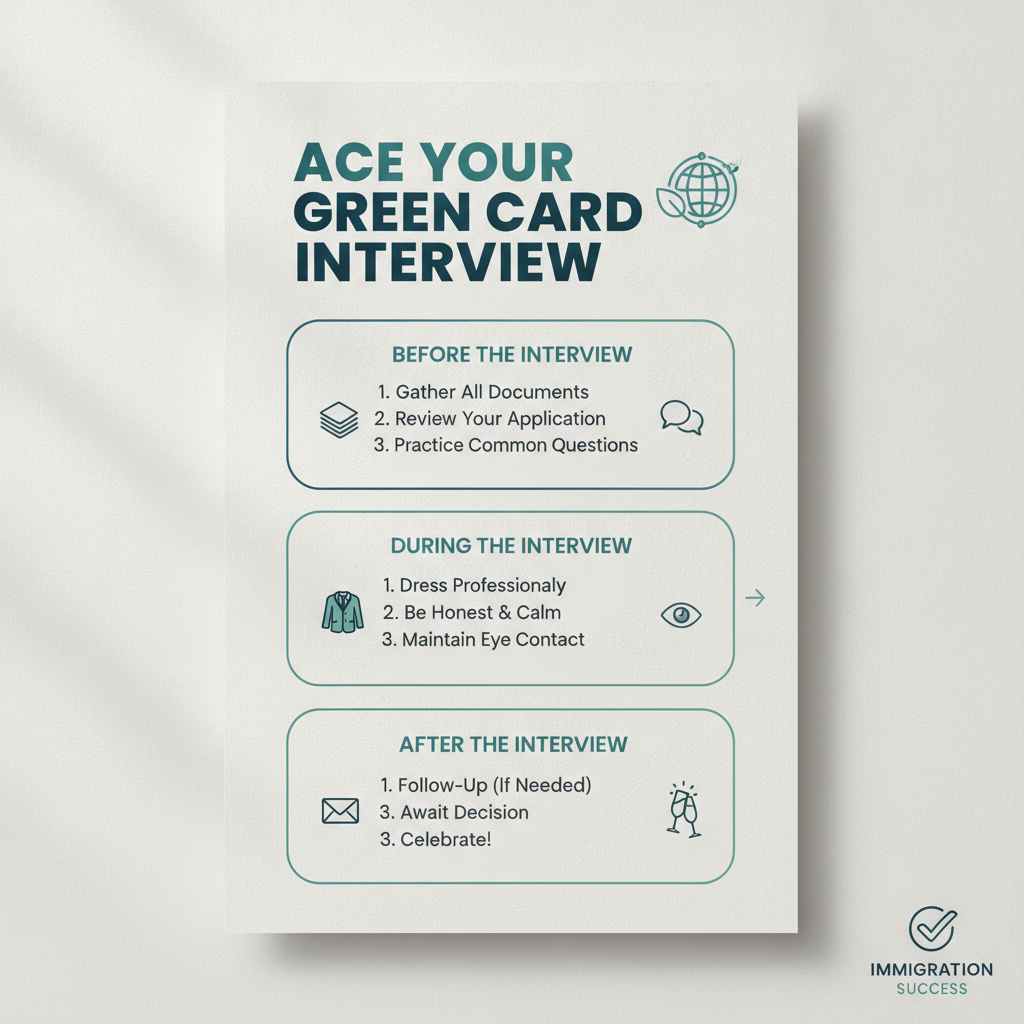
Recent discussions and articles within immigration law circles, highlighted by sources like Immigration Law news feeds, consistently emphasize the critical importance of thorough preparation for Green Card interviews. While the fundamental requirements for these interviews remain largely consistent, the evolving landscape of immigration enforcement and policy can introduce nuances in how interviews are conducted and what aspects USCIS officers prioritize. This ongoing focus on interview preparation underscores the need for applicants to be well-informed and meticulously organized. Our comprehensive guide is designed to empower you with the knowledge and tools necessary to navigate your interview with confidence, ensuring you are fully prepared for the questions and document requirements that lie ahead.
What This News Means for Immigrants in Orlando and Across Florida
For individuals and families pursuing permanent residency, particularly those undergoing the Adjustment of Status process from within the United States, the Green Card interview is a critical hurdle. The emphasis on preparation in immigration news is not just a general advisory; it’s a direct call to action for every applicant.
Why this news is showing up now
The focus on Green Card interview preparation is perennial, but its prominence often increases due to several factors. Firstly, USCIS continues to refine its interview procedures, sometimes introducing new lines of inquiry or placing greater scrutiny on specific types of cases, such as marriage-based petitions, to combat fraud. Secondly, the sheer volume of applications means that officers are often pressed for time, making a well-prepared applicant crucial for an efficient process. Furthermore, as technology advances, USCIS has greater access to background information, meaning any inconsistencies in an application or during an interview can be more easily flagged. Finally, with the increasing complexity of immigration law, individuals often seek clearer guidance, making "how-to" content for interviews highly relevant and sought after.
How it can affect Florida residents
For Florida residents, particularly those in Central Florida like Orlando, Kissimmee, and surrounding areas, this news is particularly relevant. The Orlando USCIS Field Office is one of the busiest in the country, handling a significant volume of Adjustment of Status interviews. This means:
- Increased Scrutiny: With high volume, officers strive for efficiency but also maintain rigorous standards. Being unprepared can lead to delays, requests for additional evidence (RFE), or even denials.
- Local Procedures: While federal law governs the process, individual field offices can have slight procedural variations. Knowing what to expect at the Orlando office, including typical interview styles and common questions, can be a significant advantage.
- Diverse Caseloads: Florida's diverse population means the Orlando office handles a wide array of cases, from family-based petitions to employment-based applications. Each type of case has unique interview considerations.
- Accessibility to Legal Counsel: Having experienced legal counsel familiar with the Orlando USCIS Field Office can provide invaluable insight and support, ensuring local nuances are addressed.
Understanding the importance of this stage and preparing diligently can significantly impact the outcome of your Green Card application, helping you avoid common pitfalls and move closer to achieving your dream of permanent residency in Florida.
What a Green Card Interview Is (and Why It Matters)
The Green Card interview is a formal meeting with a USCIS officer (or a Consular Officer if you are applying through Consular Processing abroad) to determine your eligibility for lawful permanent residency in the United States. It's not just a formality; it's a crucial step where the government verifies the truthfulness of your application, confirms you meet all legal requirements, and assesses your admissibility to the U.S.
A plain-English definition
Think of the Green Card interview as your opportunity to tell your story and provide proof directly to the government official who will decide your case. It’s where you, and your petitioner if applicable, sit down with an officer to answer questions about your application, your background, and the basis of your eligibility (e.g., your marriage, your job offer, your family relationship). The officer wants to confirm that everything you've stated in your forms is accurate and that you genuinely qualify for a Green Card under U.S. immigration law. It's a chance to clear up any ambiguities and present yourself as a credible applicant.
Key terms you need to know
- Green Card: The informal name for a U.S. Permanent Resident Card, which proves you have been granted authorization to live permanently in the United States.
- Lawful Permanent Resident (LPR): The official status granted to Green Card holders.
- USCIS (U.S. Citizenship and Immigration Services): The government agency responsible for processing immigration petitions and applications, including Green Cards. Their official website is a primary resource.
- Adjustment of Status (AOS): The process of applying for a Green Card while physically present in the United States. This typically involves filing Form I-485.
- Consular Processing: The process of applying for a Green Card through a U.S. embassy or consulate in your home country.
- Petitioner: The U.S. citizen or lawful permanent resident who files an immigrant petition on behalf of a foreign national (e.g., a spouse filing for their husband/wife).
- Beneficiary: The foreign national who is seeking immigration benefits based on a petition filed by another person.
- Sponsor/Joint Sponsor: The individual (often the petitioner) who signs an Affidavit of Support (Form I-864), pledging financial support for the immigrant.
- Affidavit of Support (Form I-864): A legally binding document signed by a sponsor, committing to support the immigrant financially to ensure they do not become a "public charge."
- Priority Date: The date your immigrant petition (e.g., Form I-130, Form I-140) was filed with USCIS. This date determines your place in the visa queue for certain categories.
- Request for Evidence (RFE): A letter from USCIS asking for more documentation or information to support your application.
- Notice of Intent to Deny (NOID): A letter from USCIS indicating their intention to deny your application unless you provide specific information or evidence to overcome the grounds for denial.
Confused by immigration jargon? Imigrar simplifies the process. Our Orlando-based legal team offers clear guidance in English and Spanish. Contact us at +1 786-791-3106 for a free consultation. Se Habla Español.
Current Immigration Law: The Foundation
The Green Card interview process is rooted in the Immigration and Nationality Act (INA), which is the body of law governing immigration to the United States. Understanding the legal framework is crucial for appreciating why certain questions are asked and why specific documents are required.
Federal requirements
Most Green Card applications fall under a few primary categories, each with specific legal requirements:
- Family-Based Immigration: Governed by sections of the INA such as INA § 201, INA § 203(a), and INA § 204. These sections define who can petition for whom (e.g., U.S. citizens for spouses, children, parents, siblings; LPRs for spouses and unmarried children) and establish preference categories. The petitioner typically files Form I-130, Petition for Alien Relative.
- Employment-Based Immigration: Governed by INA § 203(b), which outlines various preference categories for workers, from individuals with extraordinary ability to skilled workers and professionals. This usually begins with Form I-140, Immigrant Petition for Alien Worker.
- Adjustment of Status (AOS): The primary legal basis for applying for a Green Card from within the U.S. is INA § 245. This section allows eligible non-citizens to adjust their status to lawful permanent resident without having to leave the country. Eligibility often depends on lawful entry and maintaining lawful status, though exceptions exist for immediate relatives of U.S. citizens. The application is typically made using Form I-485, Application to Register Permanent Residence or Adjust Status.
- Admissibility Grounds: A fundamental aspect of all Green Card applications is demonstrating that the applicant is "admissible" to the United States. INA § 212(a) lists various grounds of inadmissibility, including health-related grounds, criminal grounds, security and related grounds, public charge, and misrepresentation. During the interview, the USCIS officer will be assessing whether any of these grounds apply to you.
- Public Charge Rule: A significant consideration, particularly for family-based immigrants, is the "public charge" rule under INA § 212(a)(4). This rule requires applicants to demonstrate they are not likely to become primarily dependent on the government for subsistence. This is primarily addressed through the Affidavit of Support (Form I-864), where a sponsor pledges financial support.
All forms and detailed instructions can be found on the USCIS Forms page on the USCIS official website.
Florida-specific considerations
While federal law applies nationwide, how it is implemented can have local nuances. For individuals in Florida, specifically those attending interviews at the Orlando USCIS Field Office (located at 6680 Corporate Centre Blvd, Orlando, FL 32822) or other Florida field offices:
- Local Caseload: The Orlando office handles a high volume of family-based petitions, particularly marriage-based Green Cards, given the large and diverse population of Central Florida. Officers are highly experienced in these types of cases and are adept at identifying inconsistencies.
- Interview Environment: Be prepared for a professional, yet often fast-paced, interview environment. The officers are generally courteous but focused on verifying facts.
- Common RFEs: In Florida, common RFEs might relate to insufficient proof of a bona fide marriage (for marriage-based cases), incomplete financial documentation (Form I-864), or gaps in an applicant's legal status history.
- Attorney Presence: Having an attorney present at your interview, especially in a busy office like Orlando, can provide comfort, ensure fair procedure, and help address any unexpected issues promptly.
Reminder: Staying informed about current processing times for the Orlando Field Office is also critical. You can check these at USCIS Processing Times.
How to Prepare for Your Green Card Interview: A Complete Step-by-Step Guide
Preparing for your Green Card interview is paramount to a successful outcome. This comprehensive guide will walk you through the essential steps to ensure you are ready.
1) Understand Your Case Type and the Purpose of the Interview
Before anything else, understand the specific basis of your Green Card application (e.g., marriage to a U.S. citizen, employment, asylum). The type of case dictates the focus of the interview. For marriage-based Green Cards, the interview's primary purpose is to verify the authenticity of your marriage. For employment-based cases, it's to confirm your qualifications and the legitimacy of the job offer. For all cases, USCIS also assesses your general admissibility to the U.S.
- Action: Review your original petition (e.g., Form I-130, Form I-140) and your Form I-485. Understand the legal arguments and facts presented.
- Key Documents to Review:
- Original Immigrant Petition (e.g., Form I-130, Form I-140)
- Form I-485, Application to Register Permanent Residence or Adjust Status
- Any previous RFEs or responses
- Your spouse’s (petitioner’s) information if applicable
2) Gather and Organize All Original Documents (and Copies)
This is perhaps the most critical step. You must bring all original documents related to your application, along with a complete set of photocopies. USCIS officers will often ask to see originals and may keep the copies for their file.
- General Required Documents for ALL Applicants:
- Interview Appointment Notice (Form I-797C)
- Passport(s) (valid and expired)
- Birth Certificate(s)
- Marriage Certificate(s) (if applicable)
- Divorce Decree(s) or Death Certificate(s) for any prior marriages (for both applicant and petitioner, if applicable)
- Medical Examination Report (Form I-693) in a sealed envelope (if not already submitted or if it has expired)
- Form I-94, Arrival/Departure Record (if you entered legally)
- Two passport-style photos (taken within 30 days of the interview)
- All original immigration forms filed (e.g., Form I-130, Form I-485, Form I-864, Form I-765, Form I-131)
- Original criminal records, court dispositions, police reports (if any arrests or convictions)
- Proof of financial support: Original Form I-864, Affidavit of Support (signed by your sponsor), sponsor's recent tax returns (federal, not state), W-2s, employment verification letter, pay stubs, bank statements.
- Specific Documents for Marriage-Based Green Cards (to prove a bona fide marriage):
- Joint Financial Documents: Joint bank accounts, joint credit card statements, joint tax returns, joint utility bills, joint mortgage/lease agreements.
- Joint Property: Deed or lease for joint property, vehicle titles with both names.
- Insurance Policies: Health, life, auto insurance policies listing each other as beneficiaries.
- Children's Birth Certificates: If you have children together.
- Photos: Wedding photos, photos with family and friends over time, travel photos.
- Correspondence: Cards, letters, emails, text messages exchanged (selectively, not all).
- Affidavits from Friends/Family: Letters from people who know your relationship, notarized.
- Any other evidence proving you share a life together.
- For Employment-Based Green Cards:
- Original job offer letter, employment verification letter.
- Educational degrees, transcripts, certifications relevant to the petition.
- Professional licenses.
- Letters of recommendation.
- Evidence of extraordinary ability (if applicable, e.g., awards, publications).
- Organization Tip: Use a binder with dividers and labels for each category of documents. This makes it easy to find specific items when the officer asks.
3) Review Your Application Forms Thoroughly
You will be questioned about every detail in your submitted forms. Any discrepancy, no matter how minor, can raise red flags. It is crucial to know exactly what you submitted.
- Action: Read through your entire application package – Form I-130, Form I-485, and all supporting documents – multiple times. Pay attention to dates, addresses, employment history, and travel history.
- Self-Correction: If you find any errors or omissions, notify your attorney immediately. You may need to prepare an errata sheet to present at the interview, or your attorney may advise you on how to address it. Honesty is key.
4) Prepare for Interview Questions
Anticipate the types of questions you might be asked. The questions will vary based on your case type but generally aim to verify information and assess admissibility.
- General Questions:
- Confirming personal details: Name, date of birth, place of birth, parents' names.
- Immigration history: How you entered the U.S., previous visas, past applications, travel history.
- Criminal history: Any arrests, charges, convictions (even if expunged).
- Admissibility questions: Questions related to grounds of inadmissibility (public charge, security, health, misrepresentation).
- Marriage-Based Questions (for both spouses, often separately):
- How and where did you meet?
- When and where was your first date?
- What did you do on your first date?
- Who proposed, and how?
- Details about your wedding (date, location, guests).
- Where do you live? What does your home look like?
- Details about daily life: What did you have for breakfast? Who cooks? What side of the bed do you sleep on?
- Financial habits: Who pays bills? Do you have joint accounts?
- Family and friends: Do you know each other's families?
- Previous relationships and children.
- Practice: Have a trusted friend, family member, or your attorney conduct a mock interview with you. Practice answering clearly, concisely, and truthfully.
5) Practice Your English (if needed) and Interview Demeanor
While you have the right to an interpreter, demonstrating some English proficiency can often streamline the interview. Your demeanor also plays a significant role.
- Language: If you are not fluent in English, bring an official, certified interpreter. Do not rely on a family member or friend unless specifically approved by USCIS. Your attorney can often act as your interpreter.
- Demeanor:
- Be polite and respectful to the officer.
- Listen carefully to each question. If you don't understand, ask for clarification.
- Answer truthfully and directly. Do not volunteer extra information unless asked.
- Maintain eye contact.
- Avoid fidgeting or appearing nervous, though a little nervousness is understandable.
- Dress professionally, as you would for a job interview.
6) Consult with an Experienced Immigration Attorney
This step is highly recommended, especially for complex cases or if you have any concerns about your eligibility or past history.
- Benefits of Legal Counsel:
- An attorney can review your entire application for accuracy and completeness.
- They can identify potential issues or red flags in your case and help you prepare to address them.
- They can prepare you thoroughly for questions and conduct mock interviews.
- They can attend the interview with you, providing support, clarifying questions, and ensuring your rights are protected.
- If an RFE or NOID is issued, an attorney can help you formulate a strong response.
- For Orlando residents: Choosing an immigration lawyer familiar with the Orlando USCIS Field Office can be particularly beneficial, as they understand local procedures and officer tendencies.
7) Logistics: Dress, Arrive Early, What to Expect on Interview Day
The day of the interview itself requires specific preparation.
- Dress: Wear clean, professional, and comfortable attire. First impressions matter.
- Arrival: Plan to arrive at the Orlando USCIS Field Office (or other designated location) at least 30-45 minutes before your scheduled appointment. This allows time for parking, security checks, and finding the correct waiting area. Traffic on the I-4 corridor can be unpredictable, so factor that into your travel time.
- What to Expect:
- Security: You will go through airport-style security. Leave prohibited items at home.
- Waiting Area: You will check in and wait for your name to be called.
- Officer Introduction: The officer will call your name, lead you to their office, and administer an oath to tell the truth.
- Fingerprints/Photos: In some cases, fingerprints or photos may be taken again.
- Document Review: The officer will review your original documents and compare them to the copies in your file.
- Questioning: The core of the interview. Be prepared for direct questions.
- Decision: Most often, the officer cannot give you a final decision on the spot. They will tell you the next steps, which could be an approval, an RFE, or a referral for further review.
- Typical Duration: Interviews can last anywhere from 15 minutes to over an hour, depending on the complexity of the case.
Important: Remain calm and composed throughout the interview. Your honesty and preparedness are your greatest assets.
Practical Steps You Can Take Today
Even before you receive your interview notice, you can start preparing. Here's an actionable checklist:
Actionable Checklist:
- ✅ Start a "Green Card Interview" Binder: Create a physical binder and digital folder to organize all immigration-related documents.
- ✅ Gather Core Documents: Locate original birth certificates, marriage certificates, passports, and any divorce decrees. Make copies.
- ✅ Review Your Submitted Forms: Pull out copies of your Form I-130, Form I-485, and any other forms you've filed. Read them thoroughly to refresh your memory.
- ✅ Collect Relationship Evidence (if applicable): If applying based on marriage, begin collecting joint documents (bank statements, utility bills, photos, etc.) from the date of your marriage to the present.
- ✅ Update Financial Documents: Ensure your sponsor's latest tax returns, W-2s, and employment letters are available.
- ✅ Address Any Past Issues: If you have any criminal history, consult an attorney to gather certified court dispositions. If you have had any immigration violations, prepare to discuss them honestly.
- ✅ Improve English Skills: If English is not your first language, practice speaking and understanding everyday conversations.
- ✅ Consult an Attorney: Schedule a consultation with an immigration lawyer, especially if your case has complexities or you feel unsure about any aspect of the process.
- ✅ Check USCIS Processing Times: Regularly monitor the USCIS Processing Times for the Orlando Field Office to get an idea of the waiting period after your interview.
Document Preparation Guidance
- Originals vs. Copies: Always bring originals AND a full set of photocopies. The officer will review originals and often keep the copies.
- Order and Labels: Organize your documents logically within your binder, using tabs for easy navigation (e.g., "Passports," "Birth Certificates," "Marriage Evidence," "Financial Documents").
- Translations: Any document not in English must be accompanied by a certified English translation. The translator must provide a statement attesting to their competence and the accuracy of the translation.
- Photos: For marriage-based cases, arrange photos chronologically, perhaps with captions explaining the date, location, and people in the picture.
Timeline Expectations
- Interview Notice: You typically receive an interview notice (Form I-797C) by mail 3-6 weeks before your scheduled interview date.
- Interview Day: The interview itself can range from 15 minutes to over an hour.
- Decision Post-Interview: A decision is usually not given on the spot. USCIS aims to issue a decision or an RFE within 90-120 days after the interview, but this can vary significantly based on the field office workload and case complexity. For the Orlando USCIS Field Office, it's wise to anticipate these variations.
- Green Card Delivery: If approved, your Green Card will typically be mailed within 2-3 weeks after approval.
How Imigrar Helps Immigrants in Orlando
At Imigrar, we understand the complexities and anxieties that come with the Green Card interview process. Our firm is dedicated to providing comprehensive and compassionate legal services to immigrants and their families in Orlando, Central Florida, and nationwide.
Our experience and expertise
With years of focused experience in immigration law, our team at Imigrar has successfully guided countless clients through their Green Card interviews. We are intimately familiar with the procedures, expectations, and common challenges faced at the Orlando USCIS Field Office and other offices across the country. Our expertise includes:
- Thorough Case Review: We meticulously review your entire application package to ensure accuracy and completeness, identifying and addressing any potential issues before the interview.
- Personalized Preparation Sessions: We conduct detailed interview preparation sessions, including mock interviews, tailored to your specific case type (e.g., marriage-based, employment-based). We prepare you for both common and challenging questions.
- Document Organization: We help you organize your supporting documents efficiently, ensuring you have all necessary originals and copies readily available.
- Attorney Representation: Our attorneys can accompany you to your Green Card interview, providing vital support, clarifying questions, and advocating on your behalf if unexpected issues arise.
- Post-Interview Support: Should you receive an RFE or NOID, we are prepared to help you formulate a strong and timely response.
Our tagline, "Keep Families Together," is not just a slogan; it's our mission. We are committed to helping you navigate this critical step towards securing your future in the United States.
Free consultation offer
Facing a Green Card interview can be daunting, but you don't have to do it alone. Imigrar offers a free, no-obligation consultation to discuss your specific situation, assess your needs, and outline how we can assist you. This is an opportunity to get expert advice and peace of mind.
Se Habla Español. Our team is fully bilingual, ensuring that language is never a barrier to receiving top-tier legal assistance. We are here to serve the diverse communities of Orlando, Orange County, and beyond.
Ready for your Green Card interview? Let Imigrar guide you. Call our Orlando office today at +1 786-791-3106 for a free, confidential consultation. Se Habla Español.

Frequently Asked Questions
Q: How long after I file my Green Card application will I get an interview notice?
A: The timeline varies significantly based on the type of Green Card (family-based, employment-based), your specific preference category, and the USCIS Field Office processing times. For an Adjustment of Status application (Form I-485) filed in Orlando, it can range from 8 months to over 2 years after filing your initial petition (e.g., Form I-130 or Form I-140) and your Priority Date becoming current. You can monitor average processing times on the USCIS Processing Times website by selecting the Orlando Field Office.
Q: What if I have a criminal record
Related Topics
Need Legal Assistance?
Our experienced immigration attorneys are here to help with your case. Contact Imigrar today for a free consultation and let us guide you through the legal process with confidence.
📍 Orlando, Florida • Serving clients nationwide
📧 info@imigrar.com