
Navigating H-1B Visa Lottery Changes for FY2027: Your Imigrar
Major changes have arrived for the H-1B visa lottery for Fiscal Year 2027. Understand the new beneficiary-centric USCIS rules, what they mean for your application, and how Imigrar can help secure your future in the U.S.

The landscape of U.S. immigration is constantly evolving, and for those pursuing a professional career in the United States, staying informed is paramount. At Imigrar, we understand the complexities and the high stakes involved, especially when it comes to the highly sought-after H-1B visa program.
The reporting that sparked this guide:
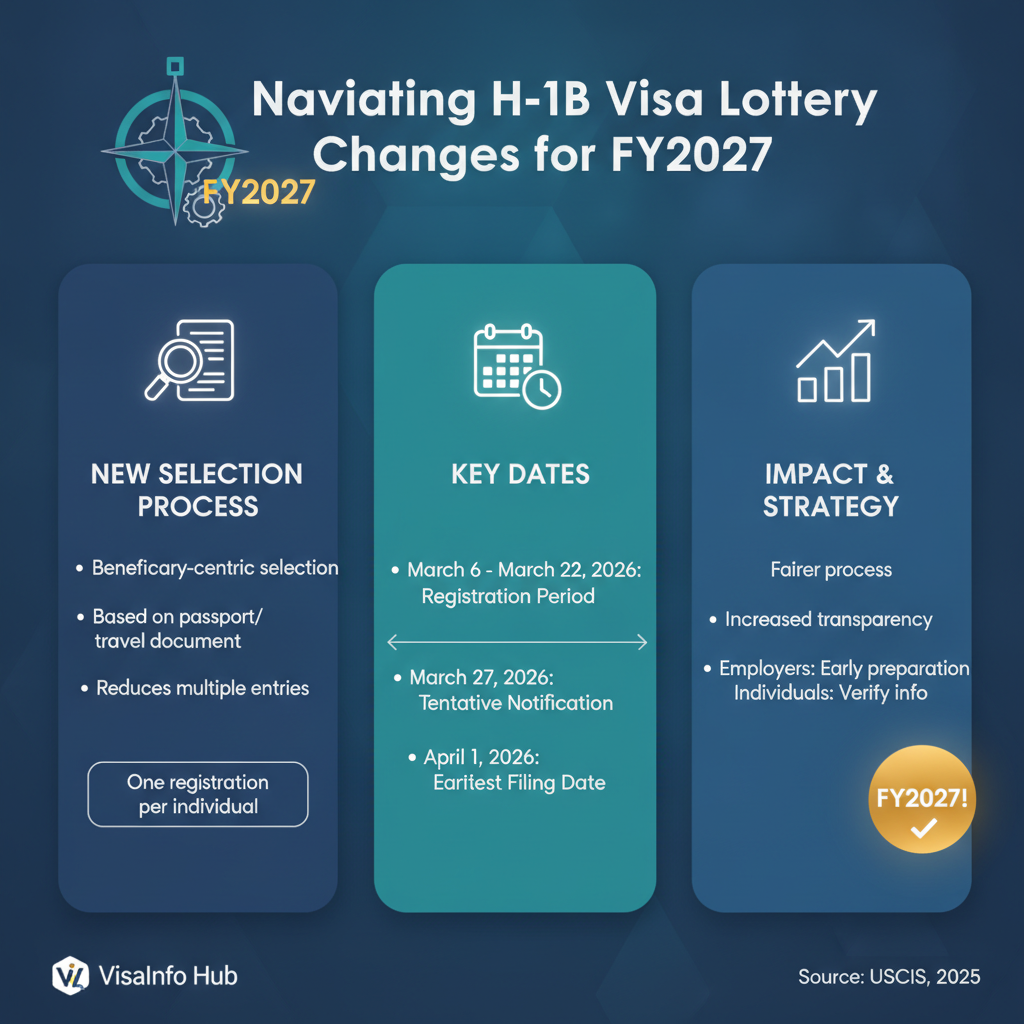
H-1B Visa Lottery Changes for FY2027 (Legal News)
This news highlights critical updates to the H-1B visa lottery process, specifically impacting the upcoming Fiscal Year 2027. These changes, primarily focused on enhancing the integrity of the lottery system, demand careful attention from both prospective H-1B beneficiaries and sponsoring employers.
Feeling overwhelmed by H-1B changes? Our Orlando immigration team specializes in complex work visa applications. Call +1 786-791-3106 for a free consultation to discuss your specific situation, or message us online. Se Habla Español.
What This News Means for Immigrants in Orlando and Across Florida
The H-1B visa program is a cornerstone for many skilled professionals seeking to work in the U.S. and for American businesses looking to fill critical talent gaps. The recent changes to the H-1B lottery process for Fiscal Year 2027 (FY2027) represent a significant shift designed to address long-standing concerns about fairness and prevent abuse of the system. For immigrants in Orlando, across Central Florida, and throughout the nation, understanding these adjustments is not just important – it's crucial for your future.
Why this news is showing up now
The U.S. Citizenship and Immigration Services (USCIS) has been actively working to enhance the integrity of the H-1B cap registration process. Following widespread reports and concerns regarding fraud and multiple registrations submitted on behalf of the same beneficiary by different employers – often without the beneficiary's full knowledge or consent – USCIS implemented a new rule. This rule, which became effective for the FY2025 cap lottery, is now firmly established and will govern the upcoming FY2027 lottery registration period, typically held in March 2026.
The core of this change is a shift from a "per registration" selection model to a "per beneficiary" selection model. This means that instead of multiple registrations increasing a single beneficiary's chances, only one registration per unique beneficiary will be entered into the lottery, regardless of how many employers offer them a job. This measure aims to level the playing field, ensuring that every eligible beneficiary has an equal chance, rather than those with multiple employer offers having an unfair advantage. USCIS finalized these rules to ensure that the H-1B program serves its intended purpose: to bring highly skilled foreign workers to fill specialty occupations in the U.S. workforce, free from manipulative practices.
How it can affect Florida residents
Florida is a vibrant hub for innovation, technology, healthcare, and tourism, drawing a diverse international talent pool. Cities like Orlando, Tampa, and Miami are home to numerous companies that rely heavily on the H-1B program to staff their specialty occupation roles. For residents of Florida, both prospective H-1B beneficiaries and their sponsoring employers, these changes have direct implications:
- For Beneficiaries in Florida: If you are a student on an F-1 visa with Optional Practical Training (OPT) in Orlando, or a professional already working in Florida on another nonimmigrant visa, you must now proactively engage with your potential H-1B sponsoring employer. You will need to decide which employer will submit your single registration for the lottery, as multiple registrations on your behalf will be invalid. This requires clear communication and trust with your employer.
- For Florida Employers: Companies in the I-4 corridor, including Orlando, that frequently sponsor H-1B visas must adapt their internal processes. They need to verify that their prospective H-1B beneficiary has not already been registered by another employer for the same fiscal year. This new rule emphasizes the importance of due diligence and direct communication with beneficiaries to avoid submitting invalid registrations, which could lead to disqualification and wasted resources.
- Increased Competition and Focus on Quality: While the rule aims for fairness, the demand for H-1B visas remains exceptionally high. Employers will likely become even more selective in who they choose to register, focusing on candidates who are a precise fit for specialty occupations and who demonstrate clear intent to work for the petitioning company.
- Need for Expert Guidance: Navigating these changes without experienced legal counsel can be perilous. Florida businesses, particularly those in Orange County and surrounding areas, will benefit from working with an immigration law firm like Imigrar to ensure compliance and maximize their chances of success under the new regulations.
The new rules underscore the importance of meticulous preparation and strategic planning for everyone involved in the H-1B process, from students graduating from Florida universities to established professionals and burgeoning tech firms.
What H-1B Visa Lottery Changes for FY2027 Is (and Why It Matters)
The H-1B visa program is a critical pathway for U.S. employers to hire foreign workers in "specialty occupations." With demand consistently outstripping supply, the annual H-1B lottery has become a high-stakes event. The changes for FY2027 are not merely procedural tweaks; they represent a fundamental shift in how the lottery is conducted, aiming to foster greater equity and integrity within the system.
A plain-English definition
The H-1B visa is a non-immigrant visa that allows U.S. employers to temporarily employ foreign workers in specialty occupations. A specialty occupation is one that requires a bachelor's degree or higher in a specific field, or its equivalent, as a minimum entry requirement. Examples include IT professionals, engineers, doctors, scientists, and architects.
Due to high demand, USCIS sets an annual cap on the number of H-1B visas issued each fiscal year. This cap is currently 65,000 visas, plus an additional 20,000 for those with a U.S. master's degree or higher (the "Master's Cap"). When the number of registrations exceeds the annual cap, USCIS conducts a random selection process, commonly known as the H-1B lottery.
The "changes for FY2027" refer to new rules impacting this lottery process. Historically, an employer could submit multiple registrations for the *same individual* if they had multiple job offers. This led to situations where a single beneficiary could have their name entered into the lottery multiple times, significantly increasing their odds of selection compared to someone with only one job offer. The new rule, effective for FY2025 and continuing for FY2027, mandates a beneficiary-centric selection process. This means that each unique beneficiary can only have *one* registration submitted on their behalf in any given fiscal year, regardless of how many employers wish to sponsor them. If a beneficiary is registered multiple times, all registrations for that individual will be deemed invalid, and they will be disqualified from the lottery for that year.
This change matters immensely because it aims to:
- Increase Fairness: By giving every eligible beneficiary an equal chance, it reduces the advantage previously held by those with multiple job offers.
- Combat Fraud: It directly addresses concerns about employers and individuals manipulating the system with "ghost" registrations to boost selection odds.
- Streamline Processing: It should help USCIS manage the registration volume more efficiently by eliminating duplicate entries.
Key terms you need to know
Navigating the H-1B process requires familiarity with specific terminology. Here are some essential terms:
- H-1B Cap: The annual numerical limit on H-1B visas. Currently, 65,000 for the regular cap and an additional 20,000 for the U.S. Master's Cap.
- Cap-Subject: H-1B petitions that are subject to the annual numerical limit. Most new H-1B petitions fall into this category.
- Cap-Exempt: H-1B petitions that are not subject to the annual cap. This typically applies to petitions filed by institutions of higher education, non-profit organizations affiliated with higher education, or non-profit research organizations, and government research organizations.
- Beneficiary: The foreign national worker who is seeking the H-1B visa.
- Petitioner: The U.S. employer who is sponsoring the foreign national for the H-1B visa.
- Specialty Occupation: An occupation that requires theoretical and practical application of a body of highly specialized knowledge, and a bachelor's degree or higher in a specific specialty, or its equivalent, as a minimum for entry into the occupation in the United States.
- H-1B Registration: The electronic process where employers submit basic information about the prospective H-1B beneficiary and the job offer to USCIS during a designated registration period. This is the first step before the lottery.
- Lottery (Random Selection Process): The mechanism USCIS uses to select registrations when the number of eligible registrations exceeds the annual H-1B cap.
- DHS/USCIS: The Department of Homeland Security (DHS) is the parent agency of U.S. Citizenship and Immigration Services (USCIS), which administers immigration benefits.
- Department of Labor (DOL): The federal agency responsible for certifying the Labor Condition Application (LCA) for H-1B petitions, ensuring fair wages and working conditions.
- Labor Condition Application (LCA): Form ETA-9035. An application filed with the DOL by an employer seeking to hire an H-1B worker, attesting that they will pay the H-1B worker at least the prevailing wage or the actual wage, whichever is higher, and provide working conditions that will not adversely affect other workers. A certified LCA is a prerequisite for filing an H-1B petition.
- Form I-129: Form I-129, Petition for a Nonimmigrant Worker, is the primary form filed by the employer with USCIS to request H-1B classification for a foreign national.
- Form I-797: Form I-797, Notice of Action, is a receipt or approval notice issued by USCIS.
- Premium Processing: An optional service offered by USCIS that guarantees processing of certain petitions (including H-1B) within 15 calendar days for an additional fee.
Understanding these terms is fundamental to navigating the H-1B process effectively, especially with the added layer of the new beneficiary-centric selection rules.
Don't risk your H-1B application! The new rules are complex. Let Imigrar guide you. Contact our experienced Orlando immigration lawyers at +1 786-791-3106 for a free consultation. We speak English and Se Habla Español.

Current Immigration Law: The Foundation
The H-1B visa program operates under federal immigration law, primarily the Immigration and Nationality Act (INA) and its corresponding regulations. While the lottery process has seen significant changes, the underlying legal framework for H-1B eligibility remains consistent.
Federal requirements
The H-1B visa is authorized under Section 101(a)(15)(H)(i)(b) of the Immigration and Nationality Act (INA). The specific regulations governing H-1B nonimmigrants are found at 8 CFR 214.2(h). To qualify for an H-1B visa, both the employer (petitioner) and the foreign worker (beneficiary) must meet specific federal requirements:
- Specialty Occupation: The job offered must qualify as a specialty occupation. This means it typically requires a bachelor's degree or its equivalent in a specific field as a minimum entry requirement. USCIS evaluates the job duties, the requirements for the position, and the industry standards.
- Educational Qualification of Beneficiary: The beneficiary must possess at least a bachelor's degree or its equivalent that is directly related to the specialty occupation. This can be demonstrated through a U.S. bachelor's degree, a foreign degree evaluated as equivalent to a U.S. bachelor's, or a state license in a specialty occupation, or a combination of education, training, and experience equivalent to a bachelor's degree.
- Employer-Employee Relationship: A valid employer-employee relationship must exist between the petitioning U.S. employer and the H-1B beneficiary. USCIS scrutinizes this, especially for third-party placements or consulting arrangements, to ensure the petitioner has sufficient control over the beneficiary's work.
- Labor Condition Application (LCA): Before filing an H-1B petition, the employer must obtain a certified LCA (Form ETA-9035) from the U.S. Department of Labor (DOL). The LCA attests that the employer will pay the H-1B worker at least the prevailing wage for the
Related Topics
Need Legal Assistance?
Our experienced immigration attorneys are here to help with your case. Contact Imigrar today for a free consultation and let us guide you through the legal process with confidence.
📍 Orlando, Florida • Serving clients nationwide
📧 info@imigrar.com