
DACA Updates & Renewal: Your Comprehensive Guide for 2026
Stay informed on DACA program updates and the crucial renewal process for 2026. This guide provides step-by-step instructions, eligibility details, and expert advice for DACA recipients in Orlando, Florida, and nationwide.

The landscape of immigration law is constantly evolving, and for thousands of young people across the United States, few programs hold as much significance as Deferred Action for Childhood Arrivals (DACA). As we move through 2026, staying informed about the latest DACA program updates and understanding the renewal process is not just important—it's critical for maintaining your protected status and work authorization.
At Imigrar, an immigration law firm based in Orlando, Florida, we understand the anxieties and uncertainties that DACA recipients and their families face. Our mission is to "Keep Families Together" by providing professional, accurate, and actionable legal guidance. This comprehensive guide is designed to empower you with the knowledge needed to navigate the DACA renewal process successfully, drawing on the latest information available from official sources.
The reporting that sparked this guide:
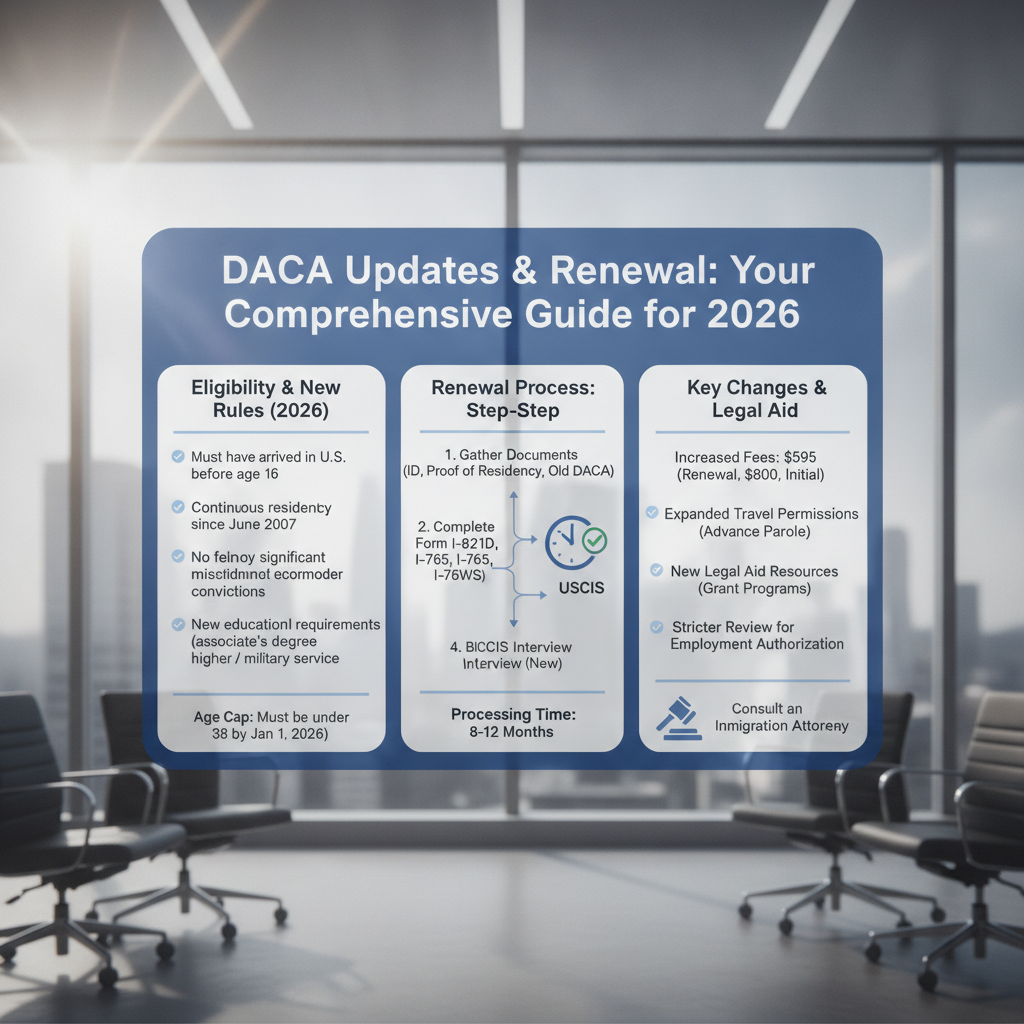
DACA Program Updates and Renewal Information (USCIS)
What This News Means for Immigrants in Orlando and Across Florida
The ongoing discussions and updates surrounding the DACA program are a constant source of concern and hope for nearly 600,000 DACA recipients nationwide. For the thousands of DACAmented individuals living in Florida, particularly in vibrant communities like Orlando, this news directly impacts their lives, their families, and their futures.
Why this news is showing up now
The DACA program has been a subject of intense legal and political debate since its inception in 2012. While new initial DACA applications have been paused due to court orders, renewals have generally continued. However, the program's legal standing remains precarious, with ongoing litigation challenging its legality. Courts have issued rulings that both affirm and limit the program, creating a complex and often confusing environment. As of October 15, 2026, USCIS continues to accept DACA renewal requests, but the long-term future of the program is still being determined by federal courts. This means that every piece of official communication or court decision can signal a potential shift in how the program operates, making it vital for recipients to stay informed and act proactively.
Recent news often revolves around court hearings, administrative policy tweaks, or legislative discussions in Congress that seek to provide a permanent solution for DACA recipients, often referred to as "Dreamers." These developments create a constant flow of information that can be overwhelming to process without expert guidance.
How it can affect Florida residents
Florida is home to a significant population of DACA recipients, many of whom are contributing members of our workforce, students in our universities, and integral parts of our communities. For those living in Orlando, Central Florida, and throughout the state, the stability of the DACA program directly affects their ability to work legally, pursue education, and plan for their families' futures without fear of deportation.
- Work Authorization: A DACA renewal means continued eligibility for an Employment Authorization Document (EAD), allowing recipients to work legally and support themselves and their families. Without this, economic stability is severely threatened for individuals and for the Florida businesses that employ them.
- Driver's Licenses: In Florida, DACA recipients are eligible for driver's licenses upon presentation of their valid EAD. A lapse in DACA status can lead to the inability to renew a driver's license, impacting daily life, commuting to work along the busy I-4 corridor, and accessing essential services.
- Educational Opportunities: While Florida does not currently offer in-state tuition benefits for DACA recipients at its public universities, a valid DACA status and EAD can still be crucial for accessing certain scholarships or private educational programs.
- Uncertainty and Stress: The constant legal challenges create immense psychological stress for DACA recipients and their families. This uncertainty can affect mental health, long-term planning, and overall well-being.
- Local Economy: DACA recipients contribute significantly to Florida's economy through taxes, consumer spending, and filling critical labor shortages. Any disruption to their status can have ripple effects across various sectors in Orange County and beyond.
Staying current with DACA updates and ensuring timely renewals is paramount for Florida residents to maintain their stability and continue contributing to our community.
Need Help? Our Orlando immigration team is ready to assist. Call +1 786-791-3106 for a free consultation, or message us online. Se Habla Español.
What DACA Is (and Why It Matters)
The Deferred Action for Childhood Arrivals (DACA) program is a critical, albeit temporary, immigration policy that has provided a lifeline to hundreds of thousands of young immigrants across the United States since its inception in 2012. Understanding what DACA is and why it matters is fundamental to comprehending its impact and navigating its processes.
A plain-English definition
Simply put, DACA is a program that offers certain young undocumented immigrants who came to the U.S. as children protection from deportation (known as "deferred action") for a renewable period of two years. It also grants them eligibility for a work permit (Employment Authorization Document, or EAD). Important: DACA is not a path to a green card or U.S. citizenship. It does not provide lawful immigration status; instead, it provides temporary relief from deportation and authorization to work legally in the U.S.
The program was established by the Obama administration through an executive memorandum, not through an act of Congress. This non-statutory basis is why DACA has faced, and continues to face, numerous legal challenges. While new initial DACA applications have largely been halted by court orders, USCIS is currently permitted to accept and process DACA renewal requests.
Key terms you need to know
- Deferred Action: This is a discretionary decision by the Department of Homeland Security (DHS) to defer removal (deportation) proceedings against an individual. It does not confer lawful status or a pathway to citizenship.
- DACA Recipient / Dreamer: These terms refer to individuals who have been granted deferred action under the DACA program. The term "Dreamer" originates from the DREAM Act, a legislative proposal that would have provided a path to permanent residency for similar individuals.
- Employment Authorization Document (EAD): Also known as a work permit, this card allows DACA recipients to legally work in the United States for the duration of their deferred action period. It is typically valid for two years and must be renewed alongside DACA.
- USCIS: U.S. Citizenship and Immigration Services, the federal agency responsible for administering DACA and other immigration benefits.
- Continuous Residence: A key eligibility requirement for DACA, meaning the applicant has maintained their residence in the United States from a specific date (e.g., June 15, 2007, for initial DACA) up to the present time. Brief, casual, and innocent departures do not necessarily break continuous residence.
- Significant Misdemeanor / Felony: DACA eligibility can be denied if an applicant has been convicted of certain crimes. A "significant misdemeanor" is generally defined as an offense for which the maximum term of imprisonment is one year or less, but greater than five days, and involves specific types of offenses (e.g., domestic violence, sexual abuse, burglary, DUI). Felonies are crimes punishable by imprisonment for more than one year.
Understanding these terms is crucial when discussing DACA and preparing any associated applications. For non-lawyers, navigating these definitions can be challenging, which is why seeking expert legal counsel is always recommended.
Current Immigration Law: The Foundation for DACA
The legal framework surrounding DACA is complex and distinct from statutory immigration law, as DACA itself is not a law passed by Congress. Instead, it is a policy established through executive action and implemented through administrative memoranda. The original policy was announced by then-Secretary of Homeland Security Janet Napolitano in June 2012. Over the years, it has been refined and challenged, notably by the Mayorkas Memorandum in 2021, which sought to codify DACA into a formal regulation.
However, federal courts have intervened, notably the U.S. Court of Appeals for the Fifth Circuit, which in October 2022 affirmed a lower court's ruling that DACA is unlawful. This ruling allowed current DACA recipients to continue renewing their status but prohibited USCIS from approving new initial DACA applications. As of October 15, 2026, this remains the legal status quo, meaning the policy continues to exist for renewals, but its long-term future is still contested in the courts.
Federal requirements for DACA renewal
While the initial DACA application criteria are no longer being processed, understanding them provides context for renewals. For DACA renewals, applicants must meet the following criteria:
- You must have previously been granted DACA.
- You must not have departed the United States on or after August 15, 2012, without advance parole.
- You must have continuously resided in the United States since you submitted your most recent DACA request that was approved.
- You must not have been convicted of a felony, a significant misdemeanor, or three or more other misdemeanors, and not otherwise pose a threat to national security or public safety.
Important: USCIS emphasizes that DACA renewal applicants must continue to meet the original DACA requirements, including the educational requirement (currently enrolled in school, graduated or obtained a certificate of completion from high school, obtained a General Education Development (GED) certificate, or are an honorably discharged veteran of the Coast Guard or U.S. Armed Forces).
The primary forms for DACA renewal are:
- Form I-821D, Consideration of Deferred Action for Childhood Arrivals
- Form I-765, Application for Employment Authorization
- Form I-765WS, Worksheet for Form I-765
These forms must be completed accurately and submitted with supporting documentation and the correct filing fees. You can find the latest versions of these forms and detailed instructions on the USCIS official website.
Florida-specific considerations
While DACA is a federal program, its implications are felt at the state level. For DACA recipients in Florida, particularly those in Orange County and surrounding areas, there are specific practical considerations:
- Driver's Licenses: The Florida Department of Highway Safety and Motor Vehicles (FLHSMV) issues driver's licenses to DACA recipients who can present a valid EAD and other required identification documents. Timely DACA renewal is essential to maintain your driving privileges.
- Professional Licenses: DACA recipients in Florida may be eligible for certain professional licenses, depending on the occupation and specific state board requirements. A valid EAD is often a prerequisite.
- Access to Services: While DACA does not grant eligibility for most federal public benefits, it can affect eligibility for certain state or local programs. It is crucial to consult with an attorney to understand what you may or may not be eligible for.
- Local Law Enforcement: Maintaining DACA status provides a layer of protection from deportation. However, DACA recipients should always be aware of their rights and responsibilities when interacting with local law enforcement.
For more specific guidance regarding state-level implications in Florida, consulting with an experienced immigration attorney at Imigrar is highly recommended.
Need Help? Our Orlando immigration team is ready to assist. Call +1 786-791-3106 for a free consultation, or message us online. Se Habla Español.
How to Renew Your DACA: A Complete Step-by-Step Guide
Renewing your DACA and Employment Authorization Document (EAD) is a critical process that requires careful attention to detail and timely submission. Here’s a complete step-by-step guide to help you navigate it:
1) Determine Your Eligibility for Renewal
Before you begin, confirm you meet the DACA renewal criteria. You must have previously been granted DACA. USCIS generally requires you to meet the same criteria as your initial DACA request, with some updates:
- You have not departed the United States on or after August 15, 2012, without obtaining advance parole.
- You have continuously resided in the United States since you submitted your most recent DACA request that was approved.
- You have not been convicted of a felony, a significant misdemeanor, or three or more other misdemeanors, and do not otherwise pose a threat to national security or public safety.
- You still meet the educational requirement (e.g., currently in school, graduated, GED, or veteran).
Warning: Any criminal convictions, even minor ones, since your last DACA approval could affect your eligibility. If you have any arrests or convictions, consult with an attorney immediately.
2) Gather Required Documents
Preparation is key. Collect all necessary documents before filling out your forms. This typically includes:
- Previous DACA Approval Notices: Copies of your most recent Form I-797 Approval Notice for Form I-821D and your current Employment Authorization Document (EAD).
- Proof of Identity: Copy of your birth certificate with translation, passport identity page, or other national identity document.
- Proof of Continuous Residence: Documentation proving you have continuously resided in the U.S. since your last DACA approval. Examples include:
- School records (transcripts, diplomas)
- Employment records (pay stubs, W-2s, employment verification letters)
- Bank statements
- Medical records
- Rental agreements, utility bills
- Tax returns
- Copies of Florida driver's licenses or state IDs for the period.
- Photos: Two identical passport-style photos taken within 30 days of filing. Write your name and A-number lightly on the back of each photo.
- Criminal History Records (if applicable): If you have any arrests or convictions since your last DACA approval, you must obtain certified court dispositions for all charges, even if they were dismissed or expunged.
- Proof of Educational Attainment: If your educational status has changed or you haven't submitted this before (e.g., you obtained your GED since your last renewal).
Reminder: Do not send original documents unless specifically requested by USCIS. Always send copies.
3) Complete the Forms
You will need to complete three forms for DACA renewal:
- Form I-821D, Consideration of Deferred Action for Childhood Arrivals: Fill out every section completely and accurately. If a question does not apply, write "N/A" (not applicable).
- Form I-765, Application for Employment Authorization: This form requests your work permit. For DACA renewals, your eligibility category will typically be (c)(33).
- Form I-765WS, Worksheet for Form I-765: This worksheet helps USCIS determine if you have an economic need to work. Be honest and provide clear explanations of your financial situation.
Important: Use the latest version of these forms, available on the USCIS Forms page. Ensure all information is consistent across forms. Sign and date each form in blue ink.
4) Prepare Supporting Evidence
Organize your gathered documents and copies. Create a cover letter listing all the contents of your application package. Arrange documents in the order they are listed in your cover letter or according to USCIS instructions for Form I-821D and Form I-765. For example, place photos in a small envelope stapled to the upper left corner of Form I-765.
- Attach copies of your previous DACA approval notice and EAD.
- Include copies of all continuous residence documentation.
- If applicable, include certified court dispositions.
- Ensure all non-English documents are accompanied by a certified English translation.
5) Pay the Filing Fees
As of October 15, 2026, the current filing fee for a DACA renewal is $495. This includes the Form I-765 fee ($410) and the biometrics services fee ($85). There is no separate fee for Form I-821D.
- You must pay the fee with a money order, personal check, cashier's check, or by credit card using Form G-1450, Authorization for Credit Card Transactions.
- Make checks or money orders payable to "U.S. Department of Homeland Security." Do not abbreviate.
- Warning: Fee waivers are generally NOT available for DACA renewals.
6) Mail Your Application Package
Send your completed application package to the correct USCIS Lockbox Facility. The mailing address depends on your state of residence. For Florida residents, you will typically mail to the USCIS Chicago Lockbox. Check the USCIS Direct Filing Addresses for Form I-821D page for the most current and accurate address.
- Use a mailing service that provides tracking and delivery confirmation (e.g., USPS Certified Mail with Return Receipt, FedEx, UPS). This provides proof of mailing and delivery.
- Keep a complete copy of your entire application package for your records.
7) Attend Biometrics Appointment (if required) and Monitor Your Case
After filing, USCIS will send you a receipt notice (Form I-797C). Subsequently, you may receive an appointment notice (Form I-797C) for a biometrics (fingerprints, photo, signature) appointment at a local Application Support Center (ASC), such as the one serving the Orlando area. It is crucial to attend this appointment.
- Bring your appointment notice, a valid photo ID (like your EAD or Florida driver's license), and any other documents requested.
- You can check the status of your case online using the receipt number provided on your Form I-797C at the USCIS Case Status Online tool.
- Be prepared for potential Requests for Evidence (RFEs) if USCIS needs more information. Respond promptly and thoroughly to any RFEs.
Practical Steps You Can Take Today for DACA Renewal
Proactive planning is essential for a smooth DACA renewal process. Don't wait until the last minute!
Actionable Checklist:
- Mark Your Calendar: Your DACA and EAD are typically valid for two years. Set a reminder to start your renewal process 150 to 120 days (approximately 4-5 months) before your current EAD expires. While USCIS recommends filing within 150 days, filing too early (more than 150 days) can lead to rejection. Filing too late risks a lapse in your work authorization.
- Review Your Criminal History: If you've had any arrests or convictions since your last DACA approval, even minor ones, gather all certified court dispositions. This is a critical step, and consulting an attorney is highly advised.
- Start Gathering Documents: Begin collecting proof of continuous residence immediately. This includes utility bills, bank statements, school records, employment records, and medical records from the last two years.
- Update Your Address with USCIS: If you've moved, file Form AR-11, Alien's Change of Address Card, online or by mail within 10 days of moving. This ensures you receive all USCIS notices.
- Save for Fees: The filing fee for DACA renewal is $495. Start saving this amount well in advance.
- Seek Legal Counsel: If you have any doubts about your eligibility, document requirements, or criminal history, schedule a consultation with an experienced immigration attorney. The investment in legal advice can prevent costly mistakes and delays.
Document Preparation Guidance:
- Organize Chronologically: Arrange documents, especially proof of continuous residence, in chronological order to make it easy for USCIS to review.
- Label Clearly: Use sticky notes or section dividers to label different types of documents (e.g., "School Records," "Employment History," "Bank Statements").
- Keep Copies: Make at least two full copies of your entire application package (forms, supporting documents, check/money order). One for your records, and another to provide to your attorney if you hire one.
- Professional Photos: Get passport-style photos from a reputable provider (e.g., a pharmacy or professional photo studio) to ensure they meet USCIS specifications.
Timeline Expectations:
- Filing Window: Apply between 150 and 120 days before your current DACA/EAD expires.
- Receipt Notice: You should receive a receipt notice (Form I-797C) from USCIS within 2-4 weeks after filing.
- Biometrics Appointment: An appointment notice for biometrics usually arrives 3-8 weeks after filing. The actual appointment will be scheduled a few weeks after that.
- Processing Times: DACA renewal processing times can vary significantly. As of October 15, 2026, you can check the current estimated processing times for Form I-821D and Form I-765 on the USCIS Processing Times page. It’s crucial to monitor these times, especially if your EAD is nearing expiration.
- Decision: Most DACA renewal applications are processed within 3-6 months. However, some cases can take longer, especially if an RFE is issued.
Warning: If your EAD expires before your renewal is approved, you will not be authorized to work until the new EAD is issued. Plan accordingly to minimize gaps in employment.
How Imigrar Helps DACA Recipients in Orlando and Beyond
At Imigrar, we understand that the DACA renewal process can be a source of significant stress and confusion, especially with the program's uncertain future. Our dedicated team of immigration attorneys in Orlando is here to provide clarity, support, and expert legal representation for DACA recipients across Florida and nationwide.
Our experience and expertise
With years of focused experience in immigration law, our attorneys are intimately familiar with the complexities of the DACA program and its evolving legal landscape. We stay abreast of the latest court rulings, administrative changes, and USCIS policies to ensure our clients receive the most current and accurate advice. Whether you are a long-time DACA recipient in Central Florida or someone navigating the renewal process for the first time in Orange County, we can help with:
- Eligibility Assessment: Thoroughly reviewing your personal history, including any travel or criminal records, to confirm your eligibility for DACA renewal.
- Document Preparation: Assisting you in gathering and organizing all necessary supporting documents, ensuring your application is complete and compelling.
- Form Completion: Meticulously preparing and reviewing Form I-821D, Form I-765, and Form I-765WS to minimize errors and potential delays.
- Criminal History Review: Providing expert advice on how any past arrests or convictions might impact your DACA renewal and strategizing the best approach to disclose this information.
- Responding to RFEs: Helping you understand and respond effectively to any Requests for Evidence from USCIS.
- Case Monitoring: Tracking your application status and providing updates, so you don't have to navigate the USCIS system alone.
- Addressing Complex Situations: Offering guidance for unique situations, such as significant travel outside the U.S. or changes in personal circumstances since your last approval.
Our commitment is to "Keep Families Together," and for DACA recipients, this means helping you maintain your stability and peace of mind.
Free consultation offer
We believe that everyone deserves access to quality legal advice. That's why Imigrar offers a free consultation to discuss your DACA renewal needs. During this consultation, you can speak directly with an experienced immigration attorney, ask your questions, and understand the best path forward for your specific situation. There's no obligation, just clear, professional guidance.
Don't face the DACA renewal process alone. Let our Orlando-based team provide the expert support you need to protect your future.
Se Habla Español. Nuestro equipo está aquí para servir a la comunidad hispanohablante de Orlando y de todo el país. No dude en llamarnos con cualquier pregunta.
Ready to Renew Your DACA? Contact Imigrar today for expert legal assistance. Call +1 786-791-3106 for your free consultation, or fill out our online contact form. Se Habla Español.

Frequently Asked Questions About DACA Renewal
Q: What if my DACA expired a long time ago? Can I still renew?
A: USCIS generally considers a DACA request to be a "renewal" if you file it within one year of your last DACA expiration. If your DACA expired more than one year ago, USCIS may consider it an "initial" request. However, due to ongoing court orders, USCIS is currently not accepting or processing "initial" DACA requests. If your DACA expired more than a year ago, it is crucial to consult with an immigration attorney at Imigrar to understand your options, as the situation is highly complex and depends on the latest court rulings.
Q: Does DACA provide a path to a green card or U.S. citizenship?
A: No, DACA does not provide a path to a green card (lawful permanent residency) or U.S. citizenship. It is a temporary form of deferred action that offers protection from deportation and work authorization for two years. While many DACA recipients hope for a legislative solution, the program itself does not lead to permanent immigration status. However, some DACA recipients may be eligible for other immigration benefits through family petitions or employment-based visas, particularly if they entered the U.S. with inspection or have since obtained advance parole. An attorney can assess your individual circumstances.
Q: How long does DACA renewal typically take, and what if my EAD expires during processing?
A: DACA renewal processing times vary, but typically range from 3 to
Related Topics
Need Legal Assistance?
Our experienced immigration attorneys are here to help with your case. Contact Imigrar today for a free consultation and let us guide you through the legal process with confidence.
📍 Orlando, Florida • Serving clients nationwide
📧 info@imigrar.com