The reporting that sparked this guide: DACA Program Updates and Renewal Information (USCIS)
What This News Means for Immigrants in Orlando and Across Florida
Why this news is showing up now
The DACA program, originally established in 2012, has been a subject of intense legal and political debate for years. In early 2026, the news cycle around DACA isn't necessarily about a brand-new policy change, but rather the continuous ripple effects of past court decisions and the persistent uncertainty surrounding its future. The U.S. Fifth Circuit Court of Appeals has previously affirmed a Texas district court's ruling that found DACA unlawful, preventing USCIS from approving new DACA applications. However, existing DACA recipients are allowed to apply for renewal. This creates a dual reality: a program that continues to offer hope and stability to those already enrolled, while also highlighting the urgent need for a permanent legislative solution for those who remain ineligible or are seeking initial DACA status. The "news" appearing now often revolves around administrative processing updates, changes in USCIS guidance for renewals, and most significantly, the ongoing legal battles that could, at any moment, impact the program's ability to continue even for renewals. Each court filing, each administrative bulletin, and each political statement contributes to the conversation, making it crucial for DACA recipients and their advocates to remain vigilant. The consistent news flow underscores the program's precarious nature and the constant need for readiness and accurate information, especially concerning timely renewals.How it can affect Florida residents
Florida is home to one of the largest populations of DACA recipients in the nation, with thousands of individuals contributing to our economy, culture, and communities, from the vibrant streets of Orlando to the coastal cities. For Central Florida residents, particularly those in Orange County and along the I-4 corridor, these DACA updates have very real, immediate consequences. * **Work Authorization:** Maintaining DACA status means retaining the ability to hold an Employment Authorization Document (EAD), which is vital for legal employment. Without a valid EAD, DACA recipients cannot legally work, impacting their ability to support themselves and their families, pay taxes, and contribute to the local economy. * **Protection from Deportation:** DACA provides a temporary reprieve from deportation. Any disruption to the program or a lapse in renewal could place individuals at risk of removal, separating families and disrupting lives built over decades in the U.S. * **Driver's Licenses:** In Florida, DACA recipients are eligible to apply for a driver's license, which is contingent on having a valid EAD. A lapse in DACA renewal directly impacts their ability to legally drive, affecting commutes to work or school, and general mobility. * **Educational Opportunities:** While DACA does not automatically grant in-state tuition, some Florida colleges and universities may consider DACA status in their admissions and tuition policies. The stability offered by DACA allows many to pursue higher education, contributing to Florida’s skilled workforce. * **Community Impact:** DACA recipients are integral members of Florida communities. Their continued ability to live and work without fear of deportation strengthens the social fabric of cities like Orlando, allowing families to remain together and thrive. The uncertainty surrounding DACA can create significant stress and anxiety for individuals and their families. It underscores the importance of proactive planning, precise documentation, and seeking expert legal advice to navigate the renewal process successfully and prepare for potential future changes. Imigrar understands these unique challenges faced by Florida’s Dreamers and stands ready to provide guidance.Need Help? Our Orlando immigration team is ready to assist. Call +1 786-791-3106 for a free consultation, or message us online. Se Habla Español.
What DACA Is (and Why It Matters)
The Deferred Action for Childhood Arrivals (DACA) program is a critical U.S. immigration policy that has provided immense relief and opportunity to hundreds of thousands of young people across the country. Understanding what DACA is, its origins, and its current status is fundamental for anyone impacted by it.A plain-English definition
At its core, DACA is an exercise of "prosecutorial discretion" by the U.S. government. This means that instead of actively seeking to deport certain undocumented immigrants, the government has chosen to "defer action" – essentially putting their deportation on hold for a temporary period. Specifically, DACA allows certain undocumented immigrants who came to the United States as children to receive a renewable two-year period of deferred action from deportation and to be eligible for a work permit (Employment Authorization Document, or EAD). It’s crucial to understand what DACA is *not*: * **It is NOT a path to U.S. citizenship.** DACA does not provide a legal pathway to permanent residency (a Green Card) or U.S. citizenship. * **It is NOT a form of legal status.** DACA recipients are considered to be lawfully present in the U.S. for the period of deferred action, but they do not have permanent legal status. Their status is temporary and subject to renewal. * **It is NOT a law passed by Congress.** DACA was created through an executive memo issued by the Secretary of Homeland Security in 2012. This is why it has been susceptible to legal challenges and policy changes by different administrations. For the hundreds of thousands of young people who qualify, DACA means the ability to work legally, pursue higher education without constant fear, obtain a driver's license in many states (including Florida), and build a life free from the immediate threat of deportation. It allows them to contribute more fully to the only country they've ever truly known.Key terms you need to know
Navigating DACA requires familiarity with specific immigration terminology. Here are some key terms: * **Deferred Action:** This is the core concept of DACA. It means the government is choosing to delay or defer enforcement of immigration laws against an individual for a specific period. It does not confer legal status. * **Dreamers:** A widely used term referring to young undocumented immigrants who were brought to the U.S. as children. While DACA specifically addresses a subset of these individuals, the term often encompasses all those who would benefit from the proposed DREAM Act (Development, Relief, and Education for Alien Minors Act). * **Employment Authorization Document (EAD):** Also known as a work permit, this document allows DACA recipients to legally work in the United States. It is typically valid for two years, coinciding with the DACA deferred action period. USCIS Form I-765 is used to apply for it. * **USCIS (U.S. Citizenship and Immigration Services):** The federal agency responsible for administering the DACA program, including processing applications and renewals. * **Continuous Residence:** A DACA eligibility requirement meaning the applicant has resided in the U.S. for a specified unbroken period. For DACA, this generally means residing in the U.S. since June 15, 2007, up to the present time. Brief, casual, and innocent absences from the U.S. do not necessarily break continuous residence. * **Significant Misdemeanor/Felony:** DACA eligibility requires applicants not to have been convicted of a felony, a significant misdemeanor, or three or more other misdemeanors. A "significant misdemeanor" is defined by specific criteria related to the sentence imposed or the nature of the crime. * **DHS (Department of Homeland Security):** The federal department under which USCIS operates. The Secretary of Homeland Security oversees immigration enforcement and policy, including DACA. * **Pro Bono:** Legal services provided without charge. Many organizations and attorneys offer pro bono assistance to DACA applicants, though Imigrar operates on a fee-for-service model with competitive pricing and transparent fees. Understanding these terms will help DACA recipients better comprehend the requirements, processes, and legal discussions surrounding the program.Current Immigration Law: The Foundation
While DACA itself is not a law enacted by Congress, it operates within the framework of existing immigration statutes and relies on the executive branch's authority regarding prosecutorial discretion. The "current law" regarding DACA is, therefore, a complex interplay of administrative policy, federal court rulings, and ongoing litigation.Federal requirements
DACA was established through a memorandum issued by then-Secretary of Homeland Security Janet Napolitano on June 15, 2012. This memorandum outlined specific criteria for individuals to be considered for deferred action. While the program has faced numerous legal challenges, the eligibility criteria for *renewal* remain largely consistent with the original guidelines. To be considered for DACA renewal in early 2026, applicants must generally meet the following federal requirements: 1. **Age:** You must have been under the age of 31 as of June 15, 2012. 2. **Arrival in U.S.:** You must have come to the United States before your 16th birthday. 3. **Continuous Residence:** You must have continuously resided in the United States since June 15, 2007, up to the present time. 4. **Physical Presence:** You must have been physically present in the United States on June 15, 2012, and at the time of making your request for DACA. 5. **No Lawful Status:** You must not have had lawful immigration status on June 15, 2012. 6. **Education:** You must currently be in school, have graduated or obtained a certificate of completion from high school, have obtained a general education development (GED) certificate, or be an honorably discharged veteran of the Coast Guard or Armed Forces of the United States. 7. **Criminal Record:** You must not have been convicted of a felony, a significant misdemeanor, or three or more other misdemeanors, and not otherwise pose a threat to national security or public safety. **Important:** As of early 2026, due to a federal court order in *Texas v. United States*, USCIS is *prohibited from approving initial DACA requests*. They are currently only processing DACA renewal requests from individuals who have previously been granted DACA. This distinction is critical and impacts tens of thousands of potential new applicants. The forms used for DACA renewal are: * Form I-821D, Consideration of Deferred Action for Childhood Arrivals * Form I-765, Application for Employment Authorization * Form I-765WS, Worksheet (detailing income, expenses, and assets for fee waiver consideration, though fee waivers are rarely granted for DACA) For the most up-to-date information on DACA policy and forms, always refer to the USCIS official website.Florida-specific considerations
While DACA is a federal program, its impact and certain ancillary benefits can vary by state. For Florida residents, DACA status can influence several aspects of daily life: * **Driver's Licenses:** DACA recipients in Florida are eligible to apply for a Florida driver's license. The Department of Highway Safety and Motor Vehicles (DHSMV) requires a valid EAD (Form I-766) and other identification documents. A lapse in your DACA and EAD renewal will directly affect your ability to drive legally in Florida. * **In-State Tuition:** This is a complex area. While DACA itself does not automatically grant in-state tuition at Florida public universities, the Florida Legislature has passed laws (such as House Bill 851, effective July 1, 2014) that allow certain undocumented students who meet specific criteria (including attending a Florida high school for at least three years and graduating from a Florida high school) to be eligible for in-state tuition rates. DACA recipients often fall into this category, making higher education more accessible. * **Professional Licenses:** The ability to obtain certain professional licenses (e.g., nursing, teaching) in Florida may be contingent on having a valid work permit and, in some cases, specific state legislation. DACA status, through the EAD, facilitates access to these opportunities. * **Local Resources:** Communities across Florida, including Orlando and Central Florida, have various non-profit organizations and legal aid groups that offer support, workshops, and sometimes financial assistance to DACA recipients. These local resources can be invaluable. **Reminder:** State laws and policies can change. It's always advisable to verify current regulations with relevant state agencies or an immigration attorney, especially for issues like driver's licenses and tuition. The Orlando USCIS Field Office may also have specific local procedures for certain inquiries, though DACA renewals are centrally processed.Navigating DACA renewal can be complex. Don't risk delays or denial. Contact Imigrar for expert guidance. Call +1 786-791-3106 for a free consultation, or message us online. Se Habla Español.
How to Renew Your DACA: A Complete Step-by-Step Guide
Renewing your DACA is a critical process that requires attention to detail and timely submission. Failure to renew correctly or on time can lead to a lapse in your work authorization and protection from deportation. Follow this comprehensive guide to ensure a smooth renewal process.1) Understand Your Timeline and Prepare Early
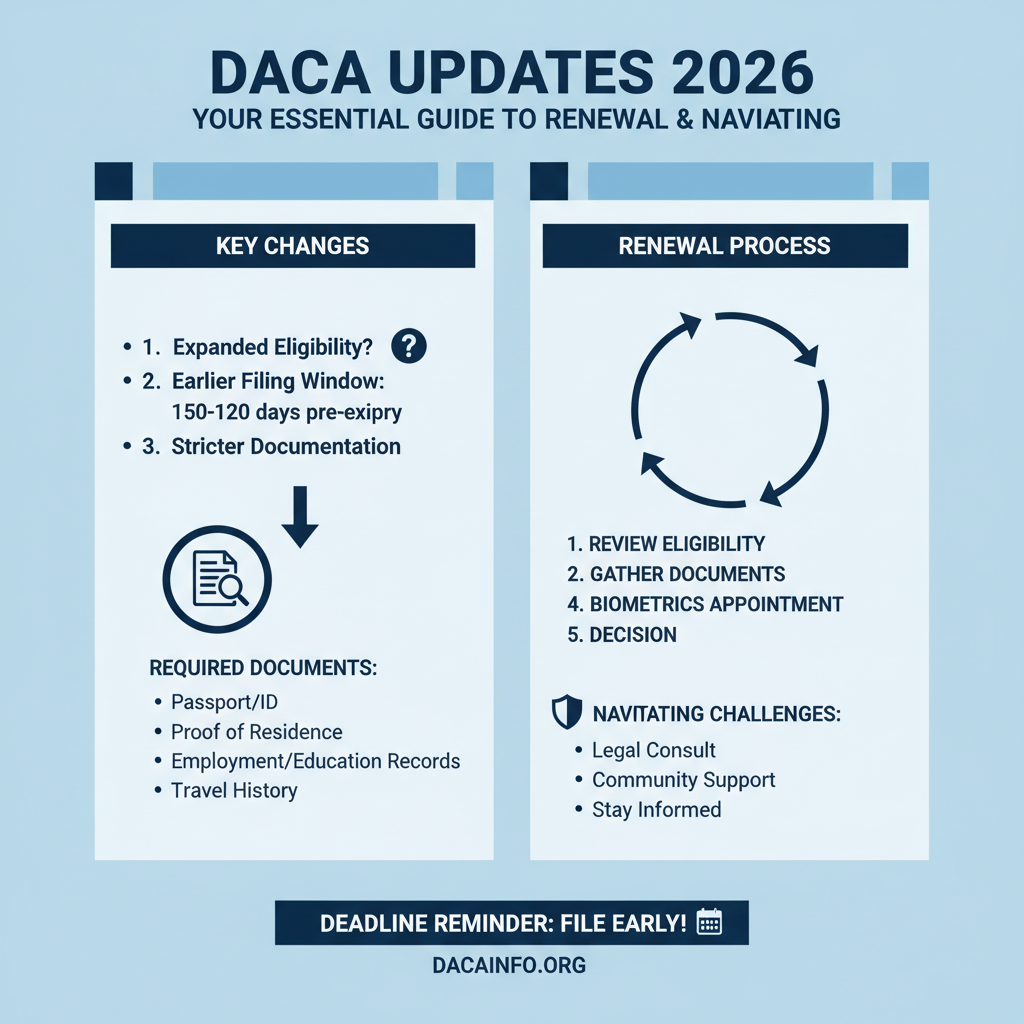
The most crucial aspect of DACA renewal is timing. USCIS recommends filing your renewal application between **120 and 150 days** (approximately 4 to 5 months) before your current DACA and EAD expire. Filing too early (more than 150 days) may result in USCIS rejecting your application, while filing too late risks a lapse in your employment authorization and deferred action. * **Actionable Advice:** Mark your calendar immediately upon receiving your initial DACA approval or EAD. Set multiple reminders. * **Document Preparation:** Start gathering documents well in advance. This isn't a last-minute task.2) Gather All Required Documents
Having a complete set of documents is paramount. USCIS requires specific forms and supporting evidence to process your renewal. * **Required Documents Checklist:** * **Previous DACA Approval Notices:** All notices (Form I-797) for previously approved DACA and EADs. * **Current EAD:** A copy of your most recent Employment Authorization Document (Form I-766). * **Identification Documents:** Copies of your passport (if you have one), birth certificate, and any other government-issued photo identification. * **Photos:** Two identical, passport-style color photographs taken within 30 days of filing. Ensure they meet USCIS specifications (2x2 inches, white background, full face front view). Write your name and A-Number lightly on the back of each photo. * **Proof of Continuous Residence (Optional but Recommended):** While not strictly required for renewal if your previous DACA was approved, it's wise to include some recent evidence of continuous residence in the U.S., especially if you have had any brief absences or if your previous application was difficult. Examples include: * Bank statements * Utility bills * Pay stubs * School transcripts * Rental agreements * Medical records * **Criminal History Records (If Applicable):** If you have had *any* arrests, charges, or convictions since your last DACA approval, you **must** provide certified court dispositions and police records for *every* incident, even if charges were dropped or expunged. Failure to disclose can lead to denial and severe immigration consequences. * **Proof of Education (If Applicable/Changed):** If your educational status has changed (e.g., you completed your GED or graduated high school since your last application), include updated proof.3) Complete USCIS Forms Accurately
The DACA renewal process involves three primary forms. Complete them thoroughly and accurately. Do not leave any fields blank; if a question does not apply to you, write "N/A." * **Forms to Complete:** * **Form I-821D, Consideration of Deferred Action for Childhood Arrivals:** This is the primary request for DACA renewal. Ensure all biographical information matches your previous application and supporting documents. Pay close attention to Part 3 ("Information About Your Presence in the United States") and Part 4 ("Basis for Requesting Deferred Action"), ensuring you meet all eligibility criteria. * **Form I-765, Application for Employment Authorization:** This form requests your work permit. For DACA renewals, your eligibility category will be (c)(33). Ensure your personal details are consistent with Form I-821D. * **Form I-765WS, Worksheet:** This form is used to determine if you are eligible for a fee waiver, though fee waivers for DACA renewals are rarely granted. You still need to complete it, even if you are paying the full fee, as it's typically part of the DACA application package. * **Important:** Read the instructions for each form carefully, available on the USCIS Forms page. Errors or omissions can cause delays or even rejection.4) Prepare Your Filing Fee or Fee Waiver Request
As of early 2026, the total filing fee for DACA renewal is **$495**, which includes the Form I-821D fee (no separate fee, but part of the combined cost) and the Form I-765 fee, plus the biometrics fee. * **Payment Options:** * Personal check, cashier’s check, or money order payable to "U.S. Department of Homeland Security." Do NOT use abbreviations. * Credit card using Form G-1450, Authorization for Credit Card Transactions. * **Fee Waivers:** Fee waivers for DACA renewals are extremely difficult to obtain and are typically only granted in very limited circumstances, such as severe financial hardship. If you believe you qualify, you must submit Form I-912, Request for Fee Waiver, along with compelling evidence of your inability to pay. Most DACA applicants should plan to pay the full fee.5) Assemble and Mail Your Application Package
Proper assembly and mailing are crucial. A misplaced document or incorrect address can cause significant delays. * **Assembly Order:** * Payment (check, money order, or Form G-1450) on top. * Form I-821D * Form I-765 * Form I-765WS * Supporting documents (copies only, unless originals are specifically requested). Organize them logically (e.g., in chronological order, by category). * Two passport-style photos in a small envelope clipped to the top of Form I-821D. * **Mailing Address:** Check the USCIS website for the correct mailing address for DACA applications, as it can vary based on your state of residence. For Florida residents, it typically goes to a USCIS Lockbox facility. Use a reliable mailing service that provides tracking, such as USPS Certified Mail with Return Receipt, FedEx, or UPS. * **Keep Copies:** Make a complete copy of your entire application package (all forms and supporting documents) before mailing it. This is your personal record.6) Attend Your Biometrics Appointment (If Required)
After USCIS receives your application, you will typically receive a receipt notice (Form I-797C) and then an appointment notice (Form I-797C) for a biometrics (fingerprints and photo) appointment at an Application Support Center (ASC). * **What to Bring:** Your appointment notice, a valid photo ID (e.g., driver's license, passport), and any other requested documents. * **Importance:** Attending this appointment is mandatory. Failure to appear will likely result in the denial of your application.7) Monitor Your Application Status and Respond to RFEs
USCIS will process your application. You can check the status online using the receipt number provided on your Form I-797C at USCIS Case Status Online. * **Request for Evidence (RFE):** USCIS may send you an RFE if they need additional information or clarification. Respond to RFEs promptly and comprehensively, providing all requested documentation by the deadline specified in the notice. * **Processing Times:** DACA renewal processing times can vary. Check USCIS Processing Times for current estimates. Be prepared for potential delays, especially given the ongoing legal complexities surrounding DACA.Worried about your DACA renewal? Imigrar ensures your application is perfect. Get peace of mind with our experienced team. Call +1 786-791-3106 for a free consultation, or message us online. Se Habla Español.
Practical Steps You Can Take Today
Proactive preparation is your best defense against potential delays or issues with your DACA renewal. Here are actionable steps you can take right now to ensure you're ready. * **Actionable Checklist:** * **Check Your Expiration Date:** Locate your current EAD (Form I-766) and DACA approval notice (Form I-797). Note the exact expiration date. * **Set Renewal Reminders:** Input renewal reminders into your phone, calendar, and email for **150 days prior** to your expiration date. * **Create a DACA Renewal Folder:** Start a physical or digital folder specifically for your DACA documents. Include copies of all previous DACA applications and approvals. * **Review Personal Information:** Ensure all your personal details (name, address, date of birth) are consistent across all your identification documents and previous DACA applications. If anything has changed, prepare to document it. * **Financial Check-up:** Assess your ability to pay the $495 filing fee. If you anticipate financial difficulty, research local organizations that may offer assistance or legal aid. Remember, fee waivers are rare for DACA. * **Criminal History Review:** Honestly review your entire criminal history since your last DACA approval. Obtain certified court dispositions for *any* arrests or charges, no matter how minor or old they seem, and even if they were dismissed. This is critical. * **Consult an Attorney:** Even if you've renewed DACA before, consulting an experienced immigration attorney, especially if you have any changes in circumstances (e.g., arrests, travel, new address), is highly advisable. Imigrar offers free consultations for this very purpose. * **Document Preparation Guidance:** * **Organize Everything:** Use dividers or separate digital folders for each type of document (e.g., "Previous DACA Approvals," "Identification," "Financial," "Criminal Records"). * **Make Copies, Not Originals:** Always send copies unless USCIS specifically requests an original document. Keep all your originals safe. * **Clarity and Legibility:** Ensure all copies are clear and easy to read. If a document is difficult to read, consider getting a fresh copy from the source. * **Translate Foreign Documents:** If any of your supporting documents are not in English, you must include a certified English translation along with a copy of the original document. The translator must certify that they are competent to translate and that the translation is accurate. * **Timeline Expectations:** * **150-120 Days Before Expiration:** This is your target window to file. * **1-4 Weeks After Filing:** Expect to receive a receipt notice (Form I-797C) from USCIS confirming they've received your application. * **2-8 Weeks After Filing:** Anticipate receiving a biometrics appointment notice. * **3-10 Weeks After Biometrics:** USCIS will typically process your application. Processing times can vary significantly. * **Potential Delays:** Be prepared for potential delays due to high volume, administrative backlogs, or if an RFE is issued. * **Warning:** Do NOT plan international travel or make critical life decisions based on an assumption of quick DACA renewal. Always have a valid EAD before starting new employment or renewing a driver's license.