


The landscape of U.S. immigration law is constantly evolving, and for many, the news surrounding Temporary Protected Status (TPS) is a beacon of hope and a source of crucial legal updates. As an immigration law firm dedicated to keeping families together, Imigrar understands the profound impact these announcements have on individuals and communities across the nation, especially here in Orlando and throughout Florida.
This comprehensive guide is designed to break down the latest TPS extension news, provide clear, actionable steps for those affected, and offer the expert legal assistance you need to navigate these complex processes successfully. Whether you are an existing TPS holder or seeking to understand your options, we are here to help.
Urgent TPS Questions? Don't risk your status. Our Orlando immigration team is ready to assist. Call +1 786-791-3106 for a free, confidential consultation, or message us online. Se Habla Español.
The reporting that sparked this guide
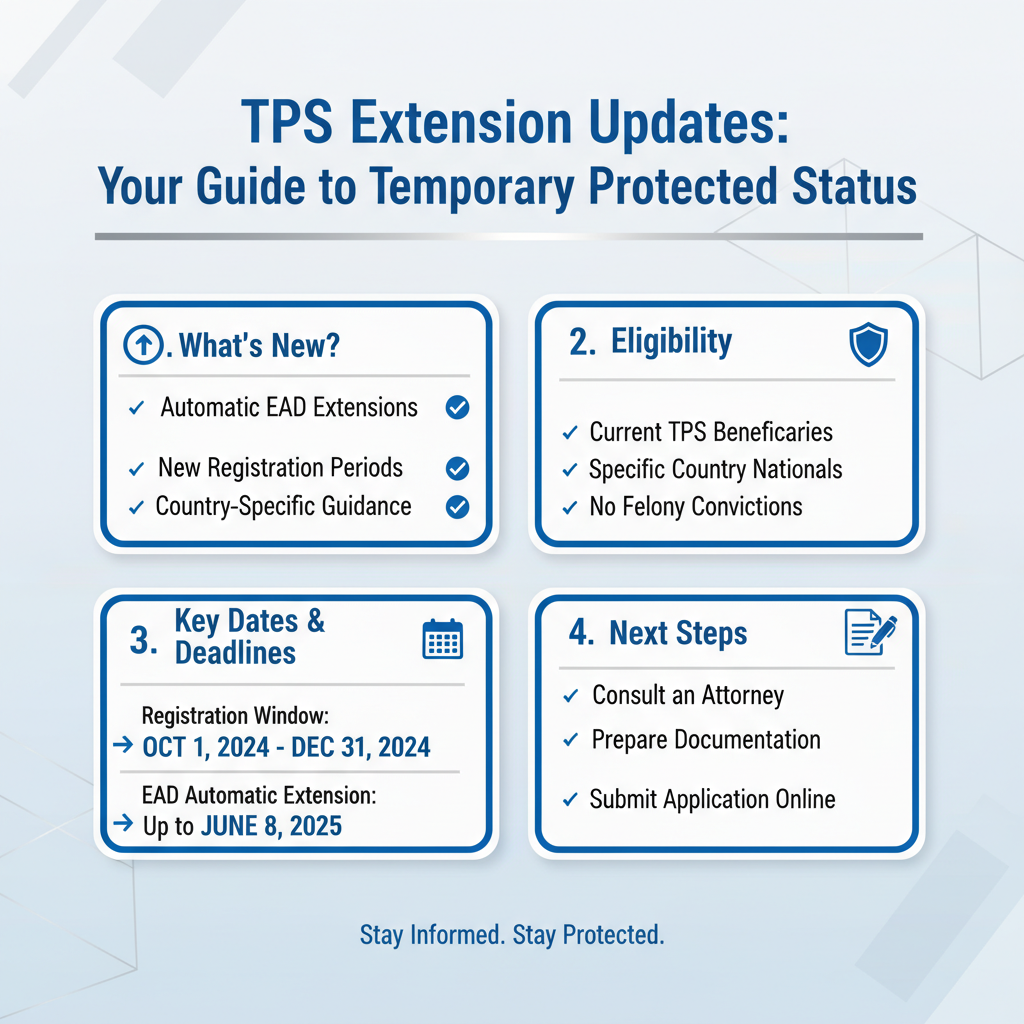
Recent reports regarding TPS extensions for various designated countries have been widely circulated, particularly within legal news outlets and immigrant advocacy circles. These announcements are critical, as they dictate the continued protection and eligibility for hundreds of thousands of individuals living in the United States.
TPS (Temporary Protected Status) Extension News (Legal News)
This news, frequently sourced from official U.S. government announcements and subsequently analyzed by legal experts, highlights the ongoing commitment to providing humanitarian relief to foreign nationals whose home countries are experiencing extraordinary and temporary conditions. For those holding TPS, these extensions are not just administrative updates; they are lifelines that allow families to remain united, continue their work, and contribute to their communities without fear of immediate deportation.
What This News Means for Immigrants in Orlando and Across Florida
Florida, and particularly the vibrant city of Orlando, is home to a significant and diverse immigrant population. News of TPS extensions resonates deeply here, affecting countless families, workers, and businesses. Understanding the implications is paramount for anyone whose country has been designated for TPS.
Why this news is showing up now
TPS designations and extensions are not arbitrary; they are the result of continuous monitoring by the Secretary of Homeland Security (DHS) of conditions in designated countries. These conditions typically include ongoing armed conflict, environmental disaster, or other extraordinary and temporary circumstances that prevent nationals from safely returning home. As of early 2026, many countries continue to face such challenges, necessitating reviews and, in many cases, extensions of their TPS designations.
The U.S. government periodically reviews these designations, often 6 to 18 months before the current expiration date. This ensures that the protection offered by TPS remains relevant to the evolving situations abroad. The recent announcements reflect these ongoing reviews and the determination that conditions in certain countries still warrant temporary protection for their nationals residing in the U.S.
For example, if a country designated for TPS continues to experience political instability, widespread violence, or the aftermath of a catastrophic natural disaster that occurred years prior, DHS may determine that an extension is necessary. This ensures that beneficiaries are not forced to return to dangerous or unlivable conditions.
How it can affect Florida residents
Florida, with its robust economy and diverse communities, has a large population of immigrants, including many from TPS-designated countries. For residents in Orlando, Tampa, Miami, and along the I-4 corridor, TPS extensions offer critical protections:
- Continued Legal Presence: Beneficiaries can continue to live and work in the U.S. legally, without fear of immediate deportation. This stability is foundational for families and individuals.
- Work Authorization: The extension typically comes with an automatic extension of Employment Authorization Documents (EADs), allowing individuals to maintain their jobs and contribute to Florida's economy. This is vital for countless families who rely on these wages.
- Family Stability: TPS allows families to remain together, preventing the traumatic separation that deportation would entail. This is particularly important for mixed-status families living in Orange County and surrounding areas.
- Community Contribution: TPS holders are integral parts of their communities, contributing culturally, socially, and economically. Extensions allow these contributions to continue uninterrupted.
- Planning for the Future: While TPS is temporary, its extension provides a crucial window for individuals to explore other potential pathways to permanent residency, if eligible, with the guidance of an Orlando immigration attorney.
For Central Florida residents, understanding these updates is not just about legal status; it's about maintaining livelihoods, ensuring children can continue their education, and sustaining the fabric of their communities. The Orlando USCIS Field Office processes many of these applications, making local legal guidance particularly valuable.
What Temporary Protected Status (TPS) Is (and Why It Matters)
Temporary Protected Status (TPS) is a humanitarian immigration benefit provided by the United States to eligible foreign nationals from certain countries. It is a vital program designed to offer a temporary reprieve from deportation and the ability to work legally in the U.S. when conditions in their home country make a safe return impossible or extremely dangerous.
A plain-English definition
Imagine your home country is hit by a massive earthquake, or it's embroiled in a civil war, or perhaps a devastating hurricane has made it uninhabitable. The U.S. government, through the Department of Homeland Security (DHS), can decide that it's too dangerous or impractical for people from that country to return home safely. In such cases, the Secretary of Homeland Security can designate that country for Temporary Protected Status (TPS).
If you are a national of a designated country and meet certain eligibility requirements, TPS allows you to:
- Legally live in the United States for a temporary period.
- Obtain an Employment Authorization Document (EAD), which allows you to work legally.
- Apply for a Travel Authorization (Advance Parole), which may allow you to travel outside the U.S. and return.
- Be protected from deportation (removal) from the U.S.
It's important to understand that TPS is temporary and does not automatically lead to a Green Card or permanent residency. However, it provides a stable, lawful status that can be renewed as long as the country's designation is extended.
Key terms you need to know
Navigating TPS requires understanding specific terminology. Here are some key terms:
- Designated Country: A foreign country whose nationals are eligible for TPS due to ongoing armed conflict, environmental disaster, or other extraordinary and temporary conditions. The Secretary of Homeland Security makes this designation.
- Re-registration Period: A specific window of time (typically 60 days) during which current TPS beneficiaries must apply to extend their status when their country's designation is extended. Missing this deadline can result in loss of TPS.
- Employment Authorization Document (EAD): Also known as a "work permit," this document (Form I-766) allows TPS beneficiaries to work legally in the U.S. Its validity is typically tied to the TPS designation period.
- Travel Authorization (Advance Parole): A document (Form I-512) issued by USCIS that allows a TPS beneficiary to travel outside the U.S. and be readmitted upon return, without jeopardizing their TPS status. Applying for this requires filing Form I-131.
- Date of Designation: The official date on which a country is first designated for TPS. This date is crucial for determining eligibility criteria, particularly regarding continuous residence and physical presence.
- Continuous Physical Presence (CPP): One of the eligibility requirements for TPS, meaning you must have been physically present in the U.S. for a specified period without significant absences, typically since the country's most recent designation date.
- Continuous Residence (CR): Another eligibility requirement, meaning you must have continuously resided in the U.S. since a specified date, usually the country's initial or most recent designation date. Brief, casual, and innocent absences are generally permitted.
- USCIS: The U.S. Citizenship and Immigration Services, the federal agency responsible for administering immigration and naturalization benefits, including TPS. USCIS official website is the primary source for forms, instructions, and updates.
- Temporary Protected Status (TPS): The official term for the humanitarian immigration status itself.
Understanding these terms is the first step toward successfully managing your TPS status and ensuring you remain compliant with U.S. immigration laws. For any clarification, a trusted immigration attorney in Orlando can provide invaluable assistance.
Confused by Immigration Jargon? Let Imigrar simplify it for you. We provide clear, expert guidance on TPS and all immigration matters. Call +1 786-791-3106 for a free consultation. Se Habla Español.
Current Immigration Law: The Foundation of TPS
Temporary Protected Status is rooted in federal immigration law, specifically the Immigration and Nationality Act (INA). It is not a discretionary program but one with clear statutory guidelines and requirements.
Reference specific laws and statutes
TPS is authorized by **Section 244 of the Immigration and Nationality Act (INA)**, found at 8 U.S.C. § 1254a. This section grants the Secretary of Homeland Security the authority to designate a foreign country for TPS. The designation can occur if the Secretary finds that:
- There is an ongoing armed conflict in the country, posing a serious threat to the personal safety of nationals returning there.
- An earthquake, flood, drought, epidemic, or other environmental disaster has occurred in the country resulting in a substantial, but temporary, disruption of living conditions, and the country is unable to handle the return of its nationals adequately.
- There are extraordinary and temporary conditions in the foreign state that prevent nationals from returning safely, unless the Secretary finds that allowing such nationals to remain in the U.S. would be contrary to the national interest.
Once a country is designated, the Secretary also determines the specific effective date of the designation, the period for which it is designated, and the criteria for eligibility. These designations and extensions are published in the Federal Register, providing official notice to the public.
Federal requirements
To be eligible for TPS, whether for initial registration or re-registration, individuals must meet several federal requirements:
- Nationality: Be a national of a country designated for TPS, or a person without nationality who last habitually resided in that country.
- Continuous Physical Presence (CPP): Have been continuously physically present in the United States since the effective date of the most recent TPS designation for their country. Brief, casual, and innocent departures do not break CPP.
- Continuous Residence (CR): Have continuously resided in the United States since a date specified by the Secretary of Homeland Security for their country's designation.
- Admissibility: Meet general immigration admissibility requirements. Certain criminal offenses (e.g., felony convictions, two or more misdemeanors) and specific immigration-related offenses (e.g., drug trafficking, national security concerns) will render an applicant ineligible.
- Timely Application: Apply for TPS (or re-register) within the specific registration period announced by USCIS.
Important: Even if you meet the nationality and presence requirements, certain criminal history or grounds of inadmissibility can make you ineligible for TPS. It is crucial to be honest and thorough in your application and consult with legal counsel if you have any concerns about your eligibility.
Florida-specific considerations
While TPS is a federal program, its implementation and impact are deeply felt at the state level. Florida does not have its own TPS laws; federal immigration law governs all aspects of TPS for residents of Orlando, Miami, Tampa, and every other city in the state. However, there are practical considerations for Florida residents:
- Orlando USCIS Field Office: Many TPS applicants in Central Florida will have their biometrics appointments scheduled at the Orlando USCIS Field Office or other Application Support Centers (ASCs) throughout Florida.
- Local Resources: Access to community organizations and legal aid groups in Florida, particularly in densely populated areas like Orange County, can be vital for assistance with applications and understanding local support networks.
- Economic Impact: TPS beneficiaries contribute significantly to Florida's economy, particularly in sectors such as agriculture, hospitality, and construction. Extensions directly impact the stability of these industries.
- Legal Expertise: Navigating TPS re-registration, especially with complex cases or prior immigration issues, requires specialized legal knowledge. An Orlando immigration lawyer from Imigrar can provide localized, expert advice.
For those living in Florida, being aware of these local considerations, alongside the federal requirements, ensures a smoother application process. All official forms and instructions are available on the USCIS official website.
Key USCIS forms for TPS include:
- Form I-821, Application for Temporary Protected Status
- Form I-765, Application for Employment Authorization
- Form I-131, Application for Travel Document (for Advance Parole)
- Form I-912, Request for Fee Waiver (if eligible)

How to Re-register for TPS: A Complete Step-by-Step Guide
If your country's TPS designation has been extended, you must re-register to maintain your status. This process is critical, and missing the deadline can lead to the loss of your protected status and employment authorization. Here’s a detailed guide to help you through the process.
1) Determine Your Eligibility and Re-registration Period
The first and most crucial step is to confirm that your country's TPS designation has indeed been extended and to identify the specific re-registration period. USCIS announces these details through Federal Register notices and on its website. You must meet the criteria for continuous physical presence and continuous residence since your country's designation date.
- Check Official Announcements: Regularly visit the USCIS official website for the latest updates on your country's TPS status and the specific re-registration window.
- Review Your Previous TPS Documents: Locate your prior TPS approval notice (Form I-797) and EAD to confirm your current status and any relevant dates.
- Consult an Attorney: If you have any doubts about your eligibility, particularly due to travel history, criminal record, or previous immigration issues, seek legal advice immediately.
Required Documents for this Step (for review):
- Your current TPS approval notice (Form I-797)
- Your current Employment Authorization Document (EAD)
- Any travel documents (e.g., Advance Parole) if you have traveled internationally
2) Gather All Required Documents
Accurate and complete documentation is vital. Start gathering these documents well in advance of the re-registration deadline. Missing documents can lead to delays or even denial.
- Proof of Identity and Nationality:
- Passport or national identity document from your country of origin.
- Birth certificate with photo identification.
- National identity card with photo and/or fingerprint.
- Any previous TPS documentation.
- Proof of Entry into the U.S.:
- Passport entry stamps.
- I-94 Arrival/Departure Record.
- Airline tickets or boarding passes.
- Any other official travel records.
- Proof of Continuous Residence in the U.S. (since the specified date for your country): This is critical and requires documents from various points in time.
- Employment records (pay stubs, W-2 forms, letters from employers).
- Rent receipts, utility bills (electricity, water, gas, phone).
- School records (transcripts, report cards) for yourself or your children.
- Medical records (hospital, doctor, clinic records).
- Bank statements.
- Affidavits from friends, family, or employers attesting to your residence.
- Other dated receipts, letters, or official documents showing your address.
- Proof of Continuous Physical Presence in the U.S.: (Often overlaps with continuous residence, but specifically addresses any absences).
- As above, records showing you were physically present. If you traveled with Advance Parole, keep records of your departure and return.
- Two Passport-Style Photos: Taken within 30 days of filing.
- Previous TPS Approval Notice: A copy of your most recent Form I-797, Notice of Action, showing your TPS approval.
- Current EAD: A copy of the front and back of your current Employment Authorization Document.
Reminder: Organize all documents clearly. If any document is not in English, it must be accompanied by a complete English translation certified by the translator.
3) Complete and File Form I-821 and Form I-765
To re-register for TPS, you generally need to file Form I-821, Application for Temporary Protected Status. If you want to continue working, you must also file Form I-765, Application for Employment Authorization.
- Complete Form I-821: Fill out every section accurately and completely. Be truthful about all questions, especially those regarding criminal history or previous immigration violations.
- Complete Form I-765: If you need an EAD, ensure you select the correct eligibility category (usually (c)(19) for TPS).
- Pay Filing Fees or Apply for a Fee Waiver:
- There is typically no fee for filing Form I-821 for re-registration.
- There is a fee for Form I-765 (EAD).
- There is a biometrics services fee (unless you are under 14 or over 79).
- If you cannot afford the fees, you may be eligible for a fee waiver by filing Form I-912, Request for Fee Waiver, along with supporting documentation of your inability to pay.
- Assemble Your Application Packet:
- Completed and signed Form I-821.
- Completed and signed Form I-765 (if seeking EAD).
- All supporting documents (copies, not originals, unless specifically requested).
- Two passport-style photos.
- Check or money order for fees, or Form I-912 with supporting documents.
- Mail Your Application: Send your packet to the correct USCIS lockbox facility. The address depends on your mailing address and the type of application. Always check the "Direct Filing Addresses for Form I-821" page on USCIS Forms for the most current address.
Warning: Always sign your forms in blue ink. An unsigned form will be rejected and delay your application.
4) Attend Biometrics Appointment (If Required)
After USCIS receives your application, you will typically receive a notice (Form I-797C) scheduling a biometrics appointment at an Application Support Center (ASC). This appointment is mandatory unless USCIS explicitly waives it.
- Bring the Notice: You must bring your biometrics appointment notice.
- Bring Valid Photo ID: A government-issued photo identification (e.g., passport, state ID).
- Purpose: At the appointment, your fingerprints, photograph, and signature will be collected. This is for background checks and identity verification.
- Location: For Central Florida residents, this will likely be at the Orlando USCIS Field Office's ASC or another facility in Florida.
Important: Missing your biometrics appointment without rescheduling can lead to the denial of your application.
5) Respond to Requests for Evidence (RFE) or Notices of Intent to Deny (NOID)
USCIS may send you a Request for Evidence (RFE) if they need more information or documents to make a decision on your case. A Notice of Intent to Deny (NOID) indicates that USCIS intends to deny your application unless you provide compelling evidence to overcome the grounds for denial.
- Timely Response: You will be given a specific deadline to respond to an RFE or NOID. Failure to respond within the given timeframe will likely result in a denial.
- Provide All Requested Information: Carefully read the RFE/NOID and provide *all* the requested documents or explanations.
- Seek Legal Help: Responding to an RFE or


