

The reporting that sparked this guide
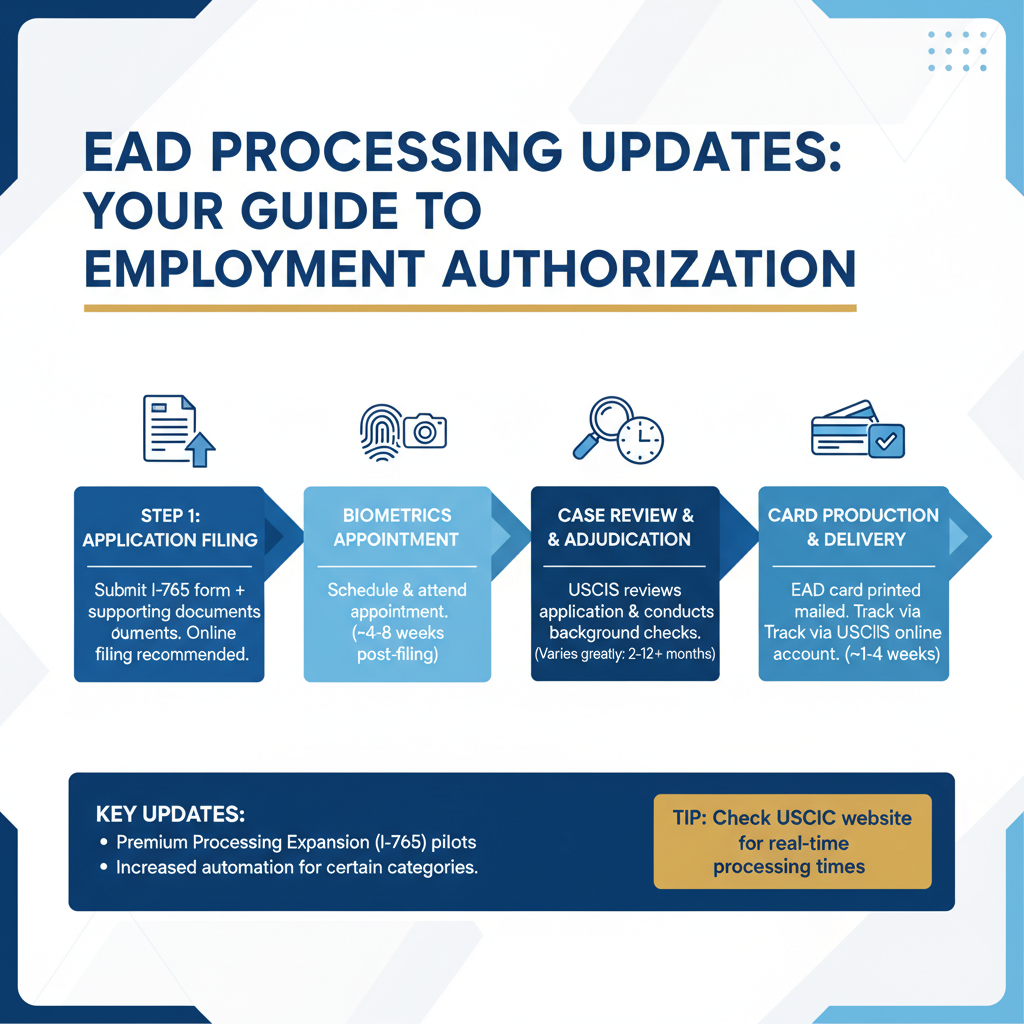
Recent developments and ongoing discussions from USCIS regarding the processing of Employment Authorization Documents (EADs) have been a significant point of interest for immigrants nationwide. This guide addresses the updates and provides clarity on what they mean for you and your family.
What This News Means for Immigrants in Orlando and Across Florida
The ability to work legally in the United States is a cornerstone for many immigrants seeking to build a new life, support their families, and contribute to their communities. For those in Orlando, Central Florida, and across the Sunshine State, the Employment Authorization Document (EAD), often called a "work permit," is the key to unlocking this opportunity. Recent updates and ongoing USCIS efforts to streamline EAD processing carry significant implications for thousands of individuals and families.
Why this news is showing up now
Over the past few years, U.S. Citizenship and Immigration Services (USCIS) has faced unprecedented backlogs in processing various immigration applications, including the Form I-765, Application for Employment Authorization. These backlogs led to extensive wait times, causing immense stress, financial hardship, and uncertainty for applicants. Many individuals found themselves in a precarious situation, unable to work legally while awaiting their EADs, sometimes for over a year.
In response to these challenges, USCIS has been implementing various policy changes and operational improvements. These efforts, which have been unfolding over the past few years and continue into 2026, aim to reduce processing times, increase efficiency, and provide greater flexibility for certain EAD categories. News surrounding these updates often highlights:
- Increased EAD Validity Periods: For certain categories, USCIS has temporarily or permanently increased the maximum validity period for EADs, reducing the frequency of renewals. This is a significant relief, as it means fewer applications need to be filed and processed over time.
- Temporary Final Rules (TFRs): USCIS has issued TFRs for specific categories (e.g., asylum applicants, certain adjustment of status applicants) allowing for automatic EAD extensions beyond the standard 180 days, sometimes up to 540 days, while renewal applications are pending. This prevents gaps in employment authorization.
- Premium Processing Expansion: While not applicable to all EAD categories, USCIS has incrementally expanded premium processing options to certain Form I-765 filings, allowing applicants to pay an additional fee for expedited adjudication.
- Operational Efficiency Measures: Internally, USCIS is working on hiring more staff, improving technology, and optimizing workflows to tackle the backlog more effectively.
These ongoing adjustments are constantly in the news because they directly impact the daily lives and economic stability of countless immigrants. As a firm dedicated to keeping families together, Imigrar closely monitors these changes to provide the most current and effective guidance to our clients.
How it can affect Florida residents
For immigrants residing in Orlando, across Orange County, and throughout the I-4 corridor, these EAD processing updates have direct and tangible effects:
- Employment Stability: Longer EAD validity periods and extended automatic renewal periods mean greater job security. Individuals can maintain continuous employment without the fear of losing their job due to a lapsed work permit while their renewal is pending. This is crucial for family budgeting, mortgage payments, and overall financial well-being.
- Economic Contribution: With faster processing and fewer employment gaps, EAD holders in Florida can continue to contribute to the local economy, filling vital roles in various industries, from hospitality and tourism (a major sector in Orlando) to healthcare, technology, and agriculture.
- Planning and Uncertainty: While improvements are being made, processing times can still be unpredictable. This uncertainty affects personal and professional planning. Understanding the latest policies helps residents of Central Florida anticipate timelines and prepare accordingly.
- Access to Services: An EAD is often required for obtaining a driver's license in Florida, opening bank accounts, and accessing other essential services. Consistent EAD availability ensures immigrants can fully integrate into society and access necessary resources in their Orlando community.
- Stress Reduction: The emotional toll of waiting for an EAD, or fearing its expiration, is immense. Positive news regarding processing improvements brings relief and hope to many families in Florida.
Whether you're an asylum seeker in Kissimmee, an adjustment of status applicant in Winter Park, or an H-4 spouse in Daytona Beach, these federal policy shifts directly influence your ability to live, work, and thrive in Florida. Imigrar understands these local impacts and is here to navigate these complexities with you.
Need Help Navigating EAD Updates? Our Orlando immigration team is ready to assist you. Call +1 786-791-3106 for a free consultation, or message us online. Se Habla Español.
What Employment Authorization Document (EAD) Processing Is (and Why It Matters)
At its core, an Employment Authorization Document (EAD) is a permit issued by USCIS that grants non-citizens legal authorization to work in the United States for a specific period. It is often referred to simply as a "work permit." For many immigrants, securing an EAD is a critical step towards financial independence and stability.
A plain-English definition
Think of an EAD as your official permission slip from the U.S. government to get a job. If you're not a U.S. citizen or a lawful permanent resident (Green Card holder), you generally need an EAD to work legally in the U.S. It's a physical card, similar to a driver's license, that you can show to employers to prove your eligibility to work. Without it, most employers cannot legally hire you.
The "processing" of an EAD refers to the entire journey your application takes from the moment USCIS receives it until they make a decision. This includes data entry, background checks, biometrics appointments, review by an immigration officer, and finally, the mailing of the decision and the EAD card itself.
Key terms you need to know
Navigating the EAD application process requires understanding a few key terms:
- EAD (Employment Authorization Document): The official card that proves your eligibility to work in the U.S.
- USCIS (U.S. Citizenship and Immigration Services): The government agency responsible for processing immigration benefits, including EADs. You will file your application with them. USCIS official website
- Form I-765, Application for Employment Authorization: This is the specific form you must file with USCIS to request your EAD.
- Eligibility Category: EADs are not available to everyone. You must fall into one of many specific categories defined by immigration law to be eligible. Examples include:
- Adjustment of Status (AOS) Applicants: Individuals applying for a Green Card while physically present in the U.S. (Category C9/C09).
- Asylum Applicants: Individuals seeking asylum whose applications have been pending for a certain period (Category A5/C8).
- DACA (Deferred Action for Childhood Arrivals) Recipients: Individuals granted deferred action (Category C33).
- H-4 Spouses: Certain spouses of H-1B visa holders (Category C26).
- L-2 Spouses: Spouses of L-1 visa holders (Category A18).
- F-1 OPT/STEM OPT: Students authorized for Optional Practical Training after graduation (Category C3B/C3C).
- Automatic Extension: For certain EAD categories, when you file a renewal application on time, your existing EAD may be automatically extended for a specific period (e.g., 540 days) while USCIS processes your renewal. This prevents a gap in work authorization.
- Biometrics: A required appointment where USCIS collects your fingerprints, photograph, and signature for background checks.
- RFE (Request for Evidence): A notice from USCIS asking for additional documents or information to support your application. Responding accurately and on time is crucial.
- Processing Times: The estimated duration it takes USCIS to process an application from the date of receipt to the final decision. These vary significantly by form type and service center. You can check current times at USCIS Processing Times.
Understanding these terms is the first step in successfully navigating the EAD application or renewal process. It empowers you to understand communications from USCIS and to advocate for your case effectively.
Current Immigration Law: The Foundation of EAD Eligibility
The authority for granting Employment Authorization Documents stems from federal immigration law, primarily the Immigration and Nationality Act (INA), and its corresponding regulations found in the Code of Federal Regulations (8 CFR). These laws establish the specific categories of non-citizens who are eligible to apply for an EAD and outline the procedures for doing so.
Federal requirements
The core federal requirement for an EAD is that an applicant must fall into one of the many specific eligibility categories defined by 8 CFR §274a.12. There is no general "work permit for anyone" option; eligibility is tied to a specific underlying immigration status or application. For example:
- 8 CFR §274a.12(c)(9): This section covers individuals who have filed Form I-485, Application to Register Permanent Residence or Adjust Status. If you're applying for a Green Card while in the U.S., you're typically eligible for an EAD under this category.
- 8 CFR §274a.12(a)(5) / (c)(8): These sections relate to asylum applicants. Generally, after your asylum application has been pending for at least 150 days (and is not attributable to your delay), you can apply for an EAD.
- 8 CFR §274a.12(c)(33): This category applies to individuals granted Deferred Action for Childhood Arrivals (DACA).
- 8 CFR §274a.12(c)(26): This allows certain H-4 dependent spouses of H-1B nonimmigrants to apply for an EAD, particularly if the H-1B spouse is the principal beneficiary of an approved Form I-140, Immigrant Petition for Alien Worker.
- 8 CFR §274a.12(a)(18): This covers L-2 dependent spouses of L-1 intracompany transferees.
Each category has its own specific requirements, which may include:
- A pending underlying application (e.g., Form I-485, asylum application).
- A specific nonimmigrant status (e.g., H-4, L-2, F-1 OPT).
- Meeting certain criteria related to the principal visa holder.
- Maintaining a specific immigration status.
It is crucial to correctly identify your eligibility category on Form I-765. An incorrect category can lead to delays or denial. You can find detailed information on eligibility categories and their specific requirements on the USCIS Employment Authorization Eligibility page.
Florida-specific considerations
While EADs are federal documents issued by USCIS, their impact is felt at the state level, particularly in Florida. Here are some considerations for residents in Orlando and statewide:
- Driver's Licenses: In Florida, an EAD is typically required to obtain a Florida driver's license or state identification card if you are not a U.S. citizen or permanent resident. The expiration date on your EAD will usually dictate the expiration date of your driver's license. A lapse in your EAD can mean a lapse in your driving privileges, which can significantly impact daily life, especially in a car-dependent city like Orlando.
- Professional Licensing: Many professions in Florida (e.g., healthcare, teaching, real estate) require state licenses. To obtain or renew these licenses, you must often demonstrate legal work authorization, which an EAD provides.
- Employment Opportunities: The strong job market in Orlando, particularly in the tourism, hospitality, and healthcare sectors, means that an EAD opens up numerous opportunities for legal employment, allowing immigrants to contribute to the local economy and support their families.
- Local USCIS Field Offices: While EAD applications are generally processed at USCIS service centers, the Orlando USCIS Field Office may handle certain interviews or provide limited in-person assistance for specific situations. However, most communication will be through mail or online.
Understanding both the federal requirements for your EAD and how it interacts with state-level services in Florida is essential for seamless integration and stability. Imigrar ensures our clients are well-informed about both aspects.
How to Apply for or Renew Your EAD: A Complete Step-by-Step Guide
Applying for an EAD for the first time or renewing an existing one requires careful attention to detail and a thorough understanding of the process. Here's a comprehensive step-by-step guide:
1) Determine Your Eligibility and Gather Initial Documents
Before you begin, confirm you meet the criteria for an EAD. This is the most crucial first step. Your eligibility category will dictate the specific documents and information you need.
- Identify Your Category: Review the USCIS eligibility categories (USCIS official website) or consult with an immigration attorney to determine which category applies to you. For example, if you have a pending Form I-485, your category is typically (c)(9).
- Initial Document Checklist (General):
- Your most recent EAD card (if renewing).
- Proof of your underlying immigration status or pending application (e.g., receipt notice for Form I-485, asylum application).
- Passport or other government-issued identification.
- Form I-94, Arrival/Departure Record (if applicable).
- Birth certificate (with certified translation, if not in English).
- Marriage certificate (if applicable, with certified translation).
- Previous EAD cards (if any).
Important: Start this process early, especially for renewals. USCIS processing times can be lengthy, and you want to avoid any lapse in your work authorization.
2) Complete Form I-765, Application for Employment Authorization
This is the core of your application. The form is available for free download from the USCIS Forms page.
- Download the Latest Version: Always ensure you are using the most current version of Form I-765. USCIS frequently updates forms, and using an outdated version can lead to rejection.
- Read Instructions Carefully: The official instructions for Form I-765 are extensive. Read them thoroughly to understand each question and requirement.
- Fill Out Accurately and Completely:
- Provide all requested personal information (name, address, date of birth, country of birth, A-Number, USCIS Online Account Number).
- Indicate whether you are applying for initial permission, a renewal, or a replacement.
- Crucially, select the correct eligibility category. Double-check this against your specific situation.
- Answer all questions truthfully. If a question does not apply, write "N/A" (Not Applicable). Do not leave blanks.
- If you need more space, attach a separate sheet, clearly indicating the part and item number to which your answer refers.
- Sign the Form: An unsigned form will be rejected. Make sure your signature is clear and matches your other documents.
3) Prepare Supporting Evidence and Required Documents
Beyond Form I-765 itself, you must submit a package of supporting documents. These documents prove your identity, eligibility, and current immigration status.
- Required Documents (General):
- Two identical passport-style photos (taken within 30 days of filing). Write your A-Number (if you have one) lightly in pencil on the back of each photo.
- Copy of your last EAD card (front and back, if renewing or replacing).
- Copy of your birth certificate (if applicable).
- Copy of your passport identity page.
- Copy of your visa (if applicable).
- Copy of Form I-94 (front and back, if applicable). Print your electronic Form I-94 from the CBP website.
- Copy of any previous notices or receipts from USCIS related to your underlying petition (e.g., Form I-485 receipt notice, Form I-130 approval notice).
- Proof of Eligibility for Your Category: This is highly specific. Examples include:
- For (c)(9) (AOS applicants): Copy of Form I-485 receipt notice.
- For (c)(8) (Asylum applicants): Copy of Form I-589 receipt notice.
- For (c)(26) (H-4 spouses): Copy of your spouse's H-1B approval notice, your marriage certificate, your spouse's Form I-140 approval notice, and your spouse's most recent pay stubs.
- Any other documents specifically requested in the Form I-765 instructions for your category.
- Translations: Any document not in English must be accompanied by a complete English translation and a certification by the translator that the translation is accurate and that the translator is competent to translate from the foreign language into English.
Warning: Never send original documents unless specifically requested by USCIS. Always send clear photocopies.
4) Pay the Filing Fees
Most EAD applications require a filing fee. Fee amounts can change, so always check the USCIS website for current fees before filing.
- Current Fee: As of early 2026, the fee for Form I-765 is typically $410, but this can vary. Some categories (e.g., initial EAD for asylum applicants) may be fee-exempt.
- Payment Method: You can pay by money order, personal check, cashier's check, or by credit card using Form G-1450, Authorization for Credit Card Transactions.
- Checks: Make checks payable to "U.S. Department of Homeland Security." Write your A-Number on the memo line.
- Fee Waivers: In certain circumstances, you may be eligible for a fee waiver by filing Form I-912, Request for Fee Waiver. Eligibility for fee waivers is strict and typically based on specific financial hardship criteria.
Reminder: Incorrect fees or payment methods are common reasons for application rejection.
5) Mail Your Application
Once your form is completed, signed, and all supporting documents and fees are prepared, it's time to mail your application package.
- USCIS Filing Addresses: The mailing address depends on the specific eligibility category you are filing under and sometimes where you live. Check the "Where to File" section on the USCIS Form I-765 page.
- Package Organization: Organize your package neatly. Use clips (not staples) to keep related documents together. Place the check/money order on top, followed by Form I-765, and then your supporting documents.
- Delivery Confirmation: Always send your application via certified mail with return receipt requested, or a courier service that provides tracking. This provides proof of mailing and delivery. Keep the tracking number.
- Keep Copies: Make a complete copy of the entire application package for your records before mailing it.
6) Attend Biometrics Appointment (If Required)
After USCIS receives your application, most applicants will receive an appointment notice (Form I-797C, Notice of Action) for a biometrics services appointment at an Application Support Center (ASC).
- Purpose: This appointment is to collect your fingerprints, photograph, and signature for background and security checks.
- What to Bring:
- The appointment notice itself.
- A valid photo identification (e.g., passport, state ID, driver's license).
- Location: For Central Florida residents, your appointment will likely be at the Orlando USCIS Application Support Center or another nearby ASC.
- Rescheduling: If you cannot attend your scheduled appointment, you must request to reschedule it immediately by following the instructions on the notice.
7) Track Your Application and Respond to RFEs
The waiting period can be challenging, but it's important to monitor your application's progress and be prepared to respond to any USCIS requests.
- Receipt Notice: Within a few weeks of mailing, you should receive a Form I-797C, Notice of Action, confirming receipt of your application. This notice will include your receipt number, which you can use to track your case online.
- Online Case Status: Use your receipt number on the USCIS Case Status Online tool to check for updates.
- Requests for Evidence (RFEs): If USCIS needs more information, they will send an RFE. Respond promptly and thoroughly by the deadline provided. Failure to respond or an incomplete response can lead to denial.
- Approval and EAD Card: If approved, you will receive an approval notice, and then your EAD card will be mailed to you. Ensure your mailing address with USCIS is always current.
Feeling Overwhelmed by the EAD Process? Don't risk delays or denials. Imigrar's experienced Orlando immigration lawyers can guide you through every step. Call +1 786-791-3106 for a free consultation. Se Habla Español.

Practical Steps You Can Take Today for Your EAD Application
Preparing for your EAD application or renewal doesn't have to wait. Here are practical steps you can take right now to set yourself up for success, especially for those in Orlando and surrounding Florida communities.
Actionable Checklist (5+ items)
- Confirm Your Eligibility: Re-verify your EAD eligibility category. Changes in your immigration status or the law might affect it. Visit the USCIS website or consult with Imigrar.
- Check Your Current EAD Expiration Date (for renewals): Mark your calendar 180 days before your current EAD expires. This is the ideal window to file your renewal, taking advantage of automatic extensions where applicable.
- Gather Core Documents: Start collecting essential documents like your passport, Form I-94, previous EADs, birth certificate, and marriage certificate. Ensure they are valid and readily accessible.
- Review USCIS Processing Times: Check the USCIS Processing Times page for the specific service center handling your EAD category. This gives you a realistic expectation of how long your application might take.
- Update Your Address: If you've moved, ensure your address is updated with USCIS via their online change of address tool. Missing notices can severely impact your case.
- Consult with an Immigration Attorney: If you have any doubts about your eligibility, the correct category, or specific documentation, schedule a consultation with Imigrar. Our expertise can save you time and prevent costly mistakes.
Document Preparation Guidance
- Organize Digitally and Physically: Create a digital folder for scanned copies of all documents and a physical binder for originals and copies. This makes it easy to retrieve and review.
- Photocopy Everything: Before sending anything to USCIS, make a full set of photocopies of the entire application package, including the signed Form I-765 and your check/money order.
- High-Quality Scans/Copies: Ensure all copies are clear, legible, and true representations of the originals. Poor-quality copies can lead to RFEs.
- Label Clearly: If you're submitting multiple documents, consider using sticky notes or cover sheets to label what each document is (e.g., "Copy of Passport," "Form I-485 Receipt Notice").
- Translations: For any non-English document, obtain a certified English translation. The translator must provide a statement certifying their competence and the accuracy of the translation.
Timeline Expectations
While USCIS has made efforts to improve EAD processing, it's still subject to significant variability. Here's what to expect:
- Filing Window: For renewals, aim to file approximately 180 days before your current EAD expires. This allows for the automatic extension period (if eligible) to kick in and minimizes the risk of an employment gap.
- Receipt Notice: Expect to receive a receipt notice (Form I-797C) within 2


