


The journey to obtaining a Green Card, also known as lawful permanent residency, is a pivotal moment for many immigrants and their families in the United States. For most applicants, this path culminates in a personal interview with a U.S. Citizenship and Immigration Services (USCIS) officer. This interview is a critical step, designed to verify the information provided in your application and to ensure you meet all eligibility requirements. For residents of Orlando and across Florida, understanding how to prepare for this interview is paramount to a successful outcome.
Need Help? Our Orlando immigration team is ready to assist. Call +1 786-791-3106 for a free consultation, or message us online. Se Habla Español.
The reporting that sparked this guide
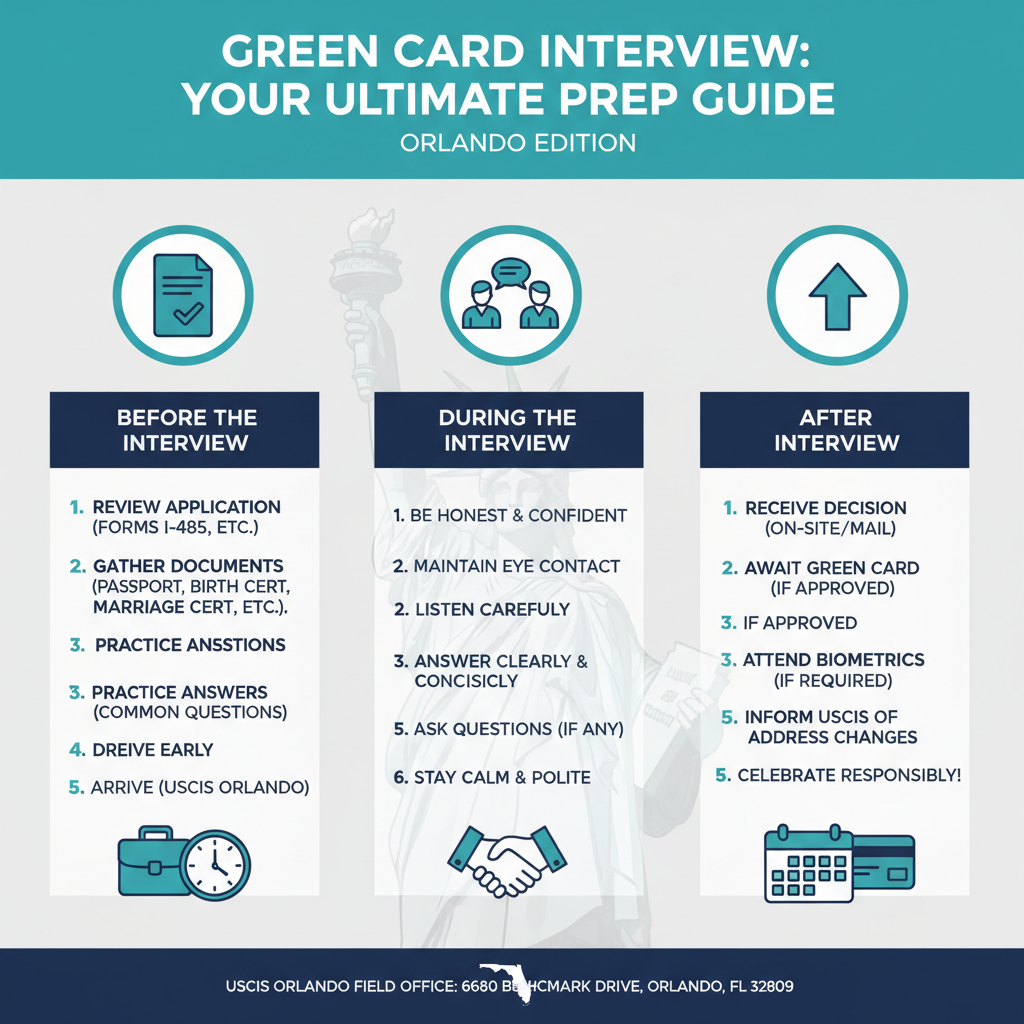
The importance of thorough preparation for your Green Card interview is a consistently highlighted topic in immigration law discussions. Recent reports underscore the continuous focus on interview integrity and applicant readiness, influencing how USCIS processes applications nationwide. This ongoing emphasis from the Green Card Interview Preparation Tips (Immigration Law) serves as a crucial reminder for all applicants to approach this final hurdle with diligence and expert guidance.
What This News Means for Immigrants in Orlando and Across Florida
For immigrants living in Orlando, Central Florida, and throughout the Sunshine State, the ongoing emphasis on Green Card interview preparation is more than just news; it's a direct call to action. Florida is home to a vibrant and diverse immigrant population, and many residents are actively pursuing their dreams of permanent residency. The success of their applications often hinges on how well they navigate the interview process.
Why this news is showing up now
While the Green Card interview itself is a long-standing requirement for most applicants, the topic of preparation tips frequently resurfaces in immigration news for several key reasons:
- Continuous Processing: USCIS continues to process a high volume of Green Card applications, meaning thousands of interviews are conducted daily across the country, including at the Orlando USCIS Field Office. This makes interview preparation an evergreen and essential topic.
- Policy Adjustments: Although the core requirements remain, USCIS policies and procedures can evolve, sometimes subtly affecting the interview process or the scrutiny applied to certain types of cases (e.g., marriage-based interviews).
- Applicant Success Rates: Immigration attorneys and advocacy groups constantly share insights and best practices to improve applicant success rates, recognizing that adequate preparation is a significant factor in avoiding delays or denials.
- Complexity of Cases: As immigration laws become more intricate, applicants often face more complex scenarios, making expert guidance on interview preparation more critical than ever.
How it can affect Florida residents
For individuals residing in Florida, particularly along the bustling I-4 corridor encompassing cities like Orlando, Kissimmee, and Tampa, the implications are direct:
- Local USCIS Field Office: Most Adjustment of Status interviews for Central Florida residents take place at the Orlando USCIS Field Office. Officers at this location are highly experienced, and coming prepared means you can efficiently present your case to them.
- Diverse Case Types: Florida’s diverse population means the Orlando USCIS Field Office handles a wide array of Green Card applications, including family-based, employment-based, asylum-based, and special immigrant cases. Each type requires specific preparation tailored to its unique requirements.
- Increased Scrutiny for Some Cases: While all interviews require diligence, certain categories, such as marriage-based Green Cards, may involve more detailed questioning to establish the bona fides of the relationship. Florida's high volume of such applications means this is a common experience for many.
- Importance of Consistency: For residents of Orange County and surrounding areas, ensuring all documentation and responses are consistent with previous filings is crucial. Any discrepancies, however minor, can lead to Requests for Evidence (RFEs) or even denials, causing significant delays.
At Imigrar, we understand these local nuances and are dedicated to ensuring that our Orlando and Florida-based clients are fully prepared for every aspect of their Green Card interview, helping them navigate the process with confidence and peace of mind.
What Green Card Interview Preparation Is (and Why It Matters)
The Green Card interview is a mandatory step for most individuals seeking to become lawful permanent residents of the United States, whether through Adjustment of Status (applying from within the U.S.) or Consular Processing (applying from abroad). It is the culmination of your application process, providing USCIS with a direct opportunity to verify your eligibility, review your submitted documents, and resolve any potential inconsistencies or concerns.
A plain-English definition
In simple terms, a Green Card Interview is a face-to-face meeting with a USCIS immigration officer. Its primary purpose is to confirm that you meet all the legal requirements to receive a Green Card. Think of it as the final exam for your immigration journey. The officer will ask questions about your application, your background, your family, your finances, and the basis of your eligibility (e.g., your marriage, your job offer, your relationship to a U.S. citizen or Green Card holder). They will also review all the original documents you've submitted and request any missing information.
This interview is not meant to trick you, but to ensure the integrity of the immigration system. It’s your chance to present your case clearly and honestly, demonstrating your eligibility for permanent residency.
Key terms you need to know
Understanding the jargon associated with the Green Card process is crucial for effective preparation. Here are some key terms:
- Green Card: The common name for a Permanent Resident Card, which proves you are authorized to live and work permanently in the United States.
- Adjustment of Status (AOS): The process of applying for a Green Card while physically present in the United States. Most interviews covered in this guide are for AOS applicants.
- Consular Processing: The process of applying for a Green Card through a U.S. embassy or consulate in your home country. This involves an interview abroad.
- USCIS (U.S. Citizenship and Immigration Services): The government agency responsible for overseeing lawful immigration to the United States. They conduct Green Card interviews. (USCIS official website)
- Sponsor: The U.S. citizen or lawful permanent resident who files an immigration petition (e.g., Form I-130) on behalf of a foreign national.
- Beneficiary: The foreign national who is seeking immigration benefits, such as a Green Card.
- Form I-130, Petition for Alien Relative: The form filed by a U.S. citizen or Green Card holder to establish a qualifying relationship with an eligible foreign relative who wishes to immigrate to the United States.
- Form I-485, Application to Register Permanent Residence or Adjust Status: The primary application form filed by an individual seeking to adjust their status to lawful permanent resident while in the U.S.
- Form I-864, Affidavit of Support: A legally binding document signed by the Sponsor to accept financial responsibility for the Beneficiary, ensuring they will not become a public charge.
- Form I-693, Report of Medical Examination and Vaccination Record: The medical exam report required for most Adjustment of Status applicants, completed by a USCIS-approved civil surgeon.
- Form I-797C, Notice of Action: A general notice from USCIS. Your interview notice will typically be a type of Form I-797C, specifying the date, time, and location of your interview.
- Priority Date: The date your immigration petition (e.g., Form I-130) was filed. This date determines when an immigrant visa becomes available for certain categories.
- Request for Evidence (RFE): A letter from USCIS requesting additional documents or information to support your application.
- Public Charge: A person who is likely to become primarily dependent on the government for subsistence, as demonstrated by receiving public cash assistance for income maintenance or long-term institutionalization at government expense.
Need Help? Our Orlando immigration team is ready to assist. Call +1 786-791-3106 for a free consultation, or message us online. Se Habla Español.
Current Immigration Law: The Foundation
The legal framework governing Green Cards and their associated interviews is primarily found within the Immigration and Nationality Act (INA). This foundational law outlines who is eligible for permanent residency, the categories under which they can apply, and the procedures involved, including the interview requirement.
Specifically, Section 245 of the INA (8 U.S.C. § 1255) governs the process of Adjustment of Status for individuals already in the United States. This section details the eligibility criteria, such as having been lawfully admitted or paroled, being admissible to the U.S., and having an immigrant visa immediately available. The interview serves as the primary mechanism for USCIS to verify that these statutory requirements are met.
Federal requirements
At the federal level, USCIS officers conducting Green Card interviews are tasked with verifying several key aspects of an applicant's case:
- Eligibility for the Green Card Category: Whether it's a family-based petition (e.g., through marriage to a U.S. citizen, parent-child relationship), an employment-based petition, or another category, the officer must confirm that the applicant meets all the specific criteria for that category. For family-based petitions, this includes verifying the bona fides of the relationship.
- Admissibility to the United States: Applicants must be admissible to the U.S. This means they must not fall under any grounds of inadmissibility, such as certain criminal convictions, health-related issues, immigration violations, or security concerns. The medical exam (Form I-693) and background checks are crucial here.
- Lack of "Public Charge" Inadmissibility: The officer will assess whether the applicant is likely to become a public charge. This is addressed primarily through the Affidavit of Support (Form I-864), where a sponsor demonstrates sufficient financial resources to support the applicant.
- Truthfulness and Consistency of Information: The interview provides an opportunity to compare verbal testimony with the information and documents submitted in the application forms (e.g., Form I-130, Form I-485). Any inconsistencies can raise red flags and require further explanation.
- Identity Verification: The officer will confirm the applicant's identity using passports and other identification documents.
All federal requirements and forms can be found on the USCIS official website, which is the authoritative source for immigration policies and procedures. It's crucial to refer to USCIS Forms for the most current versions.
Florida-specific considerations
While immigration law is federal, its implementation has local aspects. For those in Florida, particularly Central Florida, the Orlando USCIS Field Office is the primary venue for Adjustment of Status interviews. USCIS officers here are well-versed in the specific challenges and common scenarios that arise from the local population demographics. For example, given the large number of family-based petitions, especially marriage-based applications, officers at the Orlando office are highly skilled at evaluating the authenticity of marital relationships.
There are no Florida-specific immigration laws that directly impact Green Card eligibility or the interview process, as immigration is a federal matter. However, local resources, such as access to legal aid, community support organizations, and experienced immigration attorneys like Imigrar, play a vital role in helping Florida residents navigate these federal requirements successfully. Understanding the local context, such as typical processing times for the Orlando USCIS Field Office (which can be checked via USCIS Processing Times), can help manage expectations.
Reminder: Always ensure you are working with the most current versions of USCIS forms, as they are updated periodically. Failure to use the correct version can lead to rejection or delays.

How to Prepare for Your Green Card Interview: A Complete Step-by-Step Guide
Preparing for your Green Card interview is perhaps the most critical stage of your application process. Thorough preparation can significantly increase your chances of a smooth and successful outcome. Here’s a detailed, step-by-step guide to help you navigate this important milestone.
1) Understand Your Interview Notice (Form I-797C)
The first step begins the moment you receive your interview notice, typically a Form I-797C, Notice of Action. This document is vital and contains all the essential information you need.
- What to Look For:
- Date and Time: Mark it immediately on your calendar. Do not be late.
- Location: For Central Florida residents, this will usually be the Orlando USCIS Field Office. Confirm the full address and plan your travel.
- Required Documents: The notice will include a list of documents you must bring. This list is crucial and should be your primary checklist.
- Applicant(s) Required: It will specify who must attend (e.g., both spouses for a marriage-based petition).
- Actionable Advice:
- Read the notice carefully and completely.
- If you need to reschedule, contact USCIS immediately. Rescheduling can significantly delay your case.
- If you are unsure about any detail on the notice, consult with an immigration attorney promptly.
2) Gather and Organize All Required Documents
This is arguably the most intensive part of your preparation. You must bring all original documents, along with a complete set of photocopies, even if you submitted them previously. The interview notice will provide a specific list, but generally, you should prepare the following:
- Interview Notice: Your original Form I-797C.
- Identification:
- Valid passport (and any expired passports you used to enter the U.S.).
- Driver's license or state ID (especially for Florida residents).
- Any other government-issued photo identification.
- Application Forms:
- A complete copy of your filed Form I-130 (if applicable) and Form I-485, along with all supporting documents you originally submitted.
- Copies of Form I-864, Affidavit of Support, and all supporting financial documents (tax returns, W-2s, bank statements, employment verification letters) for the sponsor and any joint sponsors.
- Your original Form I-693, Report of Medical Examination and Vaccination Record, sealed in an envelope, if you haven't already submitted it.
- Civil Documents:
- Original birth certificates (for you, your spouse, and any children included in the application).
- Original marriage certificate (if applicable).
- Divorce decrees or death certificates for any previous marriages of you or your spouse (if applicable).
- Original adoption decrees (if applicable).
- Proof of Relationship (for Family-Based Petitions, especially Marriage-Based):
- Joint bank accounts statements.
- Joint lease agreements or mortgage statements.
- Utility bills in both names.
- Insurance policies showing each other as beneficiaries.
- Birth certificates of any children born to the marriage.
- Photos together (wedding, holidays, everyday life, with family/friends) – organize them with dates/names.
- Affidavits from friends/family attesting to the bona fides of your relationship.
- Travel itineraries, hotel bookings for trips taken together.
- Any other evidence proving your relationship is genuine and ongoing.
- Financial Documents:
- Updated employment verification letters and recent pay stubs for you and your sponsor.
- Evidence of assets (bank statements, property deeds).
- Immigration History Documents:
- Entry/Exit records (I-94 arrival/departure records).
- Previous immigration petitions or applications.
- Any notices or decisions from USCIS or immigration court.
- Photographs: Two U.S. passport-style photos, even if you submitted them previously.
Important: Organize your documents in a binder with tabs for easy access. Keep originals separate from copies. This demonstrates preparedness and efficiency to the officer.
3) Review Your Application Forms Thoroughly
Before the interview, you and your attorney should meticulously review every answer on your Form I-130, Form I-485, and all other submitted forms. The interviewing officer will have these forms in front of them and will base many questions on the information provided.
- Know Your Answers: Be familiar with every detail you submitted, including dates, addresses, employment history, and answers to "yes/no" questions about your background.
- Consistency is Key: Ensure your verbal answers match the written information on your forms. Any discrepancies, even minor ones, can raise suspicion and prolong the interview. If there's an error, be prepared to explain it clearly and truthfully.
- Understand the "Why": Don't just memorize answers. Understand the context and reasons behind your responses. For instance, if you listed a previous address, be ready to explain why you moved.
4) Practice Answering Potential Questions
While you can't predict every question, many common themes arise in Green Card interviews. Practicing can help you feel more comfortable and confident.
- General Questions:
- "What is your full name, date of birth, and place of birth?"
- "What is your current address?"
- "How did you enter the U.S.?"
- "Have you ever been arrested or convicted of a crime?" (Be honest, and if applicable, bring certified court dispositions).
- "Have you ever been deported or removed from the U.S.?"
- For Marriage-Based Interviews: Be prepared for detailed questions about your relationship. Both spouses will be questioned, sometimes separately, to verify the authenticity of the marriage.
- "How did you meet?"
- "When and where did you get married?"
- "Describe your wedding day."
- "What does your spouse do for work?"
- "What did you do last weekend together?"
- "What are your spouse's parents' names?"
- "Who wakes up first in the morning?"
- "What side of the bed do you sleep on?"
- "What is your favorite meal to cook/eat together?"
- Actionable Advice:
- Practice with a trusted friend, family member, or your attorney.
- Focus on clear, concise, and truthful answers.
- Avoid volunteering unnecessary information. Answer the question asked, and then stop.
5) Prepare for the Interview Day Logistics
The day of the interview requires careful planning to ensure you arrive prepared and on time.
- Arrive Early: Plan to arrive at the Orlando USCIS Field Office at least 30-45 minutes before your scheduled appointment. This allows time for parking, security checks, and finding the correct waiting area. Being late can lead to rescheduling, causing significant delays.
- Dress Appropriately: While there's no formal dress code, dressing in neat, conservative attire (business casual) projects respect for the process and the interviewing officer.
- Bring an Attorney: While not mandatory, having an experienced immigration attorney from Imigrar accompany you to the interview is highly recommended. Your attorney can provide support, clarify questions, and intervene if necessary to protect your rights. For residents in Orlando, having local representation is invaluable.
- Bring a Translator (if needed): If you are not fluent in English, you must bring a certified interpreter. Your attorney cannot act as your interpreter. Inform USCIS in advance if you need one, or ensure your chosen interpreter is qualified and present.
6) During the Interview: What to Expect
The interview itself can be nerve-wracking, but knowing what to expect can ease some of the tension.
- Take an Oath: You will be asked to swear or affirm that your testimony will be truthful.
- Be Honest and Truthful: This is paramount. Providing false information can lead to severe penalties, including a permanent bar from the U.S.
- Answer Clearly and Concisely: Listen carefully to each question. If you don't understand a question, politely ask the officer to repeat or rephrase it. Do not guess.
- Maintain a Respectful Demeanor: Be polite and cooperative. Avoid arguing with the officer.
- Your Attorney's Role: Your Imigrar attorney will be there to advise you, ensure proper procedure is followed, and address any legal issues that may arise. They can also help clarify questions if there's a misunderstanding.
7) Post-Interview Actions
The interview doesn't always end with an immediate decision. Be prepared for follow-up steps.
- Immediate Decision: Sometimes, the officer will approve your application on the spot, or inform you that it will be approved shortly.
- Request for Evidence (RFE): If the officer needs more documents or information, they will issue an RFE. Respond promptly and thoroughly by the specified deadline. Your attorney can help you compile and submit the required evidence.
- Notice of Intent to Deny (NOID): In more serious cases, USCIS might issue a NOID, giving you a chance to rebut the grounds for denial. This is a critical stage where legal representation is essential.
- Decision by Mail: Most decisions are mailed to you within a few weeks or months. You can check your case status online via the USCIS Case Status Online tool.
Warning: Never leave the interview without asking if there's anything else needed or if you should expect further communication. If you received an RFE, ensure you understand exactly what is required.
Need Help? Our Orlando immigration team is ready to assist. Call +1 786-791-3106 for a free consultation, or message us online. Se Habla Español.
Related Articles
You may also be interested in:
-
EAD Processing Updates: Your Guide to Employment Authorization
Understand the latest USCIS updates on Employment Authorization Documents (EADs). Get practical advice, timelines, and expert guidance from Imigrar to...
-
TPS Extension Alert 2026: Critical Updates for Florida Immigrants
Stay informed on recent TPS extensions affecting thousands in Florida. Learn who qualifies, how to re-register, and secure your status with Imigrar's ...
-
Critical New Changes: Only 10 Days to Appeal Asylum Cases [2026]
Understand the critical new changes for asylum appeals in 2026. You may have only 10 days to appeal to the BIA for most asylum cases. Get expert help ...
-
Critical New Rule: Only 10 Days to Appeal Asylum Cases [2026]
Urgent changes to asylum appeals in 2026 mean only 10 calendar days to file. Understand the critical new rules and how Imigrar in Orlando, Florida, ca...


