
DACA Renewal Guide: Updates & Protecting Your Status in Orlando
Stay informed on DACA program updates and renewal requirements. Imigrar provides crucial guidance for Dreamers in Orlando and across Florida to protect their status.

The landscape of immigration law is constantly shifting, and for beneficiaries of the Deferred Action for Childhood Arrivals (DACA) program, staying informed is not just important – it's crucial for maintaining their status and future. At Imigrar, we understand the anxieties and uncertainties that come with these changes. Our mission is to provide clear, actionable guidance to help you navigate these complexities, keeping families together.
Is your DACA status nearing expiration? Don't risk losing your protections. Our experienced Orlando immigration team specializes in DACA renewals and is ready to assist. Call +1 786-791-3106 for a free consultation, or message us online. Se Habla Español.
The reporting that sparked this guide:
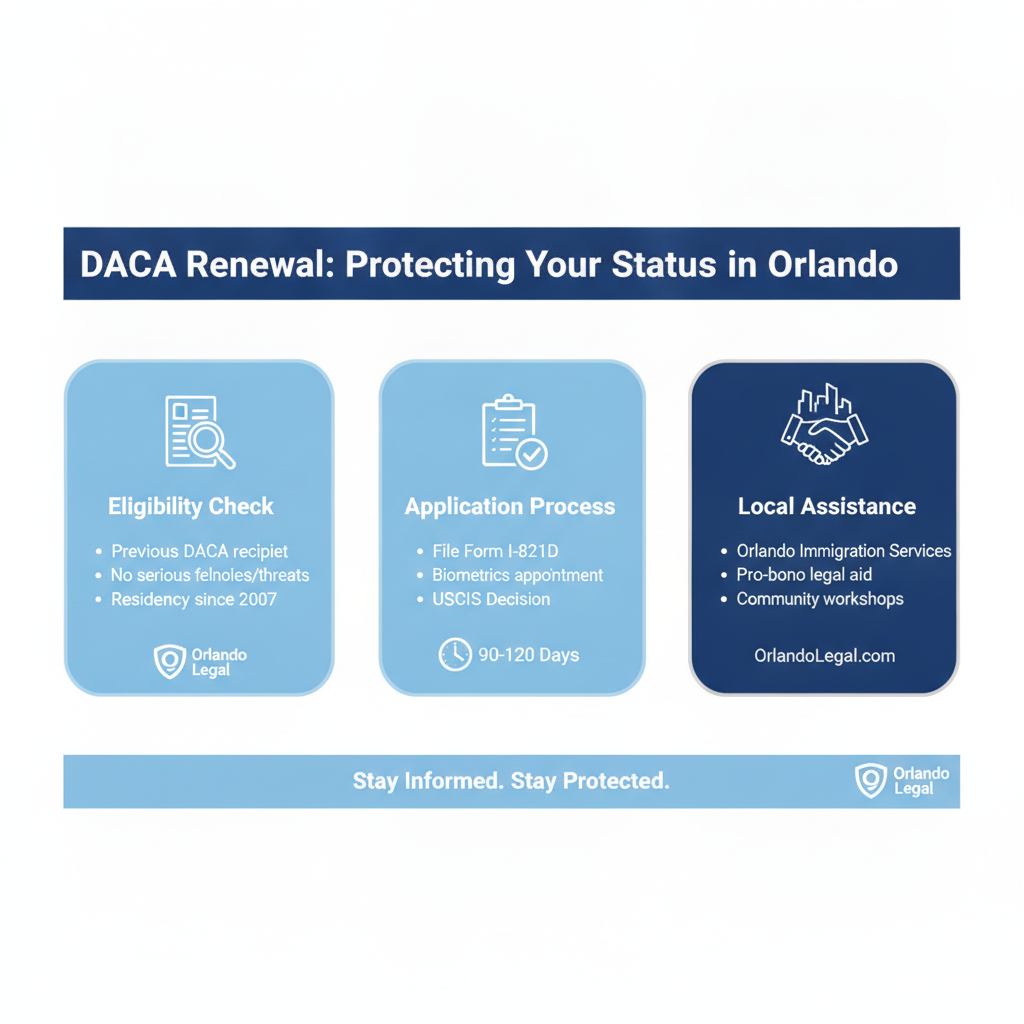
DACA Program Updates and Renewal Information (USCIS)
What This News Means for Immigrants in Orlando and Across Florida
The news cycle regarding the DACA program is a constant ebb and flow, often filled with legal challenges and policy adjustments. For the hundreds of thousands of DACA recipients, including the significant population here in Florida, these updates are not abstract legal discussions but direct impacts on their lives, their families, and their ability to live and work in the United States.
Why this news is showing up now
The DACA program, originally established in 2012, has faced continuous legal and political challenges. Today, 2026-10-19, the program remains under intense scrutiny, primarily due to ongoing litigation. A federal court ruling in Texas v. United States has declared the DACA program unlawful, preventing U.S. Citizenship and Immigration Services (USCIS) from approving new, initial DACA applications. However, USCIS is permitted to continue accepting and processing DACA renewal requests, as well as associated applications for employment authorization (EADs) and advance parole.
This ongoing legal battle means that DACA's future, particularly for those who have never applied before, remains uncertain. The current news often reflects the latest court orders, directives from the Department of Homeland Security (DHS), and USCIS guidance on how to proceed under these constraints. It’s a delicate balance of maintaining the status quo for existing recipients while awaiting a more permanent legislative or judicial resolution.
For DACA recipients, this means a heightened sense of urgency and diligence is required for renewals. Any delay or mistake could put their deferred action status and work authorization at risk, especially given the unpredictable nature of future court decisions.
How it can affect Florida residents
Florida is home to a substantial number of DACA recipients, often referred to as Dreamers. Many of these individuals contribute significantly to our state’s economy, work in essential industries, pursue higher education, and are deeply integrated into their communities. For them, the ability to renew their DACA status is paramount. Losing DACA protections would mean:
- Loss of Employment Authorization: Without a valid Employment Authorization Document (EAD), DACA recipients would lose the legal right to work, impacting their ability to support themselves and their families, pay taxes, and contribute to Florida’s economy. This is particularly critical in economic hubs like Orlando, where DACA recipients are employed across various sectors.
- Risk of Deportation: DACA provides temporary protection from deportation. Without it, recipients could be subject to removal proceedings, tearing families apart and disrupting lives built over decades in the U.S.
- Impact on Education and Driver's Licenses: While Florida has complex rules regarding in-state tuition for DACA recipients, maintaining DACA status often facilitates access to educational opportunities and the ability to obtain a driver's license, which is essential for daily life and employment, especially for those commuting along the I-4 corridor.
- Uncertainty and Stress: The constant legal flux creates immense stress and uncertainty for DACA recipients and their families in Central Florida and beyond, affecting mental health and long-term planning.
For Central Florida residents, particularly those in Orlando and Orange County, understanding these updates and acting decisively on renewals is critical. The Orlando USCIS Field Office processes many of these applications, and local knowledge of procedures and support networks can make a significant difference.
What DACA Is (and Why It Matters)
To fully grasp the importance of current DACA updates, it's essential to understand the program itself and why it holds such significance for hundreds of thousands of individuals across the nation.
A plain-English definition
DACA stands for Deferred Action for Childhood Arrivals. It is an executive policy implemented by the Department of Homeland Security (DHS) in June 2012. DACA provides certain eligible undocumented young people who came to the United States as children with two main benefits:
- Deferred Action: This means that for a specific period (typically two years), the government agrees to "defer" or postpone any deportation action against these individuals. It does not grant lawful status but rather provides temporary relief from removal.
- Work Authorization: Along with deferred action, eligible individuals can apply for and receive an Employment Authorization Document (EAD), which allows them to legally work in the U.S.
Important: DACA is not a pathway to U.S. citizenship or a Green Card. It is a temporary, renewable program that offers a measure of stability and opportunity to young immigrants who grew up in the United States, often knowing no other home.
Key terms you need to know
- Deferred Action: A discretionary determination by DHS to defer removal action against an individual. It does not confer lawful status.
- Dreamers: A term often used to refer to young undocumented immigrants who were brought to the U.S. as children. While DACA recipients are a subset of Dreamers, not all Dreamers qualify for DACA.
- Employment Authorization Document (EAD): Also known as a work permit, this card proves an individual is authorized to work in the United States. It is typically valid for two years for DACA recipients.
- USCIS (U.S. Citizenship and Immigration Services): The government agency responsible for overseeing lawful immigration to the United States, including processing DACA applications.
- Initial Application: The first time an individual applies for DACA. Due to court orders, USCIS is currently not processing these.
- Renewal Application: The process by which current DACA recipients apply to extend their deferred action and work authorization for another two years. These are currently being processed.
- Advance Parole: A document issued by USCIS that allows a DACA recipient to travel outside the U.S. and return lawfully. It is granted for humanitarian, educational, or employment purposes.
Feeling overwhelmed by DACA regulations? Imigrar can help simplify the process for you. Our Orlando-based legal team is here to answer your questions and guide you through your DACA renewal. Call +1 786-791-3106 for a free consultation. Se Habla Español.
Current Immigration Law: The Foundation of DACA
Understanding DACA requires a grasp of its unique legal standing. It is not a statutory law passed by Congress, but rather an exercise of executive discretion by the Department of Homeland Security (DHS). This distinction is key to why it has been subject to so many legal challenges.
The original DACA policy was established through a memorandum issued by then-Secretary of Homeland Security Janet Napolitano on June 15, 2012. This memo outlined the criteria for deferred action and work authorization. In 2022, DHS published a DACA Final Rule, codifying the program into federal regulations (8 CFR Part 236.21-25) in an attempt to solidify its legal footing. However, this rule is also subject to the ongoing litigation in Texas v. United States, which has found the DACA program unlawful and vacated the 2012 memo. The court's order, however, allowed the existing DACA program to continue for current recipients, pending further appeals.
Federal requirements for DACA Renewal
As of 2026-10-19, USCIS continues to accept and process DACA renewal applications. To be eligible for a DACA renewal, you must meet the following criteria, consistent with the 2012 DACA memorandum and the 2022 DACA Final Rule:
- You must have previously received DACA.
- You must not have departed the United States on or after August 15, 2012, without first obtaining advance parole.
- You must have continuously resided in the United States since you submitted your most recent DACA request that was approved.
- You must not have been convicted of a felony, a significant misdemeanor, or three or more other misdemeanors, and not otherwise pose a threat to national security or public safety.
Reminder: The original eligibility criteria for DACA, such as having arrived in the U.S. before age 16 and having resided continuously since June 15, 2007, still form the basis for initial eligibility. While these are not re-evaluated in the same way for renewals, any significant changes to your life circumstances (e.g., criminal convictions, extended unauthorized travel) could jeopardize your renewal.
For DACA renewals, applicants must submit:
- Form I-821D, Consideration of Deferred Action for Childhood Arrivals
- Form I-765, Application for Employment Authorization
- Form I-765WS, Worksheet (for demonstrating economic necessity for employment)
It is crucial to use the most current versions of these forms, available on the USCIS Forms page. Always double-check the edition date.
Florida-specific considerations
While DACA is a federal program, its impacts resonate at the state level, particularly in Florida. Here's how DACA status can interact with Florida state policies:
- Driver's Licenses: DACA recipients in Florida are generally eligible to obtain a Florida driver's license, provided they have a valid EAD and meet all other state requirements. This is a crucial benefit for mobility and employment across Central Florida, from Orlando to Tampa.
- In-State Tuition: Florida has a complex system regarding in-state tuition for undocumented students, including DACA recipients. While some DACA recipients may qualify for in-state tuition at public universities and colleges under specific circumstances (e.g., if they attended high school in Florida for a certain number of years), it is not automatically granted simply by having DACA. This requires careful consultation with university admissions and financial aid offices.
- Professional Licenses: The ability to obtain professional licenses (e.g., nursing, real estate) for DACA recipients varies by profession and state. In Florida, DACA status can often facilitate obtaining certain occupational licenses, but applicants must meet all other state-specific educational and experiential requirements.
It's important for DACA recipients in Florida to understand that state laws and policies can change, and it's always best to verify current regulations with relevant state agencies or an experienced immigration attorney. For detailed information on federal requirements, always refer to the USCIS official website.
How to Renew Your DACA: A Complete Step-by-Step Guide
Renewing your DACA status is a critical process that requires precision and timely action. Given the ongoing legal challenges, it's more important than ever to ensure your application is complete and accurate. This guide focuses on the renewal process, as initial DACA applications are currently not being processed by USCIS.
1) Determine Your Eligibility for Renewal
Before you begin, confirm you meet the core DACA renewal criteria:
- You previously received DACA.
- You have not left the U.S. without advance parole since August 15, 2012.
- You have continuously resided in the U.S. since your last DACA approval.
- You have not been convicted of a felony, a significant misdemeanor, or three or more other misdemeanors.
- You do not pose a threat to national security or public safety.
Warning: USCIS recommends filing your renewal application within 120 to 150 days (approximately 4 to 5 months) before your current DACA and EAD expire. Filing too early might result in rejection, and filing too late could lead to a lapse in your work authorization and deferred action.
2) Gather Required Documents
Thorough documentation is key. While USCIS generally relies on your previous application for background information, you must still provide current evidence. Here's a checklist:
- Most Recent DACA Approval Notice (Form I-797) and Employment Authorization Document (EAD).
- Proof of Identity: Copy of your birth certificate, passport, or national identity document with photograph.
- Proof of Continuous Residence: While not always explicitly requested for renewals, be prepared to show evidence if there's any doubt. This could include school transcripts, employment records, tax returns, utility bills, bank statements, or rental agreements covering the period since your last DACA approval.
- Travel History: If you traveled outside the U.S. with Advance Parole since your last DACA approval, include copies of your passport entry/exit stamps and your approved Form I-131, Application for Travel Document.
- Criminal History: If you have had any arrests, charges, or convictions (even minor ones) since your last DACA approval, you must include certified court dispositions for each incident. Full disclosure is critical.
- Current Passport-style Photos: Two identical, unmounted, color passport-style photographs taken within 30 days of filing. Write your name and A-number (Alien Registration Number) lightly on the back of each photo.
Important: Always make copies of all documents you submit for your records.
3) Complete and File Forms I-821D, I-765, and I-765WS
These are the primary forms for your DACA renewal. Ensure you use the latest versions from USCIS Forms.
- Form I-821D, Consideration of Deferred Action for Childhood Arrivals:
- Fill out every section completely and accurately. If a section doesn't apply, write "N/A" (Not Applicable) or "None."
- Ensure consistency with your previous DACA application, unless there are specific updates (e.g., new address, new criminal history).
- Sign and date the form. An unsigned form will be rejected.
- Form I-765, Application for Employment Authorization:
- For DACA renewals, the eligibility category is (c)(33).
- Complete all sections. Pay close attention to your name, address, and A-number.
- Sign and date the form.
- Form I-765WS, Worksheet:
- This worksheet is required to demonstrate your economic necessity for employment.
- Provide a detailed explanation of your financial needs and how employment contributes to meeting those needs (e.g., housing, food, medical expenses, education).
Tip for Orlando residents: If you're unsure about any section, especially regarding addresses or travel, consulting with an immigration attorney at Imigrar can prevent costly errors.
4) Pay the Required Fees
As of 2026-10-19, the total filing fee for a DACA renewal is $495. This includes:
- $85 for the biometric services fee (for fingerprinting).
- $410 for the Form I-765 (Application for Employment Authorization).
- There is no separate fee for Form I-821D.
Acceptable Payment Methods:
- Personal check, cashier's check, or money order payable to "U.S. Department of Homeland Security." Do NOT use abbreviations.
- You can also pay by credit card using Form G-1450, Authorization for Credit Card Transactions.
Fee Waivers: Fee waivers for DACA renewals are extremely rare and generally only granted in very limited circumstances, such as being under 18, homeless, having a serious disability, or accumulating medical debt. Do not assume you qualify for a fee waiver without clear guidance from USCIS or an attorney.
5) Prepare and Mail Your Application Package
Organization is crucial for your submission:
- Order: Assemble your application package in the order USCIS prefers (often listed on their forms page or general filing tips). Generally, it's Fee, G-1450 (if applicable), I-821D, I-765, I-765WS, and then supporting documentation.
- Copies: Send copies of supporting documents, not originals, unless specifically requested.
- Cover Letter: While not strictly required, a simple cover letter listing the forms and documents included can be helpful.
- Mailing Address: Send your application to the correct USCIS Lockbox facility. The address depends on your state of residence. For Florida residents, you will typically mail to the USCIS Chicago Lockbox. Check the USCIS official website for the most current mailing addresses for DACA applications.
- Shipping: Use a reputable mail service that provides tracking (e.g., USPS Certified Mail with return receipt, FedEx, UPS). This provides proof of mailing and delivery.
6) Attend Biometrics Appointment (If Required)
After filing, USCIS will send you a Form I-797C, Notice of Action, confirming receipt of your application. If USCIS cannot reuse your previous biometrics, you will receive a separate appointment notice (Form I-797C, Notice of Action) for a biometrics (fingerprinting) appointment at an Application Support Center (ASC).
- What to Bring: Your appointment notice, a valid photo ID (like your EAD or Florida driver's license), and any other documents specified in the notice.
- Purpose: Biometrics are used for background checks.
- Orlando ASC: If you reside in Orlando, your appointment will likely be at the local ASC.
Reminder: It’s common for USCIS to reuse biometrics for DACA renewals, meaning you might not receive an appointment notice. This is normal and doesn't mean there's an issue with your application.
7) Monitor Your Case Status and Respond to RFEs
After your application is filed:
- USCIS Online Tools: Use the receipt number from your Form I-797C to track your case status online at USCIS Processing Times.
- Request for Evidence (RFE): If USCIS needs more information or clarification, they will send you an RFE. It's crucial to respond fully and within the specified deadline. Failure to do so can lead to a denial.
- Notice of Intent to Deny (NOID): In some cases, USCIS may issue a NOID, giving you an opportunity to explain why your application should not be denied.
- Approval: If your renewal is approved, you will receive a new Form I-797 (Approval Notice) and your new EAD card in the mail.
Important: Always update your address with USCIS using Form AR-11 if you move, especially if you relocate within Orlando or to another part of Florida. Missing important notices can severely impact your case.
Practical Steps You Can Take Today to Protect Your DACA
Proactive planning is your best defense against potential issues with your DACA renewal. Here’s an actionable checklist and practical advice:
Actionable Checklist (5+ items):
- Check Your DACA Expiration Date: Mark your calendar for 150 days before your DACA and EAD expire. This is your target filing window.
- Start Gathering Documents Early: Don't wait until the last minute. Begin collecting all necessary documents now, especially certified court dispositions if you have any new criminal history.
- Save Copies of Everything: Create a physical and/or digital folder for all your immigration documents. Keep copies of your submitted application package, payment receipts, and all correspondence from USCIS.
- Consult an Immigration Attorney: If you have any doubts about your eligibility, any changes in your criminal history, or if you need help preparing your application, seek legal counsel. An attorney can ensure accuracy and completeness.
- Update Your Address with USCIS: If you've moved since your last DACA approval, file Form AR-11, Alien's Change of Address Card, and update your address online with USCIS immediately. This prevents missing crucial notices.
- Monitor USCIS Processing Times: Regularly check the USCIS Processing Times page for the service center handling DACA renewals to get an estimate of how long your application might take.
- Review Your Criminal Record: Obtain a copy of your criminal record to ensure there are no surprises that could jeopardize your DACA renewal.
Document Preparation Guidance:
- Organize Chronologically: Arrange supporting documents in a logical, chronological order. Use tabs or dividers if your application package is extensive.
- Clarity and Legibility: Ensure all copies are clear and legible. If an original document is difficult to read, consider getting a certified copy.
- Translation: Any document not in English must be accompanied by a complete English translation and a certification by the translator that the translation is accurate and that the translator is competent to translate from the foreign language into English.
- Secure Storage: Keep all original documents in a safe and accessible place, separate from the copies you send to USCIS. Consider a fireproof safe or a secure cloud storage solution for digital copies.
Timeline Expectations:
While USCIS aims to process DACA renewals within a reasonable timeframe, actual processing times can vary significantly. As of 2026-10-19:
- Filing Window: File between 120 to 150 days before your DACA/EAD expires.
- Receipt Notice: You should receive a receipt notice (Form I-797C) within 2-4 weeks after USCIS receives your application.
- Biometrics Appointment: If required, an appointment notice typically arrives 3-8 weeks after filing. The appointment itself will be scheduled a few weeks after the notice.
- Processing Time: DACA renewal processing typically takes 3-6 months. However, it can sometimes be shorter or longer depending on the USCIS service center workload and individual case complexities. Check USCIS Processing Times for the most up-to-date estimates.
- Decision and EAD Delivery: Once approved, your new EAD card usually arrives within 2-4 weeks after the approval notice.
Important: If your EAD expires while your renewal application is pending, you are not authorized to work until your new EAD is approved and received. Plan accordingly to avoid gaps in employment.

How Imigrar Helps DACA Recipients in Orlando and Beyond
Navigating the DACA renewal process, especially with the current legal uncertainties, can be daunting. At Imigrar, our dedicated team understands the unique challenges faced by Dreamers in Orlando, Central Florida, and across the nation. Our goal is to provide peace of mind and expert legal guidance, ensuring your application is meticulously prepared and submitted.
Our Experience and Expertise
Imigrar has extensive experience in immigration law, with a particular focus on DACA renewals. Our attorneys stay abreast of every legal development, court ruling, and USCIS policy change affecting the program. We offer:
Related Articles
You may also be interested in:
-
Family-Based Green Cards: Your Orlando Guide (2026 Update)
Navigate the family-based immigration petition process with Imigrar's expert guide. Learn eligibility, steps, and how to keep your family together in ...
-
H-1B Lottery Changes FY2027: A New Era for U.S. Immigration
Understand the significant H-1B visa lottery changes for FY2027, focusing on the new beneficiary-centric selection process. Imigrar guides you through...
-
TPS Extended: Crucial Updates for Florida Immigrants in 2026
Major TPS extensions announced in late 2026 bring hope and crucial deadlines for immigrants in Florida. Understand eligibility, re-registration steps,...
-
Navigating USCIS Processing Times and Updates for 2026: Your
Understand the latest USCIS processing time updates for 2026 and how they impact immigrants in Orlando and nationwide. Get practical advice, timelines...
Related Topics
Need Legal Assistance?
Our experienced immigration attorneys are here to help with your case. Contact Imigrar today for a free consultation and let us guide you through the legal process with confidence.
📍 Orlando, Florida • Serving clients nationwide
📧 info@imigrar.com