
The reporting that sparked this guide: DACA Program Updates and Renewal Information (USCIS)
What This News Means for Immigrants in Orlando and Across Florida
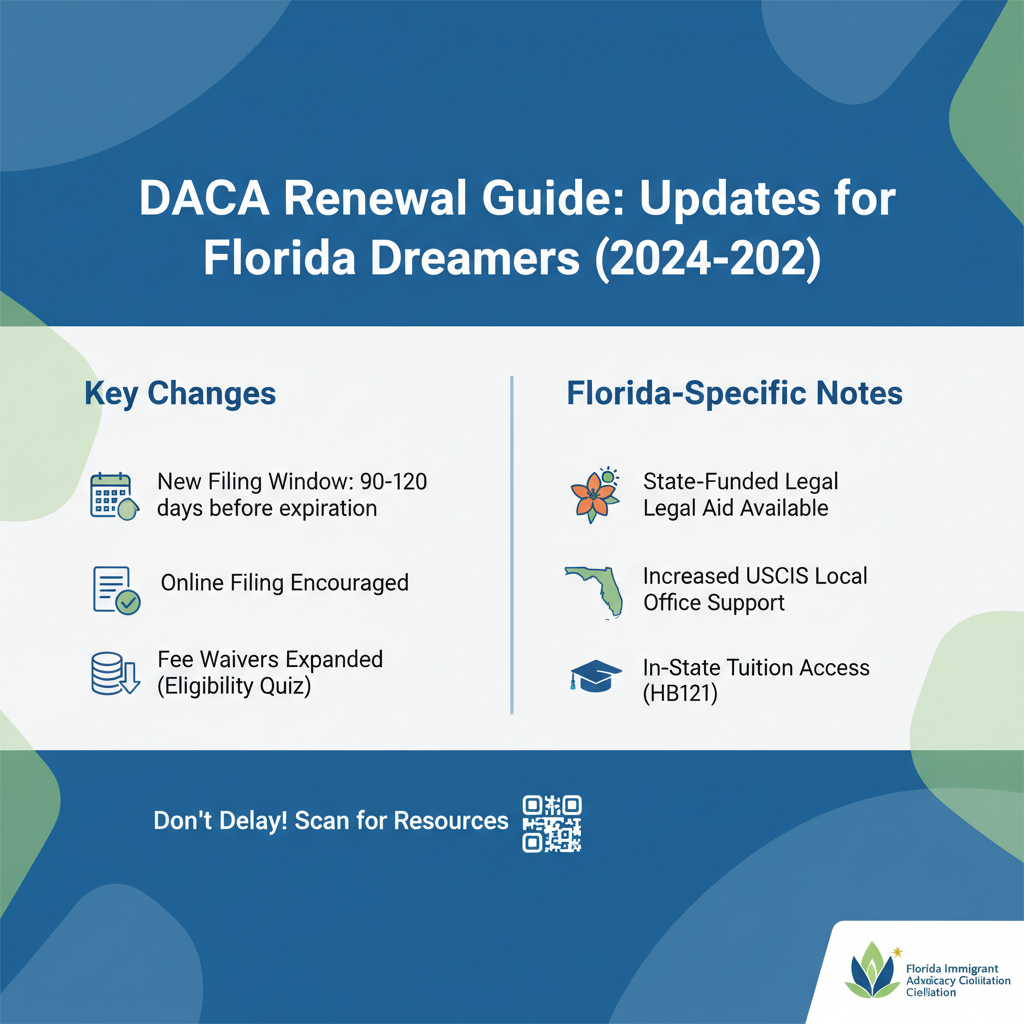
For hundreds of thousands of young immigrants across the United States, including countless individuals and families who call Orlando and the greater Florida area home, the Deferred Action for Childhood Arrivals (DACA) program represents a lifeline. It offers protection from deportation and the opportunity to work legally. However, DACA has been a program constantly navigating legal challenges and policy shifts since its inception. Staying informed about the latest updates from USCIS is not just advisable; it's absolutely critical for maintaining your status and planning your future.
Why this news is showing up now
The DACA program has been embroiled in legal battles almost continuously since its creation in 2012. As of early 2026, the program's future remains a subject of ongoing litigation, primarily stemming from the October 2022 decision by the U.S. Court of Appeals for the Fifth Circuit. This ruling affirmed a Texas federal judge's 2021 decision that DACA is unlawful, but importantly, it allowed current DACA recipients to continue renewing their status and for USCIS to process those renewal applications. However, it continues to bar USCIS from approving new DACA applications from individuals who have never before been granted DACA.
This legal landscape means that every administrative update, every court filing, and every statement from the Department of Homeland Security (DHS) or USCIS regarding DACA becomes significant news. These updates often focus on the procedural aspects of renewals, clarifying eligibility for existing recipients, or addressing the implications of potential future court decisions. The constant state of flux generates continuous news cycles, making it essential for individuals to seek reliable, current information.
How it can affect Florida residents
Florida is home to one of the largest immigrant populations in the United States, and a significant number of these individuals are DACA recipients, often referred to as "Dreamers." For those living in Orlando, Central Florida, and across the state, the ongoing legal and administrative status of DACA has profound implications:
- Uncertainty and Anxiety: The constant legal challenges create immense stress and uncertainty for DACA recipients and their families, impacting their ability to plan for education, careers, and family life.
- Renewal is Key: For current DACA recipients in Florida, the news reinforces the critical importance of timely and accurate renewal of their DACA status and Employment Authorization Document (EAD). Failure to renew can lead to a lapse in protection and work authorization, with potentially severe consequences.
- No New Applicants: The current injunction means that young people in Florida who meet DACA criteria but have never been approved for DACA cannot apply at this time. This leaves a significant portion of the undocumented youth population in limbo.
- Economic Impact: DACA recipients contribute significantly to Florida's economy, working in various sectors from tourism in Orlando to agriculture. Any disruption to their ability to work legally could have a ripple effect across the state.
- Local Policies: While DACA is a federal program, state and local policies can affect DACA recipients. For instance, debates around in-state tuition for undocumented students or access to professional licenses can be influenced by their DACA status.
For Central Florida residents, staying updated on DACA is not just about federal policy; it's about understanding how these changes can impact their daily lives, their access to education, their employment opportunities, and their overall sense of security in their communities, including those along the I-4 corridor and throughout Orange County.
Need Help? Navigating DACA renewals can be complex, especially with constant legal changes. Our Orlando immigration team is ready to assist. Call +1 786-791-3106 for a free consultation, or message us online. Se Habla Español.
What DACA Is (and Why It Matters)
The Deferred Action for Childhood Arrivals (DACA) program is an administrative relief program established by the Department of Homeland Security (DHS) in June 2012. It offers certain undocumented young people who came to the United States as children a temporary form of protection from deportation and the ability to obtain work authorization.
A plain-English definition
Imagine you were brought to the U.S. as a child, grew up here, went to school here, and consider this country your home, but you don't have legal immigration status. DACA was created to offer these young people a chance to live, study, and work here without constant fear of being deported. It's not a path to citizenship or a green card, but it provides a temporary, renewable two-year period of deferred action, meaning the government agrees not to pursue your removal from the U.S. During this time, you can also apply for an Employment Authorization Document (EAD), which allows you to legally work in the U.S.
The DACA program recognizes that these individuals, often called Dreamers, are deeply integrated into American society. They are our neighbors, friends, students, and colleagues. Providing them with temporary stability allows them to contribute more fully to their communities and the economy, without the constant threat of being separated from their families and the only home they've ever known.
Key terms you need to know
Understanding the DACA program requires familiarity with several key terms:
- Deferred Action: This is the core benefit of DACA. It means that the U.S. government has decided to postpone or "defer" any action to remove an individual from the country. It is a discretionary grant and does not confer lawful immigration status or provide a path to citizenship.
- Employment Authorization Document (EAD): Also known as a work permit, this is a card issued by USCIS that allows non-citizens to work legally in the United States. DACA recipients are eligible to apply for an EAD, typically valid for two years, coinciding with their deferred action period.
- Dreamers: This term refers to young undocumented immigrants who were brought to the U.S. as children. It often specifically refers to those who would be eligible for the never-passed DREAM Act, which DACA was intended to partially address.
- USCIS (U.S. Citizenship and Immigration Services): This is the federal agency responsible for administering the country's lawful immigration system. USCIS processes DACA applications and renewals. You can find official information and forms on the USCIS official website.
- Biometrics: These are unique physical characteristics (like fingerprints, photographs, and signatures) collected by USCIS to confirm identity and conduct background checks. DACA applicants and renewers are typically required to attend a biometrics appointment.
- Advance Parole: This is a travel document that allows certain non-citizens, including DACA recipients, to travel abroad and return to the U.S. legally. It must be approved by USCIS before travel. Warning: Travel without advance parole can lead to serious immigration consequences, including being barred from re-entry.
DACA matters because it allows hundreds of thousands of individuals to pursue higher education, secure better jobs, start businesses, and contribute taxes, all while living openly without fear. It stabilizes families, many of whom are mixed-status, meaning some members are citizens or have legal status while others are not. For Florida, and specifically for vibrant communities like Orlando, DACA recipients are integral to the social and economic fabric, and their ability to thrive directly benefits the entire state.
Current Immigration Law: The Foundation
It's crucial to understand that DACA itself is not a law enacted by Congress but rather an exercise of prosecutorial discretion by the executive branch. It was implemented through a memo from the Secretary of Homeland Security. This administrative nature is precisely why it has been subject to continuous legal challenges and policy changes, unlike statutory immigration programs.
The core legal framework influencing DACA's current status stems from specific court rulings rather than new legislation. The most recent significant development as of 2026-03-10 is the U.S. Court of Appeals for the Fifth Circuit's October 2022 decision in Texas v. United States. This ruling upheld a lower court's finding that the 2012 DACA memorandum was unlawfully created. However, the court sent the case back to the lower court to consider a new DACA rule issued by the Biden administration in 2022. Importantly, the Fifth Circuit's order maintained the existing injunction, which means:
- USCIS can continue to accept and process DACA renewal applications.
- USCIS cannot approve new DACA applications from individuals who have never before received DACA.
- The terms and conditions of DACA, as they existed prior to July 16, 2021, continue to apply for current recipients.
This means that while the program for new applicants is paused, for current DACA recipients, the administrative process for renewal remains active and vital.
Federal requirements
To be eligible for DACA (and thus for renewal), applicants must generally meet the following federal criteria, which were established in the original 2012 memo and reinforced by subsequent policy rules:
- Were under the age of 31 as of June 15, 2012.
- Came to the United States before reaching your 16th birthday.
- Have continuously resided in the United States since June 15, 2007, up to the present time.
- Were physically present in the United States on June 15, 2012, and at the time of making your request for deferred action with USCIS.
- Had no lawful status on June 15, 2012.
- Are currently in school, have graduated or obtained a certificate of completion from high school, have obtained a general education development (GED) certificate, or are an honorably discharged veteran of the Coast Guard or Armed Forces of the United States.
- Have not been convicted of a felony, a significant misdemeanor, or three or more other misdemeanors, and do not otherwise pose a threat to national security or public safety.
For renewals, the continuous residence requirement is crucial. Any travel outside the U.S. without a valid Advance Parole document can break this continuity and render you ineligible for renewal. It's imperative to consult an attorney if you have traveled internationally since your last DACA approval.
Florida-specific considerations
While DACA is a federal program, its impact and certain related benefits can vary by state. In Florida, DACA recipients face specific considerations:
- Driver's Licenses: DACA recipients in Florida are generally eligible to obtain a Florida driver's license upon presentation of their EAD card and other required identification. This is a critical benefit for work, education, and daily life, especially in sprawling areas like Central Florida where public transportation may be limited.
- In-State Tuition: Florida law has evolved regarding in-state tuition for undocumented students. While DACA does not automatically grant in-state tuition, Florida Statute 1009.26(12)(a) allows certain undocumented students, including DACA recipients, to qualify for in-state tuition rates if they meet specific residency and high school attendance requirements. This is a significant advantage for those pursuing higher education at institutions like the University of Central Florida in Orlando.
- Professional Licenses: The ability for DACA recipients to obtain professional licenses (e.g., for nursing, teaching, engineering) varies by profession and state regulations. It's important to research specific licensing board requirements in Florida.
- Community Support: Organizations in Orlando, like the Hope CommUnity Center and various legal aid societies, provide support and resources for DACA recipients, helping them navigate renewals and understand their rights within Florida's legal landscape.
Understanding these federal requirements and state-specific considerations is fundamental to a successful DACA renewal. Always refer to the most current information directly from the USCIS official website and consult with an experienced immigration attorney.
How to Renew Your DACA: A Complete Step-by-Step Guide
Renewing your DACA status is a critical process that requires meticulous attention to detail and timely submission. A lapse in DACA can lead to loss of work authorization and protection from deportation. Here’s a comprehensive, step-by-step guide to help you through the process.
1) Determine Your Eligibility and Renewal Window
First, confirm you remain eligible for DACA. The eligibility criteria are largely the same as for initial DACA requests (see "Federal requirements" above), but pay special attention to:
- Continuous Residence: You must have continuously resided in the U.S. since your last DACA approval. Any travel outside the U.S. without valid Advance Parole could jeopardize your renewal.
- Criminal History: Ensure you have not been convicted of a felony, a significant misdemeanor, or three or more other misdemeanors since your last DACA approval.
Important: USCIS recommends filing your DACA renewal application within 120 to 150 days before your current DACA and EAD expire. Filing too early (more than 150 days) may result in your application being rejected. Filing too late (after your DACA expires) can lead to a lapse in your work authorization and protection. While USCIS may accept applications filed after expiration, it significantly increases the risk and potential for complications.
Actionable Tip: Mark your calendar with your DACA expiration date and the 150-day and 120-day marks. Start preparing well in advance.
2) Gather Required Documents
Thorough documentation is key. While USCIS generally does not require all the original supporting documents you submitted for your initial DACA request, it’s wise to have them organized. For renewal, focus on documents that demonstrate continuous residence and current eligibility. Always keep copies of everything you submit.
- Previous DACA Approval Notices: Your most recent Form I-797C, Notice of Action, approving your DACA and EAD.
- Previous EAD Cards: Copies of all previously issued EAD cards.
- Proof of Continuous Residence (since your last DACA approval):
- School records (transcripts, diplomas, attendance records from institutions in Orlando or Florida)
- Employment records (pay stubs, W-2s, employment verification letters)
- Bank statements (showing transactions or address)
- Utility bills (electricity, water, gas, internet)
- Rental agreements or mortgage statements (for addresses in Central Florida)
- Medical records or insurance statements
- Tax returns (federal and state, if applicable)
- Any other dated documents showing your presence in the U.S.
- Identity Documents:
- Copy of your birth certificate (with certified English translation if not in English)
- Copy of passport or national identity card from your country of origin
- Copies of any U.S. government-issued identification (e.g., driver's license from Florida, state ID)
- Criminal History Records (if applicable): If you have had any arrests, citations, or convictions since your last DACA approval, you must obtain certified court dispositions for each incident. Even minor incidents should be disclosed.
- Two Passport-Style Photos: Taken within 30 days of filing, meeting USCIS specifications.
3) Complete USCIS Forms Accurately
You will need to complete the following forms for DACA renewal:
- Form I-821D, Consideration of Deferred Action for Childhood Arrivals: This is the primary form for DACA itself.
- Form I-765, Application for Employment Authorization: This form requests your work permit. Be sure to select category (c)(33) for DACA.
- Form I-765WS, Worksheet: This form explains your economic need for employment.
Warning: Read all instructions carefully. Answer every question truthfully and completely. If a question does not apply, write "N/A" (not applicable). Do not leave blanks. Inconsistencies or errors can lead to Requests for Evidence (RFEs), delays, or even denial.
Tip: Download the latest versions of these forms from the USCIS Forms page, as they are updated periodically. Use black ink if filling out by hand, or type your answers.
4) Prepare Your Supporting Evidence
Organize your gathered documents clearly. For each type of document, provide clear photocopies. Do NOT send original documents unless specifically requested by USCIS, except for the two passport-style photos.
- Photocopies: Make clear, legible copies of all supporting documents.
- Translations: Any document not in English must be accompanied by a complete English translation and a certification from the translator verifying their competence and the accuracy of the translation.
- Order: Arrange your documents in the order they are referenced on the forms or in the USCIS instructions. A cover letter listing the contents can be helpful but is not strictly required.
5) Pay Filing Fees
As of 2026, the DACA renewal filing fee is a combined total for Form I-821D and Form I-765. This typically includes the Form I-765 fee and the biometrics services fee. The fee amount is subject to change, so always check the USCIS Filing Fees page for the most current information.
- Current Fee: The fee is generally paid as one lump sum.
- Payment Method: You can pay by money order, personal check, cashier’s check, or by credit card using Form G-1450, Authorization for Credit Card Transactions. Make checks payable to "U.S. Department of Homeland Security."
- Fee Waivers: Fee waivers are generally not available for DACA applications and renewals, though they may be granted in very limited circumstances for Form I-765. It is rare and highly advisable to include the full fee to avoid delays or rejection.
Reminder: Ensure your check or money order is correctly made out and for the exact amount. Errors in payment are a common reason for applications to be rejected.
6) Assemble and Mail Your Application
Once all forms are completed, documents gathered, and fees prepared, assemble your application package.
- Review: Do a final review of all forms and documents for completeness and accuracy. Have someone else (preferably your attorney) review it as well.
- Assembly: Securely clip or bind your documents together (no staples if possible, use paper clips or binder clips for distinct sections). Place the payment on top, followed by Form I-821D, Form I-765, Form I-765WS, photos, and then supporting documents.
- Mailing Address: Send your application to the correct USCIS Lockbox facility. The address depends on your state of residence (for Florida residents, it's typically the Dallas Lockbox) and the courier you use (USPS vs. private courier). Verify the correct address on the USCIS Direct Filing Addresses for Form I-821D page.
- Shipping: Use a trackable mailing service (e.g., USPS Certified Mail with return receipt, FedEx, UPS). This provides proof of mailing and delivery.
7) Attend Biometrics Appointment (If Required) and Monitor Your Case
After USCIS receives your application, you will receive a Form I-797C, Notice of Action, acknowledging receipt. Within a few weeks, you will likely receive a separate notice scheduling your biometrics appointment at an Application Support Center (ASC).
- Biometrics Appointment: Attend your appointment as scheduled. Bring the appointment notice, a valid photo ID (like your Florida driver's license or passport), and your previous EAD. This appointment is crucial for background checks.
- Case Status: You can monitor the status of your case online using the receipt number provided on your Form I-797C. Visit the USCIS Case Status Online tool.
- Requests for Evidence (RFEs): If USCIS needs more information, they will send an RFE. Respond promptly and completely.
- Approval: If approved, you will receive a new Form I-797C approval notice and your new EAD card in the mail.
Important: Keep all notices and documents received from USCIS. Do not discard old EAD cards; they serve as proof of your past DACA status.
Renewal Deadline Approaching? Don't risk your DACA status. Imigrar specializes in DACA renewals for Florida residents, including those in Orlando. Call us at +1 786-791-3106 for expert guidance and peace of mind. Se Habla Español.
Practical Steps You Can Take Today for DACA Renewal
Proactive preparation is the best defense against potential delays or issues with your DACA renewal. Here’s an actionable checklist to help you get started today:
- Check Your DACA and EAD Expiration Dates Immediately: Locate your current DACA approval notice and EAD card. Note the expiration date. Set multiple reminders for 150 days and 120 days before this date.
- Create a Dedicated DACA Renewal Folder/Digital File: Start collecting all relevant documents in one secure place. This includes previous DACA notices, EADs, and any new documents demonstrating continuous residence or educational/employment updates since your last approval.
- Review Your Eligibility: Re-evaluate if you still meet all DACA criteria, especially regarding continuous residence and any new criminal history. Be honest with yourself and your attorney.
- Gather Proof of Continuous Residence: Actively collect documents from the past two years (since your last DACA approval) that show you've been living in the U.S. (e.g., bank statements, pay stubs, utility bills from your Orlando address, school transcripts).
- Obtain Certified Criminal Dispositions (If Applicable): If you’ve had any arrests or convictions, however minor, since your last DACA approval, immediately contact the relevant court to obtain certified copies of the disposition. Do not omit this information.
- Save for Filing Fees: The DACA renewal fee is significant. Start setting aside funds now to ensure you have the full amount when it’s time to file.
- Consult with an Immigration Attorney: Even if you've renewed DACA before, the legal landscape is constantly changing. An attorney can review your specific situation, identify potential issues, and ensure your application is accurate and complete. This is especially important if you have any travel history, criminal history, or gaps in your records.
- Take New Passport-Style Photos: Get two recent (taken within 30 days) passport-style photographs that meet USCIS specifications.
Document preparation guidance
Proper document preparation can significantly streamline the renewal process:
- Organization is Key: Arrange your documents logically. A good strategy is to place the forms on top, followed by the two passport photos, then your previous DACA approval and EAD, and finally, your continuous residence evidence, grouped by type (e.g., all school records together, then all employment records).
- Label Everything: If you have many supporting documents, consider creating dividers or sticky notes to label sections (e.g., "Proof of Residence: 2024 Utility Bills," "Employment Records: W-2s").
- Photocopies Only: As mentioned, do not send original documents unless specifically requested by USCIS. Make sure all photocopies are clear, legible, and full-page.
- No Staples: Use paper clips or binder clips for sections. Staples can make it harder for USCIS to scan documents.
- Keep a Complete Copy: Before mailing, make a complete photocopy of your entire application package for your records. This is invaluable if USCIS requests additional information or if your package is lost.
Timeline expectations
While USCIS processing times can fluctuate, here’s a general timeline for DACA renewal:
- 120-150 Days Before Expiration: Ideal window to submit your renewal application.
- 2-4 Weeks After Filing: Receive Form I-


