

The reporting that sparked this guide

The landscape of U.S. immigration law is constantly evolving, with significant updates frequently emerging from official channels and legal news outlets. The recent discussions and finalized rules impacting the H-1B visa lottery for Fiscal Year 2027 (FY2027) have been a focal point of these changes. These updates, reported across various legal news platforms, underscore USCIS’s ongoing efforts to enhance program integrity and streamline processes.
For detailed coverage and ongoing developments, refer to:
What This News Means for Immigrants in Orlando and Across Florida
The H-1B visa program is a cornerstone for many skilled foreign professionals seeking to contribute their talents to the U.S. economy. As an immigration law firm based in Orlando, Florida, Imigrar understands the profound impact that changes to this crucial program can have on individuals, families, and businesses throughout our community and across the nation.
Why this news is showing up now
Immigration regulations are dynamic, and U.S. Citizenship and Immigration Services (USCIS) regularly reviews and updates its policies to address program integrity, efficiency, and evolving needs. The "news" surrounding H-1B visa lottery changes for FY2027 reflects USCIS's continued implementation and refinement of rules that began with the FY2025 lottery, specifically the beneficiary-centric selection process. These changes were finalized in early 2024 (effective for the FY2025 lottery) and are now being fully integrated and clarified for subsequent fiscal years, including FY2027. We are currently in March 2026, a critical period as the registration window for the FY2027 H-1B lottery typically opens. Therefore, the discussion around these rules is highly relevant and timely, as employers and prospective beneficiaries are preparing their strategies for the upcoming lottery.
USCIS aims to prevent fraud, improve fairness, and increase the chances of selection for legitimate petitions. This ongoing review and adaptation mean that stakeholders must stay vigilant and informed about the latest requirements and procedural shifts. The legal community is actively analyzing these updates to provide the most accurate and actionable advice.
How it can affect Florida residents
Florida, with its booming tech sector, growing healthcare industry, and diverse economy, relies heavily on skilled foreign workers. Major metropolitan areas like Orlando, Miami, Tampa, and Jacksonville attract thousands of H-1B professionals annually. For Central Florida residents and businesses, these changes have direct implications:
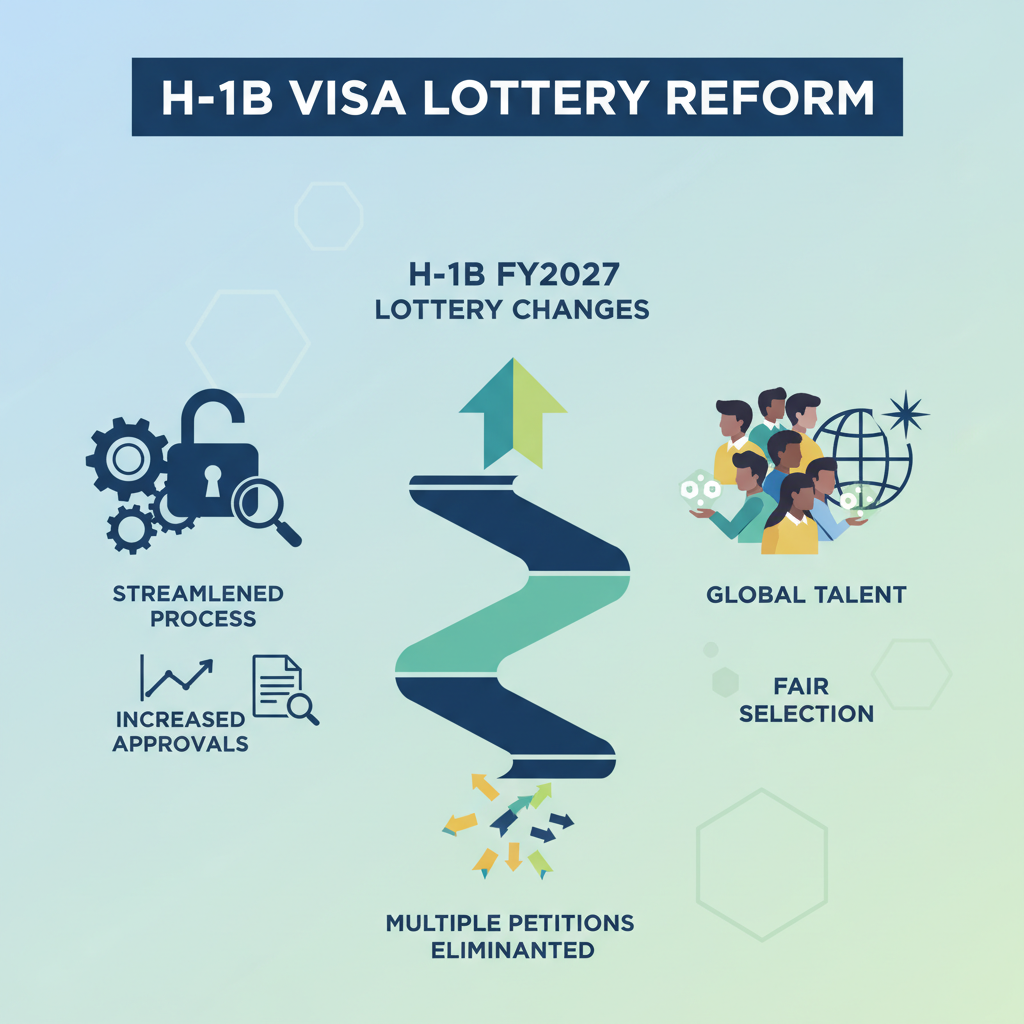
- Increased Certainty for Beneficiaries: The beneficiary-centric selection process, a key change, means that each unique beneficiary is entered into the lottery only once, regardless of how many employers register them. This significantly reduces the chances of fraud where multiple employers might have registered the same individual to increase selection odds. For legitimate candidates in Orlando seeking an H-1B visa, this could lead to a more level playing field and potentially higher selection rates for those with genuine job offers.
- Employer Compliance: Florida employers, particularly those along the I-4 corridor in sectors like simulation and training, hospitality technology, and medical research, must meticulously adhere to the new registration procedures. Understanding the requirement to provide valid passport information or travel document details for each beneficiary during registration is crucial to avoid disqualification.
- Strategic Planning: For tech startups in Orlando's Lake Nona Medical City or established companies in Orange County, securing H-1B talent requires advanced strategic planning. The new rules necessitate a deeper collaboration between the prospective employee and the sponsoring employer much earlier in the process.
- Impact on Local Economy: A smoother, fairer H-1B process benefits Florida's economy by ensuring that critical skill gaps can be filled efficiently, fostering innovation and economic growth. Conversely, any complexities or delays can impact local businesses' ability to compete globally.
- Legal Guidance is Paramount: Given the complexities, Florida residents and employers must seek qualified legal counsel. Immigration attorneys in Orlando, like those at Imigrar, are uniquely positioned to guide clients through these intricate changes, ensuring compliance and maximizing the chances of success.
Need Expert Guidance on H-1B Changes? Don't navigate the complex H-1B lottery changes alone. Our Orlando immigration team is ready to assist you. Call +1 786-791-3106 for a free consultation, or message us online. Se Habla Español.
What H-1B Visa Lottery Changes for FY2027 Is (and Why It Matters)
The H-1B visa is a nonimmigrant visa that allows U.S. employers to temporarily employ foreign workers in specialty occupations. These occupations generally require a bachelor's degree or higher in a specific specialty. The H-1B program is vital for U.S. companies to fill critical skill gaps, particularly in STEM fields.
A plain-English definition
Think of the H-1B visa as a special temporary work permit for highly skilled jobs. Because there are more people who want these visas than available spots, USCIS uses a lottery system to decide who gets to apply. The "H-1B Visa Lottery Changes for FY2027" refers to the updated rules for this lottery that USCIS has put in place, primarily to make the process fairer and prevent fraud. The most significant change is how the lottery selection is done: instead of selecting based on the employer's registration, it's now based on the individual foreign worker (the "beneficiary"). This means if one person has job offers from multiple companies, they are only entered into the lottery once, making it less likely for a single person to be selected multiple times, thereby increasing the chances for others. These changes matter because they impact who gets a chance to work in the U.S. and how employers must approach hiring foreign talent.
Key terms you need to know
Understanding the H-1B process requires familiarity with specific terminology:
- H-1B Visa: A nonimmigrant visa that permits U.S. employers to temporarily employ foreign workers in specialty occupations.
- Specialty Occupation: An occupation that requires theoretical and practical application of a body of highly specialized knowledge and a bachelor's or higher degree in the specific specialty (or its equivalent) as a minimum for entry into the occupation in the United States.
- Petitioning Employer (Petitioner): The U.S. company or organization that seeks to employ the foreign worker and files the H-1B petition.
- Beneficiary: The foreign national worker who is the subject of the H-1B petition.
- H-1B Cap: The annual limit on the number of H-1B visas issued. Congress currently sets the annual regular H-1B cap at 65,000, with an additional 20,000 visas reserved for those with a U.S. master's degree or higher (the "Master's Cap").
- Cap-Subject: An H-1B petition that is subject to the annual numerical limit.
- Cap-Exempt: Certain employers (e.g., institutions of higher education, non-profit research organizations) are exempt from the annual cap.
- H-1B Lottery (or Cap Lottery): The random selection process USCIS uses when the number of H-1B registrations exceeds the annual cap.
- Registration Period: The specific window of time (typically in March) during which prospective petitioning employers must electronically register each beneficiary for the H-1B lottery.
- Selection Process (Beneficiary-Centric): The updated method where selections are made based on unique beneficiaries, rather than unique registrations. This means if a beneficiary has multiple registrations filed on their behalf by different employers, they are still only entered into the lottery once.
- Labor Condition Application (LCA): Form ETA-9035, certified by the U.S. Department of Labor (DOL), which attests that the employer will pay the H-1B worker at least the prevailing wage or the actual wage, whichever is higher, and provide working conditions that will not adversely affect other workers.
- Form I-129, Petition for a Nonimmigrant Worker: The primary form filed by the employer with USCIS after an H-1B registration is selected in the lottery.
- Form I-907, Request for Premium Processing Service: An optional form that can be filed with Form I-129 to expedite processing for an additional fee.
- Fiscal Year (FY): The U.S. government's fiscal year runs from October 1 to September 30. H-1B visas for a specific FY (e.g., FY2027) become available on October 1 of that year.
- Request for Evidence (RFE): A letter from USCIS requesting additional documentation or information to support an H-1B petition.
Current Immigration Law: The Foundation
The H-1B visa program is governed by the Immigration and Nationality Act (INA), specifically Section 101(a)(15)(H)(i)(b), codified at 8 U.S.C. § 1101(a)(15)(H)(i)(b). This statute outlines the requirements for nonimmigrant workers in specialty occupations. Additional regulations are found in 8 CFR Part 214.2(h).
Federal requirements
To qualify for an H-1B visa, both the petitioning employer and the beneficiary must meet stringent federal criteria:
For the Employer (Petitioner):
- The employer must offer a job in a specialty occupation.
- The employer must file and obtain certification for a Labor Condition Application (LCA), Form ETA-9035, from the Department of Labor. This attests to prevailing wage compliance and working conditions.
- The employer must agree to pay the H-1B worker at least the prevailing wage for the occupational classification in the area of employment or the actual wage paid to other employees with similar experience and qualifications, whichever is higher.
- The employer must not displace U.S. workers (for "H-1B dependent" employers).
- The employer must register the beneficiary during the designated registration period if subject to the annual cap.
For the Beneficiary (Foreign Worker):
- The beneficiary must hold a U.S. bachelor's degree or higher in a specific specialty, or its foreign equivalent.
- Alternatively, the beneficiary must possess an unrestricted state license, certification, or registration to practice the specialty occupation, or have work experience equivalent to a bachelor's degree. Generally, three years of progressive work experience in the specialty is considered equivalent to one year of college education.
- The beneficiary's qualifications must be directly related to the specialty occupation position offered.
- The beneficiary must not have already used their maximum H-1B stay (typically six years).
USCIS official website is the definitive source for all forms, regulations, and policy updates related to the H-1B program.
Florida-specific considerations
While federal law dictates H-1B visa requirements, Florida's unique economic landscape and growing industries make H-1B visas particularly relevant here. There are no Florida-specific H-1B laws that supersede federal regulations, but the state's economic environment influences the types of H-1B petitions filed and their importance:
- Tech Hubs: Cities like Orlando, Tampa, and Miami are rapidly developing into significant tech hubs. Companies in software development, cybersecurity, aerospace, and simulation often seek H-1B professionals to fill specialized roles that are in high demand.
- Healthcare Industry: Florida's extensive healthcare sector, including facilities in the Orlando Medical City, frequently sponsors H-1B visas for medical professionals, researchers, and specialists.
- Tourism and Hospitality Technology: Orlando, as a global tourism capital, has a growing need for IT professionals who can support the complex technological infrastructure of its theme parks, resorts, and related industries.
- Education and Research: Florida's universities and research institutions are often cap-exempt, allowing them to petition for H-1B workers outside the lottery system, attracting top academic and research talent to the state.
For individuals residing in Central Florida or whose prospective employers are based here, the Orlando USCIS Field Office may handle certain aspects of their immigration journey, though H-1B petitions are generally processed at service centers. However, local immigration counsel is invaluable for understanding how national changes impact regional opportunities and for preparing a strong, compliant application tailored to Florida's job market.
Confused by H-1B Regulations? Imigrar's experienced attorneys are here to clarify the rules and guide you. Contact us today for a free consultation at +1 786-791-3106. Se Habla Español.
How to Navigate the H-1B Lottery Changes for FY2027: A Complete Step-by-Step Guide
Successfully navigating the H-1B lottery requires careful planning, meticulous preparation, and adherence to evolving USCIS guidelines. For FY2027, the beneficiary-centric selection process is a critical factor. Here’s a comprehensive step-by-step guide:
1) Understand the New Registration Process (Beneficiary-Centric)
The most significant change for FY2027 is the beneficiary-centric selection. Instead of multiple registrations for a single beneficiary improving selection odds, USCIS now selects based on the unique beneficiary. This means if a beneficiary has multiple job offers and therefore multiple registrations filed on their behalf, they are still only entered into the lottery once. If selected, USCIS will notify all employers who registered for that beneficiary, and each employer will then have the opportunity to file a petition.
- Action: Both employer and beneficiary must understand this fundamental shift. Beneficiaries should clearly communicate with all prospective employers to ensure accurate information is provided and to manage expectations. Employers must understand that filing multiple registrations for the same beneficiary does not increase the beneficiary's chances but rather ensures that if selected, *their* specific registration is available for petition filing.
- Required Documents/Information for Understanding: USCIS policy memos, official H-1B cap announcements, legal advisories.
2) Employer and Beneficiary Eligibility Assessment
Before any registration, both the prospective employer and the beneficiary must confirm their eligibility for the H-1B program.
- For the Employer:
- Confirm the job position qualifies as a specialty occupation.
- Determine the prevailing wage for the position in the specific geographic area (e.g., Orlando, FL).
- Assess the employer's financial ability to pay the proffered wage.
- Confirm the employer is not a "shell company" formed solely to obtain H-1B visas.
- For the Beneficiary:
- Verify possession of a U.S. bachelor's degree (or higher) or its foreign equivalent. If a foreign degree, an educational equivalency evaluation from a USCIS-recognized organization is crucial.
- Ensure the degree is in a field directly related to the specialty occupation.
- If relying on work experience, ensure it meets the "3-for-1 rule" (3 years of progressive experience for 1 year of college education) and is well-documented with letters from previous employers, pay stubs, and job duty descriptions.
- Possess a valid passport or travel document. This information is now critical for the initial registration.
- Required Documents: Job offer letter, beneficiary's academic transcripts and diplomas (with translations if necessary), educational equivalency evaluation, resume, passport copy, employment verification letters.
3) Prepare and Submit the H-1B Registration
The H-1B registration process is electronic and typically occurs in March. This is the first and most critical step for cap-subject petitions.
- Action: The petitioning employer (or their authorized representative, like Imigrar) must create a USCIS online account if they don't have one. For each beneficiary they wish to sponsor, they must submit an electronic registration.
- Important: Each registration requires a fee (e.g., $10 for FY2025, subject to change for FY2027 based on potential fee rule updates). The registration must include specific information about both the employer and the beneficiary, most notably the beneficiary's valid passport or travel document number. This passport number is key to the beneficiary-centric selection process.
- Warning: Submitting false information or attempting to manipulate the lottery process can lead to severe penalties, including denial of petition, criminal charges, and bars to future immigration benefits.
- Required Documents/Information for Registration: Employer's FEIN, legal name, address; Beneficiary's full legal name, date of birth, country of birth, country of citizenship, gender, and valid passport number or travel document number.
4) Await Lottery Results and Prepare the Full Petition
After the registration period closes, USCIS conducts the lottery. Results are typically announced by the end of March.
- Action: If a beneficiary is selected, USCIS will notify the employer (and their legal counsel) via their online account. The notification will include a selection notice, which is required for filing the full H-1B petition.
- Timeline: Employers usually have a 90-day window from the date of the selection notice to file the complete Form I-129 petition. This period is crucial for gathering all necessary documentation.
- Reminder: Begin preparing the full petition immediately upon selection. Do not wait until the last minute.
- Required Documents/Information for this phase: H-1B Selection Notice, original job offer letter.
5) File Form I-129 and Supporting Documents
This is the formal submission of the H-1B petition to USCIS.
- Action: The employer, with legal assistance, compiles and submits Form I-129, Petition for a Nonimmigrant Worker, along with all required supporting documentation and filing fees to the designated USCIS service center.
- Key Components:
- Certified Labor Condition Application (LCA), Form ETA-9035.
- Evidence that the position qualifies as a specialty occupation (e.g., job description, organizational charts, expert opinion letters).
- Evidence that the beneficiary is qualified for the specialty occupation (e.g., academic credentials, evaluations, experience letters).
- Employer's financial statements, tax returns, and business licenses to prove ability to pay.
- Copies of beneficiary's passport, visa, I-94 record, and previous immigration documents (if applicable).
- Itinerary of services (if the beneficiary will work at multiple locations).
- Fees: Be prepared for various filing fees, which have recently increased for FY2025 and may be subject to further adjustments for FY2027. These typically include the base Form I-129 filing fee, ACWIA fee, fraud prevention and detection fee, and potentially the Public Law 114-113 fee for certain employers. An optional Form I-907, Request for Premium Processing Service, fee can also be paid for expedited processing.
- Required Documents: Completed Form I-129, certified Form ETA-9035, educational documents, employment history, company documents, fee payments.
For current fee information and forms, visit USCIS Forms.
6) Monitor Status and Respond to RFEs
After filing, USCIS will acknowledge receipt of the petition. The processing time can vary significantly.
- Action: Monitor the case status online using the receipt number provided by USCIS. Be prepared to receive a Request for Evidence (RFE). An RFE means USCIS requires more information or clarification on aspects of the petition.
- Important: Responding to an RFE requires a thorough understanding of immigration law and USCIS expectations. A weak or incomplete response can lead to denial. Imigrar specializes in crafting robust RFE responses.
- Timeline: USCIS processing times can be checked at USCIS Processing Times. Premium processing guarantees a response within 15 calendar days.
- Required Documents/Information for this phase: USCIS receipt notice, any RFE notices, additional documents requested by USCIS.
7) Attend Visa Interview (if applicable) and Prepare for Start Date
If the beneficiary is outside the U.S., they will need to attend a visa interview at a U.S. consulate or embassy in their home country.
- Action: Once the H-1B petition is approved, the beneficiary will either undergo a change of status (if already in the U.S. in a valid nonimmigrant status) or apply for an H-1B visa stamp at a U.S. Embassy or Consulate abroad.
- For Consular Processing: Prepare for the visa interview by gathering all original documents, including the H-1B approval notice (Form I-797), passport, DS-160 confirmation, and other supporting evidence. Be ready to clearly articulate the job duties and qualifications.
- Start Date: H-1B visas typically become effective on October 1st of the fiscal year for which they are approved (e.g., October 1, 2026, for FY2027). Beneficiaries cannot begin H-1B employment before this date.
- Required Documents: Form I-797 approval notice, valid passport, DS-160 confirmation page, visa interview appointment confirmation, photos, original educational and employment documents.
More information on consular processing can be found at U.S. Department of State.
Practical Steps You Can Take Today
Preparing for the H-1B lottery, especially with the FY2027 changes, requires proactive measures. Here’s an actionable checklist to help you get started:
- Verify Eligibility (Employer & Beneficiary):
- Employer: Confirm the offered position meets "specialty occupation" criteria. Gather evidence of your company's financial stability and ability to pay the prevailing wage.


