

The reporting that sparked this guide
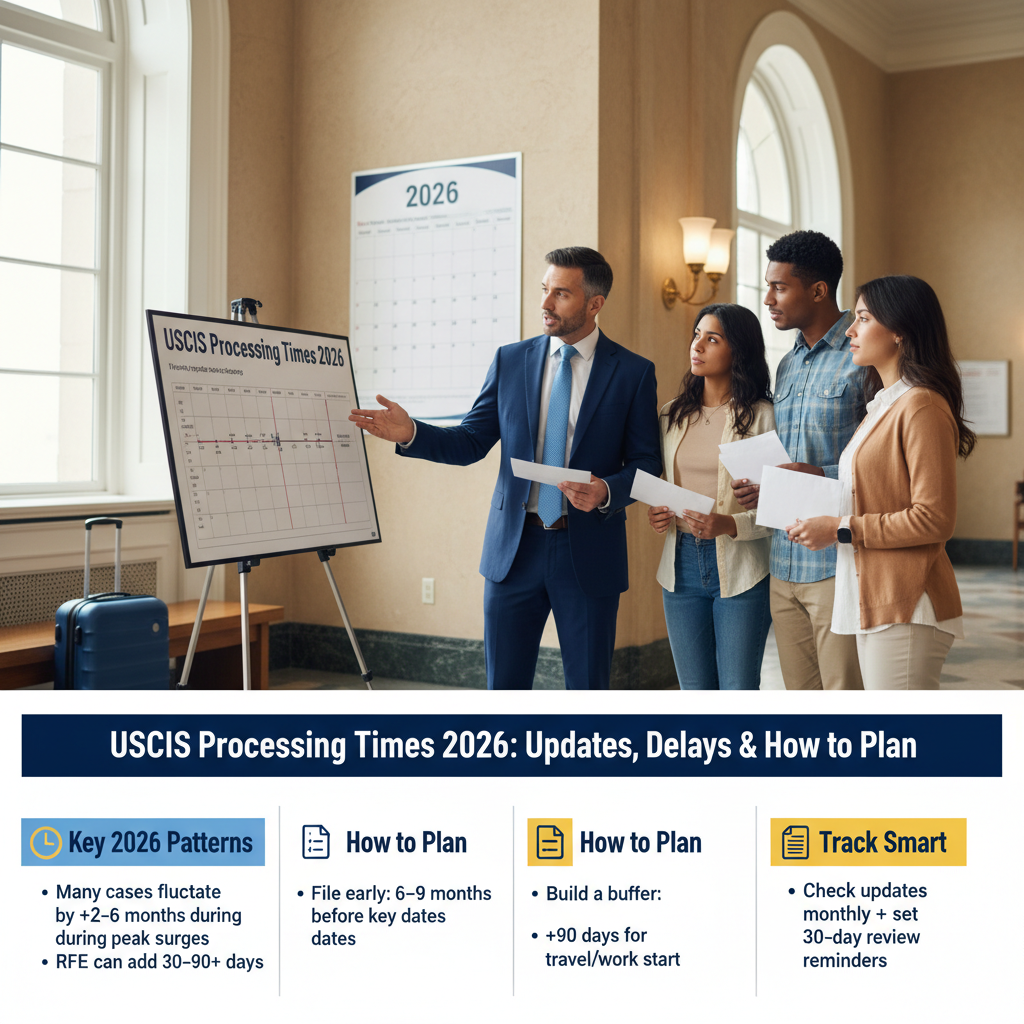
The reporting that sparked this guide comes from: USCIS Processing Times and Updates for 2026 (USCIS). This article is an educational overview based on publicly available USCIS resources and common 2026 processing-time patterns. For official, case-specific information, always verify directly with USCIS official website and your USCIS online account.
Need Help? Our Orlando immigration team is ready to assist. Call +1 786-791-3106 for a free consultation, or message us online. Se Habla Español.
What This News Means for Immigrants in Orlando and Across Florida
Why this news is showing up now
USCIS processing times are a “moving target,” and in 2026 they remain one of the most searched immigration topics because they affect nearly every benefit: family petitions, Adjustment of Status, work permits, travel documents, naturalization, and more. Processing times can shift due to:
- USCIS staffing and workload changes (hiring, training, reassignments, overtime initiatives).
- Policy and procedure updates that affect evidence standards, interview scheduling, and security checks.
- Backlog redistribution between service centers and field offices.
- Surges in filings tied to fee changes, court decisions, country conditions, or seasonal filing patterns.
- Technology modernization (online filing expansion, digitization of paper files), which can temporarily speed up some steps while slowing others.
Reminder: USCIS publishes processing times by form and office, but these are estimates—not guarantees. Your timeline depends on your category, background checks, evidence quality, interview availability, and whether USCIS issues a Request for Evidence (RFE).
For the most current USCIS estimates, use: USCIS Processing Times.
How it can affect Florida residents
If you live in Florida—especially in the I-4 corridor (Orlando, Kissimmee, Sanford, Daytona Beach, Tampa)—processing-time changes can directly affect family stability, employment, travel, and access to benefits. For example:
- Work authorization timing: Delays for Form I-765 can interrupt job start dates, renewals, and driver’s license renewals depending on your situation.
- Travel plans: Delays for Form I-131 Advance Parole can prevent travel for emergencies. Traveling without proper authorization can be a Warning: serious risk for many applicants.
- Family unity: Longer waits for Form I-130 family petitions can keep spouses and children separated abroad.
- Green card scheduling: Form I-485 cases may depend on field office interview capacity—important if your case is handled through The Orlando USCIS Field Office.
If your case is in Orlando, your timeline may be influenced by local interview scheduling capacity and how quickly your file is transferred to the field office. For Central Florida residents, planning ahead is essential—especially for renewals, travel, and life events like marriage, childbirth, or relocation.
What USCIS Processing Times and Updates for 2026 Is (and Why It Matters)
A plain-English definition
“USCIS processing time” is the estimated amount of time USCIS expects it will take to complete (approve, deny, or otherwise decide) a particular immigration application or petition. USCIS publishes these estimates by:
- Form type (example: Form I-130, Form I-485, Form N-400).
- Office handling the case (a service center or a field office such as the Orlando office).
- Category (example: immediate relative vs. preference category; employment-based category; asylum-based EAD).
In 2026, “updates” matter because USCIS regularly revises its posted timelines and occasionally changes how it calculates them. That impacts how you plan your work, travel, and family goals.
Key terms you need to know
- Receipt Notice: The first official confirmation USCIS received your filing (often a Form I-797 Notice of Action).
- Receipt Number: The case number you use to track your case in your USCIS online account.
- Biometrics: Fingerprints/photo appointment used for background checks (often at an ASC).
- RFE (Request for Evidence): USCIS asks for missing or additional proof. Responding late or incompletely can cause denial.
- NOID (Notice of Intent to Deny): A warning that USCIS plans to deny unless you overcome specific concerns.
- Interview: Many cases require an in-person interview at a field office (e.g., Orlando).
- Priority Date: Your place in line for certain categories. A key concept for family preference and employment cases.
- Visa Bulletin: Published by the Department of State; controls when certain applicants can file or be approved.
Important: For many applicants, the “processing time” you care about is not one number—it’s a sequence: receipt → biometrics → RFE (if any) → interview (if required) → decision → card production.
Helpful official references include: USCIS official website and the U.S. Department of State (especially the Visa Bulletin and consular processing information).
Need Help? Our Orlando immigration team is ready to assist. Call +1 786-791-3106 for a free consultation, or message us online. Se Habla Español.
Current Immigration Law: The Foundation
Processing times are practical—but the legal foundation determines eligibility, evidence, and what USCIS must review. Most USCIS benefits are governed by the Immigration and Nationality Act (INA) and regulations in Title 8 of the Code of Federal Regulations (8 C.F.R.).
Federal requirements
Common legal foundations that affect USCIS adjudications and timelines include:
- Family-based immigration under INA §201, §202, §203, and §204 (petitions such as Form I-130).
- Adjustment of Status under INA §245 (applications such as Form I-485).
- Affidavit of Support requirements under INA §213A (typically Form I-864).
- Employment authorization categories under 8 C.F.R. §274a (often filed via Form I-765).
- Advance Parole / travel documents under 8 C.F.R. §212.5 and related authorities (often Form I-131).
- Naturalization under INA §316 and §319 (often Form N-400).
USCIS also runs identity, criminal, and security checks. These are not optional and can affect timing even in well-prepared cases.
Reminder: Always use the latest edition of forms and instructions from USCIS Forms. Submitting an outdated form edition can cause rejection and lost time.
Florida-specific considerations
Immigration is federal law, but Florida residents face local, real-world factors that can influence case management:
- Field office scheduling: If your case is in Orlando, interview availability at The Orlando USCIS Field Office can affect the final stage of a Form I-485 or Form N-400.
- Address changes and mail reliability: High mobility in Orange County and along the I-4 corridor makes it easier to miss biometrics or interview notices if you don’t update your address promptly.
- Disaster disruptions: Florida weather events can cause short-notice rescheduling of appointments.
- State document coordination: Driver’s license renewals, employer onboarding, and school enrollment may depend on timely receipt of USCIS notices and EADs.
Warning: If you move, you typically must update your address with USCIS quickly (often within 10 days under federal requirements). Missing an appointment notice can lead to denial for abandonment in certain contexts.
Official starting point: USCIS official website. If you are in immigration court, track court procedures through the Executive Office for Immigration Review.
How to Track and Respond to USCIS Processing Times: A Complete Step-by-Step Guide
This step-by-step guide focuses on what most applicants can do in 2026 to monitor processing times, reduce avoidable delays, and escalate appropriately when a case is truly outside normal timeframes.
1) Identify your form, category, and office (the “processing time triangle”)
USCIS processing time depends on (1) the form, (2) the category, and (3) the office. Start by confirming exactly what you filed and where it’s being processed.
- Required documents / information:
- Receipt Notice(s) (Form I-797) for each filing
- Your receipt number(s)
- A copy of the full filing packet (recommended)
- USCIS online account login (if applicable)
- Any transfer notices (service center changes)
Examples:
- Family case: Form I-130 + (if eligible) Form I-485 for Adjustment of Status
- Work/travel while AOS pending: Form I-765 and Form I-131
If your case is in Orlando, the final interview (if required) will typically occur at The Orlando USCIS Field Office, even if earlier steps were handled by a service center.
2) Check the official USCIS processing-time tool the right way
Use the official tool: USCIS Processing Times. Select your form and then select the specific office listed on your receipt/transfer notice.
- Required documents / information:
- Form number (e.g., Form I-130, Form I-485)
- Office name (service center or field office)
- Category (immediate relative, family preference, etc.)
- Your receipt date
Important: USCIS often shows two key data points: (1) an estimated time range and (2) a “case inquiry date” (the date after which you can submit an outside-normal-processing inquiry). Save screenshots monthly so you can prove what USCIS was posting when you checked.
3) Track your case status and notices (don’t rely on one channel)
Processing times are broad averages; your real-time case status is in your account and notices. Make sure you can receive updates promptly.
- Required documents / information:
- USCIS online account (if you have one)
- Case status page link/bookmark
- Mailing address verification
- Copy of any RFE/NOID notices (front and back)
Reminder: If you receive an RFE, the deadline is strict. Many RFEs provide a specific due date; missing it can result in denial. Also watch for a 90-day window concept in certain contexts (for example, some renewal strategies and planning cycles), but do not assume USCIS will act within 90 days unless the law/policy specifically requires it for your case type.
4) Respond to RFEs/NOIDs strategically to avoid “resetting” your case
A high percentage of delays come from incomplete initial filings or weak RFE responses. The goal is to submit a response that is organized, complete, and easy for an officer to approve.
- Required documents (varies by case), often including:
- Copy of the RFE/NOID notice
- Cover letter with a table of contents
- Updated civil documents (birth/marriage/divorce certificates)
- Proof of bona fide marriage (if applicable): lease, bank statements, insurance, photos
- Financial evidence for Form I-864: tax transcripts, W-2/1099, paystubs
- Any missing translations with proper certification
Warning: Sending unsolicited evidence without a plan can sometimes create confusion. If you’re unsure, consult counsel before uploading or mailing additional documents.
5) Use expedite requests and emergency options only when appropriate
In 2026, many applicants ask about expediting due to long waits. Expedite is discretionary and requires strong documentation. Emergency Advance Parole may be available in limited situations.
- Required documents / evidence for expedite (examples):
- Medical emergency records (hospital letters, physician statements)
- Financial loss proof (eviction notice, job offer with start date, employer letter)
- Humanitarian documentation (death certificate, urgent family crisis evidence)
- Proof of government interest (rare)
Important: Expedite requests are not a substitute for eligibility. If your filing is incomplete or you are not eligible for the benefit, expediting won’t solve the underlying problem.
6) Submit an “outside normal processing time” inquiry when eligible
If your case is beyond the posted “case inquiry date,” you can submit a service request. This is often the correct next step before congressional assistance or litigation.
- Required documents / information:
- Receipt number
- Receipt date
- Office and form type
- Proof you are beyond the inquiry date (screenshot recommended)
- Any prior service request numbers
Keep a log of every contact attempt and response. If you later need help escalating, documentation matters.
7) Escalate carefully: congressional help, Ombudsman, or legal action
If USCIS is unresponsive and your case is truly stuck, there are higher-level options. These should be evaluated carefully with an immigration attorney:
- Congressional inquiry: Your U.S. Representative or Senator’s office may request an update.
- CIS Ombudsman (DHS): May assist in some delayed-case scenarios.
- Mandamus / APA lawsuit: In limited situations, federal litigation may be an option to challenge unreasonable delay.
- Required documents / information:
- Complete filing copies and USCIS notices
- Timeline log (dates of filing, biometrics, RFEs, responses)
- Proof of hardship (if relevant)
- Attorney evaluation of risks and strategy
Warning: Litigation is serious and fact-specific. It can be effective in the right case, but it can also create costs and require careful risk assessment.
Need Help? Our Orlando immigration team is ready to assist. Call +1 786-791-3106 for a free consultation, or message us online. Se Habla Español.
Practical Steps You Can Take Today
Processing times may be outside your control, but preparation is not. Here’s a checklist you can implement today—especially helpful for Orange County and Central Florida residents who may face appointment scheduling constraints.
- 1) Build a “USCIS master file” (digital + paper)
- Keep copies of everything filed, including exhibits and translations.
- Save every USCIS notice (front/back) and envelope if it shows a date stamp.
- 2) Track key dates and deadlines
- Receipt dates, biometrics date, RFE due date, interview date.
- Reminder: Do not miss deadlines—some are strict and unforgiving.
- 3) Plan renewals early
- If you have an EAD, plan renewal filing well in advance (often months ahead depending on category).
- Use a personal “180 days before expiration” planning rule to start preparing documents, even if your category’s earliest filing date differs.
- 4) Avoid travel risks
- If you have a pending Form I-485, do not depart the U.S. without confirming you have valid Advance Parole or another travel authorization that preserves eligibility.
- Warning: Leaving without proper authorization can be treated as abandoning the application in many situations.
- 5) Keep your address updated
- If you move along the I-4 corridor (Orlando to Tampa or Daytona), update USCIS immediately and confirm the update in your account.
- 6) Get ahead of common RFEs
- Marriage cases: joint documents across time, not just a few photos.
- Financial sponsorship: tax transcripts and proof of current income.
- Translations: certified translations for any non-English documents.
Timeline expectations (general planning guidance): In 2026, many applicants experience “lumpy” movement—long periods of no updates followed by rapid action (RFE, interview, approval). Expect variability by form, office, and category. Always check your specific form/office at USCIS Processing Times.
How Imigrar Helps Immigrants in Orlando
At Imigrar, our mission is to Keep Families Together. We help clients in Orlando, across Central Florida, and nationwide prepare strong filings, respond to RFEs, and develop realistic processing-time strategies—so delays don’t turn into denials.
- We review eligibility and risks before you file (or before you travel).
- We prepare organized filing packets and evidence indexes designed to reduce RFEs.
- We monitor timelines and advise when an “outside normal processing time” inquiry makes sense.
- We prepare clients for interviews at The Orlando USCIS Field Office, including document checklists and practice questions.
We offer a free consultation to discuss your goals and create a plan. Se Habla Español.
Frequently Asked Questions
Q: Am I eligible to file Form I-485 while my Form I-130 is pending?
A: It depends on your relationship category, your manner of entry, and whether a visa number is immediately available. Immediate relatives of U.S. citizens (spouses, unmarried children under 21, parents of U.S. citizens 21+) often can file concurrently if otherwise eligible. Family preference categories may need to wait for a current Priority Date based on the Visa Bulletin. Because eligibility can be affected by unlawful presence, prior immigration history, and other factors, consult an attorney before filing.
Q: Will checking processing times change my case or make it faster?
A: No. Checking the tool does not speed up your case. However, it helps you plan and identify when you qualify to submit an inquiry. The best “speed” strategy is submitting a complete, well-documented filing and responding quickly and thoroughly to any RFE.
Q: How long will my case take in 2026 if my interview is at the Orlando office?
A: Orlando timelines vary by form type and case complexity. Some cases move quickly after biometrics; others wait months for interview slots. The most accurate approach is to (1) confirm your form and office and (2) check the official estimates at USCIS Processing Times. If your case is beyond the “case inquiry date,” you may submit an outside-normal-processing request.
Q: What documents are most likely to cause delays if missing?
A: Common delay triggers include missing civil documents (birth/marriage/divorce certificates), missing certified translations, incomplete financial sponsorship evidence for Form I-864, and insufficient bona fide marriage evidence in marriage-based cases. For Adjustment of Status, medical exam issues (when required) can also cause delays. Prepare a clean, indexed packet and keep copies of everything.
Q: How much does it cost to file, and do delays affect fees?
A: USCIS filing fees depend on the form(s) and category, and they can change. Delays don’t usually increase USCIS fees by themselves, but if a case is rejected and you must refile, you may pay again. Also, if your work permit expires while waiting, you may need to file a renewal. Always confirm current fees and editions on USCIS Forms and consider legal guidance to avoid costly mistakes.
Q: Does a pending application protect my immigration status?
A: Sometimes, but not always. A pending Form I-485 generally places you in a period of authorized stay while it is pending, but it is not the same as having a separate nonimmigrant status. Other filings (like Form I-130 alone) do not grant lawful status. Because status issues can affect travel, work authorization, and risk of removal proceedings, get individualized advice.
Q: What happens if USCIS denies my application after a long wait?
A: A denial can have serious consequences depending on what was filed and your underlying status. Some denials may be appealed or reopened with a motion; others may require refiling or pursuing consular processing. In some situations, denial may trigger referral to immigration court. If you are in proceedings, consult the Executive Office for Immigration Review for court information and speak with an attorney immediately to evaluate options and deadlines.
Q: Can I travel internationally while waiting in 2026?
A: Travel rules depend on what you filed and your current status. Many Adjustment of Status applicants need Advance Parole (often via Form I-131) before traveling. Warning: Leaving without appropriate authorization can be considered abandonment of the Form I-485 and may trigger other immigration consequences. Always confirm before booking travel.
Common Mistakes (and How to Avoid Them)
Mistake #1: Assuming posted processing times are a promise
USCIS processing times are estimates. Avoid making irreversible plans (selling property, quitting jobs, long international travel) based solely on a posted range. Instead, plan with buffers and consult counsel about risk points.
Mistake #2: Filing incomplete packets that invite RFEs
RFEs often add months. Avoid this by using the correct form edition, including required initial evidence, organizing exhibits, and providing clear translations. A well-prepared Form I-130 and Form I-485 packet can reduce delays substantially.
Mistake #3: Missing notices due to address changes or poor tracking
In Central Florida, moves are common. If you miss biometrics or an interview notice, USCIS may deny for abandonment. Use a reliable mailing address, update USCIS promptly, and keep a calendar with alerts.
Need Help? Our Orlando immigration team is ready to assist. Call +1 786-791-3106 for a free consultation, or message us online. Se Habla Español.
USCIS Processing Times in 2026: What to Watch Next
While USCIS continues to publish estimates, the most important “update” for 2026 is that applicants should treat processing-time planning as an ongoing task, not a one-time check. Monitor:
- Shifts in your office’s posted timelines (save screenshots).
- Transfer notices—a transfer can change your processing-time baseline.
- Visa availability for preference categories via the U.S. Department of State.
- Policy updates on USCIS official website.
If your case is in Orlando, be especially proactive about interview readiness: gather originals, updated relationship evidence, and updated financial documents so you can respond quickly when your interview is scheduled.
Closing: Get a Processing-Time Strategy Built for Your Family
USCIS processing times in 2026 can be frustrating—but many delays are preventable with the right filing strategy, strong evidence, and proactive tracking. Whether you’re preparing Form I-130, pursuing Adjustment of Status with Form I-485, renewing work authorization, or waiting for an Orlando interview, a clear plan can protect your job, travel options, and family unity.
Need personalized help? Call Imigrar at +1 786-791-3106 for a free consultation or message us online. Se Habla Español. We serve Orlando, Orange County, Central Florida, and clients nationwide—because we believe in one mission: Keep Families Together.


