

The journey through the U.S. immigration system can often feel like navigating a complex maze, with one of the most significant challenges being the unpredictable nature of application processing times. For immigrants and their families in Orlando, across Florida, and nationwide, understanding current USCIS (U.S. Citizenship and Immigration Services) processing trends is not just helpful—it's absolutely critical for planning futures, managing expectations, and keeping families together.
As we move further into 2026, USCIS continues to adapt its operations, aiming to reduce backlogs while facing ongoing challenges. These updates, often subtle yet impactful, can significantly affect how long you might wait for a decision on your visa petition, green card application, or other vital immigration benefits. At Imigrar, we are committed to providing the most current and actionable information to help you and your loved ones navigate these waters successfully.
The reporting that sparked this guide:
USCIS Processing Times and Updates for 2026 (USCIS)What This News Means for Immigrants in Orlando and Across Florida
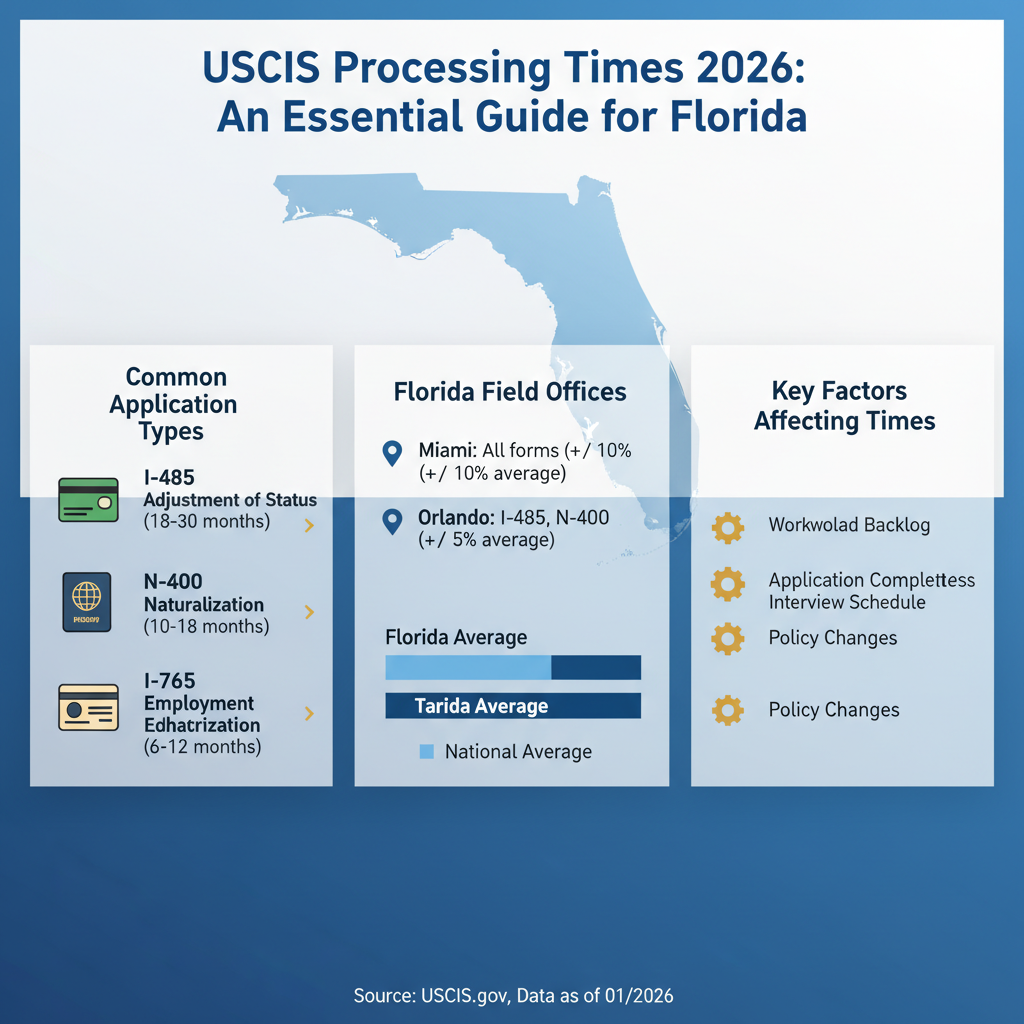
The continuous flow of information regarding USCIS processing times and operational adjustments directly impacts every immigrant family, especially those deeply rooted in vibrant communities like Orlando and throughout Florida. These updates are not just statistics; they represent the real-life waiting periods that determine when a family can reunite, when an individual can start a new job, or when someone can finally travel to see loved ones abroad.
Why this news is showing up now
USCIS, as the primary federal agency responsible for administering immigration and naturalization benefits, is constantly evaluating and adjusting its operational capacity and strategies. Processing times are dynamic, fluctuating based on a multitude of factors, including:
- Case Volume: The sheer number of applications received for specific forms or categories.
- Staffing Levels: The availability of adjudicators and support staff at various service centers and field offices.
- Policy Changes: New directives or interpretations of immigration law can alter processing procedures.
- Budgetary Constraints: Funding impacts USCIS’s ability to hire, train, and maintain efficient systems.
- Technological Advancements: Implementation of new digital tools or systems can either streamline or temporarily disrupt processing.
- Global Events: Pandemics, natural disasters, or international conflicts can affect operations and demand for services.
The updates for 2026 reflect USCIS's ongoing efforts to address the backlogs that accumulated in previous years, particularly those exacerbated by the pandemic and evolving policy landscapes. These regular reports are USCIS’s way of providing transparency and managing public expectations, even as they work towards their internal processing goals. They signal shifts in focus, potential improvements, or areas where delays persist, making it crucial for applicants and their legal representatives to stay informed.
How it can affect Florida residents
Florida, with its diverse population and significant immigrant communities, is profoundly affected by USCIS processing times. For residents of Orlando and the surrounding Central Florida region, these updates have tangible consequences:
- Family Reunification: Longer processing times for family-based petitions (like Form I-130, Petition for Alien Relative, and Form I-485, Application to Register Permanent Residence or Adjust Status) can mean extended periods of separation for families, directly challenging Imigrar's mission to "Keep Families Together."
- Employment Opportunities: Delays in obtaining Employment Authorization Documents (EADs, Form I-765) mean individuals cannot legally work, impacting their ability to support themselves and their families and contributing to economic insecurity.
- Travel Restrictions: Without approved Advance Parole (Form I-131), individuals with pending green card applications may be unable to travel internationally, preventing them from visiting family abroad or attending to urgent matters without risking their application.
- Uncertainty and Stress: Prolonged waiting periods create immense anxiety and uncertainty for applicants regarding their future in the U.S. This stress is particularly acute for those whose legal status may be tied to a pending application.
- Local Field Office Impact: The Orlando USCIS Field Office, located strategically to serve Orange County and the broader Central Florida area, plays a critical role in interviews for Adjustment of Status applications. Fluctuations in its workload and staffing directly influence how quickly local cases move forward.
- Economic Impact: Delays in immigration processes can slow down local economic growth by postponing the integration of new workers and entrepreneurs into Florida's workforce.
For individuals residing along the I-4 corridor or anywhere in Florida, these updates are not abstract. They are a direct measure of how long they must put their lives on hold. Understanding these trends and preparing proactively is key to mitigating potential negative impacts.
Need Help? Our Orlando immigration team is ready to assist. Call +1 786-791-3106 for a free consultation, or message us online. Se Habla Español.
What USCIS Processing Times Are (and Why It Matters)
At the heart of every immigrant's journey is the waiting game. This waiting period is officially measured by USCIS Processing Times. These times are critical estimates that reflect how long it takes the agency to adjudicate various immigration applications and petitions, from initial receipt to final decision. Understanding what these times signify and the factors that influence them is paramount for anyone navigating the U.S. immigration system.
A plain-English definition
Simply put, USCIS Processing Times are the estimated durations that USCIS takes to review, process, and make a decision on an immigration application or petition. When you file a form with USCIS, it enters a queue. The processing time tells you, approximately, how long that queue is for your specific type of form at the particular USCIS service center or field office handling your case. These times are not guarantees but rather a guide based on historical data of how long similar cases have taken to complete.
Several factors contribute to these varying timelines:
- Application Volume: A surge in filings for a particular form can naturally extend processing times.
- Caseload Per Office: Different USCIS service centers (e.g., California Service Center, Nebraska Service Center) and field offices (e.g., Orlando Field Office) have varying workloads and staffing levels, leading to different processing times for the same form.
- Case Complexity: Straightforward cases typically process faster than those requiring extensive review, additional evidence, or interviews.
- Completeness of Application: Applications that are incomplete or contain errors often lead to Request for Evidence (RFE) notices, significantly extending the overall processing time.
- Policy and Regulatory Changes: New immigration policies or regulations can require USCIS to adjust its procedures, which might temporarily slow down processing.
Key terms you need to know
To fully grasp the implications of USCIS processing times, it's essential to understand the terminology involved:
- Processing Times: The estimated timeframe, usually displayed as a range (e.g., 10 to 18 months), for USCIS to process a specific form at a particular office. You can check these estimates on the official USCIS Processing Times page.
- Receipt Date: The exact date USCIS officially received your application or petition. This date is crucial for tracking your case and is usually found on your Form I-797C, Notice of Action.
- Priority Date: For certain visa categories (primarily family preference and employment-based categories), this is the date your initial petition (e.g., Form I-130 or Form I-140) was properly filed with USCIS. This date determines your place in the visa queue and becomes "current" when a visa number is available, as published monthly in the Visa Bulletin by the U.S. Department of State.
- Current: Refers to a priority date for a specific visa category and country of chargeability that has become available for a final visa action (i.e., green card approval).
- Adjustment of Status (AOS): The process by which an eligible individual already present in the United States applies to change their immigration status to that of a lawful permanent resident (green card holder) without having to return to their home country. This typically involves filing Form I-485.
- Consular Processing: The alternative to Adjustment of Status, where an individual applies for an immigrant visa through a U.S. embassy or consulate in their home country or country of last residence. This process is managed by the U.S. Department of State.
- Request for Evidence (RFE): A formal notice from USCIS asking for additional documents or information to support your application. Failing to respond adequately or on time can lead to denial.
- Notice of Intent to Deny (NOID): A notice from USCIS indicating their intention to deny your application, allowing you a final opportunity to submit evidence to overcome the denial.
- Biometrics Appointment: An appointment where USCIS collects your fingerprints, photograph, and signature (biometric data) for background checks. This is a mandatory step for most green card and naturalization applications.
- National Benefits Center (NBC): A USCIS service center that processes certain forms centrally, particularly for Adjustment of Status applications, before forwarding them to local field offices for interviews.
- Field Office: A local USCIS office (like the Orlando USCIS Field Office) where applicants may be scheduled for interviews for green cards, naturalization, and other benefits.
Understanding these terms empowers you to track your case more effectively, interpret USCIS communications, and make informed decisions about your immigration journey. The importance of these processing times cannot be overstated; they are the practical timeline for achieving your immigration goals and keeping your family together.
Worried about processing delays? Don't face USCIS alone. Imigrar offers expert guidance in Orlando and nationwide. Call +1 786-791-3106 for a free consultation. Se Habla Español.
Current Immigration Law: The Foundation of Processing
All USCIS processing, including the determination of timelines, is rooted in a complex framework of federal immigration laws and regulations. The U.S. immigration system is primarily governed by the **Immigration and Nationality Act (INA)**, a comprehensive body of law that dictates who can enter the U.S., how they can obtain immigration benefits, and the procedures for doing so. While processing times themselves are administrative estimates, the eligibility criteria and procedural steps that influence these times are strictly defined by law.
The **INA** establishes the various categories for immigration, such as family-based, employment-based, refugee/asylee, and diversity visa programs. Each category has specific requirements, quotas (for preference categories), and an order of processing. USCIS operates under the authority granted by the **Department of Homeland Security (DHS)**, which itself derives its powers from the INA. The **Administrative Procedure Act (APA)** also plays a role, ensuring that federal agencies like USCIS follow proper procedures when developing regulations and making decisions.
Federal requirements
The core of any immigration application lies in meeting federal requirements. These are universal across the United States, regardless of where an applicant resides, be it Orlando, Miami, or Seattle. Key federal requirements include:
- Eligibility Criteria: Each visa category has specific conditions applicants must meet. For example, a U.S. citizen must be at least 21 years old to petition for certain family members using Form I-130.
- Admissibility: Applicants for green cards or visas must be admissible to the U.S., meaning they must not have certain criminal records, communicable diseases, or a history of immigration violations. Waivers (e.g., Form I-601, Application for Waiver of Grounds of Inadmissibility) may be available in some cases.
- Legal Entry and Status: For **Adjustment of Status** (Form I-485), applicants generally must have been inspected and admitted or paroled into the U.S. and maintained lawful immigration status, unless they are an immediate relative of a U.S. citizen.
- Financial Support: Most family-based immigrants and some employment-based immigrants require an affidavit of support (Form I-864, Affidavit of Support Under Section 213A of the INA) from a qualifying sponsor to ensure they will not become a public charge.
- Medical Examination: Applicants for green cards must undergo a medical examination by a USCIS-approved civil surgeon (documented on Form I-693, Report of Medical Examination and Vaccination Record).
- Security Checks: All applicants undergo rigorous background and security checks, including fingerprinting (biometrics).
Specific USCIS forms are the vehicles through which these requirements are demonstrated. For example:
- Form I-130, Petition for Alien Relative: Filed by a U.S. citizen or lawful permanent resident (LPR) to establish a qualifying relationship with a foreign national relative.
- Form I-485, Application to Register Permanent Residence or Adjust Status: Filed by individuals already in the U.S. to become lawful permanent residents.
- Form I-765, Application for Employment Authorization: Allows eligible non-citizens to work in the U.S.
- Form I-131, Application for Travel Document: Used to apply for a Reentry Permit, Refugee Travel Document, or Advance Parole (critical for those with pending Form I-485 who need to travel abroad).
For detailed instructions and the latest versions of forms, always refer to the USCIS Forms section on the USCIS official website.
Florida-specific considerations
While immigration law is federal, the experience of navigating it can have localized impacts. For Florida residents, specific considerations often revolve around the practicalities of where and how their cases are processed:
- Orlando USCIS Field Office: If your case requires an interview (common for Adjustment of Status), you will likely be scheduled at the Orlando USCIS Field Office. The local office’s workload and staffing directly affect interview scheduling and final adjudication times for Orlando, Orange County, and surrounding Central Florida residents.
- State-Level Support and Resources: Florida offers various community organizations that provide support, ESL classes, and integration services, though these do not directly impact federal processing times.
- Local Law Enforcement: While not directly affecting USCIS processing, interactions with local law enforcement in Florida (e.g., traffic stops, arrests) can have significant immigration consequences, potentially triggering inadmissibility issues that complicate processing. It's crucial to understand state laws and their potential federal immigration implications.
Reminder: State laws cannot override federal immigration laws. However, state policies and local conditions can influence the practical journey of an immigrant in Florida. For instance, obtaining a Florida driver's license requires proof of lawful presence, which can be affected by the status of a pending USCIS application.
How to Navigate USCIS Processing: A Complete Step-by-Step Guide
Successfully navigating the U.S. immigration system, especially when dealing with dynamic USCIS processing times, requires careful planning, meticulous preparation, and adherence to established procedures. This guide outlines the typical steps involved in a common immigration process, such as obtaining a green card through **Adjustment of Status** based on a family petition, focusing on practical advice for applicants in Orlando and across Florida.
1) Understand Your Eligibility and Category
Before filing any application, the first and most crucial step is to determine your eligibility for an immigration benefit. This involves identifying the correct visa category under the **Immigration and Nationality Act (INA)**. Are you an **Immediate Relative** of a U.S. citizen (spouse, unmarried child under 21, or parent)? Or do you fall into a **Family Preference** category (e.g., adult children, siblings of U.S. citizens, or spouses/children of **Lawful Permanent Residents**)? Each category has distinct requirements, waiting lists, and processing priorities. For preference categories, you must also monitor the Visa Bulletin to ensure your **Priority Date** is "current" before you can file your **Adjustment of Status** application (Form I-485).
- Required Documents for Eligibility Assessment:
- Proof of petitioner's U.S. citizenship or **Lawful Permanent Resident (LPR)** status (e.g., U.S. passport, birth certificate, natural


