

For many immigrants in the United States, the ability to work legally is not just a right, but the cornerstone of building a new life and providing for their families. An Employment Authorization Document (EAD), often called a "work permit," is the key that unlocks this opportunity. Recent updates from USCIS regarding EAD application and renewal processing have brought both challenges and potential solutions for individuals and families across the nation, including our vibrant community here in Orlando, Florida.
Need Help? Our Orlando immigration team is ready to assist. Call +1 786-791-3106 for a free consultation, or message us online. Se Habla Español.
The reporting that sparked this guide
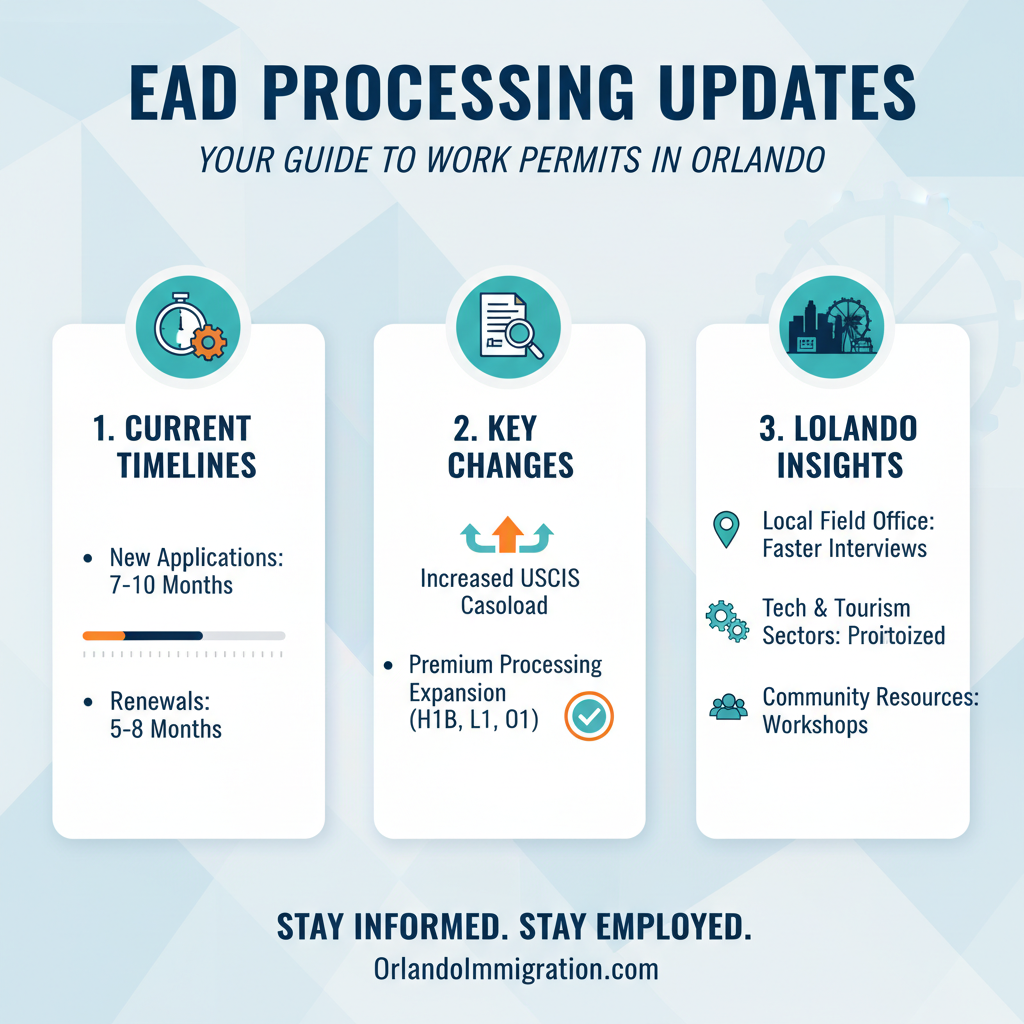
We regularly monitor official government sources and immigration news to keep our clients informed. This comprehensive guide was prompted by recent discussions and announcements concerning Employment Authorization Document Processing (USCIS), highlighting USCIS’s ongoing efforts to address processing backlogs and implement efficiencies for EAD applications and renewals.
What This News Means for Immigrants in Orlando and Across Florida
Understanding the nuances of immigration law and policy changes is crucial. These updates directly impact your ability to work, support your family, and plan your future in the United States.
Why this news is showing up now
The U.S. Citizenship and Immigration Services (USCIS) has been under immense pressure in recent years due to unprecedented application volumes, pandemic-related operational challenges, and staffing shortages. These factors have led to significant backlogs across various immigration benefits, including EAD applications. In response, USCIS has been actively exploring and implementing strategies to improve processing times, enhance efficiency, and provide relief to applicants.
This includes:
- Temporary Final Rules: Adjusting the automatic extension period for certain EAD categories to provide more certainty and prevent gaps in employment authorization.
- Internal Process Improvements: Streamlining adjudication procedures, increasing staffing, and adopting new technologies to process cases more quickly.
- Policy Clarifications: Issuing guidance to field offices and service centers to ensure consistent and efficient processing.
- Focus on Critical Pathways: Prioritizing certain categories of EADs, particularly those tied to humanitarian relief or immediate economic necessity.
The continuous evolution of these policies and processing priorities means that immigrants need to stay informed about the most current requirements and timelines, especially as USCIS strives to modernize its operations and address historical challenges.
How it can affect Florida residents
For the thousands of immigrants residing in Orlando, Central Florida, and throughout the state, these USCIS updates have very real and personal implications:
- Employment Stability: Faster processing or longer automatic extensions mean less anxiety about job loss due to an expired work permit. Conversely, continued delays can lead to financial hardship, interrupted careers, and difficulty obtaining or renewing a Florida driver's license.
- Family Well-being: The ability to work legally directly impacts a family’s financial stability, access to healthcare, housing, and overall quality of life. Delays can strain family resources and create immense stress.
- Planning for the Future: Whether you're waiting for an Adjustment of Status to become a permanent resident, are an asylum applicant, or a student on Optional Practical Training (OPT), your EAD is often a bridge to your next step. Predictable processing allows for better planning regarding employment, education, and long-term residency.
- Local Economy: A stable workforce of authorized immigrants contributes significantly to Florida's economy, from agriculture to tourism to tech. Efficient EAD processing supports this vital contribution.
- Orlando USCIS Field Office Impact: While EAD applications are primarily processed at USCIS Service Centers, residents of Orlando and surrounding areas like Orange County will interact with the local USCIS Application Support Center (ASC) for biometrics appointments. National processing trends affect the workload and appointment availability at these local facilities.
At Imigrar, we understand these impacts firsthand. Our mission, "Keep Families Together," drives us to help you navigate these changes, ensuring your right to work is protected and your family's future in Florida is secure.
What Employment Authorization Document (EAD) Is (and Why It Matters)
The Employment Authorization Document (EAD) is one of the most vital documents for many non-U.S. citizens living in the United States. It is often simply referred to as a "work permit."
A plain-English definition
An EAD is a card issued by USCIS that grants non-citizens permission to work legally in the United States for a specific period. It is proof to employers that you are authorized to accept employment in the U.S. This document is distinct from a visa or a Green Card, though it can be a stepping stone towards permanent residency or is granted while you are pursuing another immigration benefit.
Think of it this way: a visa allows you to enter the U.S. for a specific purpose (like tourism, study, or temporary work). A Green Card (permanent residency) allows you to live and work permanently in the U.S. An EAD fills the gap for many people who are legally present in the U.S. but do not yet have a Green Card or a visa that inherently allows them to work for any employer.
The EAD is critical because it empowers individuals to:
- Earn a living and support themselves and their families.
- Contribute to the U.S. economy.
- Gain valuable work experience.
- Often, obtain other necessities like a Social Security Number (SSN) and a driver's license in Florida.
Key terms you need to know
Navigating the EAD process requires familiarity with several important terms:
- Form I-765: This is the official "Application for Employment Authorization" form you must file with USCIS to obtain an EAD.
- EAD Category: This is a specific code (e.g., C09, A05, C03B) that indicates the particular immigration status or application that makes you eligible for an EAD. Your eligibility category is crucial for correctly completing Form I-765.
- USCIS: U.S. Citizenship and Immigration Services is the federal agency that oversees lawful immigration to the United States. They process EAD applications. You can find more information on the USCIS official website.
- Biometrics Appointment: A scheduled appointment at a USCIS Application Support Center (ASC) where your fingerprints, photograph, and signature are taken. These are used for background checks and identity verification.
- Processing Times: The estimated duration USCIS takes to adjudicate (make a decision on) a particular application, including Form I-765. These vary significantly by form type, service center, and EAD category. You can check current processing times at USCIS Processing Times.
- Automatic Extension: A provision that allows certain EAD holders to continue working beyond their EAD expiration date while their timely filed renewal application is pending. This is a critical relief measure for many.
- Expedited Processing: A request to USCIS to process an application faster than usual due to urgent circumstances, such as severe financial loss, humanitarian reasons, or national interest.
- Adjustment of Status (AOS): The process by which an eligible non-citizen already in the United States can apply for lawful permanent resident status (a Green Card) without having to return to their home country to complete visa processing. Many AOS applicants are eligible for an EAD while their Form I-485 (Application to Register Permanent Residence or Adjust Status) is pending.
- Nonimmigrant Visa: A temporary visa issued to foreign nationals for specific purposes (e.g., H-1B for specialty occupations, L-1 for intracompany transferees, F-1 for students with Optional Practical Training (OPT) EAD).
- Immigrant Visa: A visa issued to foreign nationals who intend to live permanently in the U.S., leading to a Green Card.
- I-94 Arrival/Departure Record: A record issued by U.S. Customs and Border Protection (CBP) documenting your legal entry into the U.S. and your authorized period of stay. Essential for many EAD applications.
Current Immigration Law: The Foundation of EAD Eligibility
The authority for granting employment authorization to non-citizens stems primarily from the Immigration and Nationality Act (INA) and its implementing regulations in the Code of Federal Regulations (CFR).
Federal requirements
The fundamental principle governing employment authorization is INA Section 274A, which makes it unlawful for an employer to hire an individual who is not authorized to work in the United States. Conversely, it is unlawful for an unauthorized individual to work.
The specific classes of non-citizens who are authorized to accept employment in the U.S. are outlined in 8 CFR § 274a.12. This regulation details who is "employment authorized incident to status" (meaning they don't need an EAD, like Green Card holders) and who must apply for an EAD by filing Form I-765.
Some of the most common categories of individuals who are eligible to apply for an EAD include:
- Asylum Applicants (Category C08): Individuals who have filed Form I-589, Application for Asylum and for Withholding of Removal, and whose application has been pending for at least 150 days.
- Asylees and Refugees (Categories A05, A03): Individuals granted asylum or refugee status.
- Applicants for Adjustment of Status (Category C09): Those with a pending Form I-485, Application to Register Permanent Residence or Adjust Status, often filed concurrently with Form I-765 and Form I-131 (Application for Travel Document, also known as Advance Parole).
- Spouses of H-1B, L-1, and E Visa Holders (Categories C26, A18, C24): Certain spouses of nonimmigrant workers, such as H-4 spouses, L-2 spouses, and E-1/E-2 spouses, may be eligible for an EAD.
- F-1 Students with Optional Practical Training (OPT) (Categories C03A, C03B, C03C): F-1 students seeking employment directly related to their field of study.
- Deferred Action for Childhood Arrivals (DACA) Recipients (Category C33): Individuals granted deferred action under the DACA policy.
- Temporary Protected Status (TPS) Recipients (Category A12): Individuals granted TPS.
- Others: Battered spouses and children (VAWA self-petitioners), K-1 fiancé(e) visa holders, and certain parolees.
Each category has specific requirements and supporting documentation. It is paramount to correctly identify your eligibility category on Form I-765 and provide all necessary evidence. Failure to do so can lead to delays or denial.
Florida-specific considerations
While EADs are federal documents issued by USCIS, their impact is felt at the state level. Florida law, like that of other states, relies on federal immigration status for various services and benefits. For instance:
- Driver's Licenses: In Florida, you typically need proof of legal presence, which often includes a valid EAD, to obtain or renew a driver's license or state identification card. An expired EAD or a lapse in authorization can prevent you from driving legally on the I-4 corridor or anywhere else in the state.
- Professional Licenses: Many professions in Florida require state licensure (e.g., healthcare, education). These licenses often necessitate proof of legal work authorization, which an EAD provides.
- Employer Verification: Florida employers are required by federal law to verify the work authorization of all new hires using Form I-9, Employment Eligibility Verification. A valid EAD card is a primary "List A" document for this purpose.
- State Immigration Policies: While Florida does not issue its own work permits, the state's legislative environment regarding immigration can underscore the importance of maintaining proper federal work authorization. Having a valid EAD ensures you meet the necessary federal requirements to live and work in Florida without legal complications related to employment.
It's important to remember that state laws cannot override federal immigration law. Your EAD, issued by USCIS, is the definitive proof of your authorization to work in Florida.
Need Help? Our Orlando immigration team is ready to assist. Call +1 786-791-3106 for a free consultation, or message us online. Se Habla Español.

How to Apply for or Renew Your Employment Authorization Document (EAD): A Complete Step-by-Step Guide
Applying for or renewing your EAD can seem daunting, but by following these steps carefully, you can navigate the process effectively. This guide covers both initial applications and renewals, as the process is largely similar.
1) Determine Your Eligibility Category and Gather Initial Information
Before you even touch Form I-765, you must confirm your specific eligibility category. This is the most crucial first step, as it dictates the documentation you'll need and the correct fee (or fee waiver eligibility).
- Review 8 CFR § 274a.12: Familiarize yourself with the list of EAD categories. If you are unsure, consult an immigration attorney.
- Consult USCIS Instructions: Always download the latest instructions for Form I-765 from the USCIS Forms page. These instructions provide detailed guidance for each category.
- Gather Basic Information:
- Your current immigration status and any related application receipt numbers (e.g., Form I-485 receipt, Form I-589 receipt).
- Your Alien Registration Number (A-Number), if you have one.
- Your Social Security Number (SSN), if you have one. If not, you can request one through Form I-765.
- Your complete address history for the past five years.
- Details of any previous EADs, if applicable.
2) Complete Form I-765 Accurately
Accuracy is paramount. Any errors or omissions can lead to Requests for Evidence (RFEs) or even denial.
- Download the Latest Version: Always use the most current version of Form I-765 from the USCIS website.
- Fill Out Completely: Answer every question truthfully and to the best of your knowledge. If a question does not apply, write "N/A" (Not Applicable) unless otherwise instructed.
- Select Correct Eligibility Category: This is field 27 on the form (as of the current version). Double-check the code (e.g., C09, A05, C33) against your eligibility.
- Sign the Form: An unsigned form will be rejected. Make sure your signature is within the designated box. If someone prepared the form for you, they must also sign.
- Biographic Information: Ensure your name, date of birth, country of birth, and other biographic details exactly match your supporting documents.
- Translation Requirements: Any documents not in English must be accompanied by a certified English translation and a translator's certification.
3) Compile All Required Supporting Documents
This is where your specific eligibility category becomes critical. The list below includes general requirements, but your category may require additional items.
- Two Passport-Style Photos: Taken within 30 days of filing, unmounted, full-face, against a white to off-white background. Write your A-Number (if any) and full name lightly on the back of each photo.
- Copy of Your Last EAD (if renewing): Front and back.
- Copy of Government-Issued Photo ID: Such as a passport, driver's license, or state ID.
- Copy of Your I-94 Arrival/Departure Record: Printed from the CBP website (CBP I-94 Website).
- Proof of Your Underlying Immigration Status: This is highly category-specific:
- For C09 (Adjustment of Status): Copy of Form I-485 receipt notice (Form I-797C), copy of birth certificate, marriage certificate (if applicable), and prior EAD/Advance Parole (if any).
- For C08 (Asylum Applicant): Copy of Form I-589 receipt notice, proof of filing date (e.g., certified mail receipt).
- For C33 (DACA): Copy of your latest Form I-797C approval notice for Deferred Action.
- For C26 (H-4 EAD): Copy of spouse's H-1B approval notice (Form I-797A/B), spouse's latest I-94, your marriage certificate, and your latest H-4 approval notice.
- For F-1 OPT (C03A


