
USCIS EAD Processing Updates: Your Essential Guide to Work
Stay informed on the latest USCIS Employment Authorization Document (EAD) processing updates. This guide offers crucial insights for immigrants in Orlando and across Florida, covering application steps, renewals, and how to navigate the system effectively.

The reporting that sparked this guide: Employment Authorization Document Processing (USCIS)
What This News Means for Immigrants in Orlando and Across Florida
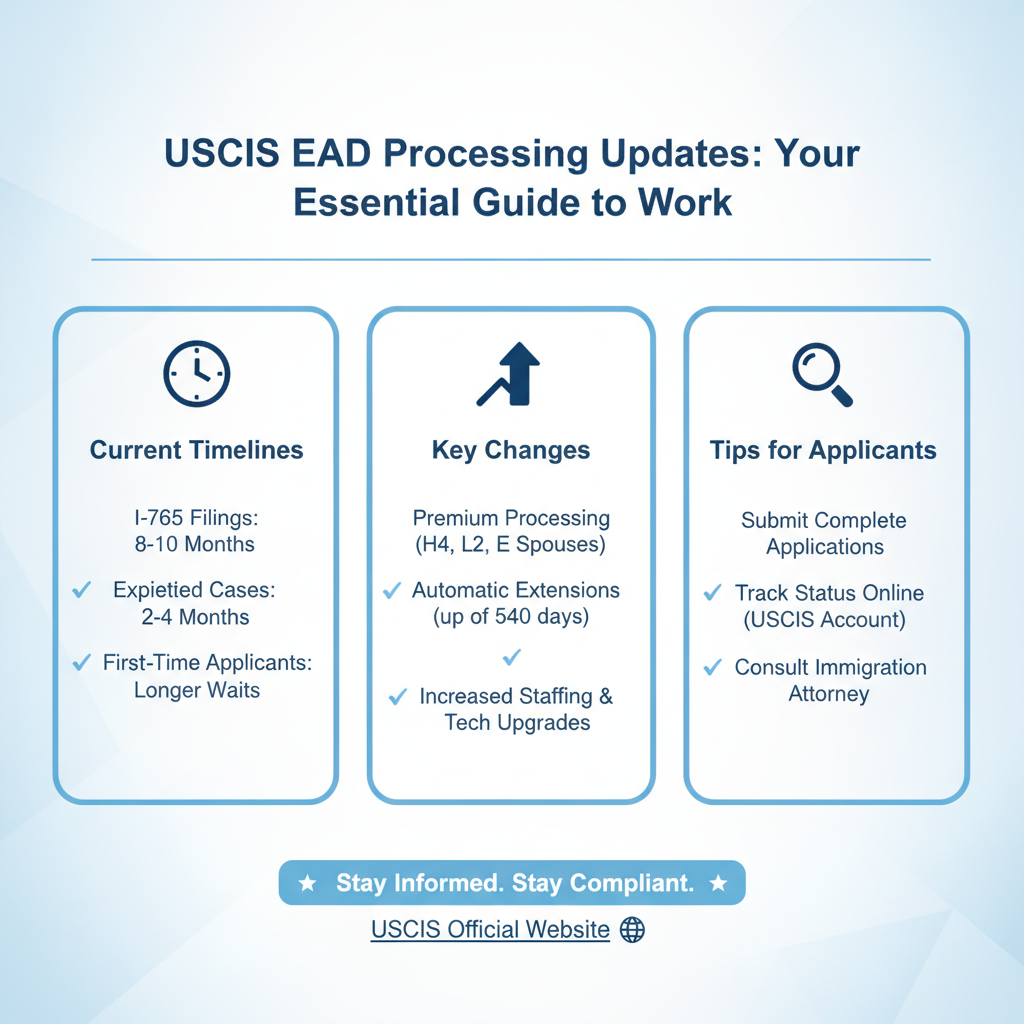
For immigrants across the United States, and particularly here in our vibrant community of Orlando and throughout Florida, the ability to work legally is not just a privilege—it’s a fundamental necessity for building a life, supporting families, and contributing to the economy. The Employment Authorization Document, commonly known as an EAD or work permit, is the key to unlocking this opportunity. Recent updates and ongoing efforts by U.S. Citizenship and Immigration Services (USCIS) regarding EAD application and renewal processing are critical news for thousands of individuals and families.
At Imigrar, "Keep Families Together" is not just our tagline; it's the core of our mission. We understand that delays or complications in obtaining or renewing an EAD can have devastating consequences, leading to job loss, financial instability, and immense stress for families. That’s why staying on top of USCIS developments is paramount, and why we’ve prepared this comprehensive guide for you today, 2026-11-07.
Why this news is showing up now
The immigration landscape is constantly evolving, and USCIS, the agency responsible for processing millions of immigration applications annually, frequently adjusts its policies and procedures. In recent years, USCIS has faced significant challenges, including substantial application backlogs, particularly for EADs. These backlogs led to extended processing times, causing widespread anxiety and uncertainty for applicants.
In response to these challenges and advocacy from immigration groups, USCIS has been implementing various strategies aimed at improving efficiency, reducing processing times, and providing relief to applicants. These efforts often involve:
- Temporary Final Rules (TFRs): Adjusting the automatic extension period for certain EAD renewal categories.
- Policy Manual Updates: Clarifying eligibility criteria or application procedures.
- Technology Enhancements: Investing in digital tools for processing and communication.
- Increased Staffing: Hiring more personnel to handle the volume of applications.
- Prioritization Efforts: Focusing resources on certain categories of applications to alleviate the most pressing backlogs.
The "news" often refers to USCIS announcements about these changes—whether it's an update on average processing times, a new policy for a specific EAD category, or a modification to the application process itself. These updates are a direct result of the agency's ongoing commitment (and sometimes, legal mandates) to address processing inefficiencies and ensure applicants can receive their work authorization in a timely manner.
How it can affect Florida residents
Florida, with its diverse population and thriving economy, is home to hundreds of thousands of immigrants who rely on EADs to maintain employment. For Central Florida residents, particularly those in Orlando, Orange County, and along the I-4 corridor, these USCIS updates have direct and significant implications:
- Employment Stability: Timely EAD processing means immigrants can start new jobs, continue existing employment without interruption, and provide for their families. Delays can lead to job loss, forcing individuals to go without income, which can be catastrophic.
- Economic Contribution: When immigrants can work, they contribute to Florida's economy through taxes, consumer spending, and filling vital labor gaps in sectors like hospitality, agriculture, healthcare, and technology—all crucial to the Orlando metropolitan area.
- Driver's License Eligibility: An EAD is often a necessary document for obtaining or renewing a Florida driver's license or state identification card. Without it, daily tasks like commuting to work, taking children to school, or accessing essential services become incredibly difficult.
- Family Well-being: The financial security provided by an EAD is paramount to family unity. It allows parents to support their children, pay rent, afford healthcare, and plan for the future, aligning perfectly with Imigrar's mission to "Keep Families Together."
- Planning and Uncertainty: Changes in processing times or requirements can create uncertainty. Knowing the latest updates helps individuals and families plan their lives, careers, and finances more effectively, reducing stress and anxiety.
For those in Orlando, understanding these updates is not just about paperwork; it's about maintaining livelihoods, contributing to the community, and securing a stable future. Imigrar is here to help you navigate these changes, ensuring your application is accurate, complete, and submitted strategically.
Need Help? Our Orlando immigration team is ready to assist. Call +1 786-791-3106 for a free consultation, or message us online. Se Habla Español.
What Employment Authorization Document (EAD) Processing Is (and Why It Matters)
The Employment Authorization Document (EAD), often referred to as a "work permit," is a critical document issued by USCIS that grants non-U.S. citizens legal permission to work in the United States for a specific period. It's a tangible piece of proof that an individual is authorized to be employed.
A plain-English definition
Think of the EAD as your official green light to work. If you're not a U.S. citizen or a lawful permanent resident (green card holder), and you want to work legally in the U.S., you generally need an EAD. It's a card, similar to a driver's license, that shows your photo, name, and the dates you are authorized to work. Employers are required by law to verify your eligibility to work, and the EAD serves as primary evidence of that authorization.
The process of "EAD processing" refers to the entire journey your application takes from the moment you submit it to USCIS until you receive a decision (and hopefully, your card). This includes everything from initial receipt, background checks, biometrics appointments, review by an immigration officer, and finally, card production and mailing.
Key terms you need to know
Navigating immigration processes often involves specific terminology. Here are some key terms related to EADs that you should understand:
- Employment Authorization Document (EAD): The official document (Form I-766) issued by USCIS, proving you are authorized to work in the U.S.
- Form I-765, Application for Employment Authorization: This is the primary form you must file with USCIS to request an EAD.
- USCIS (U.S. Citizenship and Immigration Services): The federal agency that oversees lawful immigration to the United States and processes EAD applications. Visit the USCIS official website for more information.
- Eligibility Category: The specific legal classification under which you qualify for an EAD. There are many different categories (e.g., asylum applicant, DACA recipient, spouse of certain nonimmigrant visa holders, applicant for Adjustment of Status). Each category has its own requirements and sometimes different processing rules.
- Initial EAD: Your very first application for an EAD.
- EAD Renewal: An application to extend the validity of an existing EAD that is nearing expiration.
- Validity Period: The specific dates (start and end) for which your EAD is valid, printed on the card.
- Automatic Extension: For certain EAD renewal categories, your expiring EAD and Form I-797C, Notice of Action (receipt notice for your Form I-765 renewal), can extend your work authorization for a period (e.g., 180 or 540 days) beyond your card's expiration date while USCIS processes your renewal.
- Biometrics Appointment: A scheduled appointment at an Application Support Center (ASC) where USCIS collects your fingerprints, photograph, and signature for background checks.
- Receipt Notice (Form I-797C): A notice from USCIS confirming they have received your application. It contains a receipt number you can use to track your case online.
- Request for Evidence (RFE): A letter from USCIS asking for additional documents or information to support your application.
- Notice of Intent to Deny (NOID): A letter from USCIS indicating their intention to deny your application unless you provide compelling reasons or evidence to overcome the denial.
- Adjustment of Status (AOS): The process of applying for lawful permanent resident status (a green card) while physically present in the United States. Many individuals applying for AOS also apply for an EAD concurrently.
Understanding these terms is crucial for anyone navigating the EAD application or renewal process, especially in a bustling metropolitan area like Orlando where employment opportunities are abundant but require legal authorization.
Current Immigration Law: The Foundation for EADs
The authority for USCIS to grant employment authorization stems from federal immigration law, primarily the Immigration and Nationality Act (INA) and its corresponding regulations in the Code of Federal Regulations (CFR). There is no single "EAD law" but rather specific provisions that outline who is eligible for work authorization based on their immigration status or circumstances.
Federal requirements
The core regulations governing employment authorization are found in 8 CFR § 274a.12, which lists various classes of aliens authorized to accept employment in the United States. Eligibility for an EAD is not universal; it is tied to a specific immigration status or application. Here are some of the most common categories:
- Asylees and Asylum Applicants (8 CFR § 274a.12(a)(5) and (c)(8)): Individuals granted asylum or those with a pending asylum application (after 150 days).
- Refugees (8 CFR § 274a.12(a)(3)): Individuals admitted as refugees.
- Applicants for Adjustment of Status (8 CFR § 274a.12(c)(9)): Individuals who have filed Form I-485 to adjust their status to lawful permanent resident. This is a very common category for those seeking green cards.
- Recipients of Deferred Action for Childhood Arrivals (DACA) (8 CFR § 274a.12(c)(33)): Individuals granted DACA.
- Spouses of H-1B and L-1 Visa Holders (8 CFR § 274a.12(c)(26) and (a)(17)): Certain H-4 spouses of H-1B nonimmigrants, and L-2 spouses of L-1 nonimmigrants, if the principal visa holder has reached a certain stage in their green card process or has an approved Form I-140.
- Students with Optional Practical Training (OPT) (8 CFR § 274a.12(c)(3)(i), (ii), (iii)): F-1 students seeking to gain practical experience directly related to their major area of study. This includes initial OPT, STEM OPT extensions, and cap-gap OPT.
- Temporary Protected Status (TPS) Recipients (8 CFR § 274a.12(a)(12) and (c)(19)): Individuals granted TPS.
- Parolees (8 CFR § 274a.12(c)(11)): Individuals paroled into the U.S. for urgent humanitarian reasons or significant public benefit.
Each category has specific documentary requirements and criteria that must be met. It's crucial to correctly identify your eligibility category on Form I-765, as an incorrect selection can lead to delays or denial. You can always find the latest information and specific forms on the USCIS Forms page.
Florida-specific considerations
While the laws governing EAD eligibility are federal, its impact and practical implications are felt at the state and local levels. There are no Florida-specific laws that dictate who can receive an EAD or how it is processed; however, having a valid EAD is essential for integration into Florida society and economy:
- Florida Driver's License/State ID: With a valid EAD, individuals can apply for a Florida driver's license or state identification card through the Florida Department of Highway Safety and Motor Vehicles (FLHSMV). This is vital for navigating Orlando's extensive road network and accessing services.
- Employment Verification (E-Verify): Many employers in Florida, particularly large ones, use E-Verify to confirm the work authorization of new hires. A valid EAD ensures smooth passage through this system.
- Professional Licenses: For certain professions requiring state licensure (e.g., healthcare, teaching), a valid work authorization is a prerequisite.
- Social Security Number (SSN): An EAD is typically required to apply for a Social Security Number, which is essential for employment, filing taxes, and accessing many other services.
For residents of Orlando and Central Florida, a valid EAD provides the legal foundation for employment, financial stability, and seamless participation in daily life. Without it, even with a pending immigration case, many aspects of life can come to a halt. This underscores why accurate and timely EAD processing is so vital for our Florida communities.
How to Apply for or Renew Your Employment Authorization Document (EAD): A Complete Step-by-Step Guide
Applying for or renewing your Employment Authorization Document (EAD) can seem daunting, but by following a structured approach, you can significantly increase your chances of a smooth process. This guide provides a detailed walkthrough for individuals in Orlando and across Florida.
1) Determine Your Eligibility Category and Gather Required Documents
Before you even touch Form I-765, you must accurately determine which eligibility category applies to your situation. This is perhaps the most critical first step. Review the instructions for Form I-765 carefully, as they list all categories (e.g., (c)(9) for Adjustment of Status applicants, (c)(33) for DACA recipients, (c)(26) for certain H-4 spouses). Selecting the wrong category will lead to delays or denial.
Once your category is confirmed, begin gathering your supporting documents. While requirements vary by category, general documents often include:
- Two identical, passport-style photos (taken within 30 days of filing).
- Copy of your last EAD (front and back), if renewing.
- Copy of your Form I-94, Arrival/Departure Record (front and back), or printout from CBP's website.
- Copy of your birth certificate with certified English translation (if applicable).
- Copy of your government-issued identification (e.g., passport biographic page, national ID).
- Copy of your visa (if applicable).
- Proof of your underlying immigration status or application (e.g., Form I-485 receipt notice, asylum application receipt, marriage certificate to a U.S. citizen, Form I-130 approval notice).
- Evidence of any previous EADs or work permits.
- Any other documents specified in the Form I-765 instructions for your specific eligibility category.
Important: Ensure all copies are clear and legible. Do not send original documents unless specifically requested by USCIS.
2) Complete Form I-765, Application for Employment Authorization
Download the latest version of Form I-765 from the USCIS official website. Read the instructions thoroughly before filling out the form. You can complete it electronically and then print it, or print it and fill it out neatly in black ink. Common sections include:
- Part 1. Reason for Applying: Indicate if you are applying for initial permission, a replacement, or a renewal.
- Part 2. Information About You: Personal details, contact information, country of citizenship, date of birth.
- Part 2. Your Eligibility Category: This is where you enter the specific code for your category (e.g., (c)(9), (c)(33)). Be precise.
- Part 3. Applicant's Statement, Contact Information, Declaration, Certification, and Signature: You must sign the form in blue or black ink. An unsigned form will be rejected.
Warning: Double-check every entry for accuracy. Any discrepancies with other immigration forms you’ve filed (like Form I-485 or Form I-130) could raise red flags and cause delays. If you need more space for an answer, use Part 7, "Additional Information."
3) Assemble Your Application Package
Once Form I-765 is completed and signed, and all supporting documents are gathered, it's time to assemble your package. Organize your documents in a logical order to make it easy for USCIS officers to review. A typical order might be:
- Cover Letter (optional, but recommended, listing contents)
- Form G-1145, E-Notification of Application/Petition Acceptance (if you want text/email updates)
- Payment (check or money order, or Form I-912 for fee waiver)
- Two passport-style photos in a small envelope stapled to the upper left corner of Form I-765.
- Completed and signed Form I-765
- Copies of all supporting documents (e.g., previous EAD, Form I-94, passport, birth certificate, marriage certificate, underlying petition receipt notices).
Make a complete copy of the entire assembled package for your records before mailing. This is a crucial step for your peace of mind and for future reference.
4) Pay the Filing Fee
As of 2026-11-07, the filing fee for Form I-765 is generally $410. This fee can change, so always verify the current fee on the USCIS website or the form instructions before submitting your application.
- You can pay by money order, personal check, cashier's check, or by credit card using Form G-1450, Authorization for Credit Card Transactions.
- Make checks payable to "U.S. Department of Homeland Security."
- Some categories are exempt from the fee (e.g., asylum applicants filing under (c)(8), refugees, and those applying for a fee waiver).
- If you are unable to pay the fee, you may be eligible to apply for a fee waiver by filing Form I-912, Request for Fee Waiver.
Reminder: Incorrect payment amounts or uncashed checks will cause your application to be rejected.
5) File Your Application with USCIS
The filing location for Form I-765 depends on your eligibility category and sometimes, your mailing address.
- Mail-In Applications: Check the "Where to File" section on the Form I-765 page of the USCIS website. You will typically mail your application to a specific USCIS Lockbox Facility. These facilities are regional and not the same as your local USCIS Field Office (e.g., the Orlando USCIS Field Office is not where you mail applications).
- Online Filing: For certain eligibility categories, USCIS offers the option to file Form I-765 online. This can sometimes lead to faster processing and allows for immediate receipt confirmation. Create a My USCIS online account to explore this option if available for your category.
We recommend sending mail-in applications via certified mail with a return receipt requested, or through a courier service that provides tracking. This provides proof of mailing and delivery.
6) Attend Biometrics Appointment (If Required)
After USCIS accepts your application, most applicants will receive a Form I-797C, Appointment Notice, for a biometrics services appointment at a local Application
Related Topics
Need Legal Assistance?
Our experienced immigration attorneys are here to help with your case. Contact Imigrar today for a free consultation and let us guide you through the legal process with confidence.
📍 Orlando, Florida • Serving clients nationwide
📧 info@imigrar.com