
TPS Extension Latest: Your Guide to Re-registration in Orlando &
Recent TPS extensions mean critical deadlines are approaching. Learn what this news means for you, how to re-register, and how Imigrar can help keep your family together in Florida.

The landscape of U.S. immigration law is constantly evolving, with policy shifts and humanitarian considerations frequently impacting the lives of countless individuals and families. For those holding Temporary Protected Status (TPS), staying informed about extensions and re-designations is not just important—it's absolutely critical for maintaining legal status and peace of mind.
Need Help? Our Orlando immigration team is ready to assist. Call +1 786-791-3106 for a free consultation, or message us online. Se Habla Español.
The reporting that sparked this guide:
Recent announcements regarding the extension of Temporary Protected Status for several designated countries have sent ripples of both relief and urgency through immigrant communities nationwide. These critical updates, frequently highlighted by legal news outlets, underscore the dynamic nature of U.S. immigration policy and the need for beneficiaries to act swiftly and accurately. The information provided in this guide is inspired by and directly relevant to the kind of breaking news you might find via sources like: TPS (Temporary Protected Status) Extension News (Legal News)
What This News Means for Immigrants in Orlando and Across Florida
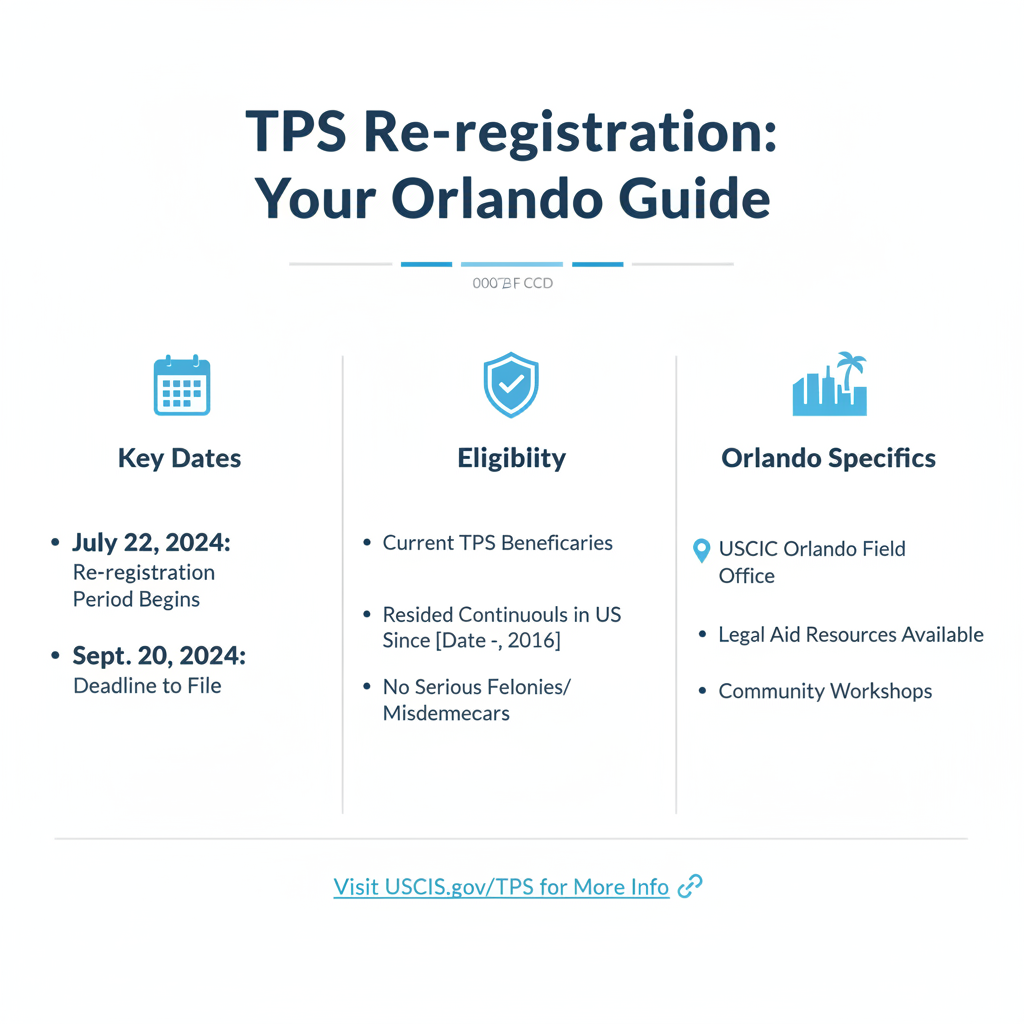
For hundreds of thousands of individuals and families who have found refuge and built lives in the United States under Temporary Protected Status (TPS), recent announcements of extensions for designated countries are monumental. This news directly impacts your ability to live and work legally in the U.S., offering continued protection from deportation and the stability needed to plan for the future. At Imigrar, we understand that these updates can be complex and sometimes overwhelming. Our goal is to break down what these extensions mean for you, especially if you reside in Orlando or elsewhere in Florida.
Why this news is showing up now
The U.S. Secretary of Homeland Security (DHS) is responsible for designating countries for TPS based on specific conditions that make return unsafe. These conditions can include ongoing armed conflict, environmental disasters (like earthquakes or hurricanes), or other extraordinary and temporary conditions. Periodically, the DHS reviews the conditions in designated countries. When these conditions persist, or when new crises emerge, the Secretary may decide to extend a country's TPS designation or even redesignate it, opening eligibility to more individuals. The recent news reports indicate that after a thorough review, the DHS has determined that the conditions warranting TPS for certain countries continue to exist, necessitating these extensions.
These decisions are typically announced with a specific re-registration period, usually lasting between 60 to 180 days, during which current beneficiaries must apply to extend their status. Missing this window can lead to serious consequences, including loss of protection and employment authorization.
How it can affect Florida residents
Florida, particularly Central Florida and the Orlando metropolitan area, is home to a significant and diverse immigrant population, including a substantial number of TPS beneficiaries. The I-4 corridor, stretching from Tampa Bay through Orlando to Daytona Beach, is a hub for many communities whose home countries are often among those designated for TPS.
- Continued Stability: For eligible residents in Orlando, Kissimmee, Sanford, and across Orange County, these extensions mean you can continue to live and work lawfully in the U.S. without fear of deportation. This stability is crucial for families, businesses, and communities.
- Employment Authorization: An extension typically comes with an automatic extension of your Employment Authorization Document (EAD), often referred to as a work permit, or the opportunity to apply for a new one. This ensures you can maintain your job and support your family.
- Travel Authorization: With a valid EAD and approved travel authorization (Form I-131, Application for Travel Document), TPS beneficiaries may be able to travel internationally and return to the U.S. This is vital for family visits or urgent matters abroad.
- Community Impact: The continuation of TPS allows thousands of Floridians to remain active, contributing members of their communities, paying taxes, running businesses, and enriching the cultural fabric of our state.
- Urgency for Re-registration: The most significant impact is the immediate need for all eligible TPS beneficiaries to understand the re-registration process and deadlines. Warning: Failure to re-register on time can lead to the loss of your TPS benefits.
At Imigrar, we are deeply committed to serving our community. If your case is in Orlando, Kissimmee, or anywhere in Central Florida, our team is ready to provide guidance and support throughout the re-registration process. We speak English and Spanish (Se Habla Español) to ensure clear communication and understanding.
What Temporary Protected Status (TPS) Is (and Why It Matters)
Temporary Protected Status (TPS) is a humanitarian immigration benefit provided by the United States government. It's a lifeline for individuals from certain countries who cannot safely return to their homelands due to specific, temporary conditions. Understanding TPS is crucial for anyone who may be eligible or has a family member who is.
A plain-English definition
Imagine your home country is experiencing a severe crisis – perhaps a devastating natural disaster like a massive earthquake or hurricane, an ongoing armed conflict, or other extraordinary circumstances that make it incredibly dangerous or impossible for you to return safely. In such situations, the U.S. government, through the Secretary of Homeland Security, can designate that country for Temporary Protected Status. This status allows eligible individuals from that country who are already in the U.S. to live and work here legally for a temporary period. It's not a path to a green card or citizenship directly, but it offers critical protection from deportation and provides work authorization, giving beneficiaries a chance to rebuild their lives in safety.
The designation is "temporary" because it's granted for a specific period (usually 6, 12, or 18 months) and can be extended if the unsafe conditions persist. If the conditions improve, the designation can be terminated, requiring beneficiaries to find other legal avenues to remain in the U.S. or depart.
Key terms you need to know
Navigating immigration law requires understanding specific terminology. Here are some key terms related to TPS:
- Designated Country: A country for which the U.S. Secretary of Homeland Security has determined that conditions warrant TPS. Examples in recent history have included Haiti, Venezuela, El Salvador, Honduras, and Nicaragua, among others.
- Beneficiary: An individual who has been granted TPS and receives its protections and benefits.
- Re-designation: When the Secretary of Homeland Security determines that a country's conditions continue to meet the criteria for TPS, and also decides to allow additional individuals from that country (who may have arrived after the initial designation) to apply for TPS. This typically happens alongside an extension of the existing designation.
- Extension: When the Secretary of Homeland Security determines that a country's conditions continue to meet the criteria for TPS, and extends the current designation period, requiring existing beneficiaries to re-register.
- Re-registration: The process by which current TPS beneficiaries apply to extend their status when a country's designation is extended. This is a mandatory step to maintain benefits.
- Employment Authorization Document (EAD): Also known as a work permit, this document (Form I-766) allows TPS beneficiaries to legally work in the United States.
- Form I-821, Application for Temporary Protected Status: The primary form used to apply for or re-register for TPS.
- Form I-765, Application for Employment Authorization: The form used to apply for or renew an EAD.
- Form I-131, Application for Travel Document: The form used to apply for Advance Parole, which allows a TPS beneficiary to travel outside the U.S. and return legally.
- USCIS (U.S. Citizenship and Immigration Services): The government agency responsible for administering immigration and naturalization benefits, including TPS applications. USCIS official website
- DHS (Department of Homeland Security): The federal department that oversees USCIS and makes decisions regarding TPS designations.
Understanding these terms is the first step toward successfully navigating the TPS re-registration process. These extensions are vital for TPS holders, offering a continued sense of security and the ability to contribute to their communities, including those in Orlando and throughout Florida.
Need Help? Our Orlando immigration team is ready to assist. Call +1 786-791-3106 for a free consultation, or message us online. Se Habla Español.
Current Immigration Law: The Foundation
Temporary Protected Status (TPS) is authorized by Section 244 of the Immigration and Nationality Act (INA), specifically 8 U.S.C. § 1254a. This law provides the framework for the Secretary of Homeland Security to grant temporary immigration status to eligible nationals of designated countries. The intent of TPS is humanitarian, offering a safe haven when a country faces conditions that prevent its nationals from returning safely.
Federal requirements
To be eligible for TPS, whether for initial designation or re-registration, federal law outlines several key requirements:
- Nationality: You must be a national of a country designated for TPS, or a person without nationality who last habitually resided in that country.
- Continuous Physical Presence (CPP): You must have been continuously physically present in the U.S. since the effective date of your country's most recent TPS designation or re-designation. Brief, casual, and innocent departures do not break CPP.
- Continuous Residence (CR): You must have been continuously residing in the U.S. since the date specified for your country's designation or re-designation. Similar to CPP, certain brief departures do not break CR.
- Timely Application: You must apply for TPS during the initial registration period or, for extensions, during the re-registration period announced by USCIS. Important: Missing this deadline can result in the loss of your TPS benefits unless you can demonstrate good cause for late filing.
- Admissibility: You must meet certain admissibility requirements. Certain criminal offenses or grounds of inadmissibility (e.g., security-related, drug trafficking) can make you ineligible for TPS. Waivers may be available for some grounds of inadmissibility.
- Security Checks: All applicants must undergo security and background checks.
The process involves filing Form I-821, Application for Temporary Protected Status, and if you wish to work, Form I-765, Application for Employment Authorization. For travel outside the U.S., you must apply for Advance Parole using Form I-131, Application for Travel Document. These forms, along with their instructions and filing fees, are available on the USCIS Forms page.
Florida-specific considerations
While TPS is a federal program, its impact and application have localized considerations, especially in states with large immigrant populations like Florida. For residents in Orlando and other parts of Florida, the federal requirements remain the same, but practical aspects may vary:
- Local USCIS Field Office: If you are required to attend an interview or submit biometrics, you will typically do so at a local USCIS Application Support Center (ASC) or Field Office. For Central Florida residents, the Orlando USCIS Field Office may be relevant, though biometrics are usually handled at ASCs.
- Community Resources: Florida has numerous community organizations and legal aid groups that may offer assistance or referrals for TPS re-registration, particularly in areas with high concentrations of beneficiaries.
- Legal Representation: Given the complexities, especially if you have any criminal history, prior immigration issues, or questions about continuous residence/physical presence, seeking legal counsel from an experienced Orlando immigration attorney is highly recommended. Imigrar is strategically located to serve clients throughout Florida.
Understanding these foundational laws and requirements is the bedrock of a successful TPS re-registration. Ensure you have the most up-to-date information by checking the USCIS official website regularly for specific country announcements and deadlines.
How to Re-register for TPS: A Complete Step-by-Step Guide
Re-registering for Temporary Protected Status (TPS) when an extension is announced is a critical process that requires attention to detail and timely action. This guide outlines the essential steps to ensure your application is submitted correctly and efficiently, safeguarding your status and work authorization.
1) Determine Your Eligibility and Re-registration Window
Before doing anything else, confirm that your country has received a TPS extension and that you are eligible to re-register. USCIS will publish a Federal Register notice announcing the extension, the specific re-registration period (e.g., 60-day window, 180-day window), and any automatic extensions of EADs and other documents.
- Check the Official Announcement: Visit the USCIS official website and look for the specific Federal Register notice pertaining to your country's TPS extension. This notice will contain all crucial dates and instructions.
- Verify Your Eligibility: Ensure you previously held TPS for the designated country and continue to meet the eligibility requirements (e.g., no disqualifying criminal convictions, maintained continuous residence and physical presence since your last registration).
- Note the Deadline: Mark the re-registration deadline prominently on your calendar. Warning: Missing this deadline can lead to the loss of your TPS and related benefits.
2) Gather Required Documents
Thorough document preparation is vital. Having everything organized before you start filling out forms will save time and prevent errors. While re-registration generally requires less initial proof than a first-time application, you must still demonstrate your identity, nationality, and previous TPS grant.
-
Proof of Identity and Nationality:
- Copy of your passport from the designated country.
- Copy of your birth certificate with photo identification.
- National identity document from your country with photo and fingerprint.
- Any previous Form I-797, Approval Notice for TPS or EAD.
-
Proof of Previous TPS Grant:
- Copy of your most recent Form I-797, Approval Notice for Form I-821.
- Copy of your previous EAD (Form I-766) issued under TPS.
- Two Passport-Style Photos: Ensure they meet USCIS specifications (2x2 inches, white background, taken within 30 days of filing).
Reminder: Do not send original documents unless specifically requested by USCIS. Always send high-quality photocopies.
3) Complete Form I-821, Application for Temporary Protected Status
This is the primary form for re-registering your TPS. Fill it out accurately and completely. You can download the latest version from the USCIS Forms page.
- Read Instructions Carefully: USCIS instructions can change. Always use the most current version.
- Provide All Requested Information: Ensure consistency with previous applications. If any information has changed (e.g., address, marital status), provide updated details.
- Answer All Eligibility Questions: Pay close attention to questions regarding criminal history or other grounds of inadmissibility. If you answer "yes" to any of these, consult with an immigration attorney immediately.
- Sign the Form: An unsigned form will be rejected.
4) Complete Form I-765, Application for Employment Authorization (Optional)
If you wish to continue working legally in the U.S., you must file Form I-765. While an automatic EAD extension is often granted in the Federal Register notice, filing a new Form I-765 ensures you receive a new card with an updated expiration date.
- Check Automatic EAD Extension: The Federal Register notice for your country's TPS extension will specify if and for how long your existing EAD is automatically extended. This can be crucial for maintaining employment while your new EAD is processed.
- Fill Out Accurately: Ensure your category code (typically (c)(19) for TPS) is correct.
- Attach Photos: Two passport-style photos are required for Form I-765 as well.
- Sign the Form: Like Form I-821, this form must be signed.
5) Prepare Supporting Evidence and Fees
The final components of your application package are the fees and any additional supporting documents.
-
Filing Fees:
- Form I-821: No fee for re-registration.
- Form I-765: There is a fee for this form, unless you are eligible for a fee waiver (Form I-912, Request for Fee Waiver). Check the current fee schedule on the USCIS official website.
- Biometrics Fee: There is a mandatory biometrics services fee, which must be submitted with your application unless you are filing Form I-912.
- Translations: If any of your supporting documents are not in English, you must include a complete English translation certified by the translator, along with a copy of the original document.
6) Submit Your Application Package
Once all forms are completed, signed, and all required documents and fees are prepared, it's time to mail your application.
-
Assemble Your Package:
- Place your check/money order or Form G-1450 on top.
- Then, Form I-821 with its supporting documents.
- Next, Form I-765 with its supporting documents.
- If applicable, Form I-912 and its evidence.
- Mailing Address: Send your application to the correct USCIS lockbox facility. The address depends on your mailing address and the type of form. Always refer to the "Where to File" section in the instructions for Form I-821 on the USCIS official website.
- Proof of Mailing: Use a service that provides tracking and delivery confirmation (e.g., USPS Certified Mail, FedEx, UPS). Keep the tracking number.
7) Attend Biometrics Appointment (If Required)
After USCIS receives your application, you will typically receive an appointment notice (Form I-797C, Notice of Action) for a biometrics appointment at an Application Support Center (ASC) near you. For Central Florida residents, this might be the Orlando ASC.
- Do Not Miss It: Attend your appointment as scheduled. Bring the appointment notice, your photo ID, and any other requested documents.
- Purpose: Biometrics (fingerprints, photograph, signature) are used for background and security checks.
8) Receive Decision
USCIS will process your application and send you a decision. You can monitor the status of your case online using the receipt number provided by USCIS on your Form I-797C, Notice of Action.
- Approval: If approved, you will receive a new Form I-797, Approval Notice for TPS and, if applied for, a new EAD.
- Request for Evidence (RFE): USCIS may send an RFE if they need more information or clarification. Respond promptly and thoroughly by the deadline provided.
- Denial: If your application is denied, it's crucial to understand the reasons for denial. Consult an immigration attorney immediately to explore potential options, such as filing a motion to reopen/reconsider or appealing the decision.
The processing times can vary significantly. You can check estimated processing times at USCIS Processing Times.
Need Help? Our Orlando immigration team is ready to assist. Call +1 786-791-3106 for a free consultation, or message us online. Se Habla Español.
Practical Steps You Can Take Today
The news of TPS extensions, while welcome, comes with a clear call to action. Proactive steps can significantly reduce stress and increase the likelihood of a successful re-registration. Here’s what you can do right now to prepare.
Actionable Checklist (5+ items)
- Verify Your Country's Status: Immediately check the USCIS official website for the latest Federal Register notice concerning your country's TPS extension. Confirm the exact re-registration period and any automatic EAD extensions.
- Locate Previous TPS Documents: Gather your previous Form I-797 Approval Notices for TPS and your most recent EAD. These are essential for re-registration.
- Update Your Address with USCIS: If you've moved since your last TPS application, file Form AR-11, Alien's Change of Address Card, online or by mail. USCIS must have your current address to send you notices. For Central Florida residents, this is particularly important if you've moved within Orange County or to a neighboring county.
- Review Your Eligibility: Reflect on any changes in your life that might affect your eligibility, especially regarding criminal history or extended stays outside the U.S. If there are concerns, seek legal advice immediately.
- Start Gathering Identification: Ensure your passport or national identity document is valid and accessible. If it has expired, begin the process of renewing it through your country's consulate (e.g., the Haitian Consulate in Orlando or Miami, or Venezuelan interests section).
- Budget for Fees: If you plan to apply for an EAD, anticipate the filing fee and the biometrics fee. If you believe you qualify for a fee waiver, start gathering evidence of your financial need for Form I-912.
Document preparation guidance
Effective document management is key to a smooth application process:
- Make Copies: Never send original documents unless specifically requested by USCIS. Make clear, legible photocopies of everything. Keep the originals in a safe place.
- Organize Your Files: Create a dedicated folder for your TPS re-registration documents. Label sub-folders for "Identity," "Previous TPS," "Photos," "Fees," etc.
- Translations: If any document is not in English, you must include a full English translation along with a certificate of translation. The translator must attest that they are competent to translate and that the translation is accurate.
- Photographs: Get new passport-style photos taken within 30 days of filing. Do not use old photos. Ensure they meet USCIS specifications.
Timeline expectations
Understanding the typical timeline can help manage expectations and reduce anxiety:
- Re-registration Window: This is the most critical timeline. It's usually a 60 to 180-day window from the date of the Federal Register notice. You must submit your application within this period.
Related Topics
Need Legal Assistance?
Our experienced immigration attorneys are here to help with your case. Contact Imigrar today for a free consultation and let us guide you through the legal process with confidence.
📍 Orlando, Florida • Serving clients nationwide
📧 info@imigrar.com