


The reporting that sparked this guide
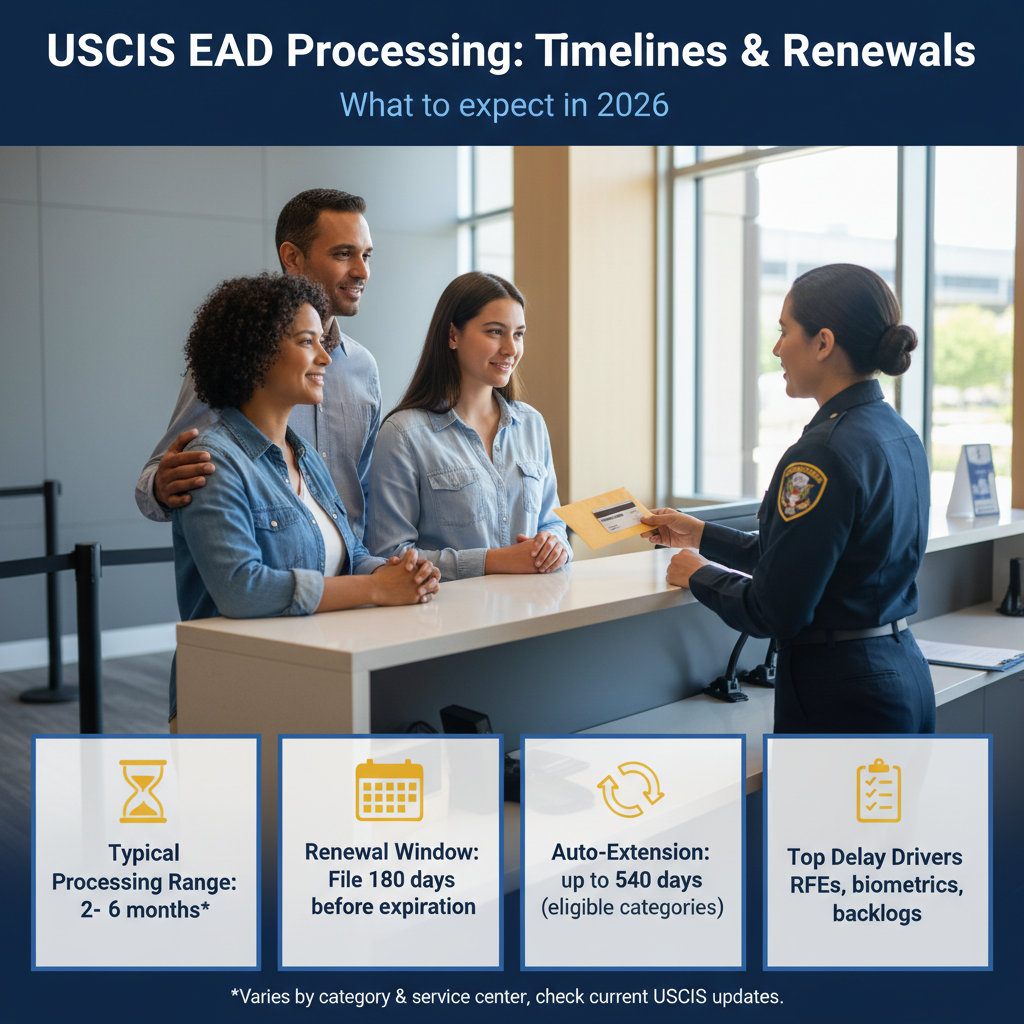
This article is inspired by ongoing USCIS-related coverage and public discussion about Employment Authorization Document (EAD) processing and renewal timelines, including updates that have been trending in immigration news feeds.
Need Help? Our Orlando immigration team is ready to assist. Call +1 786-791-3106 for a free consultation, or message us online. Se Habla Español.
What This News Means for Immigrants in Orlando and Across Florida
Why this news is showing up now
EAD processing is “trending” because work authorization touches nearly every part of an immigrant family’s stability: employment, driver’s licenses, professional licensing, and sometimes even whether a person can keep health insurance. When USCIS processing times fluctuate—or when USCIS expands or narrows automatic extension rules—people feel it immediately.
In 2025–2026, USCIS has continued to emphasize backlogs, digitization, and operational changes that affect:
- How quickly USCIS issues initial EADs after filing Form I-765
- How reliably renewal EADs arrive before an old card expires
- Whether an applicant qualifies for an 180 days or longer automatic extension (depending on category and policy)
- How employers complete Form I-9 reverification when the employee is on an EAD extension
Reminder: EAD “processing time” is not just a number on a website—it determines whether you can legally work and whether your family can pay rent and bills.
How it can affect Florida residents
For Central Florida residents along the I-4 corridor (Orlando, Kissimmee, Sanford, and nearby Orange County communities), EAD delays can show up in very practical ways:
- Work gaps if your renewal is filed late or you don’t qualify for an automatic extension
- Driver’s license renewal challenges if your EAD expires and you need updated proof of lawful presence/work authorization
- Job offer risk when an employer cannot complete I-9 verification without acceptable documents
- Financial stress for families waiting on Adjustment of Status decisions tied to Form I-485
If your case is in Orlando, you may also be dealing with local realities like appointment availability, biometrics scheduling logistics, and the ripple effects of national processing changes.
Warning: If you rely on an EAD to work, don’t assume USCIS will process your renewal in time. Plan for a buffer and file as early as allowed.
What Employment Authorization Document Processing Is (and Why It Matters)
A plain-English definition
An Employment Authorization Document (EAD)—often called a “work permit”—is a card issued by USCIS that proves you are allowed to work in the United States for a specific period of time. EAD processing refers to the steps USCIS takes to:
- Accept your application (usually Form I-765)
- Schedule biometrics when required
- Review eligibility under your category (such as pending Adjustment of Status, asylum, TPS, etc.)
- Approve and produce the card
- Mail the EAD to your address on file
For many immigrants, the EAD is the bridge that allows lawful work while a longer case is pending—like a family-based green card process through Form I-130 + Form I-485.
Key terms you need to know
- Form I-765: The USCIS application used to request an EAD (initial or renewal).
- Category: The eligibility code (for example, (c)(9) for certain pending Adjustment of Status applicants). The category determines fees, evidence, and whether an auto-extension applies.
- Receipt Notice: USCIS notice showing the case was received; it may be critical for employer verification if an auto-extension applies.
- Automatic Extension: For some renewal applicants, USCIS rules allow continued work authorization for a specific period (often 180 days, and in some situations longer by policy) if filed on time and in the same category.
- Biometrics: Fingerprints/photo/signature appointment that may be required before approval.
- RFE (Request for Evidence): USCIS request for missing documents; RFEs commonly slow EAD approvals.
- Expedite Request: A request asking USCIS to speed up a case due to qualifying hardship or urgent need (approval is discretionary).
- Priority Date: A key concept in many green card categories; while Priority Date itself does not “grant” an EAD, it often controls when someone can file Form I-485, which can unlock EAD eligibility.
- 90-day window: A planning concept many applicants use for renewals—meaning you should start preparing well before expiration. (Your actual filing eligibility depends on your category and USCIS rules.)
Important: EAD eligibility is category-specific. The “right” documents for one person may be wrong for another, even if both are renewing a work permit.
Current Immigration Law: The Foundation
EADs are authorized by federal immigration regulations, primarily under the Immigration and Nationality Act (INA) framework and its implementing regulations. The most common regulatory authority for EADs is found at 8 C.F.R. § 274a, including provisions that describe who may receive employment authorization and under what conditions.
USCIS policy guidance and Federal Register notices can also expand or clarify automatic extensions and validity periods for certain categories. Because these rules can change, always verify the latest instructions and category guidance directly with USCIS.
Federal requirements
At the federal level, the core requirements typically include:
- Filing the correct application: usually Form I-765 (Application for Employment Authorization)
- Paying the correct fee (or filing a fee waiver request when eligible)
- Proving eligibility under a specific category (for example, pending Adjustment of Status via Form I-485)
- Completing biometrics if USCIS requires it
- Maintaining accurate address information with USCIS to avoid returned cards
Helpful official links:
- USCIS official website
- USCIS Processing Times
- USCIS Forms
- U.S. Department of State
- Executive Office for Immigration Review
Florida-specific considerations
Immigration is federal law, so Florida does not “set” EAD eligibility. But Florida residents experience EAD timing issues in state-based systems such as:
- Driver license issuance/renewal based on document validity
- Employment onboarding and E-Verify practices by Florida employers
- Professional licensing timelines where proof of work authorization is required
If your case is in Orlando or you are working in Orange County along the I-4 corridor, consider planning your renewal earlier to avoid conflict with employer re-verification cycles and state renewal dates.
Important: If you have a pending removal case in immigration court, your strategy may involve both USCIS filings and EOIR scheduling. If you’re unsure, confirm whether USCIS or the court has jurisdiction over your underlying case before filing.
Common immigration forms that often relate to EAD eligibility include:
- Form I-765 (EAD application/renewal)
- Form I-485 (Application to Register Permanent Residence or Adjust Status) — a frequent basis for EAD category (c)(9)
- Form I-130 (Petition for Alien Relative) — often filed before Form I-485 in family cases
- Form I-131 (Travel Document / Advance Parole) — commonly filed with Form I-485
- Form AR-11 (Change of Address)
Need Help? Our Orlando immigration team is ready to assist. Call +1 786-791-3106 for a free consultation, or message us online. Se Habla Español.
How to Apply for or Renew an EAD: A Complete Step-by-Step Guide
1) Confirm your eligibility category (and timing rules)
Before you prepare paperwork, identify your eligibility category code for Form I-765. This code controls almost everything: what evidence you need, whether fees apply, and whether an automatic extension may protect you from a work gap.
Important: Renewal timing rules vary. Some categories allow filing up to a specific period before expiration, while others depend on the underlying status or pending application.
Documents to gather for this step:
- Your current/most recent EAD card (front and back copy)
- Your USCIS receipt notices for related cases (for example, Form I-485 receipt for (c)(9))
- Passport biographic page and visa (if available)
- I-94 record (if applicable)
- Any prior USCIS approval notices related to status (TPS, asylum, etc.)
2) Choose the correct filing method: online vs. paper
USCIS permits online filing for certain Form I-765 categories, while others must be filed by mail. The best method depends on your category, your comfort level, and whether you need to submit a complex evidence packet.
Practical note for Florida residents: Online filing can reduce mailing delays, but you must still upload clear documents and monitor your USCIS account for notices.
Documents to gather for this step:
- A scanned PDF of your identity documents (passport, prior EAD)
- Digital passport-style photo (if required for online filing)
- Payment method for filing fees (credit/debit or check/money order for paper)
- A reliable email address and secure way to store USCIS account credentials
3) Prepare Form I-765 carefully (avoid “silent” delays)
Many EAD delays are preventable. USCIS can issue RFEs or reject filings for missing signatures, incorrect fees, wrong category codes, or inconsistent information compared to prior filings.
Common areas that cause problems:
- Name formatting inconsistencies (especially multiple last names)
- Incorrect A-Number or USCIS Online Account Number
- Incorrect eligibility category
- Using an old edition date of the form (for paper filings)
- Missing explanation for “Yes” answers in eligibility questions
Documents to gather for this step:
- Prior Form I-765 copies (if available)
- All USCIS receipt notices for pending filings
- Certified court dispositions (if any arrests/citations occurred)
- Marriage certificate or legal name change documents (if applicable)
4) Assemble supporting evidence and photos (category-specific)
Supporting evidence depends heavily on your category. For example, a pending Adjustment of Status applicant typically submits proof of the pending Form I-485. An asylum applicant submits different evidence.
Reminder: Submitting the wrong evidence can be as harmful as submitting no evidence—because it can trigger confusion or an RFE.
Documents to gather for this step (common examples):
- Copy of government-issued photo ID
- Copy of I-94 (if applicable)
- Two passport-style photos (for paper filings when required)
- USCIS receipt notice for the underlying case (e.g., Form I-485, asylum, TPS)
- Prior EAD copies and approval notices
5) File the application, track delivery, and save proof
After filing, your first goal is to secure proof that USCIS received it. For paper filings, use a trackable delivery method and keep the delivery confirmation. For online filings, save the submission confirmation and uploaded document copies.
Then watch for:
- Receipt notice (often critical for an automatic extension)
- Biometrics notice (if required)
- Any “Request for Evidence” (RFE)
Documents to gather for this step:
- Courier tracking number and delivery confirmation (paper)
- USCIS online submission confirmation (online)
- Copies of the full packet you submitted
- Calendar reminders for your EAD expiration date and follow-up checkpoints
6) Respond quickly to biometrics or RFEs (and consider expedite options)
If USCIS schedules biometrics, attend on time and follow the instructions exactly. Missing biometrics can delay or derail your EAD.
If you receive an RFE, respond with an organized packet and include the RFE notice on top. Late responses can result in denial.
In limited cases, you may request expedited processing based on USCIS expedite criteria (for example, severe financial loss to a person or company, urgent humanitarian reasons, or compelling U.S. government interests). Expedite requests are discretionary and require evidence.
Documents to gather for this step (as applicable):
- Biometrics appointment notice
- RFE notice and a point-by-point response cover letter
- Evidence of hardship for expedite (past-due notices, eviction notice, employer letter, medical documentation)
- Proof of job offer/start date or risk of termination
7) After approval: prevent delivery problems and update your employer correctly
Approval is not the finish line. Many applicants face delays because the card is misdelivered, returned, or sent to an old address.
Once you receive your EAD:
- Confirm your name, category, and validity dates are correct
- Store the card securely and keep a copy
- Update your employer’s I-9 documentation as needed
- If the card is wrong, act quickly to address the error
Documents to gather for this step:
- Your new EAD card (make copies)
- Approval notice (if issued)
- Any I-9 reverification request from employer
- Proof of address and any Form AR-11 confirmation if you moved
Practical Steps You Can Take Today
If you are worried about EAD processing times, you can take meaningful action now—before you are facing a last-minute crisis at work.
Actionable checklist
- Check your EAD expiration date today and set reminders at 120, 90 (90-day window planning), 60, and 30 days.
- Confirm your category code on your current EAD and match it to your renewal eligibility.
- Download the latest form edition from USCIS Forms if filing by mail.
- Track real-time estimates using USCIS Processing Times (and remember it’s an estimate, not a guarantee).
- Prepare employer communication early if you may rely on an automatic extension (HR departments often need time to review documents).
- Scan everything into a single organized PDF folder: receipts, IDs, prior approvals, and your full submission packet.
- Update your address immediately if you move using USCIS tools and keep confirmation (wrong address is a common reason cards are returned).
Document preparation guidance
Use a “clean packet” approach:
- Make clear copies (no cut-off edges) of IDs and prior EADs.
- Use consistent names across all filings (match your passport or legal name-change documentation).
- Include a short cover letter listing contents and your eligibility category.
Important: If your EAD is tied to a pending Form I-485, include the I-485 receipt notice. If your I-485 was transferred or you have multiple receipts, include them all.
Timeline expectations (realistic planning)
USCIS timelines vary by category and service center workload. As a practical planning tool:
- Assume renewals can take multiple months, especially if biometrics or an RFE is issued.
- Mailing time adds risk—delivery issues can add weeks.
- If you qualify for an automatic extension, it can protect your work authorization while the renewal is pending—but only if you filed correctly and on time.
Warning: Do not quit your job or accept a start date based solely on a hope that the EAD will arrive “soon.” Build a buffer and talk to counsel about options.
Need Help? Our Orlando immigration team is ready to assist. Call +1 786-791-3106 for a free consultation, or message us online. Se Habla Español.
How Imigrar Helps Immigrants in Orlando
At Imigrar, we focus on practical, family-centered immigration solutions—because our mission is to Keep Families Together. EAD delays and work gaps can create serious instability, and our role is to help you reduce risk with a clear plan.
We regularly assist clients nationwide (and many in Central Florida) with:
- EAD initial filings and renewals under the correct category
- EADs based on pending Adjustment of Status (Form I-485)
- Family-based strategies tied to Form I-130 and timing considerations such as Priority Date
- Responding to RFEs efficiently
- Expedite requests with strong supporting evidence
- Address updates and delivery problem troubleshooting
If your case is in Orlando, we can also help you think through local logistics—like biometrics scheduling, document organization, and how to communicate with employers in the I-4 corridor job market.
Se Habla Español. We offer a free consultation so you can understand your options before you risk a work interruption.
Frequently Asked Questions
Q: Who is eligible to apply for an EAD through USCIS?
A: Eligibility depends on your immigration category. Many applicants qualify through a pending Adjustment of Status application (Form I-485), asylum-related categories, TPS, certain parole programs, and other classifications listed in Form I-765 instructions. The fastest way to confirm is to identify the category code that matches your status and then verify required evidence on the USCIS official website.
Q: Will filing an EAD renewal affect my immigration status?
A: In most cases, filing a renewal does not “change” your status by itself—it requests employment authorization based on an underlying eligibility (like a pending Form I-485). However, inconsistencies, missing disclosures, or undisclosed criminal history can create complications. Important: If you have had any arrests or immigration violations, get legal advice before filing so you don’t accidentally trigger avoidable issues.
Q: How long does USCIS take to process EAD applications in 2026?
A: Processing times vary by category and USCIS workload. Use USCIS Processing Times to check your form and category. Reminder: The posted time is an estimate; biometrics, RFEs, and mail delivery issues can extend it. For Central Florida residents, plan early to avoid a work gap.
Q: What documents do I need for an EAD renewal?
A: Common documents include a copy of your current/expired EAD (front/back), a government-issued ID, and proof of your underlying eligibility (for example, the receipt notice for Form I-485 if you are renewing under category (c)(9)). You may also need photos (especially for paper filing), prior approval notices, and any documents that explain name changes. Always follow the category-specific instructions for Form I-765.
Q: How much does it cost to apply for or renew an EAD?
A: Fees depend on your category and whether USCIS requires biometrics. Some categories have a filing fee; others may have no fee when filed with a pending benefit request. Check the latest fee schedule and instructions on USCIS Forms. If you cannot afford the fee, you may be eligible for a fee waiver in certain situations (with supporting evidence). Costs also include indirect costs like document translations, passport photos, and mailing.
Q: What happens if my EAD application is denied?
A: A denial can mean you cannot work (or continue working) unless you have another valid basis for employment authorization. Next steps depend on the reason for denial—such as incorrect category, missing evidence, or ineligibility. You may be able to refile with corrected evidence, file a motion, or address the underlying eligibility problem. Warning: If your EAD is tied to a broader case (like Form I-485), a denial may signal issues that could affect the larger case—get legal advice quickly.
Q: Can I work while my EAD renewal is pending?
A: Sometimes. Certain categories allow an automatic extension (often 180 days) if you filed the renewal on time and meet the criteria. Your receipt notice plus your expired EAD can serve as evidence for I-9 purposes in qualifying cases. Because eligibility rules are category-specific and can change by policy, confirm your category’s extension rules and coordinate with your employer’s HR department.
Common Mistakes (and How to Avoid Them)
Mistake #1: Filing in the wrong category (or mixing categories)
USCIS adjudicates EADs by category. If you pick the wrong code, you may receive an RFE, rejection, or denial. This is especially common when someone transitions from one basis to another (for example, from a student-based category to a pending Adjustment of Status category).
How to avoid it: Match your category to your underlying status and include the correct receipt notice (for example, Form I-485 receipt for (c)(9)).
Mistake #2: Waiting too long and assuming USCIS will be “on time”
Even a strong renewal can be delayed by biometrics, an RFE, or mail issues. Many people start preparing only a few weeks before expiration and then face a work gap.
How to avoid it: Treat the 90-day window as a minimum planning milestone and build a larger buffer when possible. Track your case and keep proof of filing.
Mistake #3: Address problems and missed notices
If you move and don’t update USCIS, you can miss biometrics or RFEs—or your approved card can be returned. This can add weeks or months.
How to avoid it: Update your address immediately and keep confirmation. Monitor your USCIS online account and mail closely.
Additional Orlando & Central Florida Notes (Field Office Reality)
The Orlando USCIS Field Office primarily handles interviews and certain in-person services related to benefits like Form I-485 interviews. Many EADs are processed by USCIS service centers rather than the field office. Still, Orlando-area applicants often experience the process as one connected journey—especially when an EAD is tied to a pending green card case.
For Central Florida residents in Orange County and along the I-4 corridor:
- Plan for employer onboarding timelines; some HR teams need extra time to evaluate automatic extension documents.
- If you have an upcoming interview for Adjustment of Status, ensure your EAD renewal strategy aligns with your broader case.
- Keep a stable mailing address and check mail frequently to avoid missing time-sensitive notices.
Need Help? Our Orlando immigration team is ready to assist. Call +1 786-791-3106 for a free consultation, or message us online. Se Habla Español.

Closing: Protect Your Job, Your Family, and Your Future
EAD processing issues can feel overwhelming—but with the right timing, correct category selection, and a complete evidence packet, many delays are avoidable. If you are renewing soon, dealing with an RFE, or worried about a work gap, it’s worth getting a plan in place now.
Need help with your EAD application or renewal? Call Imigrar in Orlando at +1 786-791-3106 for a free consultation, or message us online. Se Habla Español. Our mission is to Keep Families Together.


