


The reporting that sparked this guide
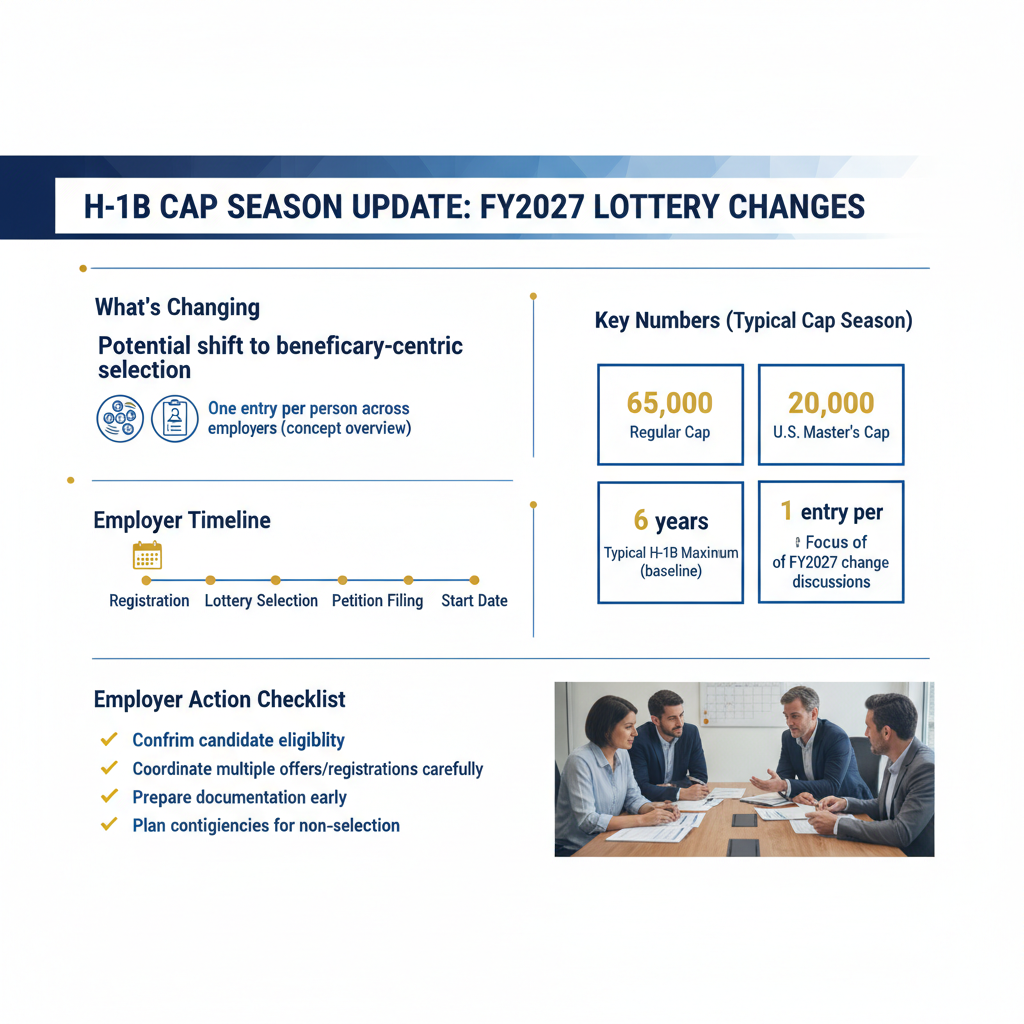
The reporting that sparked this guide: H-1B Visa Lottery Changes for FY2027 (Legal News)
Important: News coverage often summarizes proposed or newly finalized rules quickly. This guide explains how H-1B cap season typically works, what “FY2027 lottery changes” may involve, and how to prepare in a compliant, practical way—especially for employers and workers in Orlando, Orange County, and the I-4 corridor.
Need Help? Our Orlando immigration team is ready to assist. Call +1 786-791-3106 for a free consultation, or message us online. Se Habla Español.
What This News Means for Immigrants in Orlando and Across Florida
Why this news is showing up now
H-1B cap season planning starts far earlier than many people realize. For an H-1B that begins on October 1 of a given fiscal year, employers typically begin internal hiring decisions, wage reviews, job description audits, and documentation months in advance. As a result, any USCIS rule update (or even credible reporting about potential changes) becomes “trending” well before the registration window opens.
For FY2027, the attention is especially high because USCIS has been actively modernizing the H-1B process in recent years—particularly around the electronic registration system, fraud prevention, and how selections are made and validated. Employers want predictability; foreign national professionals want a fair selection process; and the government is focused on program integrity.
Reminder: “FY2027” refers to the federal fiscal year starting October 1, 2026. That means the H-1B cap registration would normally occur in early 2026 (exact dates set by USCIS each year).
How it can affect Florida residents
Florida—especially Central Florida—has a fast-growing tech, healthcare, hospitality, engineering, and professional services economy. If you live in Orlando, Kissimmee, Winter Park, Lake Nona, or anywhere along the I-4 corridor, H-1B demand can be intense for roles like software developers, data analysts, engineers, accountants, healthcare IT, and specialized managers.
FY2027 H-1B lottery changes may affect:
- How employers register candidates (including data fields and attestations)
- How USCIS identifies duplicate or improper registrations
- How quickly selected cases must be filed (the 90-day window concept often appears in practice, though USCIS sets exact filing periods in selection notices)
- How employers document specialty occupation, wages, and worksite details
- What happens if a worker is moving from F-1 OPT/STEM OPT to H-1B (cap-gap planning)
If your case is in Orlando, timing and document readiness matter because employers often need to coordinate with HR, finance, and outside counsel, while employees may be graduating from UCF or other Florida schools and facing OPT expiration dates.
What H-1B Visa Lottery Changes for FY2027 Is (and Why It Matters)
A plain-English definition
The “H-1B lottery” is the common name for USCIS’s selection process used when there are more H-1B cap-subject registrations than the annual limit (the “cap”). Employers first submit an electronic registration for each worker they want to sponsor. If USCIS receives more registrations than available slots, USCIS runs a random selection process (the “lottery”). Only selected registrations can proceed to a full H-1B petition filing.
“H-1B Visa Lottery Changes for FY2027” generally refers to updates that may change how registrations are submitted, validated, selected, or enforced—often to reduce fraud, prevent duplicate entries, and improve fairness and efficiency.
Key terms you need to know
- H-1B cap: The annual numerical limit for most new H-1B approvals (commonly 65,000 regular cap plus 20,000 U.S. master’s cap, with certain exemptions).
- Cap-subject: Petitions counted against the annual cap (typically new H-1Bs for private employers).
- Cap-exempt: Certain employers and jobs (e.g., some universities, nonprofit research organizations) that are not subject to the cap.
- Electronic registration: The online pre-registration step employers complete before filing an H-1B petition.
- Specialty occupation: A role that normally requires at least a bachelor’s degree in a specific specialty (or equivalent) related to the job duties.
- LCA (Labor Condition Application): A Department of Labor filing that sets wage and work conditions for the H-1B employee.
- USCIS selection notice: The notice in the employer’s USCIS account confirming selection and providing the filing window and instructions.
- Premium Processing: An optional paid USCIS service for faster processing for certain petitions (availability and timelines depend on USCIS rules).
Warning: Because the H-1B is employer-driven, a worker generally cannot “self-petition” for H-1B. Your strategy must align the employer’s compliance obligations with the worker’s immigration timeline (OPT end date, travel plans, dependents, etc.).
Need Help? Our Orlando immigration team is ready to assist. Call +1 786-791-3106 for a free consultation, or message us online. Se Habla Español.
Current Immigration Law: The Foundation
Any FY2027 changes will sit on top of the existing legal framework governing H-1B workers, employer obligations, and USCIS adjudications. The core authority comes from the Immigration and Nationality Act (INA) and federal regulations.
Federal requirements
Key legal and regulatory foundations include:
- INA § 214 (nonimmigrant admissions and conditions), implemented through regulations at 8 C.F.R. § 214.2(h) (H classifications, including H-1B).
- Department of Labor H-1B labor condition rules under 20 C.F.R. Part 655, Subparts H & I (wage, notice, and working conditions).
- USCIS forms and adjudication standards, including the employer’s petition using Form I-129.
USCIS resources that employers and employees should monitor include the USCIS official website, USCIS Processing Times, and USCIS Forms. For visa stamping and consular processing matters, see the U.S. Department of State.
Even though this article focuses on H-1B, many readers are also planning longer-term pathways like permanent residence via family or employment. If that is you, you may hear terms like Adjustment of Status, Priority Date, and forms such as Form I-130 and Form I-485. Those are not H-1B forms, but they often become relevant when an H-1B worker later pursues a green card.
Florida-specific considerations
Immigration is federal law, so Florida does not create separate H-1B eligibility rules. However, Florida-specific realities can affect strategy:
- Worksite geography: Central Florida employers may have multiple worksites (Orlando, Tampa, Lakeland, Daytona). LCA posting and worksite details must match reality.
- Commuting and hybrid work: If your role involves hybrid work across counties (e.g., Orange County and Seminole County), the location and wage data must be carefully reviewed.
- Local adjudication touchpoints: The Orlando area may interact with the federal system through biometrics, USCIS notices, and—if a person later files family-based or employment-based green card steps—potentially the Orlando USCIS Field Office for interviews.
If your case is in Orlando, careful planning is essential when an employee is transitioning from F-1 to H-1B and may later file Form I-485 as part of Adjustment of Status. Small timing errors can cause gaps in work authorization.
How to Prepare for the FY2027 H-1B Lottery: A Complete Step-by-Step Guide
This step-by-step guide is designed for employers and prospective H-1B employees planning for a cap-subject H-1B. Because “FY2027 lottery changes” may refine registration and enforcement, the best approach is to prepare as if USCIS will scrutinize legitimacy, specialty occupation alignment, and duplicate registration issues more intensely.
1) Confirm the job qualifies as a specialty occupation
Start by aligning the job duties with a degree field that is normally required for entry into the occupation. USCIS often looks for a clear relationship between the degree and the work performed.
Documents to gather:
- Detailed job description (daily/weekly duties, tools, projects, reporting structure)
- Minimum requirements (degree level and specific major(s))
- Organization chart showing the role’s placement
- Prior job postings for similar roles (internal or external)
- Evidence of complexity (project plans, technical specs, client requirements)
2) Evaluate the candidate’s credentials and immigration timeline
Confirm the worker’s education, equivalency (if foreign degree), and status timeline (F-1 OPT end date, STEM eligibility, current H-1B cap-exempt status, etc.). This is where planning prevents last-minute emergencies.
Documents to gather:
- Passport biographic page and all U.S. visa stamps
- I-94 record (most recent admission record)
- All prior I-20s (for F-1) and EAD cards (OPT/STEM OPT)
- Diplomas, transcripts, credential evaluations (if needed)
- Resume/CV and reference letters (if relevant to specialty)
Reminder: If you’re on OPT, you must coordinate the employer’s lottery plan with your work authorization end date. A missed filing window can create a gap that is difficult to fix.
3) Set the wage, worksite location(s), and compliance plan (LCA preparation)
The H-1B process requires an LCA certified by the Department of Labor before the H-1B petition is filed. The wage level depends on the occupation and geographic area. Hybrid work, client sites, and travel must be analyzed.
Documents to gather:
- Worksite address(es) and hybrid/remote work policy
- Proposed salary, bonuses, benefits summary
- Job SOC code analysis (often done with counsel)
- Company FEIN verification and business documentation
- Posting/notice documentation plan for LCA compliance
For Central Florida residents, wage levels can differ materially between metro areas. A role in downtown Orlando may have different prevailing wage data than a role based further outside Orange County.
4) Complete the USCIS H-1B electronic registration correctly
Employers submit an electronic registration during the USCIS registration window. FY2027 changes may increase validation, add attestations, or strengthen duplicate-detection. The safest practice is to ensure one legitimate registration per beneficiary per employer, submitted with consistent identifying information.
Documents/data to gather:
- Beneficiary legal name (exactly as in passport)
- Date of birth, country of birth, country of citizenship
- Passport number (or other requested identifiers, if required)
- Whether the beneficiary qualifies for the U.S. master’s cap
- Employer signatory info and authorized representative details
Warning: If USCIS views registrations as duplicative, coordinated, or not bona fide, it can lead to denial, revocation, or referrals. Employers should avoid “mass registration” tactics and ensure each registration reflects a real job offer.
5) If selected, file the H-1B petition (Form I-129) within the filing window
A selection is not an approval. If selected, the employer must file a complete petition package—typically including the certified LCA and supporting evidence—within the timeframe listed on the selection notice. Missing the window can forfeit the selection.
Documents to gather:
- Form I-129 and H Classification Supplement (as applicable)
- USCIS selection notice
- Certified LCA
- Employer support letter describing the role, specialty occupation basis, and terms
- Employee degree evidence + evaluations (if needed)
- Company evidence (business operations, brochures, contracts, financials as appropriate)
- Filing fee checks and forms (as required by USCIS for that cap season)
Important: USCIS fees and required forms can change. Always verify on the USCIS Forms page and the specific H-1B cap season instructions on the USCIS official website.
6) Respond to RFEs quickly and plan start-date logistics
USCIS may issue a Request for Evidence (RFE) asking for more proof of specialty occupation, employer-employee relationship, worksite details, or the candidate’s qualifications. Preparing a strong initial filing helps, but you should still plan for an RFE.
Documents to gather (if RFE comes):
- More detailed duty breakdown (percentages by task)
- End-client letters and statements of work (if placed at client site)
- Project documentation, technical requirements, deliverables
- Additional wage documentation and internal leveling policies
- Updated organizational charts and supervision evidence
If the worker is abroad, approval is only part of the process—visa stamping through the U.S. Department of State may be required before entry. If the worker is in the U.S., the petition may request change of status, and travel must be planned carefully.
7) Maintain compliance after approval (the “quiet” part that matters most)
After approval, employers must comply with LCA terms (wage, location, duties) and maintain required records. Material job changes can require an amended filing.
Documents to maintain:
- Public Access File (PAF) documents for the LCA
- Payroll records proving wage compliance
- Worksite change logs and remote work approvals
- Updated job descriptions if duties evolve
- Immigration file tracking for extensions and amendments
Need Help? Our Orlando immigration team is ready to assist. Call +1 786-791-3106 for a free consultation, or message us online. Se Habla Español.
Practical Steps You Can Take Today
Whether you are an employer in Orange County or a professional hoping to be sponsored, preparation is the best defense against shifting rules. Here is a practical, do-today checklist that remains useful even if FY2027 brings new registration or verification steps.
Actionable checklist
- Audit the job description: Ensure duties and degree requirements are specific and consistent across HR systems, offer letters, and the petition letter.
- Confirm the worksite plan: Identify every location the employee will work (including hybrid arrangements), and align that with LCA strategy.
- Collect identity and status documents early: Passport, I-94, prior approvals, EADs, and I-20s.
- Plan for cap-gap and travel: If on OPT, map out what happens if selected vs. not selected, and avoid risky travel during change-of-status periods.
- Budget for fees and timing: Government filing fees, attorney fees, credential evaluations, and potential premium processing.
- Prepare for an RFE: Build a “project evidence” folder now (org charts, technical specs, client statements of work).
- Track USCIS announcements: Monitor the USCIS official website for registration dates and procedural updates.
Document preparation guidance
Build two organized sets of documents:
- Employee packet: passport, I-94, current status documents, degrees/transcripts, evaluations, resume, prior immigration approvals.
- Employer packet: FEIN letter, business registration, brochures/website printouts, org chart, job description, wage memo, worksite list, client documents (if applicable).
Important: Keep consistent spellings and dates across all documents. Small inconsistencies can trigger delays or RFEs.
Timeline expectations
While USCIS sets exact dates, a typical cap-season timeline looks like this:
- 2–4 months before registration: job analysis, wage planning, credential review
- Registration window: employer submits electronic registration
- Selection period: USCIS posts results; some years include additional selection rounds later
- Filing window (often described as a 90-day window): selected employers file full petitions
- Adjudication: standard processing or premium processing (if available)
- Start date: typically October 1 for cap-subject H-1Bs
For up-to-date adjudication estimates, check USCIS Processing Times.
How Imigrar Helps Immigrants in Orlando
Imigrar is an immigration law firm based in Orlando, Florida, serving clients nationwide. We support both employers and foreign national professionals with H-1B cap strategy, compliance planning, and long-term immigration pathways aligned with our mission: Keep Families Together.
Our team helps by:
- Assessing specialty occupation eligibility and risk factors before registration
- Preparing compliant H-1B registration and petition filings
- Building strong evidence packets to reduce RFE risk
- Advising on F-1 to H-1B transitions, cap-gap, and travel planning
- Planning future green card strategies (where appropriate), including Priority Date tracking and Adjustment of Status readiness using Form I-485
If your case is in Orlando, we can also help you plan around local realities—commuting across the I-4 corridor, multi-site worksites, and coordination with the Orlando USCIS Field Office when future processes require interviews.
Call +1 786-791-3106 for a free consultation. Se Habla Español.
Need Help? Our Orlando immigration team is ready to assist. Call +1 786-791-3106 for a free consultation, or message us online. Se Habla Español.
Frequently Asked Questions
Q: Will FY2027 H-1B lottery changes make it easier or harder to get selected?
A: It depends on what USCIS finalizes and how it is implemented. Changes aimed at reducing duplicate or improper registrations can make the process fairer for legitimate employers and workers. However, stronger validation can also mean more technical rejections if information is inconsistent. The best approach is accuracy and early preparation, including consistent passport data and a clearly qualifying specialty occupation role.
Q: I’m on F-1 OPT in Orlando—how does this affect my immigration status?
A: Your OPT remains valid until it expires or is otherwise terminated. The H-1B cap process is separate. If selected and timely filed, you may qualify for “cap-gap” work authorization extension in certain circumstances. Because timing is critical, you should map your OPT end date, STEM OPT eligibility, and the employer’s filing plan. If your case is in Orlando and you work along the I-4 corridor, also confirm your worksite details are consistent across SEVIS/OPT reporting and the H-1B petition evidence.
Q: How long does the H-1B process take from registration to approval?
A: Registration results typically come after the registration window closes (USCIS announces timing each year). If selected, the employer must file within the selection notice filing period (often discussed as a 90-day window). After filing, processing times vary; check USCIS Processing Times. Premium processing may reduce wait times when available, but it does not guarantee approval.
Q: What documents do I need for an H-1B cap case?
A: Common documents include your passport, I-94, current status documents (I-20/EAD for F-1), degrees and transcripts, and (if needed) a credential evaluation. Employers typically provide a detailed support letter, organizational chart, business documentation, and a certified LCA. If you later pursue a green card, you may also hear about Form I-485 for Adjustment of Status, or family filings like Form I-130, but those are separate processes.
Q: What are the costs involved?
A: Costs usually include USCIS filing fees, the fraud prevention fee (where required), possible ACWIA-related fees (depending on employer size/type), attorney fees, and optional premium processing. There may also be costs for credential evaluations and translations. Because fee structures can change, confirm current requirements on the USCIS Forms page and USCIS H-1B cap instructions.
Q: What happens if my registration is not selected or my petition is denied?
A: If not selected, the worker may need an alternative plan (STEM OPT extension, cap-exempt H-1B options, other work-authorized visas, or continuing studies). If denied after filing, options can include refiling (if eligible), filing a motion/appeal in certain cases, or changing strategy. If you are placed in removal proceedings for unrelated reasons, immigration court matters are handled under EOIR; see Executive Office for Immigration Review for general information. You should speak with counsel immediately to protect lawful status and work authorization.
Q: Can my spouse and children stay with me if I get H-1B?
A: Generally, eligible dependents can apply for H-4 status. Work authorization for H-4 spouses depends on specific eligibility categories and timing. Plan early if your family needs work authorization, school enrollment, or travel. Imigrar can help build a family-forward strategy consistent with “Keep Families Together.”
Common Mistakes (and How to Avoid Them)
Mistake #1: Treating registration as “just data entry”
Registration mistakes—misspelled names, inconsistent passport details, or incorrect cap category—can cause major delays or disqualification. How to avoid it: Use the passport as the source of truth, double-check entries, and keep a standardized internal checklist for every candidate.
Mistake #2: Weak specialty occupation evidence
Vague job duties and broad degree requirements increase RFE and denial risk. How to avoid it: Provide a detailed duty breakdown, explain why a specific degree is required, and include project/technical documentation.
Mistake #3: Ignoring worksite and wage compliance (especially with hybrid work)
Hybrid work across Orange County and nearby counties can create LCA and wage issues if not addressed. How to avoid it: Identify all worksites early, align the LCA to reality, and implement compliance tracking after approval.

Closing: Get Help With Your FY2027 H-1B Strategy
The biggest takeaway from the trending FY2027 H-1B lottery change conversation is this: the government is prioritizing cleaner registrations and stronger verification, and employers and workers should respond with earlier planning, better documentation, and careful compliance.
If your case is in Orlando—or you are anywhere in Florida and need a trusted immigration team—Imigrar is here to help you prepare for the H-1B cap season and protect your long-term options.
Need Help? Our Orlando immigration team is ready to assist. Call +1 786-791-3106 for a free consultation, or message us online. Se Habla Español.


