


The reporting that sparked this guide
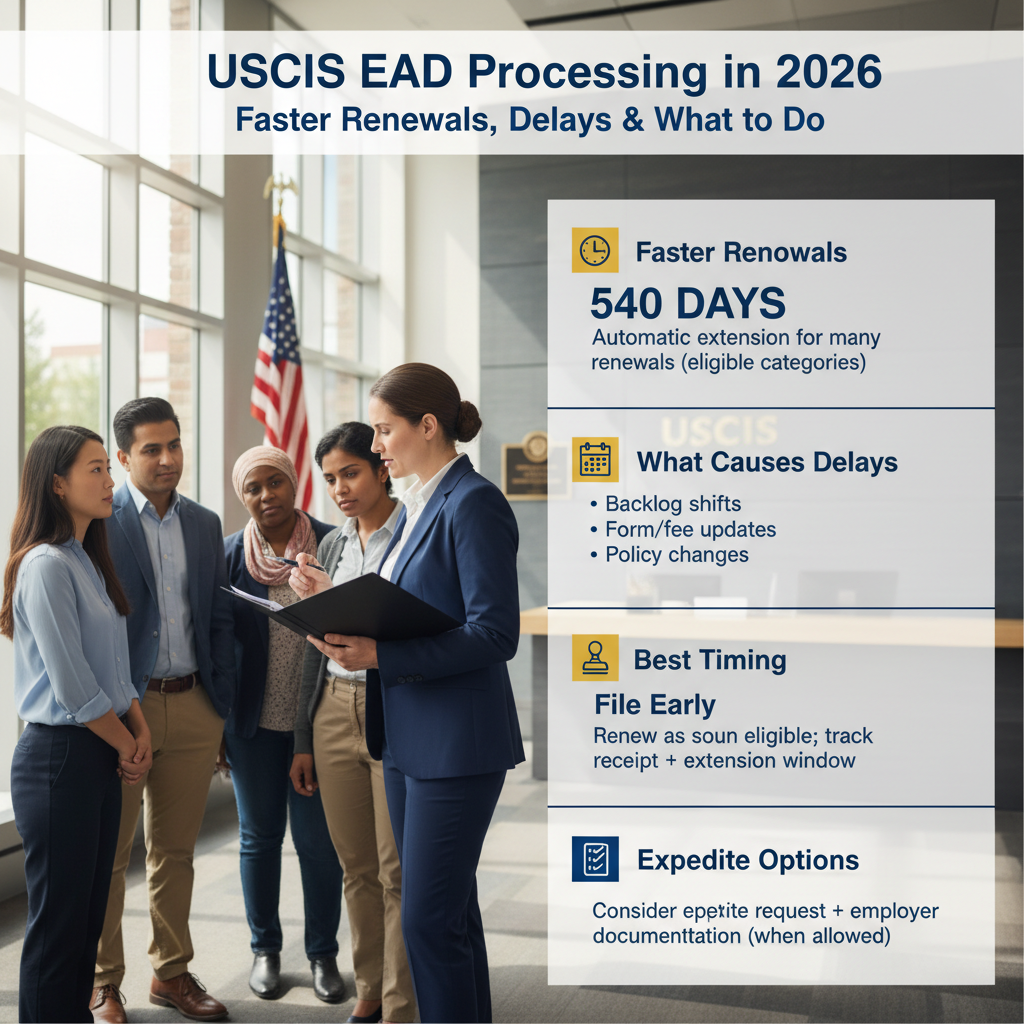
The reporting that sparked this guide comes from: Employment Authorization Document Processing (USCIS).
Important: News coverage about Employment Authorization Document (EAD) processing often summarizes multiple USCIS updates at once—policy changes, fee updates, form revisions, and shifting backlogs. This guide translates those developments into practical steps you can take now, especially if you live in Orlando or anywhere in Florida.
Need Help? Our Orlando immigration team is ready to assist. Call +1 786-791-3106 for a free consultation, or message us online. Se Habla Español.
What This News Means for Immigrants in Orlando and Across Florida
Why this news is showing up now
Employment Authorization Document processing is trending because work authorization touches nearly every part of an immigrant family’s stability: jobs, driver’s licenses, professional licenses, Social Security updates, and even the ability to keep health insurance. When USCIS changes how it processes EADs—or when backlogs grow—people feel it immediately.
Several factors commonly drive EAD-processing headlines:
- USCIS workload shifts (more filings in asylum, Adjustment of Status, and humanitarian categories).
- Form and fee changes that require new editions of forms and updated filing strategies.
- Automatic extension rules and category eligibility updates that affect whether you can keep working while a renewal is pending.
- Operational changes (digitization, lockbox intake changes, staffing levels, and service center rebalancing).
Reminder: Even when USCIS announces improvements, processing times can still vary widely depending on your eligibility category, the service center handling the case, and whether USCIS issues a Request for Evidence (RFE).
How it can affect Florida residents
For Central Florida residents—especially along the I-4 corridor (Orlando, Kissimmee, Sanford, Lakeland, Tampa)—EAD delays can have a “chain reaction” effect:
- Work interruptions if a renewal is filed late or if the applicant is not eligible for an automatic extension.
- Driver license renewal problems when the Florida DHSMV requires unexpired evidence of lawful status/work authorization.
- Employer compliance issues related to Form I-9 reverification and E-Verify practices.
- Family financial stress when the main wage earner’s authorization expires.
If your case is in Orlando, your underlying immigration process may involve the Orlando USCIS Field Office (for interviews and certain in-person steps), while the EAD itself is often processed by a USCIS service center. Understanding this split helps you track the right system and set realistic expectations.
What Employment Authorization Document Processing Is (and Why It Matters)
A plain-English definition
“Employment Authorization Document processing” means the steps USCIS takes to decide whether you can receive (or renew) an EAD—often called a “work permit.” The EAD is typically a plastic card that proves you are authorized to work in the United States for a specific time period and under a specific eligibility category.
The EAD is usually requested using Form I-765, Application for Employment Authorization. Many people file Form I-765 at the same time as an underlying application—such as Form I-485 for Adjustment of Status—while others file it as a stand-alone request (for example, certain asylum applicants).
Why it matters: your EAD impacts your ability to lawfully work, maintain income, and avoid employment gaps that can create long-term instability for families—especially families trying to “Keep Families Together.”
Key terms you need to know
- EAD: Employment Authorization Document (work permit), typically issued as a card.
- Form I-765: USCIS form used to apply for or renew an EAD.
- Category: The eligibility basis for your EAD (for example, based on a pending Form I-485, asylum, TPS, etc.).
- Receipt Notice: The USCIS notice showing they accepted your filing and assigned a case number.
- Automatic Extension: In some categories, a timely EAD renewal filing can automatically extend work authorization for a set period (often up to 180 days, and in some situations longer depending on current USCIS rules and category-specific policies).
- RFE: Request for Evidence—USCIS asks for more documents, pausing the case until you respond.
- Expedite Request: A request asking USCIS to speed up processing due to qualifying hardship or urgent need.
- Priority Date: A key date in many green card processes, especially family- and employment-based cases. While EAD eligibility often depends on a pending application, your Priority Date can affect whether you can file Form I-485 (and therefore Form I-765) in the first place.
Need Help? Our Orlando immigration team is ready to assist. Call +1 786-791-3106 for a free consultation, or message us online. Se Habla Español.
Current Immigration Law: The Foundation
EADs are authorized under federal immigration law and implemented through regulations and USCIS policy guidance. While this article is practical, it’s grounded in the legal framework that governs who can work and when.
Federal requirements
Key legal authorities include:
- Immigration and Nationality Act (INA) provisions governing admission, status, and employment eligibility (for example, INA § 274A addressing unlawful employment and verification).
- Federal regulations at 8 C.F.R. § 274a (employment authorization rules, EAD categories, and documentation).
- USCIS form instructions and policy manual guidance that interpret how applications should be filed and adjudicated.
USCIS administers EAD processing primarily through Form I-765. Many applicants encounter EADs in these common pathways:
- Family-based green cards: Form I-130 (petition) + Form I-485 (Adjustment of Status) + Form I-765 (work permit).
- Employment-based green cards: similar Form I-485 package (when eligible to file).
- Asylum-related work authorization and renewals (category-specific rules apply).
- TPS-based EADs (often subject to Federal Register notices and special extension periods).
For official guidance, start with the USCIS official website, and confirm you are using the correct form edition on USCIS Forms.
Warning: Filing the wrong edition of a form, paying an incorrect fee, or choosing the wrong eligibility category can lead to rejection (returned package) or denial (adjudicated and refused). Rejections are especially common when forms change or fees update.
Florida-specific considerations
Immigration law is federal, but Florida residents often face state-level consequences when an EAD is delayed or expires—especially regarding driver’s licenses and employment onboarding.
- Driver’s license/ID timing: Florida credential validity may be tied to your immigration document validity. If your EAD expires, you may have trouble renewing your license until you have updated proof.
- Employment market pressure: In Central Florida’s tourism, healthcare, construction, and service industries, employers often need quick onboarding—making EAD delays more disruptive.
- Local logistics: If you need fingerprints/biometrics or an in-person appointment, travel time and scheduling around Orange County and the broader I-4 corridor matters.
If your case is in Orlando, you may interact with the Orlando USCIS Field Office for interviews or case inquiries, while your EAD may still be processed elsewhere. Track your receipt number and check USCIS Processing Times for the form type and category.
How to Apply for or Renew an EAD: A Complete Step-by-Step Guide
Below is a practical roadmap that covers most EAD applicants, including first-time EAD filings and renewals. Because eligibility categories differ, treat this as a framework and confirm category rules before filing.
1) Confirm your eligibility category (and whether a renewal qualifies for an automatic extension)
Before you fill out anything, identify the correct eligibility category for Form I-765. This category determines:
- Whether you can file now or must wait
- What evidence you must submit
- Whether your renewal may qualify for an automatic extension (often up to 180 days if filed on time and the category qualifies)
- Whether you should also file other forms (for example, Form I-485 for Adjustment of Status)
Important: Some applicants assume “any renewal” gets an automatic extension. That is not always true. Eligibility depends on the category and whether the filing is timely and properly filed.
Documents to gather for Step 1:
- Current or prior EAD card (front/back copy)
- I-94 record (if applicable)
- USCIS receipt notices for pending cases (e.g., Form I-485 receipt)
- Immigration court documents if in removal proceedings (EOIR) (if applicable)
- Any prior denial notices or RFEs related to work authorization
If you are also pursuing a family-based case through Form I-130 and Form I-485, confirm your ability to file Adjustment of Status (including whether your Priority Date is current, when applicable).
2) Choose the right filing strategy: stand-alone EAD vs. filed with your underlying application
Many people apply for an EAD in one of two ways:
- Concurrent filing: Filing Form I-765 together with Form I-485 (and sometimes Form I-131 for travel) in one package.
- Stand-alone filing: Filing Form I-765 by itself when eligibility exists independently (e.g., certain asylum-related EADs, TPS EAD renewals, etc.).
The “best” strategy depends on your category, timeline, and risk tolerance. Filing together can simplify evidence, but it also means one mistake can affect the whole package.
Documents to gather for Step 2:
- Copy of passport biographic page and visa (if applicable)
- Two passport-style photos (if required for your filing method)
- Proof of identity and any name-change documents
- Copies of your underlying application receipts (if already filed)
- Proof of current immigration status (if applicable)
3) Prepare Form I-765 carefully (and match every answer to your evidence)
USCIS can reject or delay EADs for simple inconsistencies: different addresses, missing prior A-numbers, incorrect category selection, or incomplete answers.
Practical drafting tips:
- Use your full legal name exactly as shown on your identity documents.
- List all prior USCIS receipt numbers you have (especially for Form I-485 filings).
- Use a stable mailing address where you can reliably receive the card.
- Answer every question; use “N/A” or “None” where appropriate per instructions.
Reminder: USCIS periodically updates form editions. Always download directly from USCIS Forms.
Documents to include for Step 3 (typical examples):
- Completed and signed Form I-765
- Copy of government-issued photo ID (passport or other acceptable ID)
- Copy of your I-94 (if applicable)
- Copy of your current EAD (for renewals)
- Copies of USCIS notices showing the basis for eligibility (e.g., pending Form I-485)
4) Pay the correct fee (or request a fee waiver if eligible) and assemble the package
Fees can change and fee rules vary by category and by whether the EAD is filed with another application. Always confirm current fees and whether your category has a fee exemption.
Warning: Incorrect fees are a top reason USCIS rejects filings. A rejection can be devastating if you are close to expiration and counting on an automatic extension.
Documents to include for Step 4:
- Filing fee payment (check/money order/credit card form if permitted) or proof supporting a fee waiver request (if eligible)
- Cover letter summarizing eligibility category and enclosed evidence
- Form G-1145 (optional) to receive e-notifications of receipt (if filing by mail)
- All supporting exhibits, labeled and organized
5) File the application correctly (online or by mail) and track your receipt
USCIS allows online filing for some Form I-765 categories, while others require mailing to a lockbox. The correct filing address depends on your category and where you live.
Once filed, track:
- Your receipt number and receipt date
- Whether USCIS scheduled biometrics (if required)
- Whether USCIS issued an RFE
- Case status updates in your USCIS online account
Check general timelines at USCIS Processing Times. For many applicants, expectations should be framed in months, not weeks—unless an automatic extension covers you.
Documents to keep after Step 5:
- Delivery confirmation and a full copy of the filed package
- USCIS Receipt Notice (Form I-797)
- Biometrics appointment notice (if issued)
- Any RFE notices and your response copies
6) If needed, request an expedite (and do it strategically)
If you face severe financial loss, urgent humanitarian reasons, or other qualifying factors, you may request expedited processing. Expedites are discretionary—USCIS can say no even if you have a strong reason.
For Central Florida residents, expedite requests often arise when:
- A job offer is at risk due to an EAD gap
- A healthcare worker cannot start work
- A family is facing eviction or utility shutoffs
Documents to include for Step 6 (examples):
- Letter from employer with start date, job role, and consequences of delay
- Proof of financial loss (past-due notices, lease, eviction warning, bank statements)
- Medical documentation (if humanitarian)
- A concise attorney cover letter tying evidence to USCIS expedite criteria
7) After approval: verify the card, update employer I-9, and plan the next renewal early
When the EAD arrives, check it immediately for errors (name spelling, dates, category). If there is an error, you may need to request a correction.
Then:
- Provide updated work authorization to your employer for I-9 purposes
- Update your driver’s license/ID if needed
- Calendar your next renewal strategy well before expiration
Reminder: Many renewal strategies depend on filing within a specific time window and maintaining eligibility. Although people commonly refer to a 90-day window, not all categories use the same timing rule. Some allow earlier filing; others have tighter constraints. Always verify your category’s rule before relying on a 90-day window.
Need Help? Our Orlando immigration team is ready to assist. Call +1 786-791-3106 for a free consultation, or message us online. Se Habla Español.
Practical Steps You Can Take Today
Whether you are applying for the first time or renewing, the goal is the same: avoid a work gap and prevent preventable delays.
Actionable checklist (do these now)
- Check your EAD expiration date and set calendar reminders at 180, 120, and 60 days out.
- Confirm your eligibility category on Form I-765 and whether your renewal qualifies for an automatic extension (often up to 180 days if properly filed and category-eligible).
- Download the current form edition directly from USCIS Forms.
- Gather identity and status documents (passport, I-94, prior EAD, receipts for Form I-485 or other basis).
- Make a clean PDF set (if filing online) or a neatly tabbed paper packet (if filing by mail).
- Track your case and compare to USCIS Processing Times.
- Plan for contingencies: what you will do if USCIS issues an RFE or if delivery is delayed.
Document preparation guidance
- Use clear scans, readable copies, and consistent naming (e.g., “Passport_BioPage.pdf”).
- Translate any non-English documents with a proper translator certification.
- Keep your address consistent across filings; if you move, update USCIS promptly using the correct process.
Timeline expectations (realistic planning)
EAD processing varies by category and service center. As a planning approach:
- If you qualify for an automatic extension, your top priority is filing a proper renewal on time so your work authorization continues while USCIS adjudicates.
- If you do not qualify for an automatic extension, you should plan for the possibility of a work gap and discuss expedite options early.
- If your EAD depends on a pending case (like Form I-485), keep that underlying case strong—RFEs there can indirectly slow everything down.
Important: If you are within 30–45 days of expiration and you have not filed a renewal, you may be in a high-risk zone. Talk with an immigration attorney immediately.
How Imigrar Helps Immigrants in Orlando
Imigrar is an immigration law firm based in Orlando, Florida, serving clients nationwide. Our mission is to Keep Families Together by helping clients maintain lawful work authorization and move forward with long-term status solutions.
We help by:
- Confirming your correct Form I-765 eligibility category and evidence strategy
- Coordinating EAD filings with family-based cases like Form I-130 and Form I-485 (Adjustment of Status)
- Preparing organized packets that reduce rejection/RFE risk
- Advising on automatic extension rules (including the common 180 days extension where applicable)
- Helping with expedite requests supported by strong documentation
- Planning around Orlando logistics, including biometrics and field office steps
Se Habla Español. We offer a free consultation to help you understand your options and timelines.
Need Help? Our Orlando immigration team is ready to assist. Call +1 786-791-3106 for a free consultation, or message us online. Se Habla Español.
Frequently Asked Questions
Q: Who is eligible to apply for an EAD through USCIS?
A: Eligibility depends on your immigration category. Common eligible groups include people with a pending Form I-485 (Adjustment of Status), certain asylum applicants, TPS beneficiaries, and others defined in regulation (generally under 8 C.F.R. § 274a). The fastest way to confirm is to identify your correct Form I-765 category and match it to your underlying status or pending case.
Q: Will filing an EAD application affect my immigration status or green card case?
A: In many situations, filing Form I-765 is a normal, expected step and does not harm your case. However, mistakes—like filing under the wrong category or submitting inconsistent information—can create delays and credibility issues. If your EAD is tied to Form I-485 or a family petition like Form I-130, keep all forms consistent and complete.
Q: How long does USCIS take to process an EAD in 2026?
A: Processing times vary significantly by category and workload. Use USCIS Processing Times to check current estimates for Form I-765. If your case is in Orlando, remember the EAD is usually handled by a service center, not the local field office—so local interview timing may not predict EAD timing.
Q: What documents do I need for an EAD renewal?
A: Typically you need a copy of your current/expiring EAD (front and back), proof of your continued eligibility category (for example, a pending Form I-485 receipt notice), identity documents (passport ID page), and any required photos or fees. If you are relying on an automatic extension (often 180 days), file on time and keep your receipt notice—employers may need it for I-9 purposes.
Q: How much does it cost to apply for or renew an EAD?
A: Costs depend on the category and whether your EAD is filed with another application. USCIS fees can change, and some categories have fee exemptions or may qualify for a fee waiver. Always verify the current fee and instructions on the USCIS official website before you file. If cost is a concern, speak with an attorney about whether a fee waiver is appropriate in your situation.
Q: What happens if USCIS denies my EAD application or renewal?
A: A denial can mean you cannot work (or must stop working) unless you have another valid basis for employment authorization. First, read the denial notice carefully to identify whether it was a filing error, missing evidence, or a finding that you are not eligible. Next, evaluate whether you can refile, file a motion, or pursue another immigration option. If you are in proceedings, you may also need to coordinate with immigration court; see Executive Office for Immigration Review for general information, and consult counsel immediately.
Q: Can I travel while my EAD is pending?
A: The EAD itself does not authorize travel. If you have a pending Form I-485, travel can be risky without proper advance permission (often through Form I-131, depending on your case). For travel rules and visa-related guidance, consult the U.S. Department of State and speak with an attorney before leaving the U.S.
Common Mistakes (and How to Avoid Them)
Mistake #1: Filing under the wrong eligibility category
Choosing the wrong category on Form I-765 is one of the most damaging errors. It can lead to rejection, denial, or long delays. Avoid this by matching your category to your underlying status or pending application and including receipts (for example, a pending Form I-485 receipt if your EAD is based on Adjustment of Status).
Mistake #2: Filing too late and assuming an automatic extension will “save” you
Some renewals can benefit from an automatic extension (often up to 180 days), but only if you file timely and meet category requirements. Waiting until the last minute increases the chance of a work gap—especially if USCIS rejects the packet for a fee or form-edition issue.
Mistake #3: Ignoring address stability and delivery risks
EAD cards are mailed. If you move or your mailbox is unreliable, you risk non-delivery. If your case is in Orlando or anywhere in Orange County and you change apartments frequently, plan ahead: use a secure mailing option where permitted, update your address properly, and track delivery closely.
Additional Official Resources (Use These to Verify Any Update)
- USCIS official website
- USCIS Forms
- USCIS Processing Times
- U.S. Department of State
- Executive Office for Immigration Review
Reminder: Social media posts about “new EAD rules” are often incomplete. Always cross-check with official USCIS pages and, when in doubt, get legal advice.
Planning Notes for Orlando and Central Florida Applicants
For Central Florida residents, a few local realities matter:
- If your case is in Orlando... keep in mind that your EAD may be processed by a service center even if your interview is scheduled at the Orlando USCIS Field Office.
- For Central Florida residents... budgeting time for appointments and document gathering is crucial—especially for families balancing multiple jobs, childcare, and transportation along the I-4 corridor.
- The Orlando USCIS Field Office... may be relevant for interviews or in-person requests, but EAD adjudication typically follows service-center pipelines.
- Orange County logistics: If you rely on USPS delivery in large apartment complexes, consider proactive steps to avoid misdelivery (consistent name labeling, secure mailboxes, and early address updates).

Closing: Protect Your Work Authorization Before a Gap Happens
EAD processing news is trending for a reason: a work permit delay is not just “paperwork”—it can disrupt your job, your driver’s license, and your family’s stability. The best results usually come from (1) confirming the correct category, (2) filing a complete, accurate packet, and (3) filing early enough to benefit from any automatic extension rules (often 180 days where applicable).
If you are renewing soon, if your employer is asking questions, or if you are worried about delays, we can help you build a plan that fits your category and your timeline—whether you are in Orlando, elsewhere in Florida, or anywhere in the U.S.
Need Help? Our Orlando immigration team is ready to assist. Call +1 786-791-3106 for a free consultation, or message us online. Se Habla Español.


