


The reporting that sparked this guide
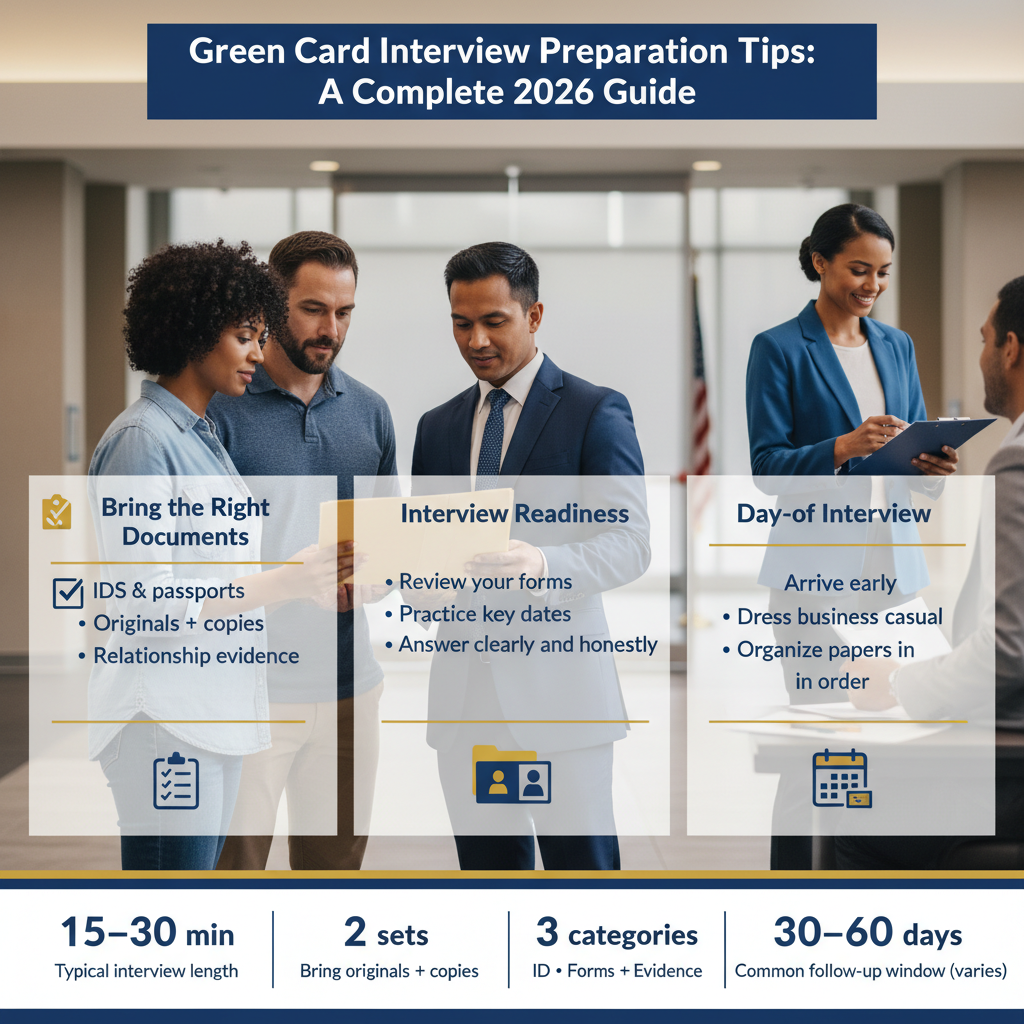
This article is inspired by recent immigration-law coverage and trends in public interest around interview readiness, document scrutiny, and case processing. See the source here: Green Card Interview Preparation Tips (Immigration Law).
Need Help? Our Orlando immigration team is ready to assist. Call +1 786-791-3106 for a free consultation, or message us online. Se Habla Español.
What This News Means for Immigrants in Orlando and Across Florida
Why this news is showing up now
Green card interview preparation is trending because more applicants are reaching the interview stage after long backlogs, and because USCIS continues to emphasize fraud prevention, identity verification, and consistency across filings. Even when your case is legitimate, the interview can feel stressful—especially if your application involves family sponsorship, prior immigration history, or any period of unlawful presence.
Another reason this topic is in the spotlight: applicants are relying heavily on “tips” from social media, which can be incomplete or risky. USCIS officers decide cases based on the law, the forms you filed (such as Form I-130 and Form I-485), and the evidence in your record—not on what worked for someone else with a different case.
Reminder: Interview practices can vary by field office, officer, and case type (family-based, employment-based, asylum-based adjustment, etc.). The best preparation is tailored preparation.
How it can affect Florida residents
For Florida residents—especially in fast-growing areas along the I-4 corridor—USCIS appointment availability, rescheduling timelines, and document expectations can be a moving target. If your case is in Orlando, your interview may be handled by The Orlando USCIS Field Office, and local patterns (like high case volume) can influence wait times and how far out interviews are scheduled.
For Central Florida residents in Orange County and nearby counties, the most common issues we see are:
- Arriving without updated civil documents or missing certified translations
- Inconsistent answers between spouses or between the interview and the forms
- Not understanding how prior entries, overstays, or prior marriages affect eligibility
- Not bringing proof of a real, ongoing relationship (for marriage-based cases)
- Not preparing for questions about work history and Adjustment of Status eligibility
Important: A well-prepared interview can reduce the chance of a delay, a request for evidence (RFE), or a “case held for review” outcome.
What Green Card Interview Preparation Tips Is (and Why It Matters)
A plain-English definition
“Green card interview preparation” means getting ready for your USCIS interview by:
- Understanding what USCIS needs to confirm (identity, eligibility, admissibility, and credibility)
- Bringing the right documents and updated evidence
- Reviewing your application for accuracy and consistency
- Practicing how to answer questions clearly and truthfully
- Planning for logistics (arrival time, interpreter needs, child care, and what to expect at security)
The interview matters because it is often the last step before approval. USCIS uses it to confirm that the evidence supports your case and that there are no legal problems (for example, misrepresentation, certain criminal issues, or prior immigration violations) that could make you inadmissible.
Key terms you need to know
- Adjustment of Status: Applying for a green card from inside the U.S., typically using Form I-485.
- Consular Processing: Applying for an immigrant visa at a U.S. consulate abroad, usually after approval of Form I-130 or an employment petition.
- Priority Date: Your place in line for an immigrant visa number in certain categories. Your Priority Date can control when you can file or be approved.
- RFE (Request for Evidence): A USCIS notice asking for additional documents.
- NOID (Notice of Intent to Deny): A serious notice indicating USCIS plans to deny unless you respond with strong evidence/legal argument.
- Admissibility: Whether immigration law allows you to get a green card (health, criminal, fraud, unlawful presence, etc.).
- Bona fide marriage: A real marriage entered into in good faith, not primarily for immigration benefits.
- 90-day window: Often discussed in immigration contexts (including visa compliance and timing). While not a single USCIS “rule” that guarantees outcomes, timing and intent can matter—talk to counsel before relying on online shortcuts.
- 180 days: A common threshold in immigration for certain benefits/penalties (for example, unlawful presence calculations and other timing-based rules). Your exact situation requires a legal review.
Warning: If there are any potential issues—prior removal orders, arrests, prior marriages, unauthorized work, or claims made to immigration—interview preparation should include a legal strategy, not just a document checklist.
Current Immigration Law: The Foundation
USCIS green card interviews are governed by federal immigration law and USCIS policy. The legal backbone includes the Immigration and Nationality Act (INA) and federal regulations in Title 8 of the Code of Federal Regulations (8 C.F.R.).
Federal requirements
Most green card interviews (especially for family-based Adjustment of Status) are connected to:
- INA § 245 (Adjustment of Status) and related rules in 8 C.F.R. § 245
- INA § 204 (Petitions such as family petitions) and related rules in 8 C.F.R. § 204
- INA § 212 (Grounds of inadmissibility) and related rules in 8 C.F.R. § 212
- USCIS authority to conduct interviews and request evidence to verify eligibility and credibility
Typical forms involved include:
- Form I-130 (Petition for Alien Relative)
- Form I-485 (Application to Register Permanent Residence or Adjust Status)
- Form I-864 (Affidavit of Support) for many family-based cases
- Form I-693 (Medical Examination and Vaccination Record)
- Form I-765 (Employment Authorization), if filed
- Form I-131 (Advance Parole), if filed
Always confirm the latest forms and instructions on the USCIS official website and the USCIS Forms page.
Florida-specific considerations
Immigration law is federal, but your experience is local. Florida-specific considerations often involve logistics and documentation realities:
- High demand for appointments and reschedules at busy field offices (including Orlando)
- Document retrieval challenges (for example, obtaining long-form birth certificates from abroad and translating them)
- Address stability: frequent moves in rental markets can cause missed notices—USCIS notices are time-sensitive
- Travel planning: if you need to travel, consult counsel before leaving the U.S. while Form I-485 is pending (Advance Parole issues can be serious)
If your case involves immigration court proceedings or prior orders, it may intersect with the Executive Office for Immigration Review (EOIR). Those situations require careful coordination because USCIS and EOIR have different roles.
For consular steps (if your case is not adjustment-based), the U.S. Department of State provides official guidance on immigrant visa processing.
Need Help? Our Orlando immigration team is ready to assist. Call +1 786-791-3106 for a free consultation, or message us online. Se Habla Español.
How to Prepare for Your Green Card Interview: A Complete Step-by-Step Guide
1) Confirm your interview type, location, and eligibility “lane”
Start by identifying what kind of green card interview you have and what USCIS must confirm. Most Orlando-area readers are preparing for a family-based Adjustment of Status interview at The Orlando USCIS Field Office, but some cases involve employment-based adjustment or other categories.
Review your interview notice carefully: it tells you where to go, when to arrive, what to bring, and whether an interpreter is required.
Documents to gather for this step:
- USCIS interview appointment notice (original)
- Government-issued photo ID (passport, driver’s license, etc.)
- Copies of all USCIS receipt notices (I-797s) for Form I-130, Form I-485, Form I-765, Form I-131 (if applicable)
- A complete copy of your filed packet (everything submitted)
- If applicable: prior immigration documents (I-94s, visas, prior EADs, prior approvals/denials)
Important: If you have any arrests, charges, or convictions—even if sealed or expunged—get legal advice before the interview. USCIS may still consider the underlying conduct and certified records can be required.
2) Build an “interview-ready” document binder (originals + organized copies)
USCIS officers commonly ask to see originals of civil documents and may keep copies for the file. A clean, organized binder reduces stress and helps you respond quickly.
Suggested binder sections:
- Identity & entry documents
- Civil documents
- Relationship evidence (if marriage-based)
- Financial sponsorship (Form I-864)
- Medical (Form I-693)
- Updates since filing (new job, new address, new child, travel, etc.)
Documents to gather for this step:
- Passports (current and expired) for applicant (and petitioner/spouse when relevant)
- Birth certificates (long-form if available) + certified English translations
- Marriage certificate + divorce decrees/annulments/death certificates for all prior marriages (both spouses)
- I-94 record (printout if applicable), visa pages, entry stamps
- Two passport-style photos (sometimes requested; follow notice)
- Proof of name changes (court orders, amended certificates) if applicable
Reminder: Translations must include a translator certification. Missing or informal translations can cause delays.
3) Review your filed forms line-by-line for consistency and updates
Many interview problems are not “big fraud issues”—they are inconsistencies. Officers compare your answers to what you already submitted. Before the interview, review: Form I-485, Form I-130, and any supporting declarations.
Pay special attention to:
- All addresses for the last 5 years (and dates)
- Employment history and school history (and dates)
- All prior entries and exits
- Prior marriages and children
- Yes/No questions on Form I-485 (security, immigration violations, membership/affiliations)
If something has changed since filing, be ready to explain it and provide evidence. If you discover a mistake, do not panic—many errors can be corrected with a clear explanation and, when needed, a written correction at the interview.
Documents to gather for this step:
- Printed copies of the exact versions you filed of Form I-130 and Form I-485
- Any USCIS notices showing updates or transfers
- Proof of changes since filing (new lease, new job letter, updated pay stubs, birth certificate of child, etc.)
- If you moved: proof you updated USCIS address (AR-11 confirmation if applicable)
Warning: Do not guess on dates or facts. If you truly do not remember, say so and offer your best good-faith estimate clearly labeled as an estimate.
4) Prepare relationship evidence (marriage-based cases) that tells a clear story
In marriage-based cases, USCIS evaluates whether the marriage is bona fide. The officer may ask about your daily life, timeline, and shared responsibilities. For Central Florida residents, it helps to show a consistent paper trail (leases, insurance, bank accounts) that reflects normal life together.
Think like this: can your documents show (1) you live together or share a home base, (2) you share finances or responsibilities, and (3) your friends/family/community recognize your relationship?
Documents to gather for this step (examples):
- Joint lease/mortgage, property deed, or landlord letter + proof of both names at same address
- Utility bills showing shared address (even if only one name appears, bring multiple months and supporting proof)
- Joint bank account statements (several months) and/or proof of transfers supporting shared expenses
- Joint insurance (health, auto, renters/homeowners) showing both spouses
- Joint tax returns or IRS tax transcripts (if available)
- Photos across time (not just one event), labeled with dates/locations/people
- Travel itineraries, hotel bookings, event tickets
- Birth certificates of children together (if applicable)
- Affidavits from friends/family (helpful but usually secondary to strong primary evidence)
Important: Quality beats quantity. A well-organized set of documents covering the relationship timeline is better than a random stack of papers.
5) Prepare the financial sponsorship and public charge-related materials (when applicable)
Many family-based cases require Form I-864 from the petitioner (and sometimes a joint sponsor). At the interview, USCIS may ask for updated evidence if your case has been pending for a while.
Be ready to show that the sponsor still qualifies and that the household income meets the requirement. If there has been a job change, bring updated proof.
Documents to gather for this step:
- Most recent federal tax return(s) for sponsor and joint sponsor (if any)
- IRS tax transcripts (often preferred when available)
- W-2s/1099s and recent pay stubs (e.g., last 1–3 months)
- Employment verification letter (current)
- Proof of lawful status for sponsor/joint sponsor (U.S. passport, birth certificate, green card)
- If using assets: bank statements, proof of ownership, appraisals (as applicable)
Reminder: If the sponsor’s income changed, it may be safer to prepare an updated Form I-864—but do not submit changes casually without legal review.
6) Practice the interview: credibility, calm answers, and “officer-ready” communication
Interview success is often about communication. USCIS officers look for clarity and credibility. You do not need perfect English—but you do need to understand questions and answer truthfully.
If you need an interpreter, follow the instructions on your notice and USCIS policy. Do not bring a child to interpret. If you are nervous, practice answering out loud.
Documents to gather for this step:
- A written timeline of your relationship (first contact, dating, move-in, engagement, marriage)
- A written list of shared addresses and dates
- A list of key biographical facts (parents’ names, prior marriages, children)
- If you had prior immigration filings: a list of applications and outcomes
Warning: Never “rehearse” false answers. If there is a real issue, preparation should focus on lawful solutions (waivers, corrected filings, legal arguments).
7) Plan interview day logistics (Orlando field office realities)
If your case is in Orlando, plan for traffic, parking, and security screening. Arrive early with your notice and IDs accessible. Dress neatly (business casual is fine).
For Central Florida residents coming from along the I-4 corridor (e.g., Kissimmee, Sanford, Lake Mary, Winter Park, or beyond), build extra time for delays.
Documents/items to prepare for this step:
- Interview notice and IDs (easy to access)
- Your organized binder + copies
- A pen and small notepad
- Any required interpreter documents (if applicable)
- Proof of any last-minute updates since filing
Important: If you cannot attend, reschedule properly—missing an interview can lead to denial or administrative closure depending on the case type.
Practical Steps You Can Take Today
If your interview is coming up soon, focus on actions that reduce risk and increase clarity. Here is a practical checklist you can start today.
Actionable interview checklist (do this now)
- Print and review your filed Form I-130 and Form I-485 packet line-by-line for consistency.
- Create a relationship timeline with dates, locations, and key events (especially for marriage-based cases).
- Collect originals of civil documents and prepare certified English translations.
- Update financial evidence (recent pay stubs, job letter, IRS transcripts) for Form I-864 support.
- Organize evidence by category in a binder and label everything.
- Check USCIS processing context and plan expectations using USCIS Processing Times.
- Plan your route to the office, parking, arrival time, and what you can/cannot bring.
Document preparation guidance (how to make evidence “officer-friendly”)
- Use a table of contents and tabs (Identity, Civil Docs, Marriage Evidence, Financial, Medical, Updates).
- Highlight names, dates, and addresses on key documents (light highlighting is usually fine).
- Bring copies of everything you may hand over; keep originals unless requested.
- For photos: print 15–30 photos across time, label them, and avoid sending hundreds of screenshots.
- For chats/calls: bring a small sample across time and focus on continuity rather than volume.
Timeline expectations (what happens before and after)
Timelines vary widely by case type and office workload. Many applicants receive a decision the same day or shortly after, but it’s also common for USCIS to say the case is “being reviewed.”
- Before interview: you receive a notice with date/time/location and instructions.
- Interview day: officer reviews identity, eligibility, and key facts; may update information.
- After interview: possible outcomes include approval, request for more evidence, further review, or (less commonly) denial.
Reminder: If USCIS requests more evidence, respond by the deadline. Missing a deadline can lead to denial. Some notices may provide only a limited response period—do not wait.
Need Help? Our Orlando immigration team is ready to assist. Call +1 786-791-3106 for a free consultation, or message us online. Se Habla Español.
How Imigrar Helps Immigrants in Orlando
At Imigrar, we help clients prepare for green card interviews with a strategy that matches the facts of their case—whether it’s a straightforward marriage-based Adjustment of Status or a case with complications like prior overstays, prior filings, or questions about admissibility.
Our support typically includes:
- Case review of your entire filing history for consistency and risk points
- Customized document checklist (not generic internet advice)
- Interview coaching: what to expect, how to answer, and how to handle confusing questions
- Preparation of updates/corrections where appropriate
- Support for RFEs/NOIDs if USCIS asks for more evidence after the interview
We are based in Orlando, Florida and serve clients nationwide. Our mission is to Keep Families Together. Se Habla Español.
Important: A “small” issue can become a big delay if it’s discovered at the interview without preparation. Getting legal guidance early can save months.
Frequently Asked Questions
Q: What if I’m not sure I’m eligible for a green card through marriage?
A: Eligibility depends on how you entered the U.S., whether you have maintained lawful status (in some categories), whether you have any inadmissibility issues under INA § 212, and whether the marriage is bona fide. Many immediate relatives of U.S. citizens can still adjust status even with certain overstays, but that is not universal. Review your entry history, prior filings, and any arrests with an attorney before the interview so you don’t accidentally create inconsistencies or admissions that harm your case.
Q: Will the green card interview affect my current immigration status?
A: It can. If you have a pending Form I-485, you generally have a period of authorized stay while it’s pending, but that does not erase prior unlawful presence or other issues. If USCIS identifies a serious problem (for example, fraud/misrepresentation or certain criminal grounds), it could lead to denial and potentially referral to immigration enforcement or immigration court in some scenarios. If you have any risk factors, get legal guidance before the interview.
Q: How long after the interview will I get a decision?
A: Some cases are approved the same day or within days; others are held for review for weeks or months. If USCIS issues an RFE, your timeline depends on how quickly you respond and how long USCIS takes to review the response. To understand broader timing patterns, you can check USCIS Processing Times, but your field office workload and case complexity matter.
Q: What documents should I bring to my green card interview?
A: Bring your interview notice, government IDs, passports, originals of civil documents (birth/marriage/divorce certificates), and a full copy of what you filed (especially Form I-130 and Form I-485). Marriage-based applicants should bring updated relationship evidence (joint lease, bank statements, insurance, photos). If sponsorship is required, bring updated financial documents supporting Form I-864. If USCIS requests a sealed medical, bring Form I-693 exactly as instructed.
Q: How much does it cost to prepare for a green card interview?
A: Government filing fees (already paid in many cases) are separate from legal fees. Attorney fees vary based on complexity—straightforward interview prep is typically less than cases involving waivers, prior removals, or responses to RFEs/NOIDs. If cost is a concern, ask for a clear scope of services and whether the firm offers a consultation to identify the minimum steps needed to reduce risk.
Q: What happens if my green card application is denied after the interview?
A: It depends on the reason for denial and your immigration posture. Some denials can be challenged through a motion to reopen/reconsider or re-filing; others may involve referral to immigration court, especially if you have no other lawful status. If denial is a possibility in your case, a proactive legal strategy before the interview is essential—sometimes the best “interview prep” is legal prep (waiver analysis, record collection, and consistent explanations).
Q: Can I bring an interpreter to the Orlando USCIS interview?
A: Often yes, but it must comply with your notice and USCIS rules. The interpreter must be fluent and should not be a minor. If you are more comfortable in Spanish, planning for interpretation can help you answer accurately. If you are unsure, consult an attorney and review the instructions on your interview notice and the USCIS official website.
Common Mistakes (and How to Avoid Them)
Mistake #1: Showing up with incomplete originals or messy evidence
Many applicants bring partial documents, screenshots without context, or forget originals. This can lead to delays or RFEs. Avoid it by preparing a labeled binder with originals and clean copies, plus certified translations.
Mistake #2: Inconsistent answers or guessing on dates
Officers compare your testimony to your forms. Guessing can create “inconsistencies” that look like credibility issues. Avoid it by reviewing your filed forms and preparing a written timeline. If you don’t know an answer, say so and offer an estimate clearly as an estimate.
Mistake #3: Ignoring legal risk factors (prior entries, overstays, arrests, prior marriages)
Some issues require more than good organization—they require legal analysis. If you have prior immigration violations, criminal history, or prior filings, interview questions can become complex quickly. Avoid it by speaking to counsel before the interview and collecting certified court dispositions and immigration records.
Additional Official Resources (Use Trusted Sources)
When preparing, rely on official guidance and verified information. Helpful starting points include:
- USCIS official website
- USCIS Forms
- USCIS Processing Times
- U.S. Department of State (consular processing)
- Executive Office for Immigration Review (immigration court)
Need Help? Our Orlando immigration team is ready to assist. Call +1 786-791-3106 for a free consultation, or message us online. Se Habla Español.

Closing: Get Confident Before Your Green Card Interview
The green card interview is a big moment—but with the right preparation, it can be manageable and even straightforward. Focus on consistency, organization, and truth. If your case is in Orlando, plan carefully for the day-of logistics and bring updated evidence that reflects your real life today—not just what you submitted months ago.
Important: If you have any complicating factors—prior overstays, prior orders, arrests, or concerns about admissibility—do not wait until the interview to find out what they mean. A tailored legal plan can protect your case and your family.
Imigrar is here to help you prepare with confidence. Call us at +1 786-791-3106 for a free consultation or message us online. Se Habla Español. Our mission is to Keep Families Together.


