
TPS Extension Updates: Your Guide for Florida Immigrants (2026)
Timely updates on Temporary Protected Status (TPS) extensions for designated countries. Learn what this means for you in Orlando and nationwide, how to re-register, and critical deadlines to protect your status.

The immigration landscape is constantly evolving, bringing both challenges and opportunities for individuals and families seeking safety and stability in the United States. One critical area that frequently sees updates is Temporary Protected Status (TPS). For many, TPS provides a vital lifeline, offering temporary protection from deportation and the ability to work legally in the U.S.
At Imigrar, your trusted immigration law firm in Orlando, Florida, we understand the profound impact these updates have on your life. Our mission, "Keep Families Together," drives us to provide clear, actionable information and unwavering legal support to our clients, whether you're in Central Florida or across the nation. Today, we delve into the latest news regarding TPS extensions, explaining what it means for you and how to navigate the re-registration process effectively.
Need Help? Our Orlando immigration team is ready to assist. Call +1 786-791-3106 for a free consultation, or message us online. Se Habla Español.
The reporting that sparked this guide
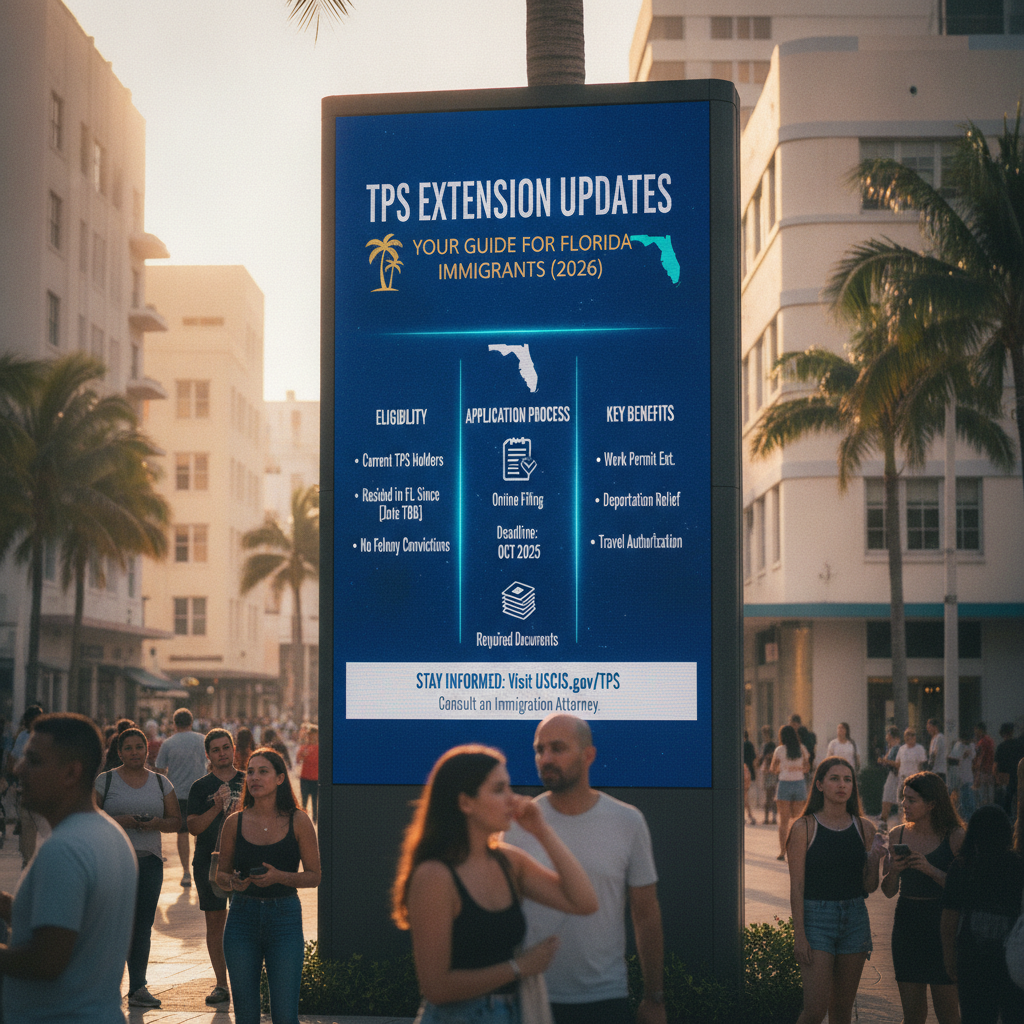
Recent reports highlight ongoing discussions and announcements from the U.S. government regarding the extension of Temporary Protected Status for several designated countries. These extensions are critical for hundreds of thousands of individuals who rely on TPS for their safety and stability in the United States.
TPS (Temporary Protected Status) Extension News (Legal News)
What This News Means for Immigrants in Orlando and Across Florida
The news of TPS extensions is a significant development for individuals from designated countries currently residing in the United States, including the vibrant immigrant communities throughout Florida, especially in the Orlando area. These extensions offer continued hope, stability, and a reprieve from the constant fear of deportation.
Why this news is showing up now
TPS designations and extensions are not arbitrary decisions; they are carefully considered by the Secretary of Homeland Security based on specific statutory criteria. These criteria, outlined in Section 244 of the Immigration and Nationality Act (INA), include ongoing armed conflict, environmental disaster, or other extraordinary and temporary conditions in a foreign country that prevent its nationals from returning safely. The U.S. government regularly reviews the conditions in designated countries. As of November 14, 2026, the current wave of news reflects the outcome of these reviews, where the Secretary has determined that the unsafe conditions persist, warranting the extension of TPS for certain nations. This means that for individuals from these countries, their protection from removal and their ability to legally work in the U.S. will continue for a specified period, usually 18 months. These announcements are crucial because they trigger a re-registration period, during which current TPS holders must apply to extend their status and often their Employment Authorization Documents (EADs).
How it can affect Florida residents
Florida, particularly Central Florida with its diverse population centers like Orlando, Kissimmee, and Tampa, is home to a significant number of TPS holders. For these individuals and their families, an extension means:
- Continued Stability: The most immediate impact is the continued legal presence in the U.S., allowing families to stay together without fear of deportation. This stability is invaluable for children attending schools in Orange County and surrounding areas, and for adults who have built lives and careers here.
- Work Authorization: TPS holders will be able to apply for new Employment Authorization Documents (EADs), allowing them to continue working legally. This is vital for sustaining families and contributing to Florida's economy. Many businesses along the I-4 corridor and throughout Central Florida rely on the dedicated workforce that includes TPS beneficiaries.
- Travel Opportunities: With proper authorization (Form I-131, Application for Travel Document), TPS holders may continue to travel internationally and return to the U.S., which can be essential for family emergencies or other critical needs.
- Planning for the Future: While TPS is temporary, extensions allow individuals to plan for their futures, pursue educational goals, or explore other potential immigration pathways with less immediate pressure. For many in Orlando, this means continued enrollment in local colleges or vocational programs, enhancing their skills and contributing to the community's growth.
- Access to Services: Continued TPS status helps maintain access to various services, including driver's licenses (issued by the Florida Department of Highway Safety and Motor Vehicles) and other state-level benefits tied to legal presence.
The Orlando USCIS Field Office and local community organizations will play a significant role in disseminating information and supporting TPS holders through this re-registration period. It's crucial for Florida residents to stay informed about the specific deadlines and requirements pertaining to their country's TPS designation.
What Temporary Protected Status (TPS) Is (and Why It Matters)
Temporary Protected Status, or TPS, is a humanitarian immigration benefit provided by the U.S. government. It offers a temporary reprieve from deportation and the ability to work legally in the United States for foreign nationals from certain countries that have been designated by the Secretary of Homeland Security.
A plain-English definition
Imagine your home country suddenly becomes extremely dangerous due to war, a devastating natural disaster, or another severe crisis. It wouldn't be safe for you to return. TPS is essentially a temporary legal permission from the U.S. government that says, "Because conditions in your home country are currently too dangerous, you can stay and work here legally for a set period, and you won't be deported during this time." It's a temporary haven, not a path to permanent residency or citizenship, but it offers crucial stability and protection when it's needed most.
Key terms you need to know
- Designation: The act by the Secretary of Homeland Security of identifying a country for TPS. This decision is based on specific criteria like armed conflict, environmental disaster, or other extraordinary and temporary conditions.
- Extension: When the Secretary of Homeland Security determines that the conditions in a designated country continue to meet the statutory requirements, they can extend the TPS designation for an additional period, typically 6, 12, or 18 months. This is what the recent news is about.
- Re-registration Period: A specific timeframe (usually 60 days) during which current TPS beneficiaries must apply to extend their status. Missing this window can lead to the loss of TPS benefits.
- Employment Authorization Document (EAD): Also known as a work permit, this document (Form I-765) allows TPS beneficiaries to work legally in the U.S.
- Protection from Removal: A core benefit of TPS, meaning you cannot be deported from the U.S. while your status is valid.
- Travel Authorization (Advance Parole): While TPS generally protects you from removal, traveling outside the U.S. requires a separate application (Form I-131) for advance parole to ensure you can re-enter the U.S. legally.
- Continuity of Status: Maintaining your TPS status by timely re-registering and adhering to all requirements. This is crucial for avoiding gaps in your legal protection.
Understanding these terms is fundamental to navigating the TPS process, especially during an extension period. At Imigrar, we simplify this complex language, ensuring you understand every step.
Current Immigration Law: The Foundation of TPS
Temporary Protected Status is rooted in U.S. federal immigration law, specifically Section 244 of the Immigration and Nationality Act (INA), codified at 8 U.S.C. § 1254a. This statute empowers the Secretary of Homeland Security to grant TPS to eligible foreign nationals from countries experiencing conditions that make safe return impossible or extremely dangerous.
Federal requirements
To be eligible for TPS, individuals must meet several federal requirements:
- Nationality: Be a national of a country designated for TPS, or a person without nationality who last habitually resided in that country.
- Continuous Physical Presence (CPP): Have been continuously physically present in the U.S. since the effective date of the most recent designation or re-designation of their country.
- Continuous Residence (CR): Have been continuously residing in the U.S. since a date specified for their country's initial designation.
- Admissibility: Meet general immigration admissibility requirements. Certain criminal convictions or national security grounds can render an individual ineligible.
- Timely Application: File the application (Form I-821, Application for Temporary Protected Status) within the specified registration or re-registration period.
Important: Even if your country's TPS status is extended, you must still meet these individual eligibility criteria for re-registration. Any criminal history, previous immigration violations, or issues with continuous physical presence could jeopardize your application.
Florida-specific considerations
While TPS is a federal program, there are practical considerations for beneficiaries residing in Florida:
- Driver's Licenses: TPS beneficiaries in Florida can apply for a Florida driver's license or state identification card through the Florida Department of Highway Safety and Motor Vehicles (FLHSMV). You will need your EAD (Form I-765) and other identity documents. The validity of your license will typically align with the expiration date of your EAD.
- Local Resources: Communities throughout Florida, including Orlando, offer various non-profit organizations and legal aid services that can provide additional support, resources, and sometimes even assistance with navigating the re-registration process.
- Orlando USCIS Field Office: If your case requires an interview or other in-person interaction (though less common for re-registrations), you would typically interact with the Orlando USCIS Field Office located at 6650 TPC Blvd, Orlando, FL 32822.
- Legal Guidance: It is highly recommended to seek legal counsel from an experienced immigration attorney in Orlando to ensure compliance with both federal and state-specific requirements.
For official information and forms, always refer to the USCIS official website.
Need Help? Our Orlando immigration team is ready to assist. Call +1 786-791-3106 for a free consultation, or message us online. Se Habla Español.
How to Re-Register for TPS: A Complete Step-by-Step Guide
When TPS for your country is extended, current beneficiaries must re-register within a specific window to maintain their status. This is a critical process that, if not handled correctly and timely, can lead to loss of benefits. Here’s a detailed guide to help you navigate it:
1) Understand the Extension Announcement for Your Country
The first and most crucial step is to be aware of the specific details of the TPS extension for your designated country. USCIS will publish a Federal Register notice announcing the extension. This notice will specify:
- The new expiration date for TPS for your country.
- The official re-registration period (a specific window, usually 60 days).
- The new validity period for Employment Authorization Documents (EADs) and travel documents.
- Any automatic extension of existing EADs, which often occurs to prevent gaps in work authorization while new EADs are processed.
Action: Regularly check the USCIS TPS page or consult with an immigration attorney immediately upon hearing news of an extension. Do not rely on rumors or unofficial sources.
2) Gather Required Documents
Even for re-registration, you must submit supporting documentation. While generally less extensive than an initial application, it's vital to provide everything necessary. Here’s a checklist:
- Proof of Identity and Nationality:
- Copy of your passport from your designated country (if available).
- Copy of your birth certificate with photo identification.
- Any national identity document from your country with a photograph and/or fingerprint.
- Previous EAD (if you have one).
- Proof of Residence:
- Copies of previous TPS approval notices (Form I-797, Notice of Action).
- Utility bills, rental agreements, or mortgage statements showing continuous residence in the U.S. since your initial designation date.
- Employment records, school records, or medical records for the required period.
- For Florida residents, documents showing your address in Orlando or Central Florida are particularly important.
- Proof of Previous TPS Grant:
- Copy of your most recent Form I-797, Notice of Action, approving your TPS.
- Copy of your most recent EAD (Form I-765) based on TPS.
- Two passport-style photos.
- Translation of Foreign Documents: Any document not in English must be accompanied by a complete English translation and a certification by the translator that the translation is accurate and that they are competent to translate.
Warning: Missing or incomplete documents are a leading cause of delays or denials. Organize everything meticulously.
3) Complete and File Forms I-821, I-765, and I-131 (If Applicable)
You will need to submit specific forms to USCIS:
- Form I-821, Application for Temporary Protected Status:
- This is the primary form for re-registration. Ensure you complete every section accurately and sign it.
- For re-registration, you generally do not need to resubmit evidence of continuous physical presence (CPP) and continuous residence (CR) or nationality, *unless* specifically requested by USCIS or if you have new information to report. However, always include copies of your prior TPS approval notice and EAD.
- There is typically no fee for filing Form I-821 for re-registration.
- Form I-765, Application for Employment Authorization:
- If you wish to continue working legally, you *must* file this form.
- A fee is generally required for Form I-765, unless you qualify for a fee waiver (Form I-912, Request for Fee Waiver).
- Reminder: Even if your EAD is automatically extended by USCIS (as stated in the Federal Register notice), you still need to file Form I-765 to receive a new EAD with the extended validity period.
- Form I-131, Application for Travel Document (Advance Parole):
- If you plan to travel outside the U.S. and return, you *must* apply for Advance Parole. Do not leave the U.S. without it, as doing so could jeopardize your TPS status and ability to re-enter.
- A fee is generally required for Form I-131, unless you qualify for a fee waiver.
- Biographic Information: You may also need to submit Form I-881, Biographic Information, if requested or if there are any changes to your biographical data.
Submission: Mail your completed forms and supporting documents to the USCIS Lockbox Facility specified in the Federal Register notice or on the USCIS website for your country's TPS designation. Ensure you send it with a tracking number.
4) Attend Biometrics Appointment (If Required)
After filing your application, USCIS will send you a notice to attend a biometrics (fingerprinting and photograph) appointment at an Application Support Center (ASC). This is a standard part of the process for identity verification and background checks.
- What to Bring: Your appointment notice (Form I-797C, Notice of Action) and a valid photo ID (e.g., passport, state ID, EAD).
- Location: For Central Florida residents, your appointment will likely be at the ASC in Orlando or a nearby location.
- Importance: Attending this appointment is mandatory. Failure to appear will likely lead to delays or denial of your application.
5) Monitor Your Application Status
After filing, you can track the progress of your application online. USCIS will send you a receipt notice (Form I-797C) containing a receipt number, which you can use to check your case status on the USCIS Case Status Online tool.
- Processing Times: Check current USCIS Processing Times for Form I-821 and Form I-765 for your service center.
- Responding to RFEs: If USCIS needs more information, they will send a Request for Evidence (RFE). Respond promptly and thoroughly to any RFE.
6) Receive Decision and New EAD
Once USCIS processes your re-registration, you will receive a written decision. If approved, you will receive a new EAD (if you applied for one) with the extended validity period. Keep all approval notices and your new EAD in a safe place. This new EAD will be crucial for employment and other official purposes in Florida.
Important: Even if your TPS is extended, it does not automatically lead to a Green Card. TPS is temporary. If you have other potential pathways to permanent residency (e.g., through family petitions, employment, or asylum), consult with an attorney to explore those options.
Practical Steps You Can Take Today for TPS
Even before a re-registration period officially opens, there are proactive steps you can take to ensure a smooth process and protect your status.
Actionable checklist
- Confirm Your Country's Status: Verify if your country's TPS designation has been extended. Check the official USCIS TPS page regularly.
- Gather Essential Documents: Start collecting all necessary documents now, especially your prior TPS approval notices, EADs, and proof of continuous residence.
- Review Eligibility: Re-evaluate your eligibility criteria. Have there been any changes in your criminal record, immigration history, or continuous physical presence that could affect your TPS?
- Update Contact Information: Ensure your address with USCIS is current. If you've moved within Orlando or Central Florida, update your address online using USCIS Change of Address tool.
- Consult an Attorney: The most crucial step. Schedule a consultation with an experienced immigration lawyer, especially if you have any questions, concerns, or changes to your situation.
Document preparation guidance
Proper document preparation is paramount. Here's how to approach it:
- Create a Master File: Keep all your immigration documents in a single, organized file. This includes past applications, approval notices (Form I-797), EADs, travel documents, and any correspondence from USCIS.
- Make Copies: Never send original documents unless specifically requested by USCIS. Make clear, legible copies of everything you plan to submit. Keep a complete set of copies for your own records.
- Translate Foreign Documents: If you have any documents in a language other than English, obtain certified English translations. The translation must be accompanied by a certification from the translator stating that they are competent to translate and that the translation is accurate.
- Proof of Residence: Collect utility bills, bank statements, lease agreements, pay stubs, or school records that show your name and address in the U.S. for the entire required period. For Orlando residents, this would include documents showing your consistent presence in the area.
Timeline expectations
Understanding the timeline for TPS extensions and re-registration is crucial:
- Extension Announcement: USCIS will announce the extension and the re-registration window through a Federal Register notice. This usually happens a few months before the current TPS designation expires.
- Re-registration Window: This is a fixed period, typically 60 days, during which you must submit your re-registration application. Missing this deadline can lead to significant complications or loss of status.
- Automatic EAD Extension: Often, USCIS will automatically extend the validity of existing EADs for a period (e.g., 6-12 months) beyond their expiration date to prevent gaps in employment authorization while new EADs are processed. Check the Federal Register notice for specific dates.
- Processing Times: After filing, processing times for Form I-821 and Form I-765 can vary, ranging from several months to over a year. You can check current USCIS Processing Times online.
- Biometrics Appointment: Expect a notice for a biometrics appointment within a few weeks to a few months after filing.
- New EAD Delivery: Once approved, your new EAD will be mailed to you.
Important: Always aim to file your re-registration application as early as possible within the designated window. This reduces stress and allows for potential delays.
How Imigrar Helps Immigrants in Orlando with TPS
Navigating the complexities of immigration law, especially with ongoing updates like TPS extensions, can be overwhelming. At Imigrar, we are dedicated to providing clear, compassionate, and effective legal representation to immigrants and their families in Orlando, Central Florida, and nationwide.
Our experience and expertise
Our team of experienced immigration attorneys possesses a deep understanding of TPS regulations, eligibility criteria, and the re-registration process. We stay abreast of the latest legal developments and policy changes announced by USCIS and the Department of Homeland Security, ensuring that our advice is always current and accurate. We have a proven track record of assisting countless individuals with their TPS applications, re-registrations, EAD renewals, and travel authorizations.
We understand the unique challenges faced by immigrant communities in Orlando and are committed to protecting your rights and ensuring your continued stability in the U.S. Our approach is personalized, recognizing that every case has its own nuances and requires tailored legal strategies.
Free consultation offer
If you or a loved one holds TPS, or believe you might be eligible, and have questions about the latest extensions, re-registration, or any aspect of your immigration journey, don't hesitate to reach out. We offer a free, no-obligation consultation to discuss your specific situation, assess your eligibility, and outline the best course of action.
During your consultation, we can help you:
- Understand the specific details of your country's TPS extension.
- Review your eligibility for re-registration.
- Identify and gather all necessary documentation.
- Properly complete and file Form I-821, Form I-765, and Form I-131.
- Prepare for biometrics appointments.
- Address any potential complications, such as criminal history or travel issues.
- Explore other potential pathways to permanent residency.
Our goal is to alleviate your stress and provide you with the peace of mind that comes from having expert legal guidance. We are here to "Keep Families Together."
Se Habla Español. We are proud to serve our Spanish-speaking community, ensuring clear communication and culturally sensitive legal support. Your journey to stability and security in the U.S. is our priority.
Need Help? Our Orlando immigration team is ready to assist. Call +1 786-791-3106 for a free consultation, or message us online. Se Habla Español.

Frequently Asked Questions About TPS Extensions
Q: Can I still apply for TPS if I missed the initial registration period for my country?
A: Generally, no. Initial registration for TPS has a specific deadline. However, there are limited exceptions. If you are a national of a country designated for TPS, but you did not apply during the initial registration period, you might still be eligible to apply if you meet one of the late initial registration provisions. These typically involve demonstrating that you were not in TPS status, were a minor, or had certain other legal impediments. This is a complex area, and you should consult with an attorney at Imigrar immediately to determine if you qualify for late initial registration.
Q: Does TPS lead to a Green Card or U.S. citizenship?
A: No, TPS itself does not provide a direct pathway to a Green Card (lawful permanent residence) or U.S. citizenship. It is a temporary humanitarian status. However, holding TPS does not prevent you from applying for other immigration benefits for which you might be eligible, such as family-based Green Cards, employment-based Green Cards, or asylum, if you meet their respective requirements. In some federal circuits, TPS recipients who entered without inspection may be able to adjust status if they travel abroad with advance parole and return. This is a nuanced area of law that requires expert legal advice
Related Topics
Need Legal Assistance?
Our experienced immigration attorneys are here to help with your case. Contact Imigrar today for a free consultation and let us guide you through the legal process with confidence.
📍 Orlando, Florida • Serving clients nationwide
📧 info@imigrar.com