
Master Your Green Card Interview: 2026 Preparation Guide for
Facing your Green Card interview in 2026? This comprehensive guide from Imigrar helps Orlando and Florida residents prepare for USCIS, understand requirements, and succeed.

The journey to obtaining a Green Card, or lawful permanent residency, in the United States is a significant milestone for many immigrants and their families. While the process can be complex, one of the most crucial steps is often the Green Card interview with U.S. Citizenship and Immigration Services (USCIS). This interview is your opportunity to demonstrate your eligibility and provide clarity on your application. For those living in Orlando and across Florida, navigating this final hurdle requires meticulous preparation and a clear understanding of what to expect.
At Imigrar, we understand the stakes involved. Our mission, "Keep Families Together," drives us to provide expert guidance and support to ensure your Green Card interview is a success. This comprehensive guide, informed by the latest immigration trends and legal standards as of late 2026, will walk you through everything you need to know to prepare confidently.
The reporting that sparked this guide
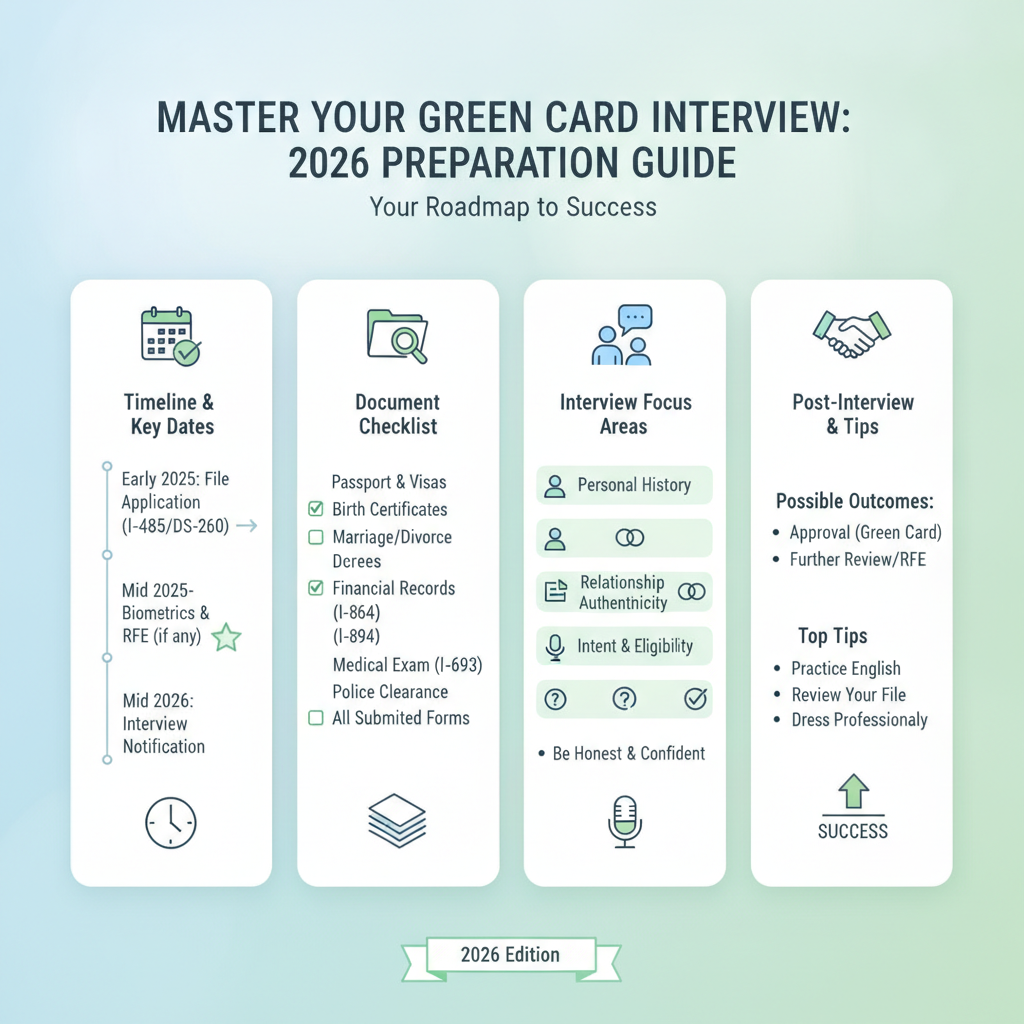
The ongoing conversation around immigration law, particularly regarding the meticulous process of obtaining a Green Card, consistently highlights the importance of thorough preparation for the USCIS interview. Reports from various legal and news outlets, including those aggregated under general immigration law searches, frequently emphasize that while the interview might seem like a formality, it is a critical step where an applicant's entire case can be affirmed or jeopardized. The need for clear, actionable advice on preparing for this interview is a perennial topic, indicating its high relevance and the anxiety it often generates among applicants. This continuous emphasis on preparation underscores the necessity for detailed guides like this one, providing up-to-date and practical strategies for success.
Green Card Interview Preparation Tips (Immigration Law)
What This News Means for Immigrants in Orlando and Across Florida
The consistent focus on Green Card interview preparation in immigration law discussions isn't just background noise; it's a direct reflection of the interview's enduring importance and the evolving landscape of immigration processing. For immigrants in Orlando, Central Florida, and throughout the Sunshine State, this emphasis means that preparedness isn't just advisable—it's essential for a smooth and successful outcome.
Why this news is showing up now
The Green Card interview has always been a cornerstone of the immigration process, serving as a vital checkpoint for USCIS officers to verify information, assess eligibility, and ensure compliance with U.S. immigration laws. The reason this topic continues to trend in legal news and discussions is multifaceted:
- Increased Scrutiny: USCIS, like many government agencies, is under constant pressure to maintain the integrity of the immigration system. This often translates to more thorough interviews and a greater emphasis on consistent, verifiable information.
- Evolving Policies and Procedures: While core immigration laws remain, the administrative procedures and specific areas of focus during interviews can shift. Keeping abreast of these nuances is crucial, and legal news often highlights these changes.
- High Stakes: For applicants, the interview is the culmination of months, sometimes years, of waiting and effort. The outcome directly impacts their ability to live and work permanently in the U.S. and "Keep Families Together," making comprehensive preparation a constant necessity.
- Complexity of Cases: As immigration patterns diversify, so do the complexities of individual cases. From intricate family-based petitions to employment-based adjustments, each case presents unique challenges that underscore the need for tailored preparation.
How it can affect Florida residents
Florida, particularly the Orlando metropolitan area, is a vibrant hub for immigrants from around the globe. This unique demographic landscape means the Green Card interview is a common and critical experience for many of our neighbors. Here’s how the emphasis on preparation directly impacts you:
- Orlando USCIS Field Office: If your case is in Orlando, your interview will likely take place at the Orlando USCIS Field Office. This office handles a high volume of cases, and officers are adept at identifying inconsistencies or gaps in applications. Proper preparation ensures you present your case clearly and confidently within this specific local context.
- Diverse Case Types: Central Florida sees a wide array of Green Card applications—from family-based petitions (spouses, parents, children) to employment-based adjustments and asylum-based Green Cards. Each type has specific interview nuances, making general preparedness, alongside case-specific knowledge, paramount.
- Language and Cultural Barriers: While USCIS provides interpreters, being prepared to clearly articulate your story and respond to questions, even through an interpreter, requires practice. Our firm, Imigrar, understands these challenges, offering services in both English and Spanish (Se Habla Español) to bridge any communication gaps.
- Local Resources and Support: Living in a large metropolitan area like Orlando means access to legal expertise is vital. The ongoing news about interview importance reinforces the value of seeking qualified legal counsel from firms like Imigrar who are intimately familiar with the local USCIS procedures and expectations.
Understanding the gravity of the Green Card interview and dedicating time to meticulous preparation is not just a suggestion—it's a fundamental strategy for success for every immigrant in Florida seeking permanent residency.
Need Help? Our Orlando immigration team is ready to assist. Call +1 786-791-3106 for a free consultation, or message us online. Se Habla Español.
What a Green Card Interview Is (and Why It Matters)
For many immigrants, the Green Card interview is the final, pivotal step before becoming a Lawful Permanent Resident (LPR) of the United States. It's a formal meeting with a USCIS officer designed to verify the information provided in your application and determine your eligibility for permanent residency.
A plain-English definition
Imagine your Green Card application as a book of your life and your reasons for wanting to live permanently in the U.S. The Green Card interview is like a thorough review of that book with an official. The USCIS officer will ask questions about your application, your background, and your relationship (if it's a family-based petition) to ensure everything is true, consistent, and meets the legal requirements for a Green Card. It's not meant to trick you, but to confirm your eligibility and ensure you don't have any inadmissibility issues that would prevent you from getting a Green Card.
Key terms you need to know
Navigating the immigration process means understanding specific terminology. Here are some key terms related to your Green Card interview:
- Green Card: Officially known as a Permanent Resident Card, it grants foreign nationals authorization to live and work permanently in the United States.
- USCIS (U.S. Citizenship and Immigration Services): The government agency responsible for processing immigration benefits, including Green Cards, and conducting interviews.
- Adjustment of Status (AOS): The process of applying for a Green Card while physically present in the United States. If you applied this way, your interview will be at a USCIS Field Office, such as the one in Orlando.
- Consular Processing: The process of applying for a Green Card through a U.S. embassy or consulate abroad. If you applied this way, your interview would be held in your home country. This guide primarily focuses on AOS interviews.
- Petitioner: The U.S. citizen or lawful permanent resident who files an immigration petition (e.g., Form I-130) on behalf of an immigrant relative.
- Beneficiary: The immigrant who is seeking the Green Card based on the petitioner's application.
- Affidavit of Support (Form I-864): A legally binding document filed by a sponsor (usually the petitioner) to accept financial responsibility for the immigrant to ensure they do not become a "public charge." This is critical evidence in many family-based cases.
- Bona Fide Marriage: A marriage entered into in good faith, not solely for the purpose of obtaining an immigration benefit. Proving a bona fide marriage is central to spouse-based Green Card interviews.
- Inadmissibility: Grounds under U.S. immigration law that can make an individual ineligible for a Green Card, such as certain criminal convictions, health issues, or past immigration violations.
- Priority Date: The date USCIS or the Department of State receives your immigrant petition. It's crucial for understanding when your Green Card becomes available, especially for categories with annual limits.
The Green Card interview matters immensely because it's your final opportunity to present your case directly to a USCIS officer. It's where all the documents, forms, and evidence you've submitted come together, and you have the chance to clarify any ambiguities or provide additional information. A well-prepared interview can lead to swift approval, while poor preparation can cause delays, requests for more evidence, or even denial.
Current Immigration Law: The Foundation
Understanding the legal framework underpinning your Green Card application and interview is crucial. The process is governed primarily by the Immigration and Nationality Act (INA), which is the body of law that dictates immigration policy in the United States. While the specifics can be intricate, knowing the basic principles will empower you during your preparation.
Federal requirements
The core requirements for a Green Card are established by federal law, specifically the INA. Key sections of the INA that are relevant to your Green Card interview include:
- INA Section 245 (Adjustment of Status): This section outlines the general requirements for an individual to adjust their status to that of a lawful permanent resident while physically present in the U.S. It specifies conditions such as lawful admission, eligibility for an immigrant visa, and the absence of certain inadmissibility grounds.
- INA Section 212 (General Classes of Aliens Ineligible to Receive Visas and Ineligible for Admission): This section details various grounds of inadmissibility, which can prevent an applicant from receiving a Green Card. These grounds include health-related issues, criminal history, security concerns, public charge concerns (where the Affidavit of Support becomes critical), misrepresentation, and prior immigration violations. The USCIS officer will be assessing whether any of these apply to you during the interview.
- INA Section 201 (Worldwide Level of Immigration): This section establishes the annual numerical limits for different categories of immigrants, impacting visa availability and your Priority Date.
- INA Section 203 (Allocation of Immigrant Visas): This section outlines the preference categories for family-sponsored and employment-sponsored immigrants, which dictate the waiting times for Green Cards.
The interview serves as the final check to ensure you meet all statutory requirements and are not subject to any grounds of inadmissibility. The USCIS officer will be reviewing your submitted forms, including but not limited to:
- Form I-130, Petition for Alien Relative: Filed by a U.S. citizen or LPR to establish a qualifying relationship with a foreign national.
- Form I-485, Application to Register Permanent Residence or Adjust Status: Your primary application for a Green Card while in the U.S.
- Form I-765, Application for Employment Authorization: Often filed concurrently with Form I-485 to allow you to work while your Green Card is pending.
- Form I-131, Application for Travel Document: Often filed concurrently with Form I-485 to allow you to travel outside the U.S. while your Green Card is pending.
- Form I-864, Affidavit of Support: A crucial financial document submitted by your sponsor.
- Form I-693, Report of Medical Examination and Vaccination Record: Completed by a USCIS-approved civil surgeon to document your medical eligibility.
For the most up-to-date information on forms, fees, and legal requirements, always consult the USCIS official website.
Florida-specific considerations
While immigration law is federal, applying uniformly across the United States, there are practical considerations for Florida residents:
- Orlando USCIS Field Office: If you reside in Central Florida, your interview will be conducted at the Orlando Field Office. Officers at this specific location are familiar with the common issues and demographics of applicants from our region. Understanding local procedures, even if informal, can be beneficial.
- High Volume of Cases: Florida, particularly the I-4 corridor including Orlando, Kissimmee, and Tampa, is a high-traffic area for immigration applications. This means processing times can fluctuate, and interviews are conducted regularly.
- Diverse Applicant Pool: The Orlando area has a large and diverse immigrant population, with significant communities from Latin America, the Caribbean, and other regions. USCIS officers are accustomed to working with applicants from various cultural backgrounds, but clear communication remains paramount.
- Access to Legal Counsel: With the high demand for immigration services, Florida residents have access to experienced legal professionals like Imigrar. Our firm is well-versed in federal immigration law and specific practices at the Orlando USCIS Field Office, providing invaluable local expertise.
Important: Always remember that state laws do not directly govern federal immigration processes. However, state criminal records or family court orders (e.g., divorce decrees, child support) will be relevant to your federal immigration case and must be accurately disclosed.
Need Help? Our Orlando immigration team is ready to assist. Call +1 786-791-3106 for a free consultation, or message us online. Se Habla Español.
How to Prepare for Your Green Card Interview: A Complete Step-by-Step Guide
Your Green Card interview is the most critical step in your journey to permanent residency. Meticulous preparation is not just recommended; it's essential for success. This step-by-step guide will walk you through the process, ensuring you're ready for every aspect of your interview at the Orlando USCIS Field Office or wherever your interview is scheduled.
1) Understand Your Case Type and Review Your Application
Before you can prepare for specific questions or documents, you must fully understand the basis of your Green Card application. Are you adjusting status through a family member (spouse, parent, child), an employer, or another category?
Action: Thoroughly review every form and document you submitted to USCIS.
- Familiarize yourself with your entire application package. This includes your initial petition (e.g., Form I-130 for family-based), your Form I-485, and all supporting evidence. Read through every question and your answer.
- Identify any potential discrepancies or areas that might need clarification. Sometimes, information changes between the time you filed and your interview (e.g., a new job, a new address, or a new baby). Be prepared to explain these changes clearly and honestly.
- For family-based petitions (especially spouse-based): Re-read your answers regarding how you met, your relationship timeline, and details about your life together. The USCIS officer will be looking for consistency and genuine intent.
- For employment-based petitions: Review your job offer, qualifications, and the details of your sponsoring employer. Be ready to discuss your role and how it meets the requirements of your visa category.
Required Documents for Review:
- Copies of your complete Form I-130, Form I-485, and all related forms (e.g., Form I-765, Form I-131).
- Copies of all supporting documents submitted with your application (birth certificates, marriage certificates, previous medical exams, financial records).
- Your original interview notice (Form I-797C, Notice of Action).
2) Gather ALL Original Documents and Evidence
The interview is where you present the original versions of all documents you previously submitted copies of, plus any new evidence that strengthens your case. Organize everything meticulously.
Action: Compile all original documents and new supporting evidence in a well-organized binder or folder with tabs.
- Identity and Travel Documents:
- Original passport (valid).
- Original birth certificate (yours and, if applicable, your petitioner's).
- Original marriage certificate (if applicable).
- Any previous passports, visas, or travel documents.
- Your EAD (Employment Authorization Document) and Advance Parole document (if you have them).
- Medical Examination:
- Your original, sealed Form I-693, Report of Medical Examination and Vaccination Record (if you haven't submitted it already or if it has expired). Make sure it's from a USCIS-approved civil surgeon.
- Financial Documents:
- Original Form I-864, Affidavit of Support, with all supporting documents (e.g., tax transcripts/returns for the last three years, W-2s, employment verification letters, pay stubs, bank statements) from your sponsor.
- If you are self-sponsoring or using assets, bring corresponding original evidence.
- Relationship Evidence (for family-based Green Cards, especially spouse-based): This is critical for proving a bona fide marriage. Bring as much original evidence as possible, even if you think you have enough:
- Joint bank account statements (spanning the entire marriage).
- Joint utility bills, leases, or mortgage statements.
- Photos together (dated, showing different times and events).
- Birth certificates of children born to the marriage.
- Joint health or life insurance policies.
- Joint tax returns.
- Affidavits from friends and family testifying to your relationship (with their contact information).
- Any other evidence of comingling of finances, shared responsibilities, or shared life.
- Criminal History (if any):
- Original certified court dispositions for any arrests, citations, or convictions, even if they were dismissed or expunged. Do not assume minor incidents are irrelevant.
- Additional Documents:
- Any other documents USCIS specifically requested in a Request for Evidence (RFE) or your interview notice.
- Copies of previous immigration applications or approvals (e.g., asylum approval, previous visa petitions).
- Divorce decrees or death certificates for any prior marriages (yours or your petitioner's).
Reminder: Bring ALL originals, even if you submitted copies. USCIS officers need to see the originals.
3) Prepare for Common Interview Questions
The USCIS officer will ask questions to verify the information on your forms and assess your eligibility. While specific questions vary by case, there are common themes.
Action: Practice answering questions truthfully, consistently, and clearly.
- Personal History:
- "What is your full name and date of birth?"
- "What is your current address?"
- "Have you ever been arrested or convicted of a crime?"
- "Have you ever been removed from the U.S. or denied entry?"
- "Have you ever claimed to be a U.S. citizen?"
- Relationship Details (for family-based):
- "How and when did you meet your spouse/petitioner?"
- "When did you get married?"
- "Where do you live together? Describe your home."
- "What are your spouse's/petitioner's parents' names?"
- "What do you do for fun together?"
- "Describe a typical day in your lives."
- "Who handles the finances? Who cooks? Who does chores?"
- "Have you ever lived apart? If so, why?"
- "Do you have joint accounts, insurance, or property?"
- Immigration History:
- "How did you enter the U.S.?"
- "What was your visa status when you entered?"
- "Have you ever overstayed a visa?"
- "Have you ever had any previous immigration petitions filed on your behalf?"
- General Eligibility:
- "Do you intend to live permanently in the U.S.?"
- "Do you understand the rights and responsibilities of a permanent resident?"
Warning: Be truthful in all your answers. Inconsistencies between your application and your interview answers can raise red flags and lead to further scrutiny or even denial.
4) Practice Your Interview Skills and Logistics
Beyond the content, your demeanor and preparation for the actual logistics of the interview are important.
Action: Plan your attire, transportation, and practice your communication style.
- Dress Code: Dress professionally, as if you were attending a job interview. This shows respect for the process and the officer.
- Punctuality: Arrive at the Orlando USCIS Field Office (or your designated location) at least 30 minutes before your scheduled appointment. This allows time for security checks, parking, and finding your way.
- Bring Your Interview Notice: You will need your original interview notice (Form I-797C) to enter the building and check in.
- Be Calm and Confident: It's natural to be nervous, but try to remain calm. Answer questions directly, clearly, and concisely. If you don't understand a question, politely ask the officer to rephrase it.
- Listen Carefully: Pay close attention to each question before answering. Do not interrupt the officer.
- Truthfulness: Always tell the truth. If you don't know an answer, state that you don't know, rather than guessing.
- Language Assistance: If you are not fluent in English, USCIS will provide an
Related Topics
Need Legal Assistance?
Our experienced immigration attorneys are here to help with your case. Contact Imigrar today for a free consultation and let us guide you through the legal process with confidence.
📍 Orlando, Florida • Serving clients nationwide
📧 info@imigrar.com