
TPS Extension: Crucial Updates for Immigrants in Florida and
Stay informed on the latest TPS (Temporary Protected Status) extensions impacting thousands of immigrants. Learn what this means for your status, re-registration steps, and how Imigrar can help keep your family together.

The landscape of U.S. immigration law is constantly shifting, and staying informed is paramount for maintaining your legal status and planning your future. At Imigrar, we are committed to providing timely, accurate, and actionable information to our community in Orlando, throughout Florida, and nationwide. Today, we delve into significant developments concerning Temporary Protected Status (TPS) extensions, a critical lifeline for many.
Urgent TPS Questions? Don't navigate these changes alone. Our Orlando immigration team is ready to assist with your TPS re-registration or application. Call +1 786-791-3106 for a free, confidential consultation, or message us online. Se Habla Español.
The reporting that sparked this guide:
TPS (Temporary Protected Status) Extension News (Legal News)
What This News Means for Immigrants in Orlando and Across Florida
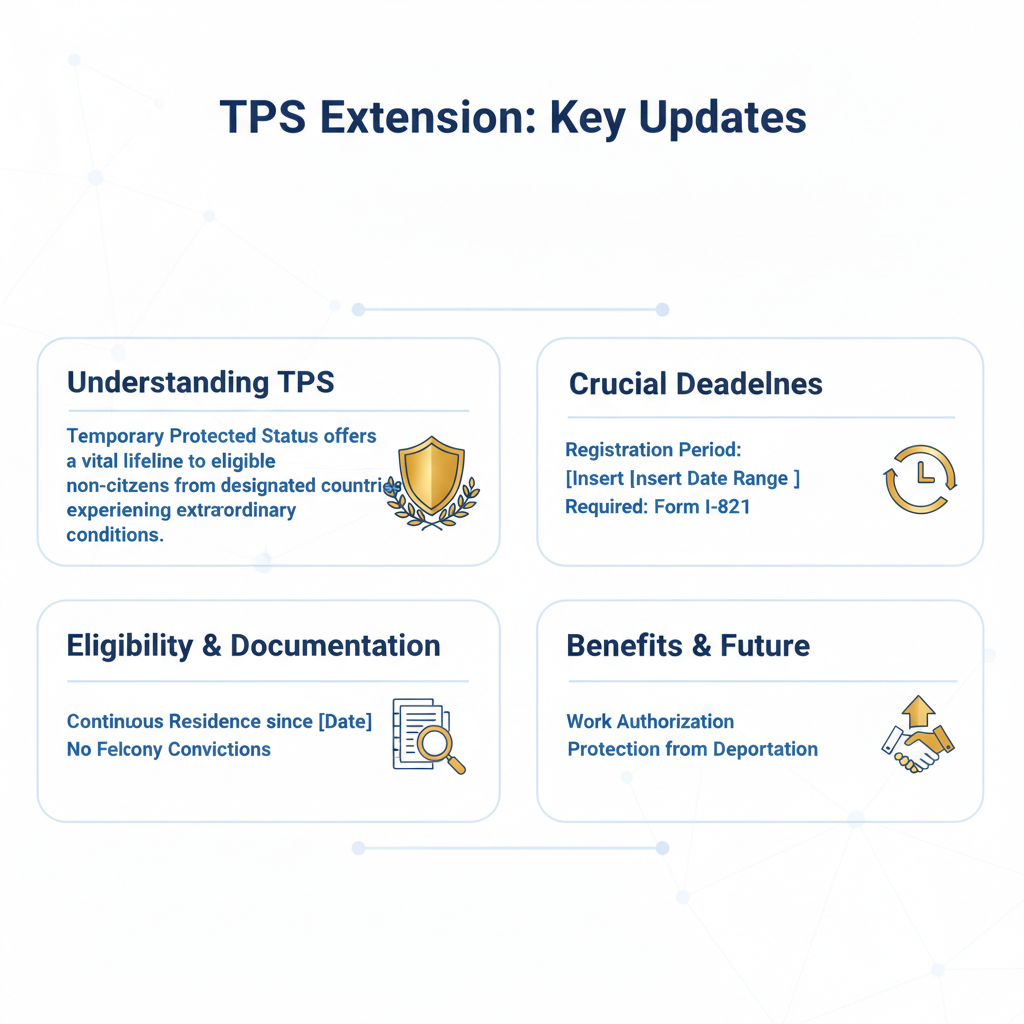
Recent announcements regarding Temporary Protected Status (TPS) extensions for several designated countries have brought both relief and a renewed sense of urgency to hundreds of thousands of individuals living in the United States. For immigrants in Orlando and across the Sunshine State, these updates are not just headlines; they are direct determinants of their ability to live and work legally, pursue educational opportunities, and, most importantly, keep their families together.
Why this news is showing up now
The U.S. Secretary of Homeland Security has the authority, under Section 244 of the Immigration and Nationality Act (INA), to designate a foreign country for TPS due to conditions such as ongoing armed conflict, environmental disaster, or other extraordinary and temporary conditions. These designations, along with any extensions or re-designations, are not permanent. They are subject to regular review, typically every 6, 12, or 18 months. As of September 18, 2026, several existing TPS designations are nearing their expiration dates, prompting the Department of Homeland Security (DHS) to announce either extensions for these countries or, in some cases, re-designations or terminations.
The current news cycle is focused on these periodic reviews and subsequent decisions. When an extension is announced, it means that nationals of that specific country who have already been granted TPS, or who meet the criteria for initial registration if the country is newly designated or re-designated, will have the opportunity to maintain their protected status for an additional period. These decisions are critical because they directly impact the legal standing of individuals who might otherwise face deportation or be unable to work legally.
How it can affect Florida residents
Florida, particularly the Orlando metropolitan area and the I-4 corridor, is home to a significant and diverse immigrant population. Many communities within Central Florida include individuals from countries currently or previously designated for TPS, such as Haiti, Venezuela, El Salvador, Honduras, Nicaragua, and others. The impact of TPS extension news on Florida residents is profound:
- Continued Legal Presence: For current TPS holders, an extension means they can continue to live and work in the U.S. without fear of deportation for the duration of the extension period. This provides stability for families, allowing children to remain in school and adults to contribute to the local economy.
- Employment Authorization: Along with TPS comes eligibility for an Employment Authorization Document (EAD), also known as a work permit (Form I-765). Extensions ensure that TPS beneficiaries can renew their EADs, maintaining their ability to work legally and support themselves and their families in Orlando and beyond. This is vital for the state's workforce, including sectors like hospitality, agriculture, and construction, which often rely on immigrant labor.
- Driver's Licenses and State IDs: In Florida, an EAD is often a key document for obtaining or renewing a driver's license or state identification card. An extension of TPS directly supports the renewal of these essential documents, enabling TPS holders to commute to work, access services, and participate fully in daily life.
- Community Stability: The certainty provided by TPS extensions helps stabilize entire communities. When residents are not living in constant fear of deportation, they are more likely to invest in their homes, businesses, and local communities, contributing to Florida's overall prosperity.
- Access to Education: For students, including those attending Orange County public schools or universities in Central Florida, TPS provides stability, allowing them to continue their education without interruption due to immigration status concerns.
- Family Unity: Perhaps most importantly, TPS extensions help keep families together. Many TPS holders have U.S. citizen children, spouses, or other relatives. The ability to remain in the U.S. legally is fundamental to maintaining family unity, a core value at Imigrar.
However, it is crucial for Florida residents impacted by these extensions to understand the re-registration process and deadlines. Missing a deadline or submitting an incomplete application can jeopardize one's status. This is where expert legal guidance becomes indispensable.
Don't Risk Your Status! The re-registration process can be complex. Imigrar offers expert assistance for TPS applications and renewals. Call us at +1 786-791-3106 or contact us online for a free consultation. Se Habla Español.
What Temporary Protected Status (TPS) Is (and Why It Matters)
Temporary Protected Status (TPS) is a humanitarian immigration benefit that provides temporary relief from deportation and work authorization to eligible foreign nationals of certain countries. It is a critical program designed to protect individuals whose home countries are experiencing conditions that make it unsafe for them to return.
A plain-English definition
Imagine your home country is hit by a massive earthquake, or it's embroiled in a civil war, making it dangerous for you to go back. The U.S. government recognizes these extraordinary circumstances and, through TPS, says, "You can stay here temporarily, legally, and work, until conditions in your home country improve." It's not a path to a Green Card or permanent residency on its own, but it offers a safe harbor and a chance to rebuild your life in the U.S. without immediate fear of being forced to return to danger.
The Secretary of Homeland Security designates a country for TPS based on:
- Ongoing Armed Conflict: Making return unsafe due to war or civil strife.
- Environmental Disaster: Such as earthquakes, hurricanes, or epidemics, leading to a substantial, but temporary, disruption of living conditions.
- Other Extraordinary and Temporary Conditions: That prevent nationals from returning safely, like a severe economic crisis or a widespread public health emergency.
Once a country is designated, eligible individuals from that country who are already in the U.S. can apply for TPS. This status is temporary and is typically granted for periods of 6, 12, or 18 months, subject to extension. It's a crucial program that truly embodies the "Keep Families Together" mission that Imigrar stands by.
Key terms you need to know
Understanding the following terms is essential when dealing with TPS:
- Designated Country: A foreign country whose nationals are eligible for TPS. The list of designated countries changes based on the Secretary of Homeland Security's assessment. Examples include Haiti, Venezuela, El Salvador, Honduras, Nicaragua, Ukraine, Sudan, and others.
- Initial Registration Period: The specific timeframe during which eligible individuals from a newly designated country can apply for TPS for the first time.
- Re-registration Period: The specific timeframe during which current TPS beneficiaries must apply to extend their status when the designation for their country is extended. It's usually a 60-day window.
- Employment Authorization Document (EAD): Also known as a work permit, this document (Form I-765) allows TPS beneficiaries to work legally in the U.S.
- Travel Authorization (Advance Parole): While TPS itself does not grant travel authorization, TPS beneficiaries can apply for Advance Parole (Form I-131) to travel outside the U.S. and return legally. This is an important consideration for those with family abroad.
- Notice of Extension: An official announcement from USCIS extending the TPS designation for a specific country, often including instructions for re-registration and automatic EAD extensions.
- Federal Register Notice: The official daily publication for rules, proposed rules, and notices of federal agencies and organizations, as well as executive orders and other presidential documents. All TPS designations, extensions, and re-registrations are published here.
- Immigration and Nationality Act (INA): The body of law that governs immigration to the United States. Section 244 specifically outlines the provisions for Temporary Protected Status.
- USCIS: U.S. Citizenship and Immigration Services, the federal agency responsible for administering immigration and naturalization benefits, including TPS. USCIS official website is your primary source for forms and official information.
Current Immigration Law: The Foundation of TPS
Temporary Protected Status (TPS) is rooted in the Immigration and Nationality Act (INA), specifically Section 244. This statute grants the Secretary of Homeland Security the discretionary power to designate a foreign country for TPS. This power is exercised when conditions in that country prevent its nationals from returning safely, or when the country is unable to adequately handle the return of its nationals. It's a humanitarian measure, distinct from asylum or refugee status, though it offers similar protections against removal.
Federal requirements
To be eligible for TPS, an individual must meet several federal requirements:
- Nationality: Be a national of a country designated for TPS, or a person without nationality who last habitually resided in that designated country.
- Continuous Physical Presence (CPP): Have been continuously physically present in the U.S. since the effective date of the most recent designation for their country.
- Continuous Residence (CR): Have been continuously residing in the U.S. since the date specified for their country's designation.
- Timely Registration: Apply for TPS during the initial registration period or any subsequent re-registration period. There are limited exceptions for late initial registration.
- Admissibility: Meet admissibility requirements, meaning they are not inadmissible under certain grounds (e.g., certain criminal offenses, national security threats).
- No Ineligibility Bars: Not be subject to certain criminal or national security-related bars to TPS. For instance, conviction of two or more misdemeanors, or one felony, typically makes an individual ineligible.
The precise dates for Continuous Physical Presence (CPP) and Continuous Residence (CR) are specific to each country's designation and are published in the Federal Register Notice. It is absolutely critical to check these dates for your specific country.
The primary forms used for TPS are:
- Form I-821, Application for Temporary Protected Status: This is the core application form for TPS.
- Form I-765, Application for Employment Authorization: Most TPS applicants also file this form to obtain or renew their work permit.
- Form I-601, Application for Waiver of Grounds of Inadmissibility: In some limited cases, if an applicant has certain grounds of inadmissibility, they may need to file this waiver, though many grounds do not apply to TPS.
All forms and their instructions are available on the USCIS Forms page. Always use the most current version of the forms.
Florida-specific considerations
While TPS is a federal program, its impact and practical considerations can vary slightly depending on your state of residence. For Florida residents, particularly those in Orlando, there are several points to keep in mind:
- Orlando USCIS Field Office: If you reside in Central Florida, your case might be processed or reviewed by the Orlando USCIS Field Office, though initial applications are generally sent to a USCIS Service Center. Interviews for certain benefits (though not typically for TPS re-registration itself) would occur here. The local office address is 5449 South Semoran Blvd, Orlando, FL 32822.
- State ID and Driver's Licenses: The Florida Department of Highway Safety and Motor Vehicles (FLHSMV) accepts a valid EAD (work permit) as proof of legal presence for obtaining a driver's license or state ID. An extension of your TPS and EAD is therefore crucial for maintaining your driving privileges and identification in Florida.
- Public Benefits: TPS holders are generally eligible for certain public benefits, such as Social Security numbers, but generally not federal means-tested public benefits. Florida has specific state-level programs, and eligibility for these would depend on state law and regulations. It’s always best to consult with an attorney regarding specific benefit eligibility.
- Local Community Resources: Orlando and surrounding areas have numerous community organizations that support immigrant populations. These organizations can be valuable resources for language assistance, social services, and referrals, working in conjunction with legal professionals like Imigrar.
Important: While Florida does not have its own state-level immigration status, state laws can affect the daily lives of immigrants. For example, laws related to employment verification or access to state services can influence how TPS holders navigate life in Florida. Always seek advice from a qualified immigration attorney to understand how federal and state laws interact in your specific situation.
Confused by Legal Jargon? Our team at Imigrar simplifies complex immigration laws. For clarity on TPS extensions and how they apply to your life in Florida, call us for a free consultation at +1 786-791-3106. Se Habla Español.
How to Re-Register for TPS: A Complete Step-by-Step Guide
When the Department of Homeland Security (DHS) announces an extension for a country’s TPS designation, it is critical for current TPS beneficiaries to re-register within the specified timeframe. This process ensures that you maintain your protected status and employment authorization. Missing the deadline can have serious consequences, potentially leading to loss of status and eligibility for an EAD. This guide will walk you through the typical re-registration process.
1) Monitor Official Announcements and Identify Your Re-registration Window
The first and most crucial step is to stay informed. TPS extensions and re-registration periods are announced via a Federal Register Notice and on the USCIS official website. These announcements will specify:
- The countries whose TPS designation has been extended.
- The new expiration date for the TPS designation.
- The specific 60-day re-registration window during which you must submit your application.
- Any automatic extensions for existing EADs, often valid for a certain period beyond the original expiration date to cover processing times.
Action: Regularly check the USCIS website for your country’s specific updates. Set reminders for the re-registration start and end dates. Imigrar actively monitors these announcements for our clients and the broader community.
Reminder: As of September 18, 2026, several countries have recent or upcoming re-registration periods. Confirm the exact dates for your country.
2) Gather Required Documents and Information
Before you begin filling out forms, compile all necessary documents. Having everything organized will streamline the process and reduce the chance of errors or delays. For re-registration, you will primarily need documents proving your identity, nationality, and current TPS status.
Required Documents (General for Re-registration):
- Copy of your most recent Form I-797, Notice of Action, showing approval of your previous TPS application or re-registration.
- Copy of your current Employment Authorization Document (EAD), even if expired, if you previously received one based on TPS.
- Copy of your passport or other national identity document with your photograph, showing proof of nationality.
- Copy of your birth certificate with photo identification.
- Copies of any previous travel documents (Form I-512L, Advance Parole Document) if you traveled outside the U.S. while on TPS.
- Proof of your continuous residence in the U.S. since the initial designation date for your country (e.g., utility bills, rent receipts, school records, employment records, bank statements, medical records). While this is usually established during initial registration, USCIS may request it again, especially if there are gaps in your record or if you’ve had significant life changes.
- Two passport-style photographs (2x2 inches, white background, taken within 30 days of filing).
Warning: Do NOT send original documents unless specifically requested by USCIS. Always send high-quality copies.
3) Complete and File Form I-821, Application for Temporary Protected Status
This is the main application for re-registration. It is crucial to fill out the form accurately and completely. Read the instructions carefully before you start.
- Download the latest version of Form I-821 from the USCIS Forms page.
- Fill out all sections truthfully. If a question does not apply to you, write "N/A" (not applicable).
- Ensure your name, date of birth, and other identifying information exactly match your previous TPS application and identity documents.
- Sign the form in blue ink. An unsigned form will be rejected.
- If you have had any changes in address, criminal history, or other relevant circumstances since your last TPS application, you must disclose them.
Fee: There is typically no fee for filing Form I-821 for re-registration. However, you will likely need to pay the biometrics services fee (currently $85). Fee waivers (Form I-912, Request for Fee Waiver) are available for those who meet specific poverty guidelines.
4) Complete and File Form I-765, Application for Employment Authorization (Optional but Recommended)
If you wish to continue working legally in the U.S., you must apply for a new EAD by filing Form I-765. It is highly recommended to file this form concurrently with Form I-821 during your re-registration period.
- Download the latest version of Form I-765 from the USCIS Forms page.
- In Part 2, Question 27, for "Eligibility Category," enter (c)(19) for TPS.
- If your EAD is expiring, USCIS often provides an automatic extension of your existing EAD for a period (e.g., 540 days) while your new EAD application is pending, provided you re-register on time. Check the Federal Register Notice for your country for specific automatic extension details.
- Sign the form in blue ink.
Fee: There is a filing fee for Form I-765 (currently $410). This fee can also be waived if you qualify for a fee waiver using Form I-912.
5) Prepare and Mail Your Application Packet
Once both forms are completed and signed, assemble your application packet carefully.
Packet Order (Recommended):
- Cover Letter (optional, but helpful, listing contents)
- Check(s) or Money Order(s) for fees (or Form I-912 if requesting a fee waiver)
- Two passport-style photographs (placed in a small envelope and stapled to the upper left corner of the Form I-821)
- Form I-821 with supporting documents (copies, not originals)
- Form I-765 with supporting documents (copies, not originals)
- Any other supporting documents (e.g., proof of continuous residence, if specifically requested or if you feel it strengthens your application).
Mail your complete packet to the correct USCIS lockbox facility. The address depends on your country of designation and where you reside. Always refer to the "Where to File" section in the instructions for Form I-821 on the USCIS website. For Central Florida residents, the mailing address is usually the USCIS Chicago Lockbox, but verify this every time.
Important: Send your application via certified mail with a return receipt requested. This provides proof that you mailed your application and that USCIS received it, which is crucial if there are any disputes about timely filing.
6) Attend Biometrics Appointment
After USCIS receives your application, they will send you a Form I-797C, Notice of Action, confirming receipt of your application. Within a few weeks to a few months, you will receive a separate notice scheduling a biometrics appointment at an Application Support Center (ASC).
- This appointment is mandatory. You will have your fingerprints, photograph, and signature taken.
- Bring your appointment notice, a valid photo ID (e.g., passport, EAD, Florida driver's license), and your Form I-797C.
- For Central Florida residents, your appointment will likely be at the Orlando ASC.
Warning: Failure to attend your biometrics appointment without rescheduling can lead to denial of your application.
7) Await Decision and Receive New Documents
After your biometrics appointment, the waiting period begins. Processing times for TPS re-registration and EADs can vary significantly. You can check current processing times on the USCIS Processing Times website.
- If your application is approved, you will receive a new Form I-797, Notice of Action, confirming your TPS extension.
- If you applied for an EAD, you will receive your new Employment Authorization Document in the mail.
- If USCIS needs more information, they will send a Request for Evidence (RFE). Respond promptly and completely to RFEs.
Reminder: Keep all notices and documents from USCIS in a safe place. These are vital records of your immigration status.
Worried About Deadlines? The 60-day re-registration window is strict. Let Imigrar ensure your TPS application is filed correctly and on time. Call +1 786-791-3106 today for your free consultation. Se Habla Español.
Practical Steps You Can Take Today
Navigating TPS extensions requires proactive planning and attention to detail. Here are practical steps you can take right now to prepare and secure your status:
- Verify Your Country's Status: Immediately check the USCIS TPS webpage for the latest updates on your country's designation and re-registration period. Confirm the exact start and end dates of the 60-day window.
- Gather All Existing Immigration Documents: Locate your previous TPS approval notices (Form I-797), current and expired EADs, any travel documents (Advance Parole), and your passport or national ID. Keep them organized in a dedicated folder.
- Update Your Address with USCIS: If you have moved, even within Orlando or Central Florida, ensure your address is updated with USCIS within 10 days of moving by filing Form AR-11, Alien's Change of Address Card, online or by mail. This is crucial for receiving important notices.
- Review Your Eligibility: Re-familiarize yourself with the general TPS eligibility requirements. While re-registration is for existing beneficiaries, ensure no new circumstances (e.g., certain criminal convictions) have arisen that could affect your eligibility.
- Start Compiling Supporting Evidence: Even if not explicitly required for re-registration, having updated proof of continuous residence (utility bills, bank statements, pay stubs from your Orlando employer, school records for your children) since your initial grant of TPS can be helpful.
- Take New Passport Photos: Get two recent, passport-style photographs taken. Ensure they meet USCIS specifications (2x2 inches, white background, full face, no hats or glasses unless for medical reasons).
- Consult with an Immigration Attorney: This is arguably the most important step. An experienced attorney, like those at Imigrar, can confirm your eligibility, help you gather documents, accurately complete forms, and ensure timely submission. This is especially vital if you have any past criminal history, have traveled abroad, or have any other complexities in your immigration record.
Document preparation guidance
- Organize Digitally and Physically: Create both digital copies (scanned PDFs) and physical copies of all documents. Label folders clearly.
- High-Quality Copies: Ensure all photocopies are clear, legible, and true representations of the original documents.
- Translate Foreign Documents: Any document not in English must be accompanied by a complete English translation certified by the translator. The certification must state that the translator is competent to translate and that the translation is accurate.
- Keep a Complete Copy of Your Submission: Before mailing your application, make a complete copy of everything you are sending to USCIS for your records. This includes the filled-out forms, all supporting documents, and the checks/money orders.
Timeline expectations
Understanding the timeline will help manage your expectations:
- Re-registration Window: This is typically a 60-day window. You must submit your application within these dates.
- Receipt Notice: USCIS usually sends a Form I-797C receipt notice within 2-4 weeks after receiving your application.
- Biometrics Appointment: A biometrics appointment notice typically arrives 4-8 weeks after your receipt notice. The appointment itself will be scheduled a few weeks after the notice.
- Processing Time for I-821 and I-765: Processing times for TPS re-registration and EADs can vary significantly, from a few months to over a year. Check the USCIS Processing Times page for the most current estimates for your service center.
- EAD Automatic Extension: During the processing period, if your EAD expires, the Federal Register Notice for your country will often provide an automatic extension of your existing EAD for a period (e.g., 540 days) from its expiration date. This allows you to continue working while your new EAD is being processed. Carry the Federal Register Notice along with your expired EAD for proof of work authorization.
Important: Start early! Do not wait until the last minute of the 60-day window to prepare and submit your application. Delays can happen, and you want to ensure your application is received on time.

How Imigrar Helps Immigrants in Orlando and Nationwide
At Imigrar, we understand that the process of re-registering for Temporary Protected Status can be daunting, especially with constantly evolving regulations and the critical need to meet deadlines. Our mission, "Keep Families Together," is at the heart of everything we do, and we are dedicated to providing compassionate, effective legal representation to immigrants across Orlando,
Related Topics
Need Legal Assistance?
Our experienced immigration attorneys are here to help with your case. Contact Imigrar today for a free consultation and let us guide you through the legal process with confidence.
📍 Orlando, Florida • Serving clients nationwide
📧 info@imigrar.com