
Orlando Family-Based Immigration: Your 2026 Petition Guide
Navigate the family-based immigration petition process with Imigrar's comprehensive 2026 guide. Learn about eligibility, required forms like Form I-130, timelines, and how to keep your family together in Orlando and nationwide.

The reporting that sparked this guide: Family-Based Immigration Petition Guide (Immigration)
What This News Means for Immigrants in Orlando and Across Florida
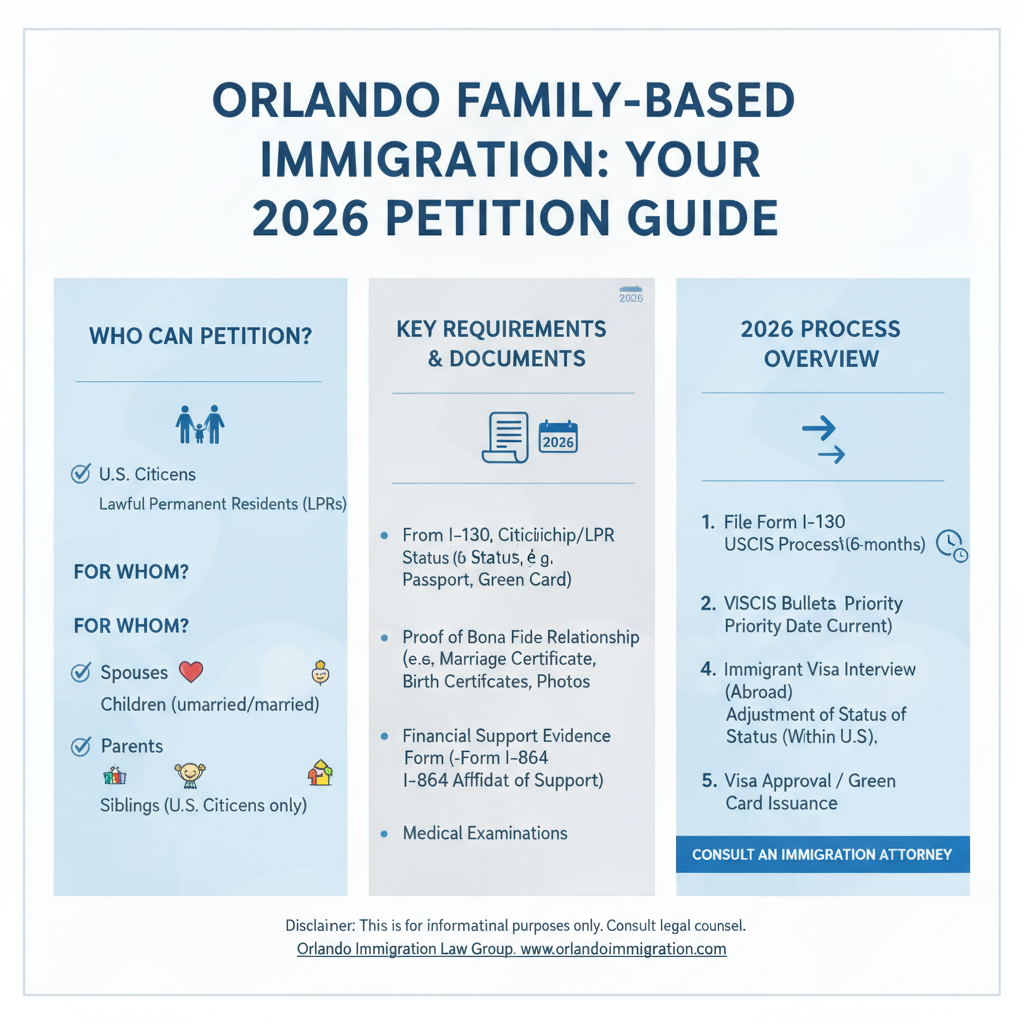
Family unity is a cornerstone of American society, and the path for U.S. citizens and lawful permanent residents (LPRs) to sponsor their loved ones for immigration has always been a topic of vital importance. While specific policies and processing times may shift, the fundamental principles of family-based immigration remain a constant area of focus for families worldwide and here in Florida.
Why this news is showing up now
In 2026, discussions around family-based immigration are more prevalent than ever. This isn't necessarily due to a single, sudden policy change, but rather a confluence of factors that keep this topic at the forefront. Firstly, the ongoing evolution of global migration patterns means more families are seeking to reunite in the United States. Secondly, advancements in digital communication and news dissemination mean that any updates, even minor procedural ones from agencies like USCIS or the Department of State, can quickly gain traction. Finally, the sheer volume of applications, coupled with processing backlogs, frequently brings the challenges and complexities of family petitions into the public discourse. Families are constantly searching for reliable, up-to-date information to navigate these intricate processes, making comprehensive guides like this one highly sought after.
How it can affect Florida residents
Florida, particularly Central Florida and the Orlando metropolitan area, is a vibrant melting pot of cultures and nationalities. Our state is home to a significant immigrant population, meaning that news and updates regarding family-based immigration have a direct and profound impact on countless families living in Orange County and surrounding areas. For many, the ability to sponsor a spouse, child, parent, or sibling is not just a legal process; it's a deeply personal journey towards keeping families together.
Residents of Orlando and across Florida often face unique circumstances, from managing complex cases involving family members abroad to dealing with the local implications of federal immigration policies. The Orlando USCIS Field Office processes a high volume of applications, and understanding the specific requirements, potential delays, and local resources available is crucial. Whether you're a U.S. citizen in Kissimmee petitioning for your spouse, or an LPR in Sanford hoping to bring your children to the I-4 corridor, staying informed about the family-based immigration petition process is essential for planning your future and ensuring your loved ones can join you.
What Family-Based Immigration Petitions Are (and Why They Matter)
Family-based immigration is the most common pathway for individuals to obtain lawful permanent residence, or a "green card," in the United States. It's built on the principle of family reunification, allowing U.S. citizens and lawful permanent residents to sponsor certain eligible relatives to come live permanently in the U.S. These petitions are the bedrock upon which millions of families have built new lives together, contributing to the cultural and economic fabric of the nation.
A plain-English definition
At its core, a family-based immigration petition is a formal request made to the U.S. government, specifically U.S. Citizenship and Immigration Services (USCIS), by a U.S. citizen or lawful permanent resident (the "petitioner") on behalf of an eligible foreign national relative (the "beneficiary"). This petition, primarily **Form I-130**, Petition for Alien Relative, establishes the legal familial relationship between the petitioner and the beneficiary. Once approved, it serves as the foundational step for the beneficiary to apply for a green card, either through **Adjustment of Status** if they are already in the U.S., or through **Consular Processing** if they are living abroad.
The entire process is designed to verify the legitimacy of the family relationship and ensure that the sponsored individual meets all other immigration requirements, including health, security, and financial criteria, without becoming a "public charge."
Key terms you need to know
Navigating immigration law requires understanding specific terminology. Here are some essential terms related to family-based petitions:
- Petitioner: The U.S. citizen or lawful permanent resident who files **Form I-130** on behalf of their relative.
- Beneficiary: The foreign national relative for whom the **petitioner** is filing **Form I-130** to immigrate to the U.S.
- Immediate Relative: A specific category of beneficiaries who are not subject to numerical visa limitations, meaning there's no waiting list for their green card once the petition is approved. This includes spouses of U.S. citizens, unmarried children under 21 of U.S. citizens, and parents of U.S. citizens (if the U.S. citizen is 21 or older).
- Preference Categories: Categories for family members who are not **Immediate Relatives**, and thus are subject to numerical limitations and often involve a waiting period. These include:
- First Preference (F1): Unmarried sons and daughters (21 or older) of U.S. citizens.
- Second Preference (F2A): Spouses and unmarried children (under 21) of lawful permanent residents.
- Second Preference (F2B): Unmarried sons and daughters (21 or older) of lawful permanent residents.
- Third Preference (F3): Married sons and daughters of U.S. citizens.
- Fourth Preference (F4): Brothers and sisters of U.S. citizens (if the U.S. citizen is 21 or older).
- Priority Date: The date USCIS receives your properly filed **Form I-130**. This date is crucial for beneficiaries in **Preference Categories**, as it determines their place in line for an available visa.
- Visa Bulletin: A monthly publication by the U.S. Department of State that provides updated information on the availability of immigrant visas for the various **Preference Categories**. It shows which **Priority Dates** are "current," meaning beneficiaries with that date or earlier can move forward with their green card application.
- Adjustment of Status (AOS): The process by which an eligible foreign national already present in the United States can apply for lawful permanent resident status without having to leave the country. This typically involves filing **Form I-485**, Application to Register Permanent Residence or **Adjust Status**.
- Consular Processing: The process by which an eligible foreign national living outside the United States applies for an immigrant visa at a U.S. embassy or consulate in their home country. Once approved, they enter the U.S. as a lawful permanent resident.
- Affidavit of Support (**Form I-864**): A legally binding document signed by the **petitioner** (and sometimes a joint sponsor) promising financial support to the beneficiary, ensuring they will not become a "public charge" in the U.S.
Need Help? Our Orlando immigration team is ready to assist. Call +1 786-791-3106 for a free consultation, or message us online. Se Habla Español.
Current Immigration Law: The Foundation for Family Petitions
The legal framework for family-based immigration is primarily established under the Immigration and Nationality Act (INA), specifically sections related to the allocation of immigrant visas. Understanding these foundational laws is crucial for anyone embarking on this journey.
Federal requirements
The INA distinguishes between two main types of family-based immigrants:
- Immediate Relatives of U.S. Citizens: As defined in **INA § 201(b)(2)(A)(i)**, these include spouses of U.S. citizens, unmarried children under 21 years of age of U.S. citizens, and parents of U.S. citizens (provided the U.S. citizen is at least 21 years old). The defining characteristic of **Immediate Relatives** is that there are no numerical limits on the number of visas issued each year in this category. This means that once **Form I-130** is approved and other requirements are met, an immigrant visa is generally immediately available.
- Family-Sponsored Preference Categories: As outlined in **INA § 203(a)**, these categories are subject to annual numerical limits, which often results in waiting lists for immigrant visas. The categories are:
- First Preference (F1): Unmarried sons and daughters (21 years of age or older) of U.S. citizens.
- Second Preference (F2A): Spouses and unmarried children (under 21 years of age) of lawful permanent residents.
- Second Preference (F2B): Unmarried sons and daughters (21 years of age or older) of lawful permanent residents.
- Third Preference (F3): Married sons and daughters of U.S. citizens.
- Fourth Preference (F4): Brothers and sisters of U.S. citizens (provided the U.S. citizen is 21 years of age or older).
For all family-based petitions, the **petitioner** must demonstrate a legitimate family relationship with the **beneficiary** and meet certain financial sponsorship requirements. This is where **Form I-864**, Affidavit of Support, becomes critical. The **petitioner** must prove they can financially support the **beneficiary** at 125% of the federal poverty guidelines for their household size. Failure to meet this requirement can lead to a denial, underscoring the importance of thorough preparation.
All official forms and detailed instructions can be found on the USCIS official website. Key forms you will encounter include:
- Form I-130, Petition for Alien Relative
- Form I-130A, Supplemental Information for Spouse Beneficiary (if petitioning for a spouse)
- Form I-485, Application to Register Permanent Residence or **Adjust Status** (for beneficiaries in the U.S.)
- Form I-864, Affidavit of Support (required for most family-based immigrants)
- Form I-765, Application for Employment Authorization (often filed concurrently with **Form I-485**)
- Form I-131, Application for Travel Document (often filed concurrently with **Form I-485** for Advance Parole)
Florida-specific considerations
While immigration law is federal, the practicalities of navigating the system can have local nuances. Florida does not have its own immigration laws; however, the impact of federal policies is acutely felt across the state. For Central Florida residents, interacting with the Orlando USCIS Field Office and the National Benefits Center (which processes many **Form I-130** petitions) is a common experience. Processing times can vary, and local field office interview schedules can fluctuate. Additionally, Florida's diverse population means that issues such as language barriers, access to certified document translation services, and the need for culturally competent legal representation are particularly relevant. For those undergoing **Adjustment of Status** in Orlando, the biometrics appointment will be at a local Application Support Center (ASC), and the interview (if required) will be at the Orlando Field Office.
Reminder: Always ensure you are working with an attorney licensed to practice immigration law, as it is a federal practice area, regardless of your state of residence.
How to File a Family-Based Immigration Petition: A Complete Step-by-Step Guide
The process of sponsoring a family member for a green card can be complex, involving multiple forms, agencies, and waiting periods. Here is a detailed, step-by-step guide to help you understand the journey.
1) Determine Eligibility and Category
Before filing any forms, the first crucial step is to determine if you (the **petitioner**) are eligible to sponsor your relative (the **beneficiary**) and to identify the correct immigration category. This will dictate which forms you file and the potential timeline.
- Petitioner's Eligibility: You must be a U.S. citizen or a lawful permanent resident (green card holder).
- U.S. citizens can petition for spouses, unmarried children (under 21), married children, parents (if the citizen is 21+), and siblings (if the citizen is 21+).
- Lawful Permanent Residents can petition for spouses and unmarried children (any age).
- Beneficiary's Eligibility: The relationship must be recognized by immigration law.
- Immediate Relative: Spouse of USC, unmarried child under 21 of USC, parent of USC (if USC is 21+).
- Family Preference Categories (F1, F2A, F2B, F3, F4): All other eligible relationships.
- Required Documents for Eligibility Determination:
- Petitioner's Proof of Status: U.S. Birth Certificate, Certificate of Naturalization, U.S. Passport, or Green Card (front and back copy).
- Proof of Relationship:
- For Spouses: Marriage Certificate, divorce decrees from prior marriages (if applicable), joint documents (leases, bank accounts, photos, affidavits from friends/family).
- For Children: Beneficiary's Birth Certificate listing the **petitioner** as parent, **petitioner's** Birth Certificate (if petitioning for parent).
- For Siblings: Both **petitioner's** and **beneficiary's** Birth Certificates showing at least one common parent.
- Any official documentation showing name changes for either party.
2) File **Form I-130**, Petition for Alien Relative
This is the initial and most critical step. The **petitioner** files **Form I-130** with USCIS to prove the qualifying relationship. This form is filed regardless of whether the **beneficiary** is inside or outside the U.S.
- Completing **Form I-130**: Fill out the form accurately and completely. If petitioning for a spouse, you will also need to complete **Form I-130A**, Supplemental Information for Spouse Beneficiary.
- Required Documents to Submit with **Form I-130**:
- Completed **Form I-130** (and **Form I-130A** if applicable).
- Filing fee (check USCIS Forms for current fees).
- Passport-style photos for both **petitioner** and **beneficiary** (if filing for a spouse).
- Copies of **petitioner's** proof of U.S. citizenship or LPR status (e.g., birth certificate, naturalization certificate, green card).
- Copies of relationship evidence (e.g., marriage certificate, birth certificates).
- Copies of any official name change documents (marriage certificates, court orders).
- Form G-1145, E-Notification of Application/Petition Acceptance (optional, for email/text alerts).
- Submission: Mail the complete package to the USCIS lockbox facility specified in the instructions for **Form I-130**.
Important: Any documents not in English must be accompanied by a certified English translation.
3) Wait for **Form I-130** Approval and **Priority Date** (if applicable)
After filing, USCIS will send a **Form I-797C**, Notice of Action, confirming receipt of your petition. This notice will include your **Priority Date**. For **Immediate Relatives**, a visa is immediately available upon approval of **Form I-130**. For **Preference Categories**, you must wait until your **Priority Date** becomes "current" according to the U.S. Department of State's monthly **Visa Bulletin**.
- Processing Times: Check USCIS Processing Times online for estimates, which can vary significantly.
- Maintaining Contact: Keep your address updated with USCIS to receive all correspondence.
4) Choose the Path: **Adjustment of Status** or **Consular Processing**
Once your **Form I-130** is approved and an immigrant visa is available (for **Preference Categories**, this means your **Priority Date** is current), the **beneficiary** can apply for their green card.
- Option A: **Adjustment of Status** (if **beneficiary** is in the U.S.)
- This is typically for **beneficiaries** who entered the U.S. legally and are maintaining their immigration status, or for **Immediate Relatives** who may be out of status but qualify for a waiver.
- Required Documents for AOS (filed concurrently or after I-130 approval):
- Form I-485, Application to Register Permanent Residence or **Adjust Status**.
- Filing fee for **Form I-485** and biometrics fee.
- **Form I-864**, Affidavit of Support (with supporting financial documents like tax returns, pay stubs).
- **Form I-693**, Report of Medical Examination and Vaccination Record (completed by a USCIS-approved civil surgeon in Orlando or nearby areas).
- Copies of **beneficiary's** birth certificate, passport ID page, visa, and I-94 arrival record.
- Two U.S. passport-style photos of the **beneficiary**.
- Evidence of the relationship (if not already submitted with **Form I-130** or updated).
- (Optional, but highly recommended): **Form I-765** (Employment Authorization Document - EAD) and **Form I-131** (Advance Parole - travel document). These allow the **beneficiary** to work and travel while their **Form I-485** is pending.
- Submission: Mail the complete package to the USCIS lockbox facility.
- Option B: **Consular Processing** (if **beneficiary** is outside the U.S.)
- After **Form I-130** approval, USCIS sends the petition to the National Visa Center (NVC) at the U.S. Department of State.
- The NVC will contact the **petitioner** and **beneficiary** to begin **Consular Processing**.
- Required Documents for Consular Processing:
- Payment of NVC fees.
- **Form DS-260**, Immigrant Visa and Alien Registration Application (completed online).
- Submission of civil documents (birth certificates, marriage certificates, police certificates, court records, military records, etc.).
- **Form I-864**, Affidavit of Support (with supporting financial documents).
- Passport photos.
- Medical examination from an authorized panel physician in the **beneficiary's** country.
- Interview: The NVC will schedule an interview at a U.S. embassy or consulate in the **beneficiary's** home country.
5) Attend Biometrics Appointment and Interview
Regardless of whether you choose **Adjustment of Status** or **Consular Processing**, both **petitioner** and **beneficiary** will likely have appointments.
- Biometrics Appointment (for AOS): USCIS will schedule the **beneficiary** for a biometrics appointment at a local Application Support Center (ASC) in Orlando or nearby. This involves fingerprinting, photos, and signature collection for background checks.
- Documents: Appointment Notice, valid photo ID.
- Interview (for AOS): If required, the **beneficiary** (and often the **petitioner**) will be scheduled for an interview at the Orlando USCIS Field Office to confirm the information provided and verify the relationship.
- Documents: Interview notice, original copies of all documents submitted (birth certificates, marriage certificates, financial documents, photos, joint assets, etc.), passports, travel documents.
- Interview (for Consular Processing): The **beneficiary** will attend an interview at the U.S. embassy or consulate.
- Documents: Appointment letter, passport, original civil documents, medical exam results, financial documents, photos.
Warning: Be truthful and consistent in all your answers during interviews. Any misrepresentation can lead to severe consequences.
6) Receive Decision and Green Card
The final step is receiving a decision on the green card application.
- For **Adjustment of Status**: If approved, the **beneficiary** will receive an approval notice, and the green card will be mailed to their address.
- For **Consular Processing**: If approved, the **beneficiary** will receive an immigrant visa stamp in their passport. They can then travel to the U.S. within the visa's validity period. Upon entry, they become a lawful permanent resident, and the green card will be mailed within several weeks.
- What if Denied? If the petition or application is denied, the notice will state the reason. Depending on the reason, you may be able to appeal the decision, refile, or seek legal remedies. This is where expert legal counsel is critical.
Need Help? Our Orlando immigration team is ready to assist. Call +1 786-791-3106 for a free consultation, or message us online. Se Habla Español.
Practical Steps You Can Take Today
The journey of family-based immigration can be long, but proactive steps can make a significant difference. Here’s how you can prepare and streamline your process:
Actionable checklist with 5+ items
- Gather and Organize Documents: Start collecting all necessary civil documents (birth certificates, marriage certificates, divorce decrees, passports, etc.) for both the **petitioner** and **beneficiary**. Ensure they are originals or certified copies and that any foreign-language documents are translated by a certified translator.
- Assess Financial Eligibility: Review the **petitioner's** income and assets to ensure they meet the **Form I-864** Affidavit of Support requirements (125% of the federal poverty guidelines). If not, identify a joint sponsor early.
- Understand Timelines and Expectations: Research current USCIS Processing Times for **Form I-130** and **Form I-485**, and consult the **Visa Bulletin** for **Preference Categories**. Be prepared for potential delays.
- Maintain Current Contact Information: Ensure USCIS and the NVC have your most current mailing address and contact information to avoid missed notices.
- Seek Legal Counsel Early: Consult with an experienced immigration attorney, especially if your case has complexities (e.g., prior immigration violations, criminal history, or unusual family relationships). A free consultation with Imig
Related Topics
Need Legal Assistance?
Our experienced immigration attorneys are here to help with your case. Contact Imigrar today for a free consultation and let us guide you through the legal process with confidence.
📍 Orlando, Florida • Serving clients nationwide
📧 info@imigrar.com