


The reporting that sparked this guide
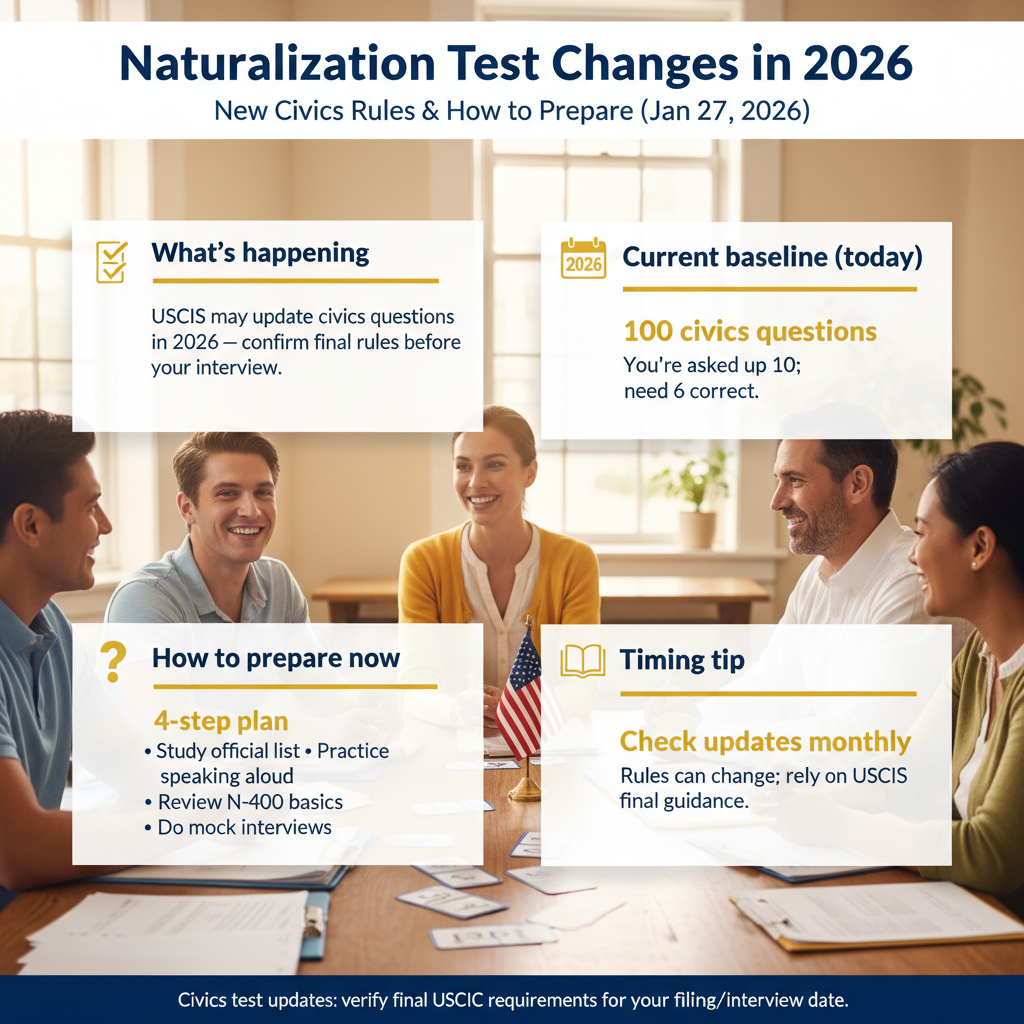
The reporting that sparked this guide is: Naturalization Test Changes Coming in 2026 (Citizenship).
Important: News coverage about “new civics test questions and requirements” often appears before USCIS publishes final details. This article explains what is currently required under federal law, what kinds of changes USCIS can make, and how to prepare so you’re ready if updates take effect in 2026.
Need Help? Our Orlando immigration team is ready to assist. Call +1 786-791-3106 for a free consultation, or message us online. Se Habla Español.
What This News Means for Immigrants in Orlando and Across Florida
Why this news is showing up now
Naturalization test updates tend to trend when USCIS signals a review of the civics curriculum, when policy priorities shift after elections, or when USCIS begins stakeholder outreach. Even when Congress does not change the law, USCIS can update the civics test content, the study materials, and certain administration procedures through policy guidance and operational changes.
Reminder: The naturalization “test” is actually two tests administered at the interview: (1) the English test (reading, writing, speaking) and (2) the civics test (U.S. history and government). The civics portion is the part most commonly updated.
How it can affect Florida residents
For Florida residents—especially in Central Florida—naturalization interview scheduling, preparation, and retesting can be impacted by changes to study materials or question banks. If your case is in Orlando, your interview will typically be handled through the local USCIS network serving the area, often involving The Orlando USCIS Field Office (depending on your ZIP code and USCIS jurisdiction at the time of filing).
For Central Florida residents along the I-4 corridor (Orlando, Kissimmee, Sanford, Lakeland, and surrounding areas), even small changes—like a revised list of civics questions, different pass/fail rules, or updated officer training—can affect:
- How you study and what you prioritize
- Whether you should file now or wait (depending on eligibility and readiness)
- How you handle a re-exam if you don’t pass on the first attempt
- How long your case might take if additional steps are required
Warning: Do not rely on social media summaries of “new test rules.” The only reliable source for final requirements is USCIS. Start with the USCIS official website and official USCIS study materials.
What Naturalization Test Changes Coming in 2026 Is (and Why It Matters)
A plain-English definition
“Naturalization test changes coming in 2026” refers to potential updates to the civics test question set, the way questions are asked, and/or the requirements for passing the English and civics portions of the naturalization interview. These updates would affect people applying for U.S. citizenship using Form N-400 (Application for Naturalization).
Even if the underlying law stays the same, USCIS can revise the civics test content. Historically, USCIS has used different versions of the civics test (for example, a 2008 version and a later revised version that was introduced and then halted). That history matters because it shows that:
- USCIS can announce a new test version with an effective date
- There may be transition rules based on when you file your Form N-400
- Applicants may be tested under different question sets depending on timing
Key terms you need to know
- Naturalization: The legal process to become a U.S. citizen after being a lawful permanent resident (green card holder) or qualifying through military service.
- Form N-400: The USCIS application used to request naturalization.
- Civics test: The U.S. history and government portion of the naturalization interview.
- English test: Reading, writing, and speaking evaluation during the interview.
- Oath ceremony: The final step where you take the Oath of Allegiance and become a U.S. citizen.
- Re-examination: If you fail the English and/or civics test, USCIS usually schedules a second chance within a set time frame.
- Good moral character: A legal requirement evaluated over the statutory period (typically 5 years, or 3 years for certain spouses of U.S. citizens).
- 90-day window: Many applicants can file up to 90-day window before meeting the continuous residence requirement (if otherwise eligible).
While this article focuses on naturalization, many readers ask how citizenship interacts with family petitions and green card processes like Adjustment of Status using Form I-485, or family sponsorship using Form I-130. Becoming a U.S. citizen can significantly improve family immigration options, including shortening wait times and changing a family member’s Priority Date category.
Need Help? Our Orlando immigration team is ready to assist. Call +1 786-791-3106 for a free consultation, or message us online. Se Habla Español.
Current Immigration Law: The Foundation
Naturalization is governed primarily by the Immigration and Nationality Act (INA) and implementing regulations. While USCIS can update the civics test content, the core eligibility requirements come from federal law.
Federal requirements
Key legal authorities include:
- INA § 316 (general naturalization requirements) and INA § 319 (certain spouses of U.S. citizens)
- 8 C.F.R. Part 316 (naturalization regulations) and related provisions
In practical terms, most applicants must show:
- Lawful permanent residence (green card)
- Continuous residence and physical presence
- Ability to read, write, and speak basic English (unless exempt)
- Knowledge and understanding of U.S. history and government (civics) (unless exempt)
- Good moral character during the statutory period
- Attachment to the U.S. Constitution and favorable disposition toward the U.S.
USCIS guidance and official resources are published at the USCIS official website. For forms and instructions, use USCIS Forms. For time estimates, see USCIS Processing Times.
Important: Naturalization is not the same as getting a green card. Many applicants first obtain permanent residence through family sponsorship (Form I-130) and then apply for a green card via Adjustment of Status with Form I-485 (if eligible), or through consular processing with the U.S. Department of State. Those pathways can affect when you become eligible to file Form N-400.
Florida-specific considerations
Naturalization is federal, so Florida does not create separate citizenship rules. However, Florida-specific realities can affect your case:
- Address history and travel: Many Florida residents travel frequently (including cruises and international travel). Trips abroad can affect continuous residence and physical presence.
- Driving and records: Florida traffic issues, arrests, or court cases in Orange County or surrounding counties can impact good moral character analysis.
- Interview logistics: If your case is in Orlando, plan for the local field office process, including biometrics (if required) and interview scheduling. Bring originals and be ready for security screening.
If you are in removal proceedings, naturalization can be more complex. The immigration court system is under the Executive Office for Immigration Review (EOIR), and you should get legal advice before filing.
How to Prepare for the 2026 Naturalization Test Updates: A Complete Step-by-Step Guide
The most effective strategy is to prepare for citizenship using today’s rules while staying flexible for updates. Below is a practical step-by-step plan designed for applicants in Orlando, Orange County, and across Florida.
1) Confirm you are eligible (and choose the right filing timeline)
Before you worry about civics questions, confirm you qualify to apply. Eligibility is often the biggest reason cases are delayed or denied.
- Continuous residence: Usually 5 years as a permanent resident (or 3 years if married to and living with a U.S. citizen spouse, with additional requirements).
- Physical presence: Usually at least 30 months out of the last 5 years (or 18 months out of the last 3 years).
- 90-day window: Many applicants can file up to 90-day window before meeting the continuous residence requirement.
Documents to gather for this step:
- Green card (front and back copy)
- Passports (current and expired) and travel history
- Marriage certificate/divorce decrees (if applicable)
- Selective Service registration proof (if applicable)
- Tax transcripts (recommended)
- Court dispositions for any arrests/citations (if applicable)
2) Identify any “risk factors” that could complicate naturalization
Naturalization is discretionary in parts, and USCIS reviews your entire immigration and criminal history. If you have issues, get legal advice early—before filing.
Common risk areas include:
- Arrests, charges, or convictions (including expunged cases)
- Unpaid child support or inconsistent tax filings
- Extended trips abroad or frequent travel that may break continuous residence
- Prior immigration violations or misrepresentations
Warning: Filing Form N-400 can bring USCIS attention to past issues. In some cases, it can trigger requests for evidence, delays, or referrals. Get a case review if anything is unclear.
Documents to gather for this step:
- Certified court records (arrest reports and final dispositions)
- Probation completion documents (if any)
- IRS tax transcripts and proof of payment plans (if needed)
- Evidence of ties to the U.S. (leases, mortgages, employment history)
3) Study for the civics and English tests using official USCIS materials
Until USCIS publishes a final 2026 test, the safest approach is to use current official study tools and build a study routine that can adapt.
Best practice study plan:
- Start with the USCIS civics question list and flashcards (official versions)
- Practice speaking answers out loud (interview conditions matter)
- Practice reading and writing sentences daily
- Track weak topics (branches of government, amendments, rights/responsibilities)
Reminder: Some applicants may qualify for English exemptions based on age and years as a permanent resident, but still must take the civics test (possibly in their preferred language with an interpreter) unless they qualify for a medical disability exception.
Documents to gather for this step:
- USCIS study materials printouts
- Personal vocabulary list (address, job title, dates, travel)
- If requesting a disability exception: medical documentation for Form N-648 (prepared by a qualified medical professional)
4) Prepare and file Form N-400 correctly (and track your case)
Filing the application accurately is critical. Mistakes can cause delays, additional evidence requests, or interview problems.
Documents to gather for this step:
- Completed Form N-400 (and any required supplements)
- Copy of green card (front/back)
- Marriage certificate and spouse’s proof of citizenship (if filing under 3-year rule)
- Evidence of marital union (if applicable): joint lease/mortgage, bank statements, insurance
- Fee payment confirmation or fee waiver request (if eligible)
- Two passport-style photos (only if required under your filing method/instructions)
You can check filing addresses and instructions on USCIS Forms and monitor timelines on USCIS Processing Times.
Need Help? Our Orlando immigration team is ready to assist. Call +1 786-791-3106 for a free consultation, or message us online. Se Habla Español.
5) Attend biometrics (if scheduled) and get interview-ready with a “citizenship binder”
USCIS may reuse biometrics from prior filings, but some applicants are scheduled for a biometrics appointment. After that, focus on interview preparation—especially if the civics test is changing and officers may emphasize updated content.
Documents to gather for this step:
- USCIS appointment notices (biometrics and interview)
- State ID/driver’s license
- All passports (current and expired)
- Original green card
- Certified court dispositions (if any)
- Tax transcripts (recommended)
- Proof of address and employment
If your case is in Orlando, plan your route, parking, and arrival time. Security screening can add time, and rescheduling can delay your case significantly.
6) Take the interview and tests, then complete any re-exam or follow-up quickly
At the interview, the officer reviews your Form N-400, tests your English (unless exempt), and administers the civics test. If you do not pass one portion, USCIS typically offers a second opportunity (a re-exam) within a set period.
Important: Many applicants are approved the same day, but some receive a decision later or get a Request for Evidence (RFE). Responding quickly and accurately matters.
Documents to gather for this step:
- Interview notice
- Originals of all civil documents submitted
- Updated travel log since filing
- Any new arrests/citations documentation (if applicable)
- Evidence of ongoing marital union (if filing under 3-year rule)
7) Attend the oath ceremony and update your records
After approval, you will be scheduled for an oath ceremony—sometimes the same day, sometimes later. Once you take the oath, you become a U.S. citizen and can apply for a U.S. passport through the U.S. Department of State.
Documents to gather for this step:
- Oath ceremony notice
- Permanent resident card (you surrender it at the oath)
- Any USCIS documents requested on the notice
- Plan to update Social Security and Florida DHSMV records after naturalization
Practical Steps You Can Take Today
Whether the civics test changes in 2026 or not, smart preparation reduces stress and improves outcomes.
- Checklist item #1: Pull your full travel history for the last 5 years (dates out and back). Trips matter for continuous residence and physical presence.
- Checklist item #2: Request IRS tax transcripts for the statutory period and confirm you filed correctly (especially if you claimed “single” while married).
- Checklist item #3: Start daily civics practice now (10–15 minutes/day). Use official materials and practice speaking answers aloud.
- Checklist item #4: Build a “citizenship binder” with originals + copies: IDs, passports, green card, marriage/divorce documents, court records.
- Checklist item #5: If you have any arrests—even if dismissed—get certified dispositions from the courthouse (e.g., Orange County Clerk of Courts).
- Checklist item #6: If you may need an English exemption or disability exception, talk to an attorney early and gather medical documentation for Form N-648.
Timeline expectations: Naturalization timelines vary by workload, background checks, and local scheduling. In Florida, some applicants complete the process in months; others take longer. Always check current estimates at USCIS Processing Times.
Reminder: If you plan to travel soon, consider how travel could affect interview scheduling and continuous residence. If you move, update your address promptly.
If you are also working on family immigration—for example, sponsoring a spouse through Form I-130 and Adjustment of Status with Form I-485—citizenship can change visa category availability and may protect certain family unity goals under Imigrar’s “Keep Families Together” approach.
How Imigrar Helps Immigrants in Orlando
Imigrar is an immigration law firm based in Orlando, Florida, serving clients nationwide. We help clients prepare strong naturalization applications, avoid pitfalls, and feel confident at the interview—especially when policy updates create uncertainty.
Our team can assist with:
- Eligibility screening and strategy (including the 90-day window)
- Reviewing travel, taxes, and good moral character issues
- Preparing Form N-400 and organizing supporting evidence
- Interview preparation, including civics and English readiness
- Complex cases involving prior immigration history or court matters
Se Habla Español. We understand the stakes—citizenship is not just a test; it’s stability, voting rights, and stronger options to petition family members.
Need Help? Our Orlando immigration team is ready to assist. Call +1 786-791-3106 for a free consultation, or message us online. Se Habla Español.
Frequently Asked Questions
Q: Will the naturalization civics test definitely change in 2026?
A: Not necessarily. News reports may reflect proposed updates, stakeholder discussions, or early planning. USCIS makes changes official by publishing guidance and updated study materials. The safest approach is to prepare under current rules while monitoring announcements on the USCIS official website.
Q: If I file Form N-400 now, which civics test will I take?
A: Historically, USCIS has used “transition rules” based on the filing date or interview date. If USCIS announces a new test version for 2026, it may specify that applicants who filed before a certain date use the older test, while later filers use the new one. Until USCIS publishes those rules, plan to study current materials and be ready to adjust.
Q: Can naturalization test changes affect my immigration status or green card?
A: A civics test change by itself does not change your underlying lawful permanent resident status. However, filing Form N-400 triggers a review of your record. If USCIS finds issues (for example, abandonment of residence or certain criminal problems), it can deny the application and—in rare cases—refer matters for further action. If you have concerns, get legal advice before filing.
Q: How long does the naturalization process take in Florida?
A: Timelines vary. Many cases move from filing to interview and oath within several months to over a year depending on USCIS workload and background checks. For the most current estimates, check USCIS Processing Times and select the field office or service center listed for Form N-400. If your case is in Orlando, local scheduling at The Orlando USCIS Field Office can affect timing.
Q: What documents should I bring to the naturalization interview?
A: Bring your interview notice, your original green card, all passports (current and expired), state ID, and originals of documents submitted with the application (marriage certificate, divorce decrees, name change orders). If you had any arrests or citations, bring certified court dispositions. It’s also wise to bring updated evidence of marital union if filing under the 3-year rule.
Q: How much does it cost to apply for U.S. citizenship?
A: USCIS filing fees can change, so confirm the current fee on USCIS Forms by selecting Form N-400. Some applicants may qualify for a fee waiver or reduced fee depending on income and circumstances. We can help you evaluate whether a fee waiver is appropriate and how to document it.
Q: What happens if my naturalization application is denied?
A: You may be able to request a hearing on the denial by filing Form N-336 within the required deadline stated on the denial notice. In some situations, it may be better to refile later after fixing the issue (for example, if you applied too early or lacked documents). If there are serious concerns—like alleged misrepresentation or criminal issues—get legal advice immediately before taking the next step.
Q: I’m applying through marriage—does a civics test change affect me differently?
A: The civics test is generally the same regardless of whether you apply under the 5-year rule or the 3-year marriage-based rule. The bigger difference is eligibility documentation (proof of spouse’s citizenship and proof you lived in marital union). A test update would mainly affect what you study and how the interview is administered.
Common Mistakes (and How to Avoid Them)
Mistake #1: Waiting to study until the interview is scheduled
If USCIS updates the civics test for 2026, late studying becomes even riskier because you may need to pivot quickly to new materials. Start now with consistent practice, and you’ll be prepared regardless of the final question set.
Mistake #2: Filing Form N-400 with missing travel details or incorrect dates
Travel history mistakes are a top cause of delays and credibility concerns. Keep a travel log, cross-check passport stamps, and pull any available entry/exit records. If you’ve taken many trips from Florida (including cruises), be extra careful.
Mistake #3: Not disclosing arrests or failing to obtain certified dispositions
USCIS expects full disclosure. Even sealed or expunged cases may need to be disclosed, and you should bring certified records. If you had a case in Orange County or elsewhere along the I-4 corridor, request documents early—courthouse processing can take time.
Warning: Avoid relying on unofficial “leaked” question lists. Use USCIS-issued materials and attorney-reviewed guidance.
Closing: Get Ready Now for 2026 Naturalization Test Updates
The best way to handle possible naturalization test changes in 2026 is to focus on what you can control: eligibility, accurate filing, and strong preparation using official resources. If USCIS announces new civics questions or requirements, we’ll help you adjust without losing momentum.
For applicants in Orlando, Orange County, and across Central Florida, planning ahead can mean the difference between a smooth approval and months of delay—especially if a re-exam is needed within USCIS’s retesting timeframe (often within 180 days depending on the notice and scheduling).
Need Help? Our Orlando immigration team is ready to assist. Call +1 786-791-3106 for a free consultation, or message us online. Se Habla Español.
Need help with citizenship? Contact Imigrar in Orlando today at +1 786-791-3106 or message us online. Se Habla Español. We’re here to Keep Families Together.


