


The reporting that sparked this guide
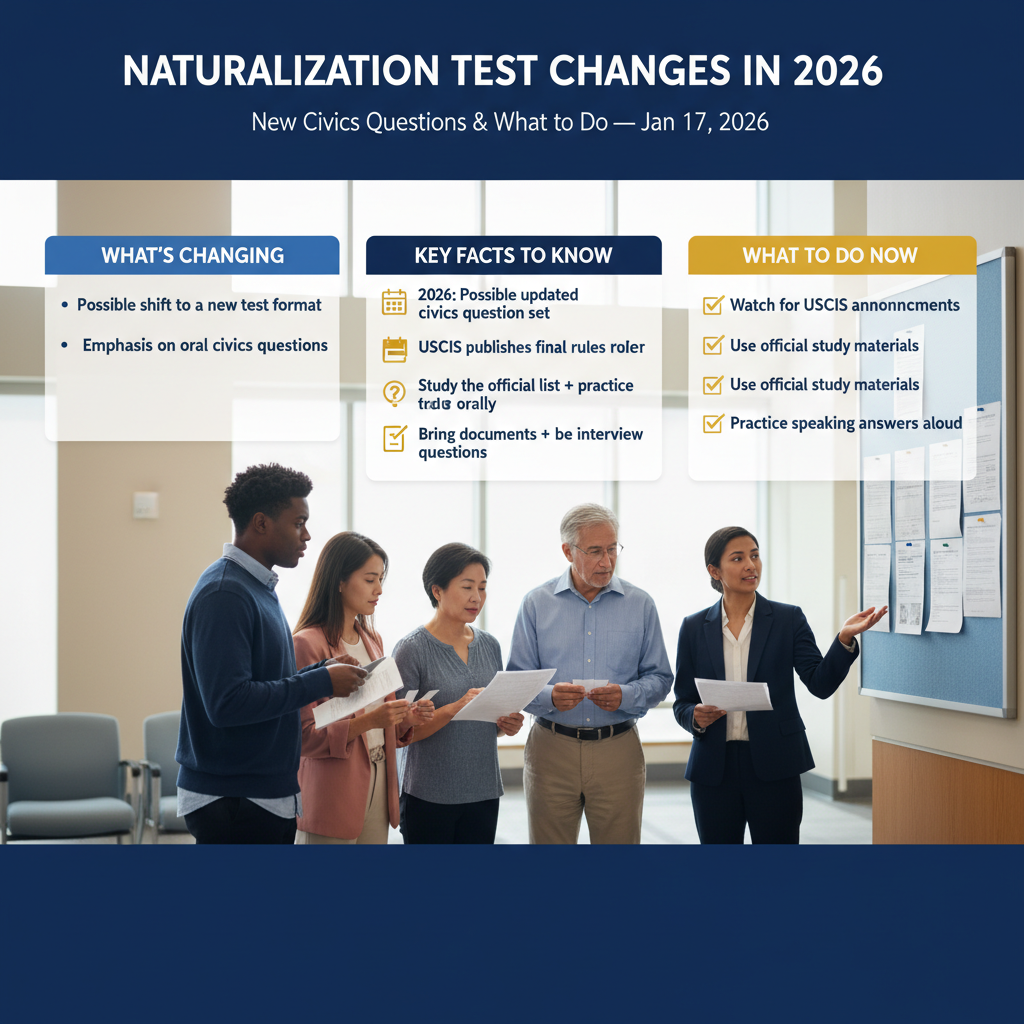
The reporting that sparked this guide comes from: Naturalization Test Changes Coming in 2026 (Citizenship)
Important: News coverage often appears before USCIS publishes final rules. This article explains what “naturalization test changes” typically mean, how USCIS implements them, and how to prepare safely even while details are still developing.
Need Help? Our Orlando immigration team is ready to assist. Call +1 786-791-3106 for a free consultation, or message us online. Se Habla Español.
What This News Means for Immigrants in Orlando and Across Florida
Why this news is showing up now
Naturalization policy is one of the most visible areas of U.S. immigration because it affects millions of lawful permanent residents (green card holders) who are eligible to become U.S. citizens. When you see headlines about “new civics test questions” or “naturalization test changes,” it usually means USCIS is considering updates to:
- The civics question bank (the list of possible questions)
- How questions are asked or scored during the interview
- Study materials and official guidance
- Implementation dates and “grandfathering” rules (who takes which version)
These changes often follow broader shifts in federal priorities, public feedback, and internal USCIS efforts to standardize interviews nationwide. It is also common for preliminary information to circulate while USCIS finalizes details.
Reminder: The only “official” version of the civics test is the one USCIS publishes and applies based on your Form N-400 filing date and interview date. Always verify updates on the USCIS official website.
How it can affect Florida residents
For Florida residents—especially in Central Florida along the I-4 corridor—naturalization demand can surge when major changes are announced. That can impact:
- Timeline expectations due to increased filing volume
- Interview preparation (different study sets depending on when you file)
- Retest planning if you do not pass English/civics on the first attempt
- Travel planning because extended trips can affect continuous residence
If your case is in Orlando, the specific scheduling and interview experience may be shaped by local capacity and appointment availability at the Orlando USCIS Field Office. While USCIS aims for consistent national standards, local backlogs can affect how quickly interviews are scheduled.
What Naturalization Test Changes Coming in 2026 Is (and Why It Matters)
A plain-English definition
“Naturalization test changes” refers to updates USCIS may make to the tests administered during the naturalization interview for U.S. citizenship. Most applicants must demonstrate:
- English ability (speaking, reading, writing), unless exempt, and
- U.S. civics knowledge (U.S. history and government), unless exempt.
The civics portion is typically administered orally during the interview. The officer selects questions from a published list, and the applicant must answer a required number correctly to pass.
Why it matters: even small changes can affect how you study, what you bring to the interview, and whether you should file now or later. For some families, naturalization is also a key step toward petitioning relatives, protecting immigration options for children, and strengthening long-term stability—aligned with Imigrar’s mission to Keep Families Together.
Key terms you need to know
- Form N-400: Application for Naturalization (the main citizenship application).
- Naturalization interview: The in-person appointment where USCIS reviews your application and tests English/civics.
- Civics question bank: The published list of possible civics questions USCIS can ask.
- English exemption: Certain applicants may qualify for modified requirements based on age and years as a permanent resident.
- Medical disability exception: Some applicants may request an exception to English/civics due to a qualifying condition (typically using Form N-648).
- Continuous residence and physical presence: Rules about how long you must live in the U.S. and how much time you can spend abroad.
- Good moral character: A legal standard USCIS evaluates, including certain criminal issues, taxes, child support, and honesty in filings.
- 90-day window: Many applicants may file up to 90 days before completing the required permanent residence period (commonly 5 years, or 3 years if married to and living with a U.S. citizen).
Warning: The naturalization test is only one part of eligibility. A perfect civics score does not overcome issues like abandonment of residence, certain criminal convictions, or misrepresentation.
Need Help? Our Orlando immigration team is ready to assist. Call +1 786-791-3106 for a free consultation, or message us online. Se Habla Español.
Current Immigration Law: The Foundation
Naturalization is governed primarily by the Immigration and Nationality Act (INA) and related federal regulations. The core legal framework includes:
- INA § 316 (general naturalization requirements, commonly the “5-year rule”)
- INA § 319(a) (naturalization for spouses of U.S. citizens, commonly the “3-year rule”)
- INA § 312 (English and civics requirements and exemptions)
- 8 C.F.R. Part 316 and Part 312 (regulatory details on eligibility and testing)
Federal requirements
While each case is unique, most applicants for naturalization must show:
- They are at least 18 years old at filing.
- They are a lawful permanent resident (green card holder).
- They meet continuous residence and physical presence rules (commonly 5 years/30 months, or 3 years/18 months for certain spouses of U.S. citizens).
- They have lived for at least 3 months in the state or USCIS district where they file.
- They demonstrate good moral character during the statutory period (and sometimes beyond).
- They can read, write, and speak basic English (unless exempt).
- They pass the civics test (unless exempt).
- They support the U.S. Constitution and take the Oath of Allegiance.
USCIS administers the process through Form N-400 and supporting evidence. Official instructions, updates, and study materials are maintained on the USCIS official website and the USCIS Forms page.
Florida-specific considerations
Florida does not set separate naturalization rules (citizenship is federal), but Florida residents should consider practical, local factors:
- Address history: Moves within Orange County or across the I-4 corridor (e.g., Orlando to Tampa) can affect where your interview is scheduled.
- Name changes: If you want a legal name change, some oath ceremonies may be judicial, which can affect timing.
- Travel patterns: Florida residents often travel internationally; long trips can disrupt continuous residence.
- Local processing realities: The Orlando USCIS Field Office appointment availability can influence timelines.
To plan realistically, check USCIS Processing Times and compare them to your travel and life plans.
Note on other forms: Many people reach naturalization after family-based immigration steps like Form I-130 (family petition) and Form I-485 (Adjustment of Status), where concepts like a Priority Date can matter. Those are usually earlier stages than Form N-400, but they often shape your eligibility timeline.
For related federal agencies and context, see: U.S. Department of State (visas and consular processing) and Executive Office for Immigration Review (immigration court).
How to Prepare for Naturalization Test Changes: A Complete Step-by-Step Guide
1) Confirm which test version applies to you (based on filing date)
USCIS typically ties test versions to the date you file Form N-400 (and sometimes the interview date). When changes occur, USCIS may publish transition rules explaining who takes the “old” versus “new” test.
Important: Do not rely on social media summaries. Verify directly through the USCIS official website and official announcements.
Documents to gather for this step:
- Copy of your green card (front/back)
- Your filing eligibility date calculation (5-year or 3-year rule; include the 90-day window if applicable)
- Any prior USCIS notices (if you previously filed and withdrew/denied)
2) Check eligibility beyond the test (residence, travel, and good moral character)
Test changes won’t matter if USCIS believes you are not eligible. Before you file, do a careful self-audit of the most common problem areas:
- Trips abroad (especially 6+ months, or 1 year+)
- Unfiled taxes, incorrect filing status, or tax debts
- Arrests/citations (even if charges were dropped)
- Selective Service registration (for many males who lived in the U.S. ages 18–25)
- Child support orders and payment history
Documents to gather for this step:
- Passport(s) and travel history (entry/exit dates)
- IRS tax transcripts (recommended over copies)
- Certified court dispositions for any arrest/citation
- Selective Service proof (if applicable)
- Proof of child support compliance (if applicable)
3) Build a study plan that works even if questions change
If USCIS updates the question bank in 2026, the safest preparation strategy is to study in a way that survives changes:
- Use official USCIS study tools and the latest published question set.
- Learn concepts, not just memorized lines (e.g., what the Constitution does, how Congress works).
- Practice speaking answers out loud—interviews are oral and can feel stressful.
- Practice English reading/writing with USCIS-style vocabulary (civics terms, dates, basic sentences).
For Central Florida residents balancing work and family, a realistic plan is 20–30 minutes per day for 6–10 weeks, plus a weekly mock interview session.
Documents/materials to gather for this step:
- Latest USCIS civics question list (download from USCIS)
- USCIS flashcards or audio study tools
- A notebook of “weak topics” and corrected answers
- Any medical records if you may qualify for a disability exception (Form N-648)
4) Prepare your Form N-400 package carefully (accuracy beats speed)
A well-prepared Form N-400 reduces the risk of delays, Requests for Evidence (RFEs), and credibility concerns. USCIS will compare your N-400 answers to prior filings—sometimes going back to your Form I-130, Form I-485 (Adjustment of Status), or consular paperwork through the U.S. Department of State.
Warning: If USCIS believes you misrepresented facts in any immigration filing, that can become a much bigger issue than the civics test.
Documents to gather for this step:
- Green card copy
- Marriage certificate/divorce decrees (if applicable)
- Proof of spouse’s U.S. citizenship (if applying under the 3-year rule)
- Proof of current address and address history
- Employment history and travel history
- Certified dispositions for any criminal matters
- Two passport-style photos only if USCIS specifically requires for your situation (most applicants do not submit photos for online filing)
5) Attend biometrics and track your case like a project
After filing, USCIS typically schedules biometrics (fingerprints/photo) unless reused. Then you wait for the interview. During periods of major news—like anticipated 2026 test changes—filing volume can increase and timelines can shift.
Use USCIS Processing Times to set expectations, and keep your address updated.
Documents to gather for this step:
- Biometrics appointment notice
- Government-issued photo ID (driver’s license/state ID)
- Your passport and green card
- USCIS receipt notices and online account access info
6) Prepare for the interview and civics/English testing (including retest planning)
At the interview, the officer reviews your Form N-400, confirms key eligibility facts, and administers the English and civics tests unless you qualify for an exemption. If you do not pass one portion, USCIS generally provides a second opportunity (a retest) within a later appointment.
If your case is in Orlando, plan logistics early: parking, arrival time, childcare, and time off work. Arriving calm and organized helps performance.
Documents to gather for this step:
- Interview appointment notice
- Green card and passport(s)
- State ID/driver’s license
- Originals of civil documents submitted (marriage/divorce, name change, etc.)
- Updated evidence since filing (new trips, job changes, marital changes)
- Tax transcripts (especially for the statutory period)
7) Oath ceremony and after-citizenship planning
If approved, you will attend an oath ceremony and receive a Certificate of Naturalization. After that, you should:
- Apply for a U.S. passport through the U.S. Department of State
- Update your Social Security record
- Update voter registration (optional but common)
- Review family immigration options (for example, petitioning certain relatives)
Reminder: Becoming a citizen can change family-based options and timelines—especially where a Priority Date matters for certain categories.
Documents to gather for this step:
- Oath ceremony notice
- Permanent Resident Card (you typically surrender it at oath)
- Certificate of Naturalization (keep it safe; consider a secure storage plan)
- U.S. passport application materials (after oath)
Need Help? Our Orlando immigration team is ready to assist. Call +1 786-791-3106 for a free consultation, or message us online. Se Habla Español.
Practical Steps You Can Take Today
Even before USCIS finalizes any 2026 civics test updates, you can take smart steps that reduce risk and improve outcomes.
Actionable checklist
- Download the latest civics study materials from the USCIS official website and study the current question bank.
- Calculate your earliest filing date using the 90-day window (if eligible) and set calendar reminders.
- Order IRS tax transcripts for the last 5 years (or 3 years if applying under the 3-year rule).
- Create a travel log (every trip, dates out and back). If you had a trip near or over 6 months, consult counsel before filing.
- Request certified court dispositions for any arrest/citation—do not assume “dismissed” means “no paperwork needed.”
- Practice a mock interview weekly: identity questions, address history, yes/no moral character questions, then civics out loud.
Document preparation guidance
Build a single “citizenship folder” (digital and paper) with:
- Green card copy + all passports
- Marriage/divorce records
- Taxes (transcripts), W-2s/1099s if needed
- Selective Service proof (if applicable)
- Any immigration receipts/notices
Important: If you previously filed Form I-485 for Adjustment of Status or had a family petition like Form I-130, keep copies. USCIS can compare answers across filings.
Timeline expectations (typical, but varies)
Naturalization timelines vary by location and workload. Many cases move through:
- Filing to biometrics: often weeks to a few months
- Biometrics to interview: often several months
- Interview to oath: sometimes same day, sometimes weeks/months depending on ceremony availability
For Central Florida residents, timelines can fluctuate based on capacity at the Orlando field office and national application surges. Always verify current estimates on USCIS Processing Times.
Reminder: If you plan international travel, consider how long trips can affect continuous residence. A trip of 180 days or more can trigger extra scrutiny and may disrupt eligibility depending on circumstances.
How Imigrar Helps Immigrants in Orlando
Imigrar is an immigration law firm based in Orlando, Florida, serving clients nationwide. We help lawful permanent residents and their families prepare strong naturalization applications and interview strategies—especially when policy news creates uncertainty.
- Eligibility review focused on travel, taxes, and good moral character
- Careful preparation of Form N-400 and supporting evidence
- Interview preparation, including civics/English practice and mock interviews
- Guidance on exemptions and accommodations when appropriate (including disability-related requests)
- Support for complex histories (prior immigration issues, arrests, long trips, or prior denials)
Se Habla Español. Our team can explain the process clearly in English or Spanish and help you plan around work schedules, family needs, and travel.
We offer a free consultation. Call +1 786-791-3106 or message us online to get a personalized plan.
Frequently Asked Questions
Q: Will the 2026 civics test changes affect my eligibility to apply for citizenship?
A: Usually, test changes affect how you are tested, not whether you are eligible. Eligibility still depends on the INA requirements: lawful permanent residence, continuous residence, physical presence, good moral character, and other rules. If you are eligible now, a future test update typically does not remove eligibility—but it may change what you must study and when you should file.
Q: If I file Form N-400 now, could USCIS make me take the new 2026 test later?
A: USCIS generally announces transition rules when it changes the test. Often, the applicable test is tied to the filing date of Form N-400, but USCIS can set different rules depending on the rollout. The safest approach is to (1) confirm official guidance on USCIS official website, and (2) study in a way that prepares you for both concepts and updated questions.
Q: Does applying for naturalization affect my current immigration status?
A: Filing Form N-400 does not take away your lawful permanent resident status by itself. However, the naturalization process can expose issues (for example, prolonged trips abroad, criminal history, or past misrepresentation). In some cases, USCIS can refer matters for further review. If you have any red flags, consult an attorney before filing.
Q: How long will my naturalization case take in Orlando?
A: Timelines vary. For Central Florida residents, the Orlando USCIS Field Office workload can affect scheduling. Check USCIS Processing Times for the most current estimates for Form N-400. Also plan for possible delays if there is a filing surge due to 2026 test-change news.
Q: What documents do I need for the naturalization interview?
A: Bring your interview notice, green card, passports, state ID, and originals of key civil documents (marriage/divorce/name change). If you had arrests, bring certified dispositions. Many applicants also bring IRS tax transcripts and evidence of any changes since filing (new trips, job changes, or address changes). If you are unsure, an attorney can provide a customized interview checklist.
Q: How much does it cost to apply for citizenship?
A: USCIS fees can change, so confirm current filing fees on the USCIS Forms page for Form N-400. Some applicants may qualify for a fee reduction or waiver depending on income and circumstances. Legal fees vary by complexity—cases involving arrests, long travel, or prior denials often require more work.
Q: What happens if I fail the civics or English test?
A: If you fail the English or civics portion, USCIS generally schedules a second chance (retest) for the part you failed. Use the time between appointments to focus on weak areas and practice out loud. If you fail again, USCIS can deny the application, but you may have options such as refiling later or requesting a hearing (depending on the reason for denial).
Q: What happens if my naturalization application is denied?
A: Denials happen for different reasons: failure to meet eligibility, inability to pass tests after retest, missing documents, or concerns about good moral character. You may be able to request a hearing on the decision (using the appropriate USCIS process) or reapply when eligible. If denial is based on serious issues, get legal advice immediately because it can affect your status and future filings.
Common Mistakes (and How to Avoid Them)
Mistake #1: Waiting too long because of “test change” rumors
Many applicants delay filing because they fear a harder test is coming. But if you are eligible now, waiting can create new problems—more travel, job changes, tax complications, or life events that make the case harder.
How to avoid it: confirm your eligibility date and consider filing strategically within the 90-day window if allowed. Verify updates only through USCIS announcements.
Mistake #2: Underestimating travel and continuous residence issues
Applicants often focus on civics study and forget that USCIS evaluates residence. Trips of 180 days or more can raise questions, and trips of 1 year or more can break continuous residence in many cases.
How to avoid it: create a complete travel log and talk to counsel before filing if you have long trips, frequent travel, or complicated residence history.
Mistake #3: Incomplete disclosures (especially arrests and prior immigration filings)
USCIS expects full disclosure. “It was expunged” or “it was dismissed” does not automatically mean it can be omitted. Inconsistencies between your Form N-400 and older filings (like Form I-485 or Form I-130) can create credibility concerns.
How to avoid it: obtain certified dispositions, keep copies of prior filings, and answer questions consistently and truthfully. If you are unsure, get legal guidance before submitting.
Closing: Get a Personalized Naturalization Plan for 2026
Naturalization test changes can feel stressful—especially when headlines move faster than official policy. The good news is that most applicants can prepare effectively by confirming eligibility, using official USCIS study materials, and filing a carefully documented Form N-400.
If your case is in Orlando or anywhere in Florida, Imigrar can help you build a strategy that fits your timeline and reduces risk—whether you file before or after any 2026 civics updates.
Need Help? Our Orlando immigration team is ready to assist. Call +1 786-791-3106 for a free consultation, or message us online. Se Habla Español.


