


The reporting that sparked this guide
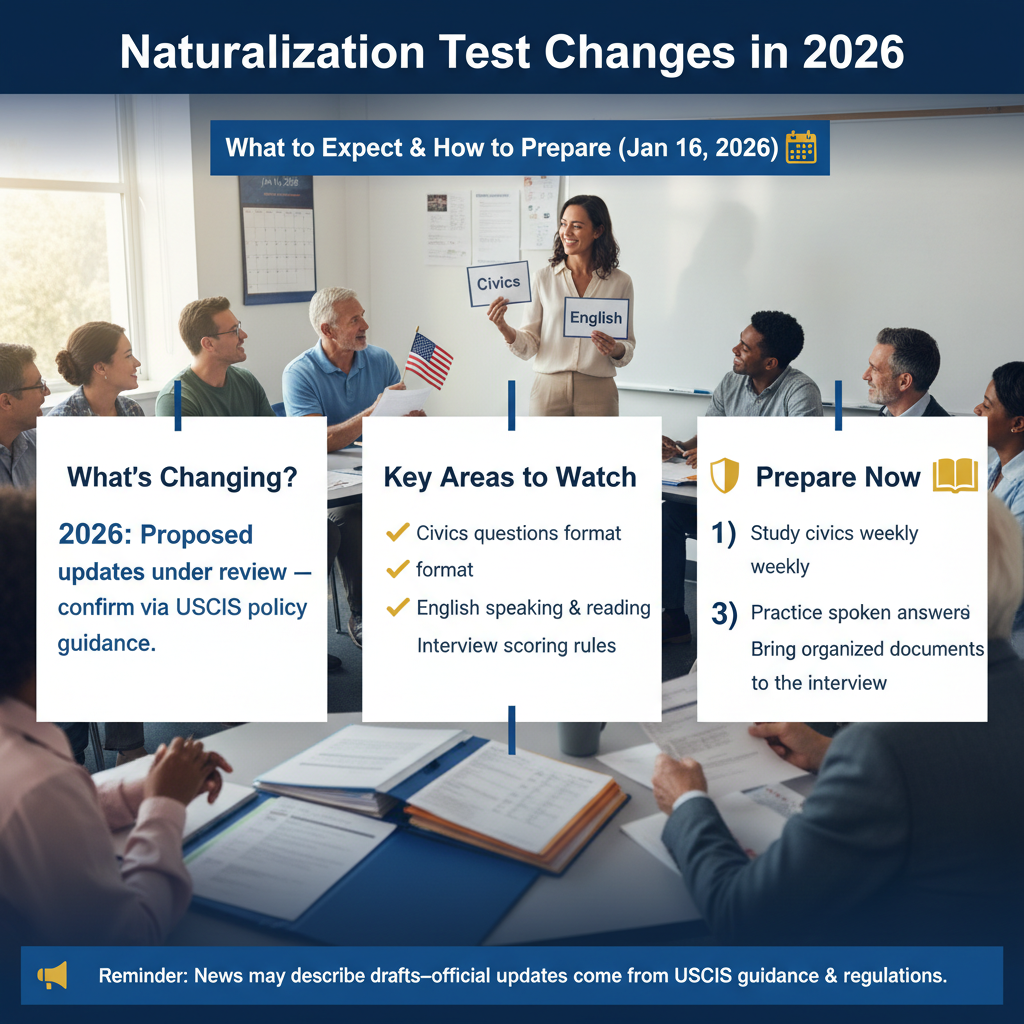
The reporting that sparked this guide: Naturalization Test Changes Coming in 2026 (Citizenship)
Reminder: News coverage often describes proposals, drafts, or agency planning before final rules are published. The official source for any naturalization test change is USCIS policy guidance and the regulations that implement the Immigration and Nationality Act (INA). We link to official references throughout this guide so you can verify what is final versus what is still developing.
Need Help? Our Orlando immigration team is ready to assist. Call +1 786-791-3106 for a free consultation, or message us online. Se Habla Español.
What This News Means for Immigrants in Orlando and Across Florida
Why this news is showing up now
The U.S. naturalization process includes an English test and a civics test administered during the Form N-400 interview. When you hear “new civics test questions and requirements,” it usually means USCIS is considering updates to:
- The civics question bank (what topics are tested and how questions are phrased)
- The structure of the test (how many questions are asked, and how many must be answered correctly)
- How officers evaluate understanding (for example, clarity standards and acceptable answers)
- Study materials and preparation resources released by USCIS
These discussions often trend when USCIS leadership signals policy priorities, when a proposed rule is being drafted, or when stakeholder meetings reference upcoming updates. In the past, USCIS has revised the civics test and then changed course again—so it is critical to track what is officially implemented, not just rumored.
Important: As of today (2026-01-16), USCIS has not universally replaced the existing civics test for all applicants without publishing official instructions, transition dates, and who is “grandfathered” under prior versions. Any 2026 change would normally come with an implementation plan (effective date, applicability rules, and updated study tools).
How it can affect Florida residents
For Florida residents—especially in high-volume areas like Orlando, Orange County, and the I-4 corridor—naturalization timelines and interview scheduling can already be tight. If USCIS introduces new civics test content in 2026, the practical impact could include:
- Study strategy changes: Applicants may need to pivot to a revised question bank.
- Timing decisions: Some applicants may consider filing sooner to test under current materials (if USCIS allows).
- Retest preparation: If an applicant fails and must return for a second interview, the version of the test used could matter depending on USCIS transition rules.
- Orlando interview readiness: If your case is in Orlando, you may be scheduled at the Orlando USCIS Field Office, where officers follow national USCIS policy but local scheduling realities can affect how quickly you move from filing to interview.
For Central Florida residents, the key is to prepare for both possibilities: (1) the current civics/English testing framework, and (2) a potential updated framework if USCIS announces a new effective date.
What Naturalization Test Changes Coming in 2026 Is (and Why It Matters)
A plain-English definition
“Naturalization test changes” refers to updates USCIS may make to the citizenship testing portion of the naturalization interview—primarily the civics test (U.S. history and government) and sometimes the English test (reading, writing, speaking). These are the tests most applicants take at the Form N-400 interview.
Why it matters: passing the test is a core requirement for most applicants to become U.S. citizens. Even if you are fully eligible, a test failure can delay your case and require a second interview.
Key terms you need to know
- Naturalization: The legal process of becoming a U.S. citizen after holding lawful permanent resident status (a green card) for the required period.
- Form N-400: The application for naturalization filed with USCIS.
- Civics test: Questions about U.S. history and government asked orally during the interview.
- English test: Speaking ability is evaluated during the interview; reading and writing are tested using USCIS sentences.
- Exception / accommodation: Some applicants qualify for age-and-residency exceptions to English requirements or may request disability accommodations using Form N-648.
- Good Moral Character (GMC): A legal requirement that looks at your conduct during the statutory period (and sometimes beyond), including criminal issues, taxes, child support, and honesty in immigration filings.
- Continuous residence & physical presence: Requirements that you maintained residence in the U.S. and were physically present for a certain number of days.
- Warning: A civics test update does not change the underlying eligibility rules, but it can change how you should prepare and how you time your filing.
Current Immigration Law: The Foundation
Naturalization is governed primarily by the Immigration and Nationality Act (INA) and implementing regulations in Title 8 of the Code of Federal Regulations (8 C.F.R.). The civics and English testing requirements come from federal law and USCIS policy guidance.
Key legal authorities include:
- INA § 312 (English language and civics requirements)
- INA § 316 (general naturalization requirements)
- INA § 319 (naturalization through marriage to a U.S. citizen)
- 8 C.F.R. Part 312 (education requirements for naturalization)
- 8 C.F.R. Part 316 (naturalization procedures)
Federal requirements
Most applicants must show:
- Lawful permanent resident status (green card holder)
- Continuous residence and physical presence
- Ability to read, write, and speak basic English (unless exempt)
- Knowledge and understanding of U.S. history and government (civics) (unless exempt)
- Good Moral Character during the required period
- Attachment to the U.S. Constitution and willingness to take the Oath of Allegiance
Your filing typically uses Form N-400 and supporting evidence. You can confirm current instructions and updates at the USCIS official website and the USCIS Forms page.
Important: Some applicants may also be working through other immigration processes at the same time (for example, family petitions or green card applications). While this article focuses on naturalization, we often see clients who previously filed Form I-130 or Form I-485 through Adjustment of Status. Those filings can affect your record, travel history, and eligibility analysis.
If you are tracking case timing, check USCIS Processing Times for your field office and form type.
Florida-specific considerations
Naturalization is federal, so the test and eligibility standards are the same nationwide. However, Florida-specific realities can still impact your planning:
- Local interview scheduling: The Orlando USCIS Field Office may have different interview availability than Miami, Tampa, or Jacksonville. This can affect whether you are interviewed before or after a new test effective date.
- Travel patterns: Florida residents often travel internationally (especially to Latin America and the Caribbean). Trips can affect continuous residence and physical presence.
- Name changes: If you want a legal name change through the naturalization process, oath scheduling may differ depending on local court coordination.
- Documentation: Hurricanes and frequent moves along the I-4 corridor can lead to missing documents. Replacing records early helps avoid delays.
If you have a pending immigration court issue, the Executive Office for Immigration Review (EOIR) is the authority for removal proceedings—those cases can affect whether you should file for naturalization now or wait.
For applicants who need consular resources (for example, to obtain civil documents from abroad), the U.S. Department of State provides guidance and country-specific information.
Need Help? Our Orlando immigration team is ready to assist. Call +1 786-791-3106 for a free consultation, or message us online. Se Habla Español.
How to Prepare for Possible Naturalization Test Changes: A Complete Step-by-Step Guide
Below is a practical preparation roadmap we recommend for clients in Orlando and across Florida who are concerned about potential 2026 civics test updates. The goal is to help you stay eligible, avoid delays, and be ready for either the current test format or an updated version.
1) Confirm you are eligible before you “study harder”
Many denials and delays have nothing to do with civics knowledge—they stem from eligibility issues like travel, taxes, prior citations/arrests, selective service, or inconsistencies in prior filings (including older Form I-130 and Form I-485 records from Adjustment of Status).
Start by identifying your naturalization basis:
- 5-year rule (INA § 316)
- 3-year rule through marriage to a U.S. citizen (INA § 319)
- Military provisions (special rules)
Documents to gather for Step 1:
- Front/back copy of your green card
- Passports (current and expired) and travel history
- Marriage certificate/divorce decrees (if applying under the 3-year rule)
- Tax transcripts (IRS) for the last 5 years (or 3 years)
- Any arrest/citation records and certified dispositions (if applicable)
- Select Service registration proof (if required)
2) Track dates carefully: filing window, travel, and “statutory period”
USCIS allows many applicants to file up to 90-day window before meeting the continuous residence requirement (for example, filing at 4 years and 9 months for the 5-year rule). This is different from other deadlines you may have heard in immigration contexts, like 180 days for certain responses or eligibility triggers in other processes.
If USCIS announces a new civics test effective date in 2026, timing could matter. Filing earlier does not always guarantee you will be interviewed earlier, but it can help position your case under transition rules if USCIS “grandfathers” applicants who filed before a certain date.
Documents to gather for Step 2:
- List of all trips outside the U.S. with dates (entry/exit)
- Evidence of residence (leases, mortgage statements, utility bills)
- Employment history records (W-2s, pay stubs, employer letters)
- School records (if relevant to residence and address history)
3) Build a “two-track” civics study plan (current + potential update)
Because news reports can move faster than policy implementation, the safest approach is to master the civics fundamentals while staying ready to adjust if USCIS publishes a new question bank.
A two-track plan means:
- Track A: Study the current USCIS civics materials and practice oral answers
- Track B: Monitor USCIS announcements for any updated question bank or new scoring rules
Important: The civics test is oral. It’s not just memorization; you must be able to answer clearly under interview conditions.
Documents/materials to gather for Step 3:
- USCIS civics study materials (download from USCIS official website)
- Notebook with “weak topics” and corrected answers
- Audio practice recordings (your phone is fine)
- Flashcards (paper or app-based)
4) Prepare for the English portion (and evaluate exemptions)
Many applicants focus only on civics, but the English components matter too: speaking is assessed throughout the interview; reading and writing use USCIS prompts.
Some applicants qualify for exceptions based on age and length of permanent residence, or may request a medical disability exception using Form N-648. These are technical rules and must be handled carefully.
Warning: Submitting a weak or inconsistent Form N-648 can create delays or lead to a denial if USCIS finds the documentation insufficient. Always coordinate with a qualified professional.
Documents to gather for Step 4:
- Proof of age and LPR admission date (passport, green card, I-551 stamp)
- If using Form N-648: medical records supporting diagnosis and functional limitations
- Interpreter plan (if permitted/needed under the applicable exception)
- Practice reading/writing sentences (USCIS materials)
5) File the case correctly and prepare for the interview like a “record audit”
Filing Form N-400 is not only about eligibility—it’s also about consistency. USCIS compares your N-400 answers with your entire immigration history. If you previously applied through Adjustment of Status using Form I-485, or you were petitioned through Form I-130, your N-400 must align with those records. Inconsistencies can trigger requests for evidence, delays, or credibility concerns.
Documents to gather for Step 5:
- Copy of your full N-400 submission package
- All prior immigration filings you can obtain (I-130/I-485 receipts, approvals, prior addresses)
- Certified court dispositions for any incidents
- Tax transcripts and proof of payment plans if needed
- Marriage evidence (if applying under 3-year rule)
6) Plan for outcomes: pass, retest, or additional review
USCIS may:
- Approve and schedule the oath
- Continue the case for additional documents
- Schedule a retest if you do not pass English and/or civics
- Issue a denial (which may be reviewable)
If a new civics test is implemented in 2026, one of the biggest practical questions is whether a retest uses the same version you started with or the new version. Historically, USCIS implementation rules determine that—so if you are close to filing, it may be wise to consult counsel about strategy.
Documents to gather for Step 6:
- Interview notice and any “results” sheet provided by the officer
- Any RFE/continuance instructions
- Updated study plan for any retest topics
- Evidence requested by USCIS (exactly as listed)
Practical Steps You Can Take Today
Whether USCIS changes the civics test in 2026 or not, the best preparation is structured and documentation-driven. Here is an actionable checklist you can start this week.
- Checklist item #1: Download and print the latest USCIS naturalization study resources and confirm you are using the current version from USCIS official website.
- Checklist item #2: Create a travel log for the last 5 years (or 3 years) and calculate total days outside the U.S.
- Checklist item #3: Order IRS tax transcripts (not just returns) and confirm filing status is consistent with marriage and residence.
- Checklist item #4: Request certified dispositions for any criminal/citation history—even if charges were dropped.
- Checklist item #5: Practice civics answers out loud 15 minutes per day; record yourself and correct unclear wording.
- Checklist item #6: If you moved recently in Orange County or along the I-4 corridor, update your address with USCIS and keep proof of the update.
- Checklist item #7: If you may qualify for an exception or accommodation, discuss Form N-648 early—do not wait until the interview is scheduled.
Timeline expectations: Naturalization timelines vary by location and workload. For Central Florida residents, it is common for the process to take several months from filing to interview, and then additional time to oath scheduling depending on ceremony availability. Always verify current estimates using USCIS Processing Times.
Document preparation guidance: Treat your N-400 like a “master record” that must match your history. If you previously filed Form I-130 or Form I-485, keep copies and align dates, addresses, and employment. If you do not have copies, consider requesting records (for example, through FOIA) so you can file accurately.
Need Help? Our Orlando immigration team is ready to assist. Call +1 786-791-3106 for a free consultation, or message us online. Se Habla Español.
How Imigrar Helps Immigrants in Orlando
At Imigrar, we help clients across Orlando, Orange County, and throughout Florida—and we serve families nationwide. Our approach is practical and detail-focused: we identify eligibility risks early, prepare a clean filing package, and coach you for the naturalization interview so you walk in confident and organized.
We can help you:
- Confirm eligibility and the best filing strategy (including timing considerations if USCIS announces a 2026 civics test update)
- Prepare and file Form N-400 with strong supporting evidence
- Address travel, tax, selective service, and Good Moral Character issues
- Prepare for English/civics testing and interview questions
- Evaluate exceptions and accommodations, including Form N-648 when appropriate
Se Habla Español. If you are worried about how new civics test questions could affect your case—especially if your case is in Orlando and you expect an interview at the Orlando USCIS Field Office—call us for a free consultation.
Frequently Asked Questions
Q: Will the naturalization civics test definitely change in 2026?
A: Not every news report results in an immediate nationwide change. USCIS must publish official guidance (and sometimes regulations) to implement new test content or scoring rules. Monitor updates directly on the USCIS official website. If USCIS announces an effective date, it will usually explain who takes which version and whether applicants are “grandfathered” based on filing date.
Q: If I file now, will I take the “old” test even if USCIS changes it later?
A: It depends on the transition rules USCIS publishes. In prior transitions, USCIS sometimes applied a new test to applicants interviewed after a certain date, and sometimes used filing date rules. If you are close to eligibility, consider filing within the 90-day window when allowed and consult an attorney about timing—especially if you anticipate a long wait at the Orlando USCIS Field Office.
Q: Can a civics test change affect my immigration status or green card?
A: A test change does not take away your lawful permanent resident status by itself. However, your Form N-400 filing can expose issues that USCIS reviews (travel, criminal history, fraud/misrepresentation, taxes). If USCIS finds a serious problem, it can create risks beyond the test. Get legal advice if you have any arrests, extended travel, or prior inconsistencies in filings like Form I-130 or Form I-485 through Adjustment of Status.
Q: How long does the naturalization process take in Orlando, Florida?
A: Timelines vary by workload and case complexity. For Central Florida residents, it can take several months from filing to interview, and then additional time to oath scheduling. Use USCIS Processing Times to check current estimates for Form N-400. Reminder: If USCIS introduces a new test version in 2026, interview timing could determine which test applies under USCIS transition rules.
Q: What documents should I bring to the naturalization interview?
A: Bring your green card, passports, state ID, interview notice, and originals of any documents you relied on in your N-400 (marriage/divorce records, tax transcripts, selective service proof, and certified court dispositions if applicable). If you are applying under the 3-year rule, bring updated proof of marital union. If your case is in Orlando, plan ahead for travel and parking so you arrive early and organized.
Q: How much does it cost to apply for naturalization?
A: USCIS fees can change, so confirm the current Form N-400 fee directly on the USCIS Forms page. Some applicants may qualify for a fee reduction or fee waiver depending on income and circumstances. We can help you evaluate whether a fee waiver request is appropriate and properly documented.
Q: What happens if I fail the civics or English test?
A: USCIS typically gives you a second chance. If you fail the English and/or civics portion, USCIS usually schedules a re-examination within a set period. Use the time to focus on the exact areas you missed. Important: If a new civics test is implemented, ask (or have your attorney ask) which version will apply at the retest based on USCIS policy at that time.
Q: What happens if my naturalization application is denied?
A: A denial may be challenged through an administrative review process in many cases (for example, filing a request for a hearing on the decision). Denials can also have broader immigration consequences depending on the reason. If you receive a denial, consult counsel immediately to evaluate deadlines, options, and risk. If you are in removal proceedings, coordination with EOIR is critical—see Executive Office for Immigration Review for general information.
Common Mistakes (and How to Avoid Them)
Mistake #1: Studying civics but ignoring eligibility “red flags”
Applicants sometimes spend months memorizing answers but overlook issues like long trips abroad, unpaid taxes, or missing court dispositions. These problems can delay or derail the case regardless of how well you test.
How to avoid it: do an eligibility review first, gather records early, and fix what can be fixed (for example, tax compliance).
Mistake #2: Filing Form N-400 with inconsistent dates and addresses
USCIS compares your N-400 to prior filings and government records. If your address history conflicts with what you listed in a prior Form I-485 (Adjustment of Status) or other applications, it can trigger credibility questions.
How to avoid it: build a master timeline (addresses, jobs, travel) and cross-check it before filing.
Mistake #3: Waiting to prepare until the interview notice arrives
In high-volume areas like the I-4 corridor, interview scheduling can move quickly once your case is queued. If USCIS changes the civics test in 2026, late preparation can be even riskier.
How to avoid it: start now, follow a weekly study plan, and keep your documents organized in a single folder.
Need Help? Our Orlando immigration team is ready to assist. Call +1 786-791-3106 for a free consultation, or message us online. Se Habla Español.

Closing: Get a Personalized Naturalization Plan for 2026
Potential civics test changes in 2026 are a reminder to prepare strategically—not just academically. The strongest naturalization cases are the ones that combine (1) solid eligibility, (2) consistent documentation, and (3) confident interview readiness.
If your case is in Orlando, if you live in Orange County or anywhere along the I-4 corridor, or if you are applying from elsewhere in Florida and want a clear plan, Imigrar can help you file correctly and prepare for the interview—no matter which civics test version USCIS ultimately applies.
Need help now? Call +1 786-791-3106 for a free consultation or message us online. Se Habla Español. Our mission is to Keep Families Together.


