


The reporting that sparked this guide
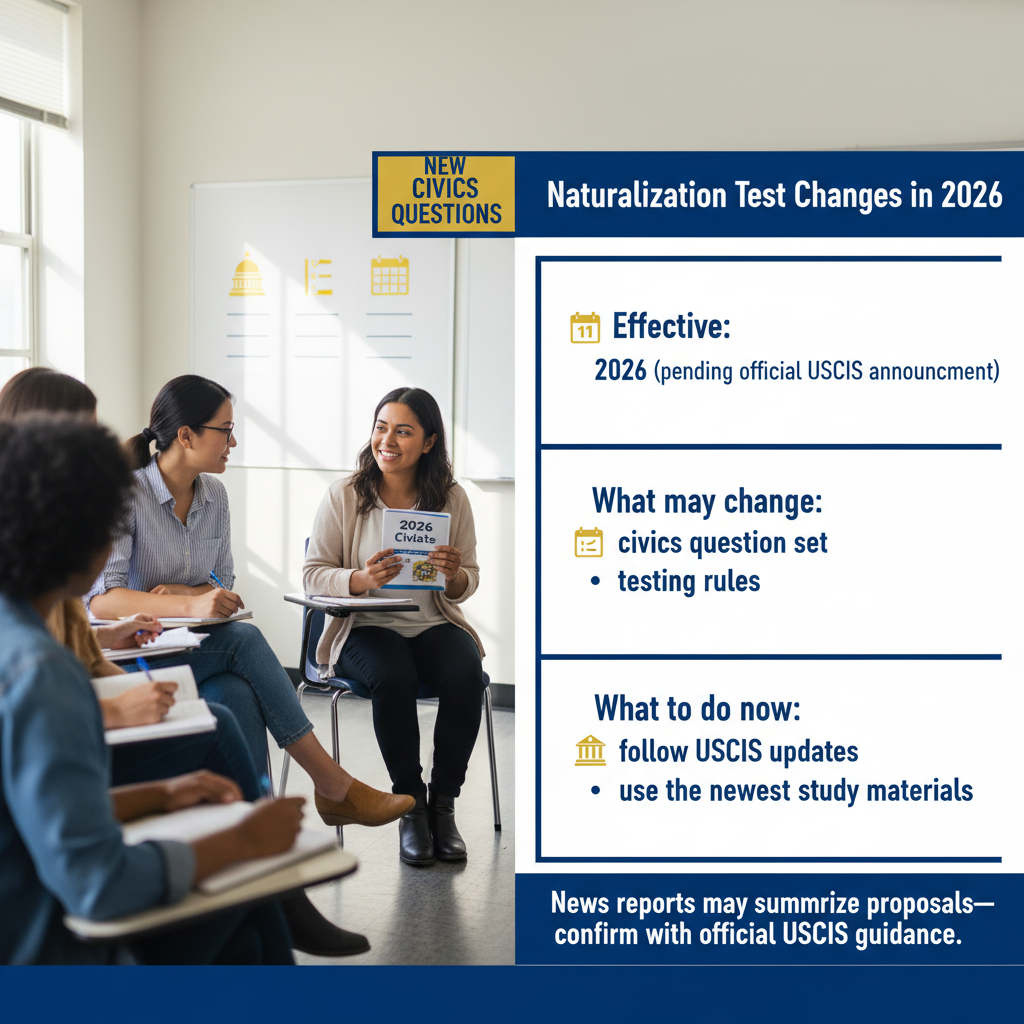
The reporting that sparked this guide: Naturalization Test Changes Coming in 2026 (Citizenship)
Reminder: News coverage often summarizes proposals, agency planning, or early policy direction. USCIS changes to the naturalization test typically happen through official announcements, updated study materials, and operational guidance. We link official resources throughout so you can verify what is final and what is still developing.
Need Help? Our Orlando immigration team is ready to assist. Call +1 786-791-3106 for a free consultation, or message us online. Se Habla Español.
What This News Means for Immigrants in Orlando and Across Florida
Why this news is showing up now
“Naturalization test changes” tends to trend whenever USCIS signals that it may update the civics portion of the naturalization exam (the questions about U.S. history and government asked during your interview). The civics test has changed before, and USCIS has the authority to revise test content and administration as long as it stays consistent with federal law and the naturalization regulations.
In practical terms, test updates usually involve:
- New or revised civics questions (what you study)
- Changes to how many questions are asked during the interview (how you’re tested)
- Updated study materials and officer scripts (how USCIS administers the test)
- Transition rules (who takes the old vs. new version based on filing date)
Important: If you are eligible to apply now, waiting “just to see” can backfire. Test changes often come with transition periods, but not always in the way people expect. Also, USCIS processing times can be long, and delaying your filing can delay your ability to vote, petition relatives, and obtain other benefits of U.S. citizenship.
How it can affect Florida residents
For Central Florida residents—especially along the I-4 corridor (Orlando, Kissimmee, Sanford, and surrounding areas)—a change to the civics test can affect how you plan your timeline and study strategy. If your case is in Orlando, your naturalization interview is typically handled through the Orlando USCIS Field Office (depending on your residence and USCIS jurisdiction at the time of scheduling).
Here are the real-world impacts we see for Florida applicants when civics requirements shift:
- Study materials become outdated quickly. Applicants relying on old YouTube videos or third-party apps may study the wrong content.
- Filing strategy matters. Depending on transition rules, your 90-day window to file early (if eligible) may determine which test version you take.
- Retests and reschedules get more stressful. If you fail the civics test once, you generally get another chance—but you don’t want to be caught between versions or using the wrong materials.
- English/civics exemptions become even more important. Some applicants qualify for age/time-in-U.S. exceptions and may have modified testing requirements.
Bottom line: If USCIS updates the naturalization civics test in 2026, Florida applicants should assume the best approach is to (1) confirm eligibility, (2) file correctly, and (3) study from official USCIS resources—then prepare for the interview like it’s a job interview.
What Naturalization Test Changes Coming in 2026 Is (and Why It Matters)
A plain-English definition
The “naturalization test” is the set of evaluations USCIS conducts during your naturalization interview to decide whether you qualify to become a U.S. citizen. It typically includes:
- An English test (speaking, reading, and writing), unless you qualify for an exception
- A civics test (U.S. history and government questions)
- Questions about your Form N-400 application and eligibility (good moral character, trips, marriage history, etc.)
When people say “new civics test questions and requirements,” they usually mean USCIS may revise:
- The list of study questions and answers
- The number of questions asked at the interview and how many you must answer correctly
- The format (for example, whether questions are more scenario-based)
Key terms you need to know
- Naturalization: The legal process of becoming a U.S. citizen after holding lawful permanent resident status (a green card) and meeting eligibility rules.
- Civics test: The portion of the naturalization test covering U.S. history and government.
- English test: Your ability to read, write, and speak basic English (with exceptions for certain applicants).
- Form N-400: The USCIS application for naturalization.
- USCIS: U.S. Citizenship and Immigration Services, the agency that adjudicates naturalization applications. See the USCIS official website.
- Good moral character: A legal standard USCIS uses to evaluate criminal history, honesty, taxes, child support, and other conduct during the statutory period (often 5 years, or 3 years for some spouses of U.S. citizens).
- Continuous residence / physical presence: Rules about how much time you must live in the U.S. and how long you can travel abroad without disrupting eligibility.
- Warning: Test changes do not replace eligibility requirements. Even perfect civics scores cannot fix ineligibility (for example, certain criminal issues or long absences).
Why it matters: The civics test is one of the most visible parts of the naturalization process—and one of the easiest to prepare for if you use the right materials. But if USCIS changes the questions, applicants who rely on outdated lists can fail unnecessarily, leading to delays, added stress, and potentially a second interview.
Current Immigration Law: The Foundation
Naturalization is governed by federal law. The civics/English testing requirements come from the Immigration and Nationality Act (INA) and related federal regulations. A test update in 2026 would not change the INA itself, but it could change the content and administration of the exam within USCIS authority.
Federal requirements
Key legal foundations include:
- INA § 312 (8 U.S.C. § 1423): Requires an understanding of English and knowledge of U.S. history and government, with statutory exceptions.
- INA § 316 (8 U.S.C. § 1427): General naturalization requirements (residence, physical presence, good moral character, attachment to the Constitution).
- INA § 319 (8 U.S.C. § 1430): Naturalization for certain spouses of U.S. citizens (often the “3-year rule”).
- 8 C.F.R. Part 316 and 8 C.F.R. Part 312: Implementing regulations for naturalization and the English/civics requirements.
The main filing form is Form N-400. USCIS publishes official instructions and updates at the USCIS official website and within the online account system.
Reminder: Many families we help are also navigating other processes at the same time. For example:
- Family petitions using Form I-130
- Green card applications through Adjustment of Status using Form I-485
- Tracking a family-based visa queue using a Priority Date
These are different processes from naturalization, but they often overlap in family planning. For official forms and editions, use USCIS Forms.
Florida-specific considerations
Florida does not create separate naturalization rules—citizenship is federal. But Florida residents may face practical, local considerations:
- Interview logistics: The Orlando USCIS Field Office schedules interviews based on capacity; rescheduling can add months.
- Name change requests: If you request a legal name change, your oath may be scheduled differently (often tied to a judicial oath ceremony). Timing varies by location.
- Travel patterns: Florida residents often travel internationally; long trips can impact continuous residence and physical presence.
- Document replacement: If you need replacement records (marriage certificates, court dispositions), Florida county processes vary. Orange County timelines may differ from other counties.
If your case is in Orlando, plan for realistic scheduling and keep your address current with USCIS to avoid missed notices.
To check general timing trends, use USCIS Processing Times.
Need Help? Our Orlando immigration team is ready to assist. Call +1 786-791-3106 for a free consultation, or message us online. Se Habla Español.
How to Prepare for the 2026 Naturalization Test Update: A Complete Step-by-Step Guide
Even before USCIS publishes final 2026 changes, you can prepare in a way that protects you from surprises: confirm eligibility, file correctly, study using official materials, and prepare for interview-day issues that cause delays (documents, travel, taxes, and selective service).
1) Confirm you are eligible to apply (and choose the right rule: 5-year or 3-year)
Most applicants file under the 5-year rule (lawful permanent resident for 5 years). Some qualify under the 3-year rule if married to and living with a U.S. citizen spouse and meeting additional requirements.
Important: USCIS allows early filing within a 90-day window before you meet the continuous residence requirement. Filing too early (outside the window) can lead to denial.
Documents to gather/check at this step:
- Front/back copy of your green card
- All passports (current and expired) covering your permanent residence period
- Travel history (dates out of the U.S.)
- Marriage certificate and spouse’s proof of U.S. citizenship (if filing under 3-year rule)
- Divorce decrees/annulments/death certificates for all prior marriages (you and spouse)
- Selective Service registration proof (if applicable)
- Tax transcripts (recommended) and proof of filing
2) Screen for issues that can delay or derail naturalization
The civics test is only one part. Many denials happen because of eligibility issues—especially criminal history, long trips, and misstatements.
Documents to gather/check at this step:
- Certified court dispositions for any arrest/citation (even if charges were dropped)
- Probation completion records, payment receipts for fines/fees
- Child support orders and proof of compliance (if applicable)
- IRS tax transcripts (recommended) and payment plans (if any)
- Prior immigration records: copies of filings, approvals, and notices
Warning: Do not assume an expunged record “doesn’t count” for immigration. USCIS can still consider the underlying conduct and may require certified records.
3) File Form N-400 correctly (and track your case)
File online or by mail, depending on your preference and eligibility. Many applicants prefer online filing because it helps track notices and uploads. However, some situations (like complex legal issues) benefit from careful attorney-guided filing.
Documents to prepare for filing:
- Green card copy
- Legal name change documents (if any)
- Marriage certificate and spouse citizenship proof (if applicable)
- Evidence of marital union (for 3-year rule), such as joint lease/mortgage, joint bank statements
- Fee payment method or fee waiver request (if eligible)
After filing, monitor your USCIS account and mail. If you move, update your address promptly.
4) Attend biometrics (if scheduled) and keep your record clean while pending
USCIS may reuse biometrics from prior applications or schedule a biometrics appointment. While your N-400 is pending, avoid new legal problems and keep documentation current.
Documents to bring/keep ready:
- Biometrics appointment notice (if scheduled)
- Government-issued photo ID
- Updated passport and travel plans
- Any new court documents if an incident occurs (ideally, avoid incidents)
5) Study civics the “USCIS way” and prepare for a possible 2026 transition
Your safest study plan is to rely on USCIS-published materials and verify the test version that applies to you. USCIS typically provides the official question list and study tools.
Study materials to use and save:
- USCIS civics questions list and official study resources from the USCIS official website
- Printed copy of the question set you are studying (write the version/date)
- Your own flashcards (based on USCIS wording)
- Notes on local answers (for example: names of your senators and representative)
Important: Some civics answers can change (elected officials). Always confirm shortly before your interview. Florida applicants should double-check current federal officeholders.
6) Prepare for the interview: English, civics, and the N-400 review
The naturalization interview is not only a test—it is also an eligibility review under oath. The officer will confirm your identity, review your N-400 answers, and test English/civics (unless exempt).
Documents to bring to the interview:
- Interview appointment notice
- Your green card
- All passports and travel documents (current and expired)
- State ID/driver’s license
- Certified marriage/divorce documents (as applicable)
- Tax transcripts (recommended), W-2/1099s if needed
- Selective Service proof (if applicable)
- Any court-certified dispositions and compliance proof
If your case is in Orlando, plan extra time for parking, security screening, and document organization. The Orlando USCIS Field Office is busy, and late arrivals can cause rescheduling.
7) Take the oath and update your records after approval
If approved, USCIS will schedule you for the oath ceremony (sometimes same-day, sometimes later). After you become a citizen, update your Social Security record and consider applying for a U.S. passport.
Documents and next steps after approval:
- Certificate of Naturalization (keep it safe; consider a secure storage plan)
- Update Social Security Administration record (citizenship status and name)
- Apply for U.S. passport via the U.S. Department of State
- Register to vote (as eligible)
- If you have family abroad, consider whether you can now file petitions faster (often using Form I-130 and tracking a Priority Date)
Practical Steps You Can Take Today
Whether the civics test changes in 2026 or not, the strongest applicants do the same things: verify eligibility, file accurately, and prepare for the interview with documentation and consistent study.
Actionable checklist
- Confirm your earliest filing date and do not file before the 90-day window opens.
- Download and print the current USCIS civics study materials (and check for updates monthly).
- Build a travel log with exact departure/return dates; compare it to passport stamps and airline records.
- Order IRS tax transcripts and resolve any filing gaps or balances before the interview.
- Collect certified court dispositions for any incident—no matter how minor it seems.
- Update your address with USCIS if you move; missed notices can lead to denial for abandonment.
- Practice a mock interview focusing on N-400 questions, yes/no eligibility questions, and English reading/writing.
Document preparation guidance
Organize your interview binder in sections: identity, immigration history, marital history, travel, taxes, and court records. Include a one-page timeline of addresses and travel. This helps you answer quickly and consistently.
Reminder: If you are also pursuing family immigration, keep copies of filings like Form I-130 and Form I-485 (for Adjustment of Status) and track your Priority Date. These won’t replace N-400 requirements, but they can matter for consistency across your immigration record.
Timeline expectations
Timelines vary by USCIS workload and field office. Many applicants see several months from filing to interview, then oath scheduling after approval. For the most current estimates, consult USCIS Processing Times.
Important: A civics test change can create temporary surges (people rush to file) and can affect scheduling. For Central Florida residents, planning early and filing cleanly can reduce delays.
Need Help? Our Orlando immigration team is ready to assist. Call +1 786-791-3106 for a free consultation, or message us online. Se Habla Español.
How Imigrar Helps Immigrants in Orlando
At Imigrar, we help clients in Orlando, Orange County, and throughout the I-4 corridor—and we serve clients nationwide. Our work is guided by our tagline: Keep Families Together.
When naturalization rules or test content may be changing, our goal is to reduce uncertainty by building a clear plan:
- Eligibility analysis (5-year vs. 3-year; continuous residence; physical presence; good moral character)
- Risk screening and document strategy for arrests, citations, and court outcomes
- Accurate Form N-400 preparation and consistency review across prior filings
- Interview preparation (English/civics practice and N-400 question coaching)
- Guidance on post-citizenship steps and family immigration planning (including Form I-130, Form I-485, Adjustment of Status, and Priority Date strategy)
We offer a free consultation. Call +1 786-791-3106. Se Habla Español.
Frequently Asked Questions
Q: Will the naturalization civics test definitely change in 2026?
A: Not every “planned” change becomes final. USCIS typically confirms changes through official announcements and updated study materials on the USCIS official website. Until USCIS publishes the final test version and transition rules, treat news reports as a signal to prepare—not a guarantee of the exact content.
Q: If I file now, will I take the old test or the new test?
A: It depends on the transition policy USCIS sets (often tied to your N-400 filing date). In previous changes, USCIS has sometimes applied a new test to applications filed after a certain date and kept the prior test for earlier filings. Important: If you are eligible now, filing within the correct 90-day window may help you fall under the current version—if USCIS uses filing date as the cutoff.
Q: Do civics test changes affect my immigration status or my green card?
A: A civics test update does not change your lawful permanent resident status by itself. If you apply for naturalization and are denied, you generally remain a green card holder unless USCIS finds a separate issue that makes you removable. Warning: The N-400 process can expose issues (criminal history, fraud/misrepresentation, abandonment of residence). If there are concerns, consult an attorney before filing.
Q: What documents should I bring to my naturalization interview in Orlando?
A: Bring your appointment notice, green card, state ID, all passports (current and expired), and supporting documents for any “yes” answers on the N-400. This often includes marriage/divorce certificates, tax transcripts, selective service proof, and certified court dispositions. If your case is in Orlando, organize documents in labeled sections so you can respond quickly during the interview at the Orlando USCIS Field Office.
Q: How long does the naturalization process take in Florida?
A: It varies by workload and field office capacity. Many applicants wait several months from filing to interview, then additional time for the oath ceremony. Check current estimates at USCIS Processing Times. Reminder: If USCIS introduces a new civics test in 2026, filing surges can temporarily increase wait times.
Q: How much does it cost to apply for U.S. citizenship?
A: USCIS filing fees can change, and the total depends on whether you request a fee waiver or reduction (if eligible). Always verify the current fee and instructions directly through USCIS and the edition of Form N-400 you are using. For official forms and instructions, use USCIS Forms. We can help you confirm the correct fee and whether a waiver is appropriate.
Q: What happens if I fail the civics test under the new requirements?
A: In many cases, USCIS allows a second opportunity to pass the English and/or civics tests within a set period after the first interview (the retest is typically scheduled later). If you fail again, USCIS may deny the N-400. The best protection is to study from official USCIS materials, practice spoken answers, and attend a mock interview. If you receive a denial, speak with counsel immediately to evaluate refiling vs. other options.
Q: What happens if my N-400 is denied—can I appeal?
A: You may be able to request a hearing on the denial by filing Form N-336 within the deadline listed on the denial notice. Deadlines are strict—missing them can forfeit the review option. If the issue is legal (good moral character, continuous residence, or prior misstatements), get legal advice quickly. If removal proceedings are involved, cases may be handled in immigration court under the Executive Office for Immigration Review.
Common Mistakes (and How to Avoid Them)
Mistake #1: Studying from outdated civics questions
If USCIS updates the test in 2026, older question lists may circulate online for months. Applicants sometimes memorize the wrong set and fail despite strong English.
- How to avoid it: Use USCIS-published resources and confirm the test version that applies to your filing date.
- Best practice: Print the official question list and note the date/version you studied.
Mistake #2: Treating the interview like “just a test” instead of an eligibility review
The officer will review your N-400 under oath. Inconsistencies about travel, addresses, marital history, or arrests can lead to requests for evidence (RFEs), continuances, or denial.
- How to avoid it: Build a timeline of addresses and trips and bring supporting documents.
- Important: Never guess. If you don’t remember a date, prepare in advance by retrieving records.
Mistake #3: Filing without addressing red flags (taxes, court issues, long absences)
Some problems can be fixed before filing (missing tax returns, unresolved warrants, lack of certified dispositions). Filing first and hoping it “works out” can create avoidable denials.
- How to avoid it: Do a full pre-filing review and gather certified records.
- Warning: If you have criminal history or long trips abroad, consult an attorney before filing.
Additional Official Resources to Track 2026 Updates
Because test changes are implemented by USCIS, the best way to stay current is to rely on official sources:
- USCIS official website (policy updates, study materials, announcements)
- USCIS Forms (correct editions and instructions for Form N-400 and related forms)
- USCIS Processing Times (timing estimates)
- U.S. Department of State (U.S. passport after naturalization)
- Executive Office for Immigration Review (immigration court info if proceedings arise)
Reminder: If you are simultaneously pursuing family-based immigration, keep track of your Priority Date and consider how citizenship could change timelines for your relatives. Many families file Form I-130 and later pursue Adjustment of Status with Form I-485 when eligible.
Need Help? Our Orlando immigration team is ready to assist. Call +1 786-791-3106 for a free consultation, or message us online. Se Habla Español.
Closing: Get a Personalized Naturalization Plan for 2026
If USCIS introduces new civics questions or requirements in 2026, the best strategy is to prepare early and prepare correctly: confirm eligibility, file a clean Form N-400, study from official materials, and walk into the interview with organized documents.
For Central Florida residents—especially if your case is in Orlando—planning ahead can reduce delays and stress at the Orlando USCIS Field Office. If you have any concerns about travel, taxes, prior arrests, or how a test transition might apply to your filing date, legal guidance can make the difference between a smooth approval and months of delay.
Need help now? Call Imigrar at +1 786-791-3106 for a free consultation, or message us online. Se Habla Español.


