


The reporting that sparked this guide
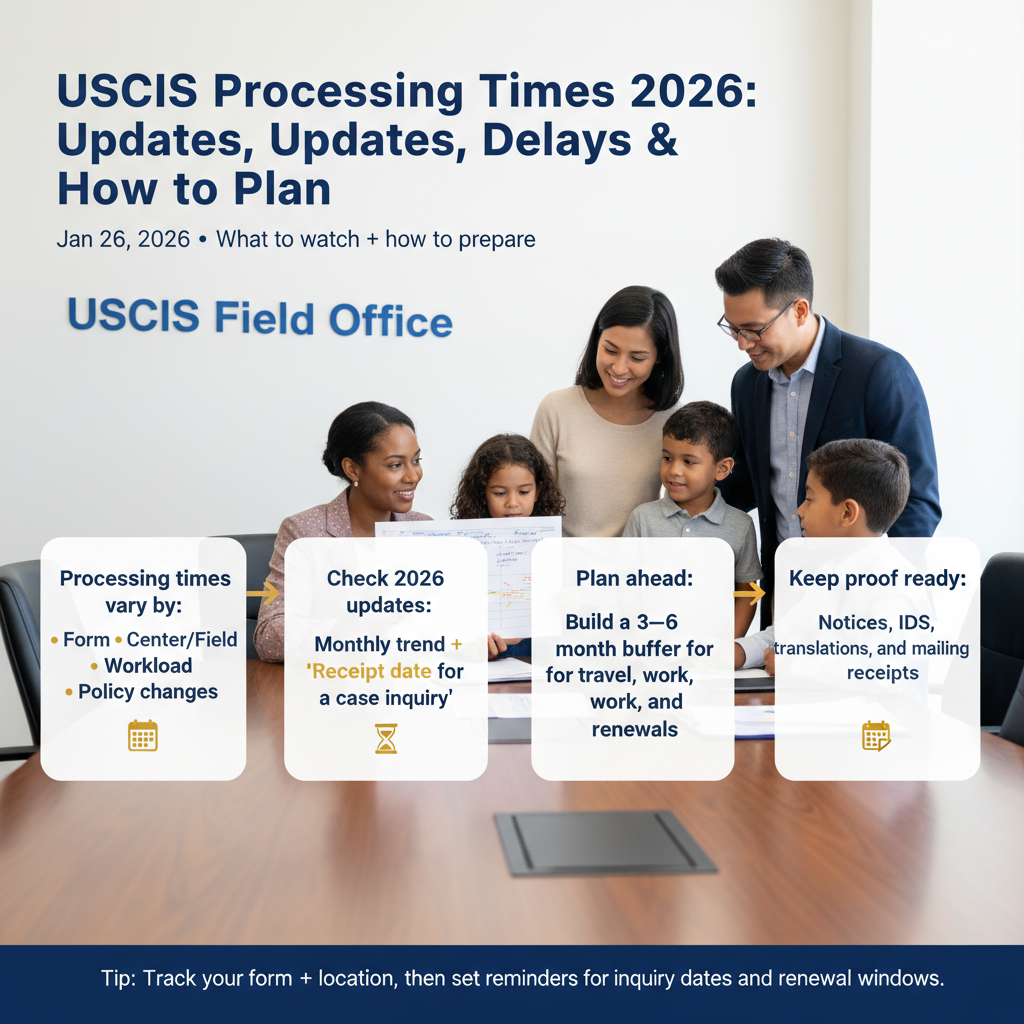
The reporting that sparked this guide: USCIS Processing Times and Updates for 2026 (USCIS)
Important: USCIS processing times fluctuate by form type, service center/field office, workload, and policy changes. This article explains how to read 2026 processing time updates, how they may affect your case, and what you can do right now—especially if your case is in Orlando or anywhere along Florida’s I-4 corridor.
Need Help? Our Orlando immigration team is ready to assist. Call +1 786-791-3106 for a free consultation, or message us online. Se Habla Español.
What This News Means for Immigrants in Orlando and Across Florida
Why this news is showing up now
USCIS processing times are “trending” in 2026 because more applicants are tracking timelines in real time—and because small changes can have big effects on work authorization, travel plans, and family stability. Processing time updates often spike in attention when:
- USCIS updates its public processing time estimates for major forms like Form I-130, Form I-485, Form I-765, and Form I-131.
- Backlogs shift between service centers and field offices (including the Orlando area).
- More applicants file family-based and employment-based cases, increasing overall volume.
- Applicants receive more RFE (Request for Evidence) notices, which can extend adjudication timelines.
- Policy and operational changes affect how quickly biometrics, interviews, and background checks are completed.
Reminder: USCIS “processing times” are not guaranteed deadlines. They are estimates based on how long it took to complete cases recently, typically presented as a range or a percentile.
How it can affect Florida residents
For Central Florida residents—from Orange County to Seminole, Osceola, and the broader I-4 corridor—USCIS timing affects everyday life. Delays can impact:
- Employment eligibility if your work permit (Form I-765) takes longer than expected.
- International travel if advance parole (Form I-131) is delayed and you have a pending Adjustment of Status application.
- Family unity when consular processing or family petitions stall and relatives remain abroad.
- Driver’s license renewals and other practical issues tied to lawful presence documentation.
- Case strategy decisions, including whether to file concurrently, how to respond to an RFE, or whether to request expedited processing.
If your case is in Orlando, processing time changes can be especially noticeable when interview scheduling patterns shift at the Orlando USCIS Field Office or when cases are transferred between locations.
What USCIS Processing Times and Updates for 2026 Is (and Why It Matters)
A plain-English definition
“USCIS processing times” are USCIS’s public estimates of how long it may take to decide a specific type of immigration application or petition. In 2026, these updates matter because they help you:
- Set realistic expectations for approvals and next steps.
- Plan around work authorization and travel needs.
- Know when you may be eligible to submit an inquiry because your case is “outside normal processing time.”
- Reduce risk by filing early and responding quickly to USCIS notices.
USCIS publishes these estimates on its official processing times tool: USCIS Processing Times.
Key terms you need to know
- Receipt Notice: The notice confirming USCIS received your filing (often starts with IOE, MSC, WAC, LIN, SRC, etc.). Your receipt date is crucial for timing.
- Priority Date: A key date in many family- and employment-based categories that determines your place in line. Your Priority Date may control when you can file or when a green card can be issued.
- Adjustment of Status: Applying for a green card from inside the U.S., often using Form I-485.
- Consular Processing: Immigrant visa processing through a U.S. consulate abroad after petition approval, generally coordinated with the U.S. Department of State.
- RFE (Request for Evidence): USCIS asks for more documents. An RFE often pauses or delays adjudication until you respond.
- NOID (Notice of Intent to Deny): USCIS indicates it plans to deny unless you respond with evidence or legal argument.
- Biometrics: Fingerprints/photo appointment used for background checks.
- Field Office vs. Service Center: Service centers often handle petitions and some benefits; field offices typically handle interviews and many Form I-485 decisions.
Warning: Misunderstanding these terms can lead to missed opportunities—such as not realizing you can file a service request once your case is outside the posted processing window.
Current Immigration Law: The Foundation
USCIS processing times are operational, but the underlying eligibility rules come from federal statutes and regulations. Understanding the legal foundation helps you avoid filings that are destined for delays, RFEs, or denials.
Federal requirements
Many of the most common applications affected by processing times in 2026 are grounded in:
- Immigration and Nationality Act (INA) provisions governing family-based immigration, employment-based immigration, and adjustment of status.
- 8 U.S.C. § 1154 (petitions for relatives and certain employment-based immigrants).
- 8 U.S.C. § 1255 (adjustment of status requirements and bars).
- 8 C.F.R. § 103 (USCIS procedures, evidence, and adjudications).
- 8 C.F.R. § 245 (adjustment of status regulations).
Common USCIS filings that applicants track closely include:
- Form I-130 (Petition for Alien Relative)
- Form I-485 (Application to Register Permanent Residence or Adjust Status)
- Form I-765 (Application for Employment Authorization)
- Form I-131 (Application for Travel Document)
- Form N-400 (Application for Naturalization)
- Form I-751 (Petition to Remove Conditions on Residence)
- Form I-129 (Petition for a Nonimmigrant Worker)
- Form I-140 (Immigrant Petition for Alien Worker)
Official references and tools: USCIS official website and USCIS Forms.
Florida-specific considerations
Immigration law is federal, but Florida residents face practical, local realities that can affect timing and case management:
- Address stability: Moves within the Orlando metro area (Orange County to Osceola or Seminole, for example) can change which field office handles your interview. Timely address updates are critical.
- Local appointment availability: Biometrics and interviews depend on local capacity. If your case is in Orlando, your interview scheduling may reflect Orlando Field Office backlogs or staffing patterns.
- State-level documentation needs: Many Florida processes (like license renewals) depend on your current immigration documentation and expiration dates, making USCIS delays more disruptive.
- Immigration court coordination: If you are in removal proceedings, your timeline may also involve EOIR. See the Executive Office for Immigration Review for court resources.
Important: If you are in proceedings or have prior immigration violations, “processing time” is only one part of the picture—strategy and eligibility analysis matter just as much.
How to Check and Respond to USCIS Processing Times in 2026: A Complete Step-by-Step Guide
The most effective way to deal with longer timelines is to (1) check your specific form and location, (2) confirm your receipt date and case type, and (3) take the right action at the right time. Below is a practical, non-lawyer step-by-step process we use with clients.
1) Identify your exact filing type, category, and where USCIS is processing it
Start with the basics: the form number, the category, and the office. For example, a marriage-based green card filed inside the U.S. often involves Form I-130 and Form I-485 (a classic Adjustment of Status scenario). But your “where” may differ: the I-130 might be at a service center, while the I-485 interview is at a field office.
Documents to gather:
- USCIS receipt notices (I-797C) for each form filed
- A copy of the full filing package (what was submitted)
- Your passport biographic page and current immigration status documents (I-94, visa page, etc.)
- Any prior USCIS notices (RFEs, biometrics notices, interview notices)
If your case is in Orlando, confirm whether your interview is likely to be scheduled at the Orlando USCIS Field Office based on your residential address in Orange County or nearby counties.
2) Check the official USCIS processing time tool the right way
Use the official tool here: USCIS Processing Times. Select:
- Your form type (example: Form I-485)
- Your category (example: family-based adjustment, employment-based adjustment, etc.)
- Your field office or service center (example: Orlando Field Office, or the service center shown on your receipt)
Documents to gather (to avoid mistakes):
- Receipt number prefix (to identify the processing location)
- Your filing date and receipt date
- Any transfer notices (cases can be moved)
Reminder: The “estimated time range” is not the same as the “receipt date for a case inquiry.” The inquiry date tells you when you can ask USCIS to look into a delayed case.
3) Compare your receipt date to the “case inquiry” date and set timeline checkpoints
Once you find the “receipt date for a case inquiry,” compare it to your receipt date on the I-797C. If your receipt date is earlier than the inquiry date, your case may be outside normal processing time.
Set checkpoints so you don’t lose time:
- 30-day check: confirm notices were received and biometrics scheduled (if required).
- 90-day check: confirm no missed RFEs; verify address is current.
- Every 60-90 days: re-check USCIS processing times and update your plan.
Documents to gather:
- All I-797C notices (receipt, biometrics, transfer, interview)
- Proof of delivery for any RFE response (USPS/UPS/FedEx confirmations)
- USCIS online account screenshots (if you use one)
Warning: If you miss an RFE deadline, USCIS can deny the case. Don’t wait until the last week to respond.
4) Use the right “nudge” at the right time: service request, expedite, or congressional inquiry
If your case is outside normal processing time, you may be able to submit an online inquiry/service request. If you have urgent needs, you might consider an expedite request (approval is discretionary).
Common options:
- Service request for cases outside normal processing time
- Expedite request (for qualifying urgent circumstances)
- Congressional inquiry through your U.S. Representative or Senator’s office
Documents to gather (varies by request):
- Receipt number(s) for each pending form
- Evidence of hardship or urgency (job offer letters, medical letters, financial documents)
- Evidence of prior attempts to resolve the issue
- Proof of status impacts (e.g., expiring EAD, employer letter)
Important: Expedite criteria are specific. Filing an expedite without strong documentation can waste time and may not help your case move faster.
5) Respond correctly to delays triggers: RFEs, interviews, and medical exams
In 2026, many delays are not “USCIS is slow” delays—they are “the file is incomplete” delays. The most common triggers:
- Insufficient relationship evidence for Form I-130
- Missing or outdated medical exam documentation for Form I-485
- Inconsistencies in addresses, employment history, or prior immigration history
- Failure to submit requested court dispositions or certified records
Documents to gather:
- RFE letter (every page) and deadline instructions
- Organized evidence packet with table of contents
- Updated civil documents (birth/marriage/divorce certificates)
- Medical exam paperwork as instructed by USCIS (if applicable)
Reminder: Some applicants assume they have a 90-day window to do something because they saw that phrase online. Always follow the deadline printed on your USCIS notice, not social media.
6) Keep your case “deliverable” and consistent: address changes, online account, and evidence hygiene
USCIS delays often become worse when mail is returned or notices are missed. This is especially common for people moving within Central Florida.
Documents and actions to prepare:
- Proof of your current address (lease, utility bill)
- A dedicated folder with every USCIS notice in date order
- Copies of every filing and response (PDF + paper)
- USCIS online account access credentials stored safely
Important: Address issues can cause missed biometrics or interview appointments—leading to months of delay or even denial for abandonment.
7) If denied or stalled, evaluate the correct next move (appeal, motion, refile, or court strategy)
Not every delay ends with an approval. Some cases get denied due to evidence issues, inadmissibility, or missed deadlines. The right response depends on the type of denial and your status.
Documents to gather:
- The full denial notice (every page)
- Your complete filing history and evidence submitted
- Any RFE/NOID responses you sent
- Immigration court documents if you are in proceedings (EOIR)
Options may include a motion to reopen/reconsider, an appeal (when available), or refiling with a stronger package. If you are in removal proceedings, timing and coordination with EOIR can be critical.
Need Help? Our Orlando immigration team is ready to assist. Call +1 786-791-3106 for a free consultation, or message us online. Se Habla Español.
Practical Steps You Can Take Today
Processing time updates can feel out of your control—but your preparation and timing are absolutely within your control. Here’s a practical checklist we recommend for 2026 applicants.
Actionable checklist (do these now)
- Check your form + office in the official tool and screenshot the results for your records: USCIS Processing Times.
- Build a “USCIS master file” with every receipt notice, RFE, response, and supporting document.
- Track expiration dates for passport, I-94, EAD, and advance parole. Set reminders 6 months and 3 months ahead.
- Prepare for biometrics/interview early: review your forms for consistency (addresses, dates, prior names).
- Plan travel carefully if you have pending Adjustment of Status. Leaving without proper authorization can create serious problems.
- Update your address promptly whenever you move (especially common around the Orlando rental market).
- Respond fast to RFEs—aim to mail within 7–14 days when possible, not at the deadline.
Document preparation guidance
In 2026, a well-organized filing can reduce the chance of an RFE and help avoid “silent delays.” Consider:
- Use clear labels and a table of contents for evidence packets.
- Submit legible scans/copies and certified translations when required.
- Include proof of identity and civil status documents consistently across filings.
- For family cases, include strong relationship evidence beyond minimum requirements.
Important: If you’re filing Form I-130 and Form I-485 together, inconsistencies between the forms are a common reason for extra scrutiny and delays.
Timeline expectations (how to think about 2026)
USCIS timelines vary widely, but you can plan using “decision points” instead of fixed dates:
- First 30–60 days: receipts, online account updates, and biometrics scheduling (when required).
- Next 3–8 months: EAD/advance parole timing is case-specific; some applicants receive combo cards, others wait longer.
- Next 8–24+ months: many green card and citizenship decisions fall in this broad range depending on category and office backlogs.
Reminder: If you’re following the Visa Bulletin and your Priority Date is not current, that can be the main reason you cannot finalize a green card even if other steps are complete. For Visa Bulletin and consular resources, see the U.S. Department of State.
How Imigrar Helps Immigrants in Orlando
At Imigrar, we help individuals and families navigate USCIS processing times with a strategy focused on strong filings, fast responses, and clear planning. Our mission is our tagline: Keep Families Together.
We regularly assist with:
- Family petitions and green cards (including Form I-130 + Form I-485 packages)
- Work permits and travel documents (Form I-765, Form I-131)
- Naturalization (Form N-400)
- Removal of conditions (Form I-751)
- Case troubleshooting: RFEs, NOIDs, delays, and denials
If your case is in Orlando, we can help you prepare for interview expectations at the Orlando USCIS Field Office, organize evidence, and avoid common timeline traps that cause preventable delays.
Call us at +1 786-791-3106 for a free consultation. Se Habla Español.
Need Help? Our Orlando immigration team is ready to assist. Call +1 786-791-3106 for a free consultation, or message us online. Se Habla Español.
Frequently Asked Questions
Q: Am I eligible to file even if USCIS processing times are long?
A: Processing times do not change eligibility rules. Eligibility depends on the specific benefit and category. For example, a spouse of a U.S. citizen may be eligible to file Form I-130 and often Form I-485 as an Adjustment of Status case (if otherwise eligible). However, issues like unlawful entry, certain criminal history, or prior immigration violations can change eligibility and strategy. If you’re unsure, get a legal screening before filing so you don’t lose months to a denial.
Q: Will checking processing times or contacting USCIS hurt my case?
A: Checking the official tool and submitting an appropriate inquiry generally does not “hurt” a case. The key is to wait until you are eligible to inquire (outside normal processing time) and to be accurate and consistent. If you submit repeated inquiries too early, you may waste time and create confusion without moving the case forward.
Q: How do I know if my case is outside normal processing time in 2026?
A: Go to USCIS Processing Times, select your form, category, and office, then look for the “receipt date for a case inquiry.” Compare that date to your receipt date on your I-797C notice. If your receipt date is earlier than the inquiry date, you may be eligible to submit a service request.
Q: What documents are most important to prevent delays for family green cards?
A: For many family cases, delays come from weak evidence or missing civil documents. Strong packages typically include: (1) identity documents, (2) certified marriage/birth/divorce documents, (3) proof of lawful entry when required (I-94), (4) complete financial sponsorship evidence, and (5) relationship evidence such as joint leases, joint bank accounts, insurance, photos, and affidavits when appropriate. For Form I-130 and Form I-485, consistency across every form and date is critical.
Q: How much does it cost to deal with USCIS delays—do I need to pay extra fees?
A: USCIS generally does not charge a fee to check processing times or submit a standard “outside normal processing time” inquiry. However, some applicants choose paid options like premium processing for certain employment forms when available (not available for all case types). Legal fees vary depending on complexity—especially if there are RFEs, prior denials, or inadmissibility issues. Always confirm current USCIS filing fees on the USCIS Forms page and the specific form instructions.
Q: What happens if my application is denied after a long wait?
A: A denial can have very different consequences depending on your current status and what you filed. Some denials allow refiling quickly with stronger evidence; others may require a motion to reopen/reconsider or an appeal (when available). In some situations, a denial can trigger status problems or create risk of removal proceedings. If you receive a denial, do not assume the only option is to “start over.” Have an immigration attorney review the denial notice and your filing history immediately so you can choose the safest next step.
Q: Does living in Orlando or Orange County change my USCIS processing time?
A: It can. Many applications are processed partly at service centers and partly at field offices. If your case is in Orlando, interview scheduling and final adjudication for certain benefits may depend on capacity at the Orlando USCIS Field Office. Moves within the I-4 corridor can also shift which field office has jurisdiction, which may affect scheduling. Always keep your address updated and track where your case is being handled.
Q: Can I travel while my Form I-485 is pending if processing times are long?
A: Travel can be risky without the right authorization. Many applicants with pending Adjustment of Status need advance parole (often filed on Form I-131) before traveling internationally. Leaving without proper authorization can be treated as abandoning the I-485 in many situations. There are exceptions and special rules, so get individualized advice before booking travel—especially if you have any prior unlawful presence or visa overstay history.
Common Mistakes (and How to Avoid Them)
Mistake #1: Using the wrong office or category in the USCIS processing time tool
Many people accidentally select the wrong field office or the wrong case category, then panic (or relax) based on incorrect information.
- How to avoid it: Match the office to your receipt notice or interview jurisdiction. Save screenshots of what you selected.
- Important: A case can be transferred—always read transfer notices carefully.
Mistake #2: Waiting until the last minute to respond to an RFE
RFEs are one of the biggest sources of avoidable delays. Even if you respond on time, last-minute responses are more likely to be incomplete, poorly organized, or missing certified documents.
- How to avoid it: Aim to respond within 7–14 days when possible. Use a table of contents and label every exhibit.
- Warning: Missing the deadline can lead to denial.
Mistake #3: Assuming “processing time” is a legal deadline and making life decisions around it
Applicants sometimes quit jobs, schedule international trips, or plan major moves based on estimated timelines. When the estimate shifts, the consequences can be severe.
- How to avoid it: Build contingency plans. Keep work/travel options flexible until you have approvals in hand.
- Reminder: Processing times are estimates, not promises.
Need Help? Our Orlando immigration team is ready to assist. Call +1 786-791-3106 for a free consultation, or message us online. Se Habla Español.

Closing: Plan Smart Around USCIS Processing Times in 2026
USCIS processing time updates in 2026 are a valuable planning tool—but only if you use them correctly. The strongest approach is to (1) file the right case the right way, (2) keep your evidence and addresses consistent, (3) respond quickly to USCIS requests, and (4) escalate appropriately when your case is truly outside normal processing time.
For Central Florida residents, delays can affect work, travel, and family stability—especially when interviews are scheduled through the Orlando USCIS Field Office. If you’re unsure what the current processing time means for your specific situation, a personalized legal review can save months of delay and reduce the risk of a denial.
Need help now? Call Imigrar at +1 786-791-3106 for a free consultation, or message us online. Se Habla Español. We’re here to help you move forward—and to Keep Families Together.


