


The reporting that sparked this guide
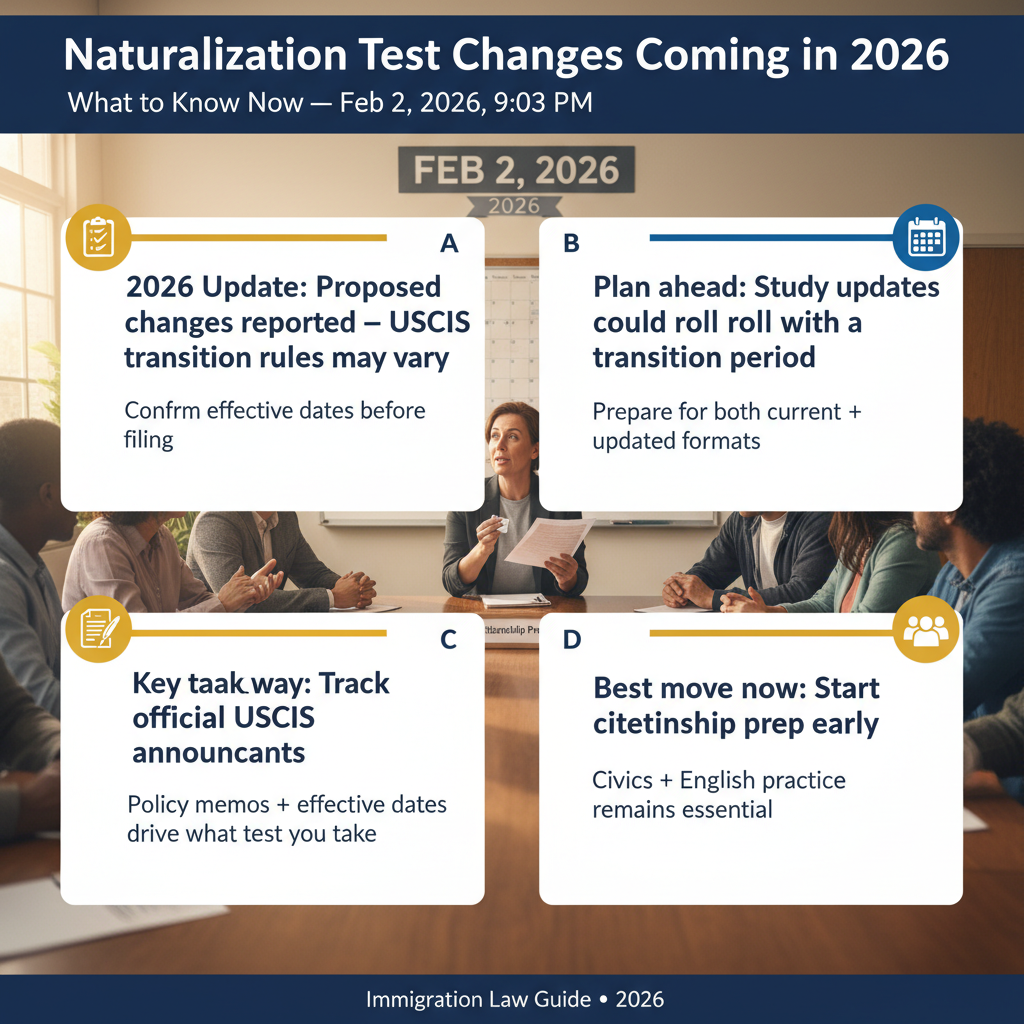
The reporting that sparked this guide comes from: Naturalization Test Changes Coming in 2026 (Citizenship).
Important: As of today (2026-02-02), USCIS has not always published final “effective dates” and transition rules for every proposed testing update at the same time news outlets begin reporting on it. This article explains how the naturalization test works under current law, what “test changes” typically mean in practice, and the safest preparation steps you can take now—especially if your case is in Orlando or anywhere along the I-4 corridor.
Need Help? Our Orlando immigration team is ready to assist. Call +1 786-791-3106 for a free consultation, or message us online. Se Habla Español.
What This News Means for Immigrants in Orlando and Across Florida
Why this news is showing up now
Naturalization testing “changes” tend to trend in the news when USCIS signals that it may update the civics questions, scoring method, interview format, or study resources. USCIS periodically reviews the civics test to reflect educational standards, clarity, and how officers administer the test at interviews. When USCIS updates the test, it often creates a transition period—meaning some applicants take the prior version while others take the new version depending on when they file Form N-400 or when USCIS receives it.
In prior cycles, public attention spikes because:
- Applicants worry they will be “switched” to a harder test mid-process.
- Schools, community groups, and ESL programs need time to update materials.
- People planning to apply in the next 90-day window (for those eligible to file early) want to time filings strategically.
Reminder: In most cases, the civics test is only one part of naturalization. Eligibility (continuous residence, physical presence, good moral character, and English requirements) usually matters more than which civics test version you receive.
How it can affect Florida residents
For Central Florida residents—especially those in Orange County and along the I-4 corridor—test changes can affect:
- Study strategy: Which official question set and study tools you should use.
- Timing: Whether filing sooner may keep you under the current test version if USCIS announces a clear cutoff date.
- Interview preparation: How to practice speaking and responding under time pressure.
- Retest planning: If you fail the English or civics portion, you typically receive a second chance within a set timeframe; understanding the test version matters for retesting.
If your case is in Orlando, your interview is commonly handled through the Orlando USCIS Field Office. Local scheduling patterns, appointment availability, and processing times can influence whether you’re interviewed before or after a new test version takes effect. You can monitor trends using the USCIS Processing Times tool.
What Naturalization Test Changes Coming in 2026 Is (and Why It Matters)
A plain-English definition
“Naturalization test changes coming in 2026” generally means USCIS may update the way it tests citizenship applicants during the naturalization interview. The naturalization test includes:
- English test (speaking, reading, writing), unless you qualify for an exemption or special consideration; and
- Civics test (U.S. history and government questions), usually asked orally by the USCIS officer.
A “change” could involve new civics questions, a new pool of questions, different pass/fail rules, updated study materials, or updated officer guidance on how questions are asked.
Key terms you need to know
- Form N-400: The application for naturalization (U.S. citizenship).
- Naturalization interview: The USCIS appointment where your eligibility is reviewed and you take the English/civics tests (if required).
- Civics question pool: The official list USCIS publishes for study; officers ask from this pool.
- Transition rule: USCIS policy that determines which test version applies (often based on the date USCIS receives Form N-400).
- Re-examination: If you fail English or civics, USCIS generally schedules a second opportunity (often within about 60–90 days, though timing can vary by office).
- Good Moral Character (GMC): A legal requirement for naturalization; certain criminal issues, fraud, or prolonged noncompliance can affect eligibility.
- Continuous residence and physical presence: Requirements based on how long you have lived in the U.S. and how much time you have spent inside the country.
Warning: Many applicants focus only on memorizing civics answers. But USCIS also evaluates your full eligibility record, including travel history, taxes, selective service registration (if applicable), prior immigration filings, and any arrests—even if charges were dismissed.
Current Immigration Law: The Foundation
Naturalization is governed primarily by the Immigration and Nationality Act (INA) and implementing regulations. The civics/English testing requirements come from federal law and USCIS policy—not state law—so Florida does not create separate citizenship requirements. However, Florida residents may experience local processing differences based on field office capacity and scheduling.
Federal requirements
Key federal legal authorities include:
- INA § 312 (8 U.S.C. § 1423): English language and civics requirements, including authority for exceptions and accommodations.
- INA § 316 (8 U.S.C. § 1427): General naturalization requirements (continuous residence, physical presence, GMC, attachment to the Constitution).
- INA § 319 (8 U.S.C. § 1430): Naturalization through marriage to a U.S. citizen (3-year rule) and special provisions.
- 8 C.F.R. Part 316 and 8 C.F.R. Part 312: Regulations on naturalization eligibility and testing standards.
USCIS administers the process and publishes official guidance and study materials at the USCIS official website. You can also access forms and instructions at USCIS Forms.
While this article is focused on naturalization, many families reach citizenship after earlier steps like family petitions and green cards. If you are still in that phase, terms like Adjustment of Status, Priority Date, Form I-130, and Form I-485 may be central to your case timeline.
Florida-specific considerations
Florida does not set the civics test, but Florida residents should consider:
- Local interview scheduling: The Orlando USCIS Field Office may have different appointment availability than Miami, Tampa, or Jacksonville.
- Name change ceremonies: If you request a legal name change, your oath ceremony may be scheduled differently (often requiring a judicial ceremony), which can extend the timeline.
- Travel patterns: Many Central Florida residents travel internationally for family; long trips can affect continuous residence and physical presence.
Reminder: If you have a pending immigration court matter, your path may involve the Executive Office for Immigration Review. Naturalization rules can be more complex when removal proceedings are involved.
Need Help? Our Orlando immigration team is ready to assist. Call +1 786-791-3106 for a free consultation, or message us online. Se Habla Español.
How to Prepare for Naturalization Test Changes in 2026: A Complete Step-by-Step Guide
1) Confirm you are eligible to file Form N-400 (and pick the right filing date)
Before worrying about which civics test version you’ll receive, confirm your eligibility and the earliest date you can file. Many applicants can file up to 90-day window before meeting the continuous residence requirement (for example, filing 90 days before the 5-year or 3-year mark).
- General rule (5 years): Lawful permanent residents (LPRs) may apply after 5 years of continuous residence.
- Marriage rule (3 years): Some LPRs married to and living with a U.S. citizen may apply after 3 years under INA § 319.
If USCIS announces a clear cutoff date for a new civics test, the date USCIS receives your Form N-400 (not the day you start studying) may determine which test applies.
Documents to gather for Step 1:
- Front and back of your green card
- Marriage certificate/divorce decrees (if applying under the 3-year rule)
- Proof your spouse is a U.S. citizen (passport, birth certificate, naturalization certificate)
- Travel history (dates of all trips outside the U.S.)
- Selective Service proof (if applicable)
- Tax transcripts (recommended)
2) Build your “eligibility file” (because the interview is more than the test)
USCIS officers test civics and English, but they also verify your entire Form N-400 and background. Preparing an organized file reduces stress and helps you answer questions clearly—especially if the officer asks follow-ups that impact Good Moral Character.
Documents to gather for Step 2:
- Certified court dispositions for any arrests/citations (even old or dismissed cases)
- Proof of child support compliance (if applicable)
- Proof of registration for Selective Service (if required)
- Evidence of marital union (if applying under the 3-year rule): joint lease/mortgage, bank statements, insurance, children’s birth certificates
- USCIS notices for prior filings (receipts/approvals/denials)
Warning: Do not guess about arrests or dates. If you are unsure, request records before filing. Inconsistencies between your application and fingerprints/background check can create delays or denials.
3) Study civics the “USCIS way” and track which test version applies
USCIS publishes official civics study resources and question sets. If changes come in 2026, USCIS typically updates the official materials and may publish transition guidance. Use only official or reputable materials aligned with the current USCIS list.
Start with the USCIS official website and the civics education pages. Avoid relying solely on third-party apps that may not update quickly.
Documents/materials to gather for Step 3:
- Printed copy of the current USCIS civics question list
- Official USCIS flashcards or verified study guides
- A notebook with your weak topics (Constitution, branches of government, rights/responsibilities)
- Calendar to plan daily study sessions (15–30 minutes/day is often more effective than cramming)
Important: If USCIS introduces “new civics questions,” the safest approach is to study the current list now and be ready to pivot as soon as USCIS posts the official 2026 list and effective date.
4) Prepare for the English test (and request accommodations if you qualify)
The English portion includes speaking (throughout the interview), reading, and writing. Many applicants who are nervous about civics actually struggle more with the reading/writing portion due to anxiety and unfamiliar vocabulary.
Some applicants qualify for age/time-in-residence exceptions (for example, certain applicants over a specific age with long-term LPR status) or for medical disability accommodations. These are governed by INA § 312 and USCIS policy.
Documents/materials to gather for Step 4:
- USCIS reading and writing vocabulary lists (official)
- If requesting a medical exception: completed medical certification (commonly Form N-648, if applicable under current USCIS rules)
- Proof of age and LPR admission date (passport/green card) for age/time exceptions
Reminder: A medical exception is not simply “I have trouble learning English.” USCIS expects detailed medical documentation showing a qualifying physical/developmental disability or mental impairment that prevents compliance.
5) File Form N-400 correctly (and keep proof of everything)
Filing errors can cause delays that matter if a new civics test version takes effect. File carefully, answer every question, and ensure your travel and address history are complete.
You can review the latest filing address, fees, and instructions at USCIS Forms.
Documents to gather for Step 5:
- Completed Form N-400 (and any required supplements)
- Copy of green card (front/back)
- Fee payment confirmation or fee waiver request (if eligible)
- Two passport-style photos (only if required for your filing method/category)
- Any required supporting evidence (marriage, divorce, court records, etc.)
Warning: If you have pending or prior filings like Form I-130 or Form I-485, or if you previously sought Adjustment of Status, inconsistencies across filings can be flagged. Your Priority Date history and prior statements may still matter.
6) Attend biometrics and get interview-ready (mock interview + document tabbing)
After filing, USCIS typically schedules biometrics (fingerprints/photo) if needed, then later an interview. Use the waiting period strategically: do a mock interview, practice civics orally, and organize your originals.
Documents to gather for Step 6:
- Biometrics appointment notice (if issued)
- Interview notice
- Original documents: green card, passports (current/expired), state ID
- Updated evidence for any changes since filing (new trips, address changes, new marriage/divorce, new arrests)
If your case is in Orlando, plan for traffic and parking near the field office and arrive early. For Central Florida residents commuting on I-4, build in extra time for delays.
7) Take the interview and plan for the oath ceremony (including name changes)
If approved, USCIS schedules you for the oath ceremony. Some applicants are approved the same day; others receive a decision later. If you requested a name change, your ceremony may be scheduled differently and can add time.
Documents to gather for Step 7:
- All passports and travel documents
- Green card (you will surrender it at the oath)
- Oath notice
- Evidence to resolve any “continuing” issues (tax payment plan proof, court final disposition, etc.)
After you naturalize, you can apply for a U.S. passport through the U.S. Department of State.
Need Help? Our Orlando immigration team is ready to assist. Call +1 786-791-3106 for a free consultation, or message us online. Se Habla Español.
Practical Steps You Can Take Today
Whether the 2026 changes end up being minor (new questions) or more substantial (new scoring rules), the best preparation is to strengthen your overall naturalization case while staying flexible on study materials.
Actionable checklist (do these now)
- 1) Verify your eligibility date and decide whether to file within the 90-day window if you qualify.
- 2) Request certified court dispositions for any incident—do not wait until the interview.
- 3) Download and study from USCIS-only materials so you’re aligned with the official question pool.
- 4) Build a travel log (all trips, dates out, dates back). Continuous residence issues often cause denials, not civics.
- 5) Get tax transcripts and confirm you filed required returns; address any IRS issues early.
- 6) Practice a mock interview weekly: yes/no questions, definitions, and civics answers out loud.
- 7) Track announcements on the USCIS official website and avoid rumors.
Document preparation guidance
- Use a binder with tabs: Identity, Residence, Marriage/Family, Taxes, Travel, Court/Police, USCIS Notices.
- Bring originals to the interview and keep copies for USCIS if requested.
- If documents are not in English, obtain certified translations.
Timeline expectations (typical, but varies)
- Filing to biometrics: often weeks to a few months (sometimes waived if USCIS reuses biometrics).
- Filing to interview: varies widely by location and workload; check USCIS Processing Times.
- Interview to oath: sometimes same day or within weeks; name changes can take longer.
Important: A test change effective date can intersect with your timeline. If USCIS uses a “received by” cutoff, filing earlier may help you stay under the current rules—but only if you are truly eligible and your application is accurate.
How Imigrar Helps Immigrants in Orlando
At Imigrar, we help clients in Orlando, throughout Central Florida, and nationwide prepare strong naturalization applications—especially when policy updates create uncertainty. Our approach is not just “test prep.” We focus on preventing the eligibility pitfalls that can delay or derail citizenship.
- Eligibility screening for continuous residence, physical presence, and Good Moral Character
- Application strategy if you have prior immigration filings (including Form I-130, Form I-485, or prior Adjustment of Status issues)
- Document organization and translation guidance
- Mock interview preparation tailored to the Orlando USCIS Field Office experience
- Support for clients who need accommodations or who qualify for exceptions
We offer a free consultation to help you understand your options and timing. Se Habla Español.
Need Help? Our Orlando immigration team is ready to assist. Call +1 786-791-3106 for a free consultation, or message us online. Se Habla Español.
Frequently Asked Questions
Q: Will the naturalization civics test definitely change in 2026?
A: News coverage may signal that changes are being discussed or drafted, but the controlling information is what USCIS publishes officially (effective date, question pool, and transition rules). Monitor the USCIS official website for confirmed updates. If you are eligible now, it may be wise to prepare your Form N-400 so you can file strategically once rules are clear.
Q: If I file now, could USCIS still give me the new 2026 test at the interview?
A: It depends on the transition policy USCIS adopts. In prior test changes, USCIS commonly applied rules based on when USCIS received the N-400 (or when it was filed online). If USCIS announces that applicants who file after a certain date must take the new test, filing before that cutoff may keep you on the prior version. We recommend keeping proof of filing/receipt and tracking any USCIS policy alerts.
Q: Do civics test changes affect my immigration status or green card?
A: A civics test update does not change your underlying lawful permanent resident status. However, filing Form N-400 triggers a full review of your record. Issues like long trips abroad, tax problems, or arrests can affect the naturalization decision and, in rare cases, can lead to further review of your immigration history. If you have concerns, consult counsel before filing.
Q: What documents should I bring to my naturalization interview in Orlando?
A: Bring your interview notice, green card, all passports (current and expired), state ID, and originals of key civil documents (marriage/divorce records, court dispositions). Also bring updated evidence for anything that changed since filing (new trips, address changes, new employment, etc.). If your case is in Orlando, organize documents in a tabbed binder so you can respond quickly to officer requests.
Q: How much does it cost to apply for citizenship, and can I get a fee waiver?
A: USCIS fees can change, so confirm the current fee on USCIS Forms before filing. Some applicants may qualify for a fee waiver or reduced fee based on income and benefits rules. A mistake in fee payment can cause rejection and delay—potentially affecting which test version applies if a cutoff date is approaching.
Q: How long does the naturalization process take in Florida?
A: Timelines vary by case complexity and field office workload. Use USCIS Processing Times to check current estimates. For Central Florida residents, the Orlando USCIS Field Office timeline can fluctuate. Also remember: requesting a name change may extend the time from interview approval to oath ceremony.
Q: What happens if I fail the civics or English test under the new rules?
A: Typically, USCIS gives you a second chance to pass the portion you failed at a re-examination appointment (often within about 60–90 days, though it can vary). If you fail again, USCIS may deny the N-400. A denial does not automatically remove you from the U.S., but it can have consequences if there are underlying eligibility problems. If denied, you may be able to request a hearing by filing Form N-336 within the deadline listed on the denial notice (often 30 days; read your notice carefully). Legal advice is strongly recommended.
Q: I have a pending family case like Form I-130 or a green card case like Form I-485. Does the 2026 civics test change affect me?
A: Not directly. The civics test applies to naturalization, not to petitions like Form I-130 or Form I-485. But your long-term plan matters: completing a green card process (often through Adjustment of Status) starts the clock toward citizenship eligibility. Your Priority Date and lawful permanent resident start date will determine when you can file Form N-400.
Common Mistakes (and How to Avoid Them)
Mistake #1: Waiting for “perfect clarity” before filing when you are already eligible
People sometimes delay for months because they fear a new test. Meanwhile, they risk new complications—more travel, a new job issue, tax problems, or a missed eligibility window. Avoid this by confirming eligibility early and preparing your file so you can file promptly if a cutoff date is announced.
Mistake #2: Studying from outdated or unofficial question lists
If a 2026 update introduces new civics questions, outdated apps and social media posts can mislead applicants. Avoid this by relying on the USCIS official website and verifying you are studying the current list.
Mistake #3: Underestimating “non-test” issues like travel, taxes, and arrests
The civics test is passable with consistent study. The bigger risk is eligibility problems—extended trips, inconsistent address history, unpaid taxes, or missing court dispositions. Avoid this by building an eligibility binder and addressing issues before the interview.
Additional Official Resources (Use These, Not Rumors)
- USCIS official website
- USCIS Forms
- USCIS Processing Times
- U.S. Department of State (passports after naturalization)
- Executive Office for Immigration Review (immigration court information)
Planning Your Next Move in Florida if the 2026 Test Changes
If your case is in Orlando, timing and preparation matter. The Orlando USCIS Field Office may schedule interviews based on its workload, which can affect whether your interview occurs before or after any new civics test effective date. For Central Florida residents commuting across Orange County and the I-4 corridor, plan ahead for appointments and keep your documents ready.
Important: If USCIS introduces new civics requirements, the best defense is a strong application and consistent study habits. Do not let uncertainty stop you from moving forward—especially if you are already eligible to naturalize.

Closing: Get a Personalized Naturalization Strategy
Naturalization is one of the most meaningful steps an immigrant can take—and policy changes can add stress. Imigrar is here to help you understand the rules, prepare the right evidence, and walk into your interview confident and organized.
Call +1 786-791-3106 for a free consultation, or message us online. Se Habla Español. Our mission is to Keep Families Together.


