
Naturalization Test 2026: Navigating Upcoming Changes for U.S.
Major changes to the U.S. naturalization civics test are coming in 2026. Learn what this means for your citizenship journey, current requirements, and how to prepare.

Today's Date: 2026-10-24
Considering U.S. Citizenship? With significant changes to the Naturalization Test on the horizon for 2026, understanding your options and preparing correctly is more critical than ever. Don't navigate this complex process alone. Our experienced immigration attorneys at Imigrar are here to guide you every step of the way. Call +1 786-791-3106 for a free consultation, or message us online. Se Habla Español.
The reporting that sparked this guide
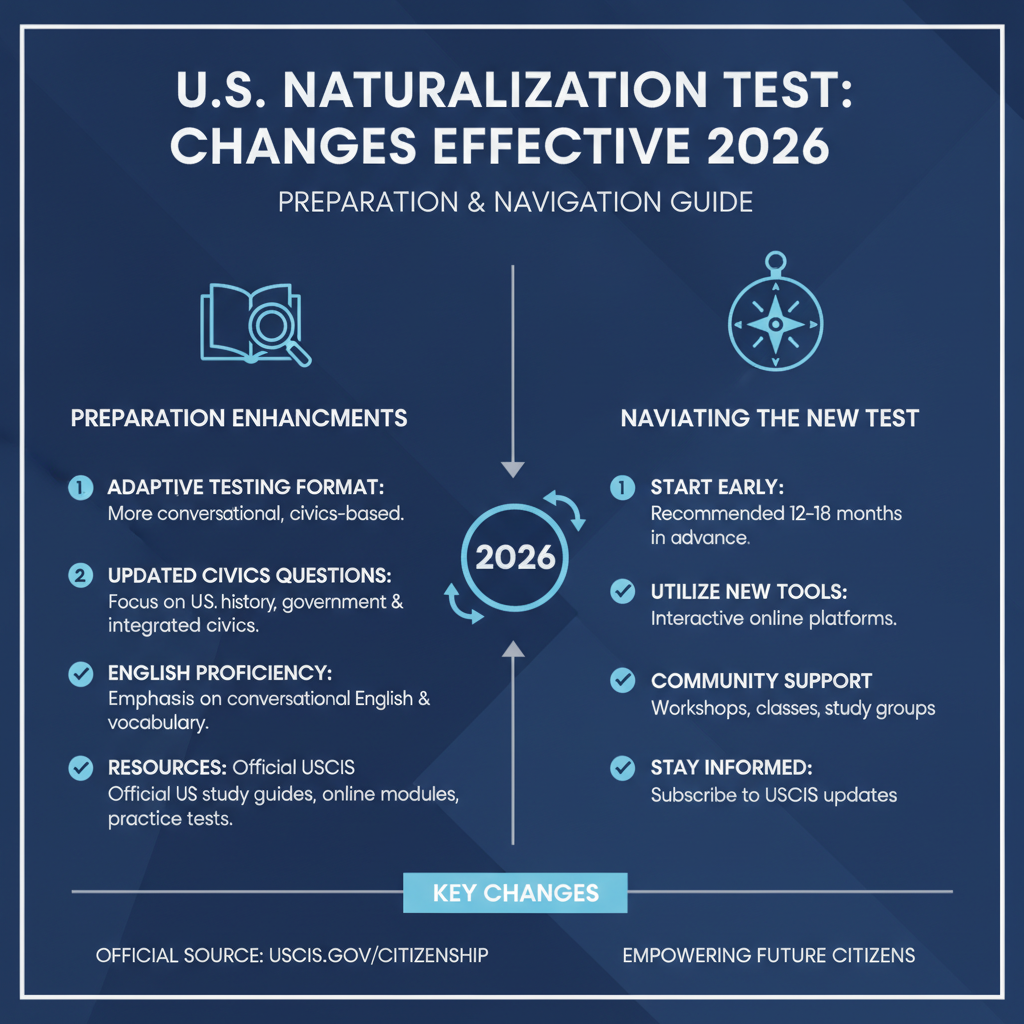
The path to U.S. citizenship is a momentous journey for millions of immigrants, symbolizing the culmination of years of dedication and aspiration. A critical component of this journey is the Naturalization Test, which assesses an applicant's knowledge of U.S. history, government, and civics, as well as their ability to read, write, and speak English. As of late 2024 and early 2025, news began to circulate regarding significant revisions to this test, with new questions and requirements slated to take effect in 2026. This has naturally led to questions and concerns among prospective citizens nationwide.
For comprehensive insights into these upcoming changes, you can refer to reports such as: Naturalization Test Changes Coming in 2026 (Citizenship).
What This News Means for Immigrants in Orlando and Across Florida
The news of impending changes to the Naturalization Test in 2026 carries significant implications for immigrants residing in Orlando, Central Florida, and throughout the Sunshine State. Florida is home to a vast and diverse immigrant population, many of whom are actively pursuing U.S. citizenship. Understanding these updates is crucial for anyone preparing to file their citizenship application or currently in the naturalization process.
Why this news is showing up now
The United States Citizenship and Immigration Services (USCIS) regularly reviews and updates its processes to ensure they remain relevant, fair, and effective. The Naturalization Test, in particular, has seen revisions over the years, with previous iterations implemented in 2008 and briefly in 2020. The current discussions and announcements about changes for 2026 are part of USCIS's ongoing commitment to periodically assess and refine the civics test. These reviews often consider educational best practices, feedback from stakeholders, and the need to ensure the test accurately reflects an applicant's understanding of American civic principles.
The timing of these announcements, nearly two years before the official implementation date, is intended to provide ample notice to prospective applicants, legal representatives, and educational institutions. This lead time allows individuals to prepare for the new format and content, mitigating potential disruptions to their citizenship journey. It also gives organizations like Imigrar the opportunity to update their resources and advise clients effectively.
How it can affect Florida residents
For the millions of immigrants in Florida, particularly those in vibrant hubs like Orlando, Miami, Tampa, and Jacksonville, these changes will directly impact their path to citizenship. Here’s a breakdown of potential effects:
- Preparation Strategy: If you are planning to apply for naturalization, your study strategy will need to adapt. Applicants who file their Form N-400, Application for Naturalization, before the 2026 changes take effect and have their interview scheduled before the new test is fully implemented, will likely take the current (2008) version of the test. However, those whose applications are filed closer to or after the implementation date, or whose interviews are significantly delayed, may face the new version. This creates a strategic decision point: apply sooner rather than later if you prefer the current test, or begin preparing for the revised format if your timeline extends into 2026.
- Educational Resources: Community organizations, adult education centers, and legal aid groups across Florida that offer citizenship classes will need to update their curricula. This includes institutions in Orlando, Orange County, and surrounding areas that serve a large immigrant population. Access to updated study materials will be paramount.
- Anxiety and Uncertainty: Any change in a significant immigration process can cause anxiety. Immigrants may worry about the difficulty of new questions, the unfamiliarity of a new format, or how these changes might delay their application. Clear, reliable information and legal guidance become even more essential during such periods.
- Impact on Diverse Communities: Florida’s immigrant population is incredibly diverse, encompassing individuals from Latin America, the Caribbean, Asia, and Europe. The new test questions may introduce different cultural or historical perspectives, requiring a broader range of study for some applicants.
- Legal Guidance: The complexity of navigating immigration law, coupled with impending test changes, underscores the value of experienced legal counsel. An immigration attorney can help you understand your specific timeline, advise on whether to apply now or wait, and ensure your entire naturalization application is robust and accurate, minimizing the risk of delays or denials.
Reminder: The Orlando USCIS Field Office, like all others, will implement these changes uniformly. While the test content is federal, the local impact on processing times and resource availability for preparation can vary. Being proactive and informed is your best defense against potential complications.
What Naturalization Test Changes Are (and Why It Matters)
The "Naturalization Test Changes Coming in 2026" refer to proposed modifications to the civics and English components of the U.S. naturalization interview. This is a crucial part of the process for obtaining U.S. citizenship, and any alteration can have profound effects on applicants.
A plain-English definition
Simply put, the Naturalization Test is an oral exam administered by a USCIS officer during your citizenship interview. It has two main parts:
- English Test: Assesses your ability to read, write, and speak basic English. You must be able to understand and answer questions about your Form N-400 application, read one out of three sentences correctly, and write one out of three sentences correctly.
- Civics Test: Assesses your knowledge and understanding of U.S. history, government, and civics. You are asked up to 10 questions from a predefined list of 100 civics questions, and you must answer 6 out of 10 correctly to pass.
The "changes coming in 2026" primarily focus on revising the civics test questions and potentially the format or content of the English reading and writing portions. This matters because it means the specific information you need to study, and possibly the way you demonstrate your knowledge, will be different from the current test. It's not just about learning new answers; it might involve understanding new types of questions or even how the interview is conducted.
Key terms you need to know
Understanding these terms is vital as you prepare for naturalization:
- Naturalization: The process by which a foreign citizen or national can become a U.S. citizen.
- USCIS (U.S. Citizenship and Immigration Services): The federal agency that oversees lawful immigration to the United States. They administer the naturalization process and the test.
- Form N-400, Application for Naturalization: The primary application form you must file to apply for U.S. citizenship.
- Civics Test: The portion of the naturalization interview that assesses your knowledge of U.S. history, government, and civics. This is the part undergoing significant changes.
- English Test: The portion of the interview that assesses your ability to read, write, and speak basic English.
- Lawful Permanent Resident (LPR): Also known as a "Green Card" holder. This status is generally a prerequisite for naturalization.
- Continuity of Residence: A requirement for naturalization where you must show you have continuously lived in the U.S. for a certain period (e.g., 5 years or 3 years if married to a U.S. citizen).
- Physical Presence: A requirement that you must have been physically present in the U.S. for a specified cumulative period during your continuous residence.
- Good Moral Character: A legal requirement for naturalization, meaning you must demonstrate adherence to certain moral standards, free from specific criminal offenses or behaviors.
- Oath of Allegiance: The final step in the naturalization process, where you formally pledge loyalty to the United States.
- N-400 Interview: The in-person interview with a USCIS officer where your application is reviewed, and the English and Civics tests are administered.
These changes matter because they directly affect your ability to pass a mandatory component of the naturalization process. If you are not adequately prepared for the new test, it could lead to a denial of your citizenship application, requiring you to reapply and incur additional costs and delays. Staying informed and preparing strategically is paramount.
Navigating the Path to Citizenship? The upcoming Naturalization Test changes can add layers of complexity. Let Imigrar simplify the process for you. Our Orlando-based immigration lawyers are experts in naturalization and can help you prepare for the current or new test. Call us today at +1 786-791-3106 for a free consultation. Se Habla Español.
Current Immigration Law: The Foundation
The naturalization process, including the requirement for a civics and English test, is rooted in federal immigration law. While the specifics of the test questions are administrative decisions by USCIS, the underlying authority comes from the Immigration and Nationality Act (INA).
Federal requirements
The primary legal framework for naturalization is found in Chapter 2 of Title III of the Immigration and Nationality Act (INA), specifically sections 310 through 339 (8 U.S.C. §§ 1421-1450). Key federal requirements for naturalization include:
- Age: You must be at least 18 years old at the time of filing Form N-400.
- Lawful Permanent Residency: You must be a lawful permanent resident (Green Card holder) for a certain period, typically 5 years, or 3 years if you are married to a U.S. citizen and meet other specific requirements.
- Continuous Residence and Physical Presence:
- 5-Year Rule: You must have continuously resided in the U.S. as an LPR for at least 5 years immediately preceding your application, and have been physically present in the U.S. for at least half of that time (30 months).
- 3-Year Rule (Spouses of U.S. Citizens): If married to and living with a U.S. citizen, you must have continuously resided in the U.S. as an LPR for at least 3 years immediately preceding your application, and have been physically present for at least half of that time (18 months). Your spouse must have been a U.S. citizen for the entire 3-year period.
- Other Exceptions: Special rules apply to military members, certain children of U.S. citizens, and others.
- Residence in District: You must have resided for at least 3 months in the state or USCIS district where you file your application. For Central Florida residents, this would typically be the Orlando USCIS Field Office jurisdiction.
- Good Moral Character: You must demonstrate good moral character for the statutory period (typically 5 or 3 years) immediately preceding your application, and up to the time of taking the Oath of Allegiance. This involves an assessment of your criminal record, tax compliance, and other aspects of your conduct.
- Attachment to the Principles of the U.S. Constitution: You must demonstrate an attachment to the principles of the U.S. Constitution and be well-disposed to the good order and happiness of the United States.
- English Language Proficiency: As per INA 312(a)(1), you must be able to read, write, and speak English at a basic level. There are exceptions for age and length of LPR status:
- Applicants 50 years old or older who have lived in the U.S. as LPRs for at least 20 years (50/20 rule).
- Applicants 55 years old or older who have lived in the U.S. as LPRs for at least 15 years (55/15 rule).
- Applicants 65 years old or older who have lived in the U.S. as LPRs for at least 20 years (65/20 rule) get a simpler civics test.
- Individuals with certain medical disabilities may also be exempt (Form N-648, Medical Certification for Disability Exceptions).
- Knowledge of U.S. History and Government (Civics): As per INA 312(a)(2), you must demonstrate knowledge and understanding of the fundamentals of U.S. history and government. This is the component subject to the 2026 changes.
- Oath of Allegiance: You must take an Oath of Allegiance to the United States.
For the most current and detailed information on all requirements, always refer to the USCIS official website.
Florida-specific considerations
While the naturalization process is federal, there are practical considerations for Florida residents:
- USCIS Field Offices: The primary USCIS Field Office serving Central Florida, including Orlando, Orange County, and the surrounding I-4 corridor, is located in Orlando. Your naturalization interview will typically be scheduled here. Understanding the specific procedures and average processing times for the Orlando office is beneficial. You can check USCIS Processing Times for the Orlando Field Office.
- Local Resources: Florida has numerous community organizations, non-profits, and educational institutions that offer citizenship preparation classes. These resources are invaluable for studying the English and Civics tests. As the 2026 changes approach, ensure that any preparatory courses you consider have updated their curriculum to reflect the new test content.
- Diverse Population Needs: Florida's large Spanish-speaking population, among other linguistic groups, often benefits from resources available in multiple languages. Imigrar, for example, offers services in both English and Spanish (Se Habla Español) to ensure clear communication and support throughout the process.
- State-Specific Legal Aid: While Imigrar serves clients nationwide, our local presence in Orlando means we are deeply familiar with the nuances of the local USCIS office and can provide tailored advice to Florida residents.
How to Become a U.S. Citizen: A Complete Step-by-Step Guide
Becoming a U.S. citizen through naturalization is a multi-step process. Here’s a detailed guide, incorporating the considerations of the upcoming 2026 test changes.
1) Determine Your Eligibility and Gather Initial Documents
Before you even begin filling out forms, you must confirm you meet the basic naturalization requirements. This is the foundational step.
- Check Eligibility:
- Are you 18 years or older?
- Are you a Lawful Permanent Resident (Green Card holder)?
- Have you held your Green Card for at least 5 years (or 3 years if married to a U.S. citizen and meet other criteria)?
- Have you met the continuous residence and physical presence requirements?
- Have you resided in your USCIS district (e.g., Orlando) for at least 3 months?
- Can you demonstrate good moral character?
- Initial Document Checklist:
- Your Green Card (Form I-551)
- State-issued identification (e.g., Florida Driver's License)
- Social Security Card
- Current and all expired passports
- Marriage certificate (if applying under the 3-year rule)
- Divorce decrees or death certificates for all prior marriages (for you and your spouse, if applicable)
- Birth certificates of your children (if applicable)
- Proof of Selective Service registration (if you are a male who lived in the U.S. between ages 18-26)
Important: If you have any criminal history, even minor offenses, it is crucial to consult with an immigration attorney at this stage. Certain convictions can bar you from naturalization, and transparency is key.
2) Prepare and File Form N-400, Application for Naturalization
This is the core application form for U.S. citizenship. It is extensive and requires accurate and complete information about your personal history, residence, employment, family, and good moral character.
- Complete Form N-400: Fill out every section truthfully and completely. Pay close attention to questions about your travel history, employment, and any interactions with law enforcement.
- Gather Supporting Documents for N-400:
- Copies of your Green Card (front and back).
- Copies of your marriage certificate (if applicable).
- Copies of divorce decrees/death certificates (if applicable).
- Copies of court dispositions for any arrests or citations (traffic tickets, etc.), even if charges were dropped or expunged.
- Copies of your tax returns/IRS tax transcripts for the past 5 (or 3) years, proving you've filed taxes.
- Proof of child support payments (if applicable).
- Two identical passport-style photos (if filing by mail; online filers will upload).
- If applying for a medical disability exception, Form N-648, Medical Certification for Disability Exceptions, completed by a licensed medical professional.
- Calculate Fees: Check the USCIS Forms page for the current filing fee for Form N-400, plus the biometrics fee. Fee waivers may be available for eligible applicants (Form I-912, Request for Fee Waiver).
- File Your Application: You can file Form N-400 online through the USCIS website or by mail to the appropriate USCIS Lockbox facility. Filing online can sometimes expedite receipt notices and provide real-time updates.
Warning: Any false statements or omissions on Form N-400 can lead to denial, accusations of misrepresentation, and even deportation. Accuracy is paramount.
3) Attend Biometrics Appointment
After USCIS accepts your application, you will receive an appointment notice (Form I-797C, Notice of Action) for a biometrics appointment at an Application Support Center (ASC).
- Purpose: At this appointment, USCIS will collect your fingerprints, photograph, and signature. These are used for background checks by the FBI and other government agencies.
- What to Bring:
- Your Biometrics Appointment Notice.
- A valid photo identification (e.g., Green Card, Florida Driver's License).
- Process: The appointment is typically brief. No interview or test takes place at the ASC.
Reminder: Do not miss your biometrics appointment. If you have an unavoidable conflict, follow the instructions on the notice to reschedule immediately.
4) Complete the Naturalization Interview (and Test)
This is the most critical step, where you meet with a USCIS officer. Your interview will typically be scheduled at the Orlando USCIS Field Office if you reside in Central Florida.
- Receive Interview Notice: USCIS will mail you an interview appointment notice (Form I-797C) with the date, time, and location.
- Prepare for the Interview:
- Review your N-400: Be prepared to answer questions about every detail of your application.
- Study for English Test: Practice reading and writing simple English sentences.
- Study for Civics Test: Memorize the answers to the 100 civics questions. As of 2026-10-24, the 2008 civics test is still in effect. If your interview is scheduled before the 2026 changes, prepare for the 2008 version. If your interview is likely to fall after the implementation, or if you expect delays, begin familiarizing yourself with any new questions or formats USCIS releases for the 2026 test.
- Gather Original Documents: Bring ALL original documents you submitted copies of with your Form N-400, plus any updated documents (e.g., new passport, updated tax returns if requested).
- During the Interview:
- The officer will review your Form N-400 answers, confirming details about your life, travel, and good moral character.
- You will take the English test (reading, writing, and speaking).
- You will take the Civics test (up to 10 questions, need 6 correct).
- The officer will determine if you meet all eligibility requirements.
- Possible Outcomes:
- Recommended for Approval: If you pass all tests and meet all requirements.
- Continued: If the officer needs additional documents or clarification, or if you failed a portion of the test. You will typically be given a second chance for the English/Civics test within 60 to 90 days.
- Denied: If you fail the second attempt at the test, or if you are found ineligible for other reasons.
Important: If you are unsure whether you will take the current or the 2026 test, it is best to prepare for both if possible, or consult with Imigrar to strategize based on your specific application timeline.
5) Receive Decision and Attend Oath Ceremony
This is the final stage of your journey to U.S. citizenship.
- Decision Notification: If recommended for approval, you will receive a Form N-652, Naturalization Interview Results, at the end of your interview, indicating approval. You will then receive a Form N-445, Notice of Naturalization Oath Ceremony, with the date, time, and location of your oath ceremony.
- Oath Ceremony:
- This is a formal ceremony where you will take the Oath of Allegiance to the United States.
- You will surrender your Green Card (Form I-551).
- You will receive your Certificate of Naturalization, which is proof of your U.S. citizenship.
- After the Oath:
- You can apply for a U.S. passport.
- You can register to vote.
Congratulations! You are now a U.S. citizen. Keep your Certificate of Naturalization in a safe place, as it cannot be easily replaced.
Ready to Apply for Citizenship? Don't let the upcoming test changes deter you. Imigrar's dedicated team in Orlando provides comprehensive support for naturalization applications, from eligibility assessment to interview preparation. Call +1 786-791-3106 for your free consultation today. Se Habla Español.

Practical Steps You Can Take Today
With the 2026 Naturalization Test changes on the horizon, proactive preparation is key. Here are actionable steps you can take now, whether you plan to apply soon or later.
Actionable Checklist (5+ items):
- Assess Your Eligibility: Use the requirements outlined above to determine if you meet the continuous residence, physical presence, and good moral character criteria. If you're close to meeting the residency requirements, calculate your eligibility date carefully.
- Gather All Necessary Documents: Start compiling all original and copy documents needed for Form N-400. This includes your Green Card, passports, marriage/divorce certificates, tax records, and court documents (if any). Organize them meticulously.
- Begin Studying for the Current Civics Test: Even if the test changes, many core principles of U.S. government will remain. USCIS provides official study materials for the current 100 civics questions. Start memorizing them. You can find them on the USCIS official website.
- Improve Your English Skills: The English test is a constant. Practice reading simple sentences, writing them out, and conversing in English. Watch U.S. news, read local newspapers (like the Orlando Sentinel), and engage in English-speaking communities.
- Consult with an Immigration Attorney: This is arguably the most crucial step. An attorney from Imigrar can evaluate your specific situation, advise on the best time to file given the 2026 changes, help you prepare a robust application, and guide you through interview preparation.
- Check USCIS Updates Regularly: Stay informed about the exact nature and effective date of the 2026 test changes. Monitor the USCIS official website for announcements.
- Consider Filing Sooner Rather Than Later: If you are eligible now and prefer to take the current (2008) version of the civics test, filing your Form N-400 promptly might allow your interview to be scheduled before the 202
Related Topics
Need Legal Assistance?
Our experienced immigration attorneys are here to help with your case. Contact Imigrar today for a free consultation and let us guide you through the legal process with confidence.
📍 Orlando, Florida • Serving clients nationwide
📧 info@imigrar.com