
H-1B Visa Lottery Changes FY2027: Your Imigrar Guide
Navigate the H-1B Visa Lottery Changes for Fiscal Year 2027 with Imigrar. Learn about new rules, requirements, and how to optimize your application for success.
What This News Means for Immigrants in Orlando and Across Florida
Why this news is showing up now
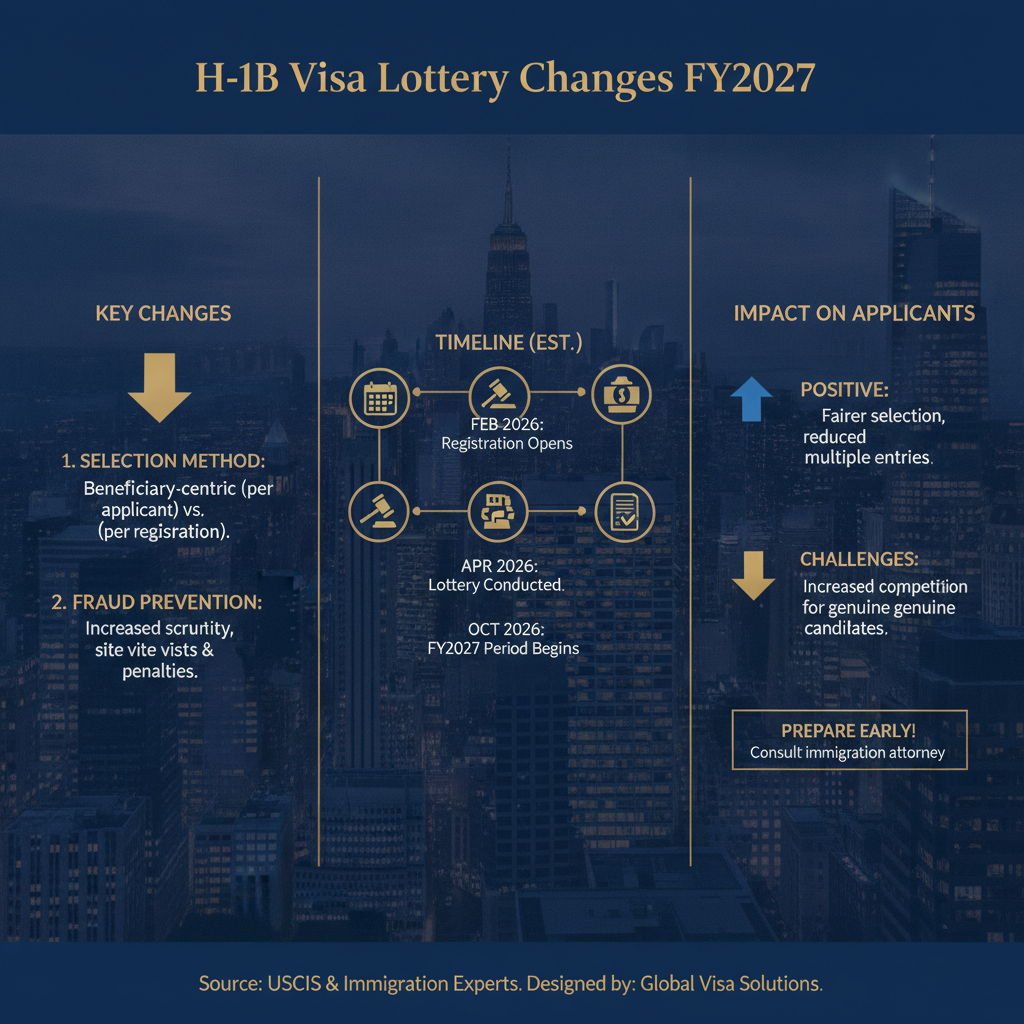
The H-1B cap-subject visa program operates on a fiscal year that begins on October 1st. To allow sufficient time for petition filing and processing, U.S. Citizenship and Immigration Services (USCIS) typically opens the electronic registration period in early March of the calendar year *before* the fiscal year begins. For FY2027, this means the registration period will likely open in March 2027, with the earliest employment start date of October 1, 2027. The "news" surrounding H-1B changes often surfaces in the months leading up to the registration period. This is when USCIS finalizes and announces specific policy adjustments, fee updates, or procedural modifications for the upcoming lottery cycle. Given that today is October 22, 2026, discussions about potential changes for FY2027 are highly relevant and timely. Stakeholders, including immigration attorneys, employers, and professional organizations, closely monitor these announcements to prepare for the annual surge of applications. These discussions are often driven by ongoing efforts to combat fraud, improve the integrity of the lottery process, and ensure fair opportunities for eligible beneficiaries.How it can affect Florida residents
Florida, particularly the Orlando and Central Florida region, is a hub for various industries that heavily rely on H-1B visa holders. Our state boasts thriving sectors in technology, aerospace, healthcare, tourism, and education. Companies in these fields, from startups to multinational corporations along the I-4 corridor, frequently sponsor H-1B petitions to bring in skilled talent that is in high demand. For individuals residing in Orlando, Tampa, Miami, or other Florida cities who aspire to obtain an H-1B visa, these changes have direct implications: * **Increased Scrutiny:** Any new rules, especially those aimed at curbing fraud, could mean more rigorous review of registrations and petitions. This might include stricter requirements for demonstrating a bona fide job offer or a specialty occupation. * **Procedural Adjustments:** Changes to the registration process, fee structures, or documentation requirements could alter how you and your sponsoring employer prepare. Being informed is key to avoiding delays or rejections. * **Competitive Landscape:** While the overall H-1B cap often remains the same, changes in how the lottery is conducted (such as the recent shift to a "beneficiary-centric" selection process) can affect your odds of selection. Understanding these nuances is vital for strategizing your application. * **Employer Readiness:** Florida-based employers must adapt quickly to new regulations to ensure compliance and maintain their ability to attract international talent. This could impact their willingness or capacity to sponsor H-1B visas. At Imigrar, we understand that these changes can create anxiety and uncertainty. Our mission is to keep families together and help individuals achieve their professional dreams in the U.S. We are here to guide you through every step of the H-1B process, ensuring you are prepared for whatever the FY2027 changes may bring.Need Help Navigating H-1B Changes? Our Orlando immigration team is ready to assist. Call +1 786-791-3106 for a free consultation, or message us online. Se Habla Español.
What H-1B Visa Lottery Changes for FY2027 Is (and Why It Matters)
The H-1B visa is a nonimmigrant visa that allows U.S. employers to temporarily employ foreign workers in specialty occupations. These occupations generally require a bachelor's degree or higher in a specific specialty. Given the high demand for these visas and the annual statutory cap, USCIS conducts a lottery to select eligible registrations when the number of registrations exceeds the available visas. The "changes" for FY2027 refer to any modifications USCIS implements for this upcoming lottery cycle, which are crucial because they directly impact the fairness, efficiency, and integrity of the selection process.A plain-English definition
Imagine a limited number of highly sought-after tickets for a big event. The H-1B visa is like one of those tickets, allowing skilled foreign professionals to work in specific jobs in the U.S. Each year, there's a cap on how many of these visas can be issued. Because far more people want these visas than are available, USCIS runs a "lottery" to pick who gets a chance to apply. The "H-1B Visa Lottery Changes for FY2027" refers to any new rules or adjustments USCIS makes to *how* this lottery is run for the fiscal year starting October 1, 2027. These changes are incredibly important because they can affect your chances of being selected, the information you need to provide, and the overall integrity of the system. For instance, recent changes have aimed at preventing fraud where multiple employers might register the same individual to increase their odds, without a genuine job offer. These new rules are designed to make the lottery fairer and ensure that genuine job opportunities are prioritized.Key terms you need to know
Understanding the H-1B process requires familiarity with specific terminology: * **H-1B Visa:** A nonimmigrant visa category that permits U.S. employers to temporarily employ foreign workers in specialty occupations. * **Specialty Occupation:** An occupation that requires theoretical and practical application of a body of highly specialized knowledge, and a bachelor's or higher degree in the specific specialty (or its equivalent) as a minimum for entry into the occupation in the United States. * **H-1B Cap:** The annual statutory limit on the number of H-1B visas issued. Currently, Congress has set the annual regular cap at 65,000 visas, with an additional 20,000 visas reserved for those with a U.S. master's degree or higher (the "Master's Cap"). * **USCIS:** **U.S. Citizenship and Immigration Services**, the government agency responsible for administering immigration and naturalization benefits. * **Beneficiary:** The foreign national employee for whom the H-1B visa is sought. * **Petitioner:** The U.S. employer who files the H-1B petition on behalf of the beneficiary. * **LCA (Labor Condition Application):** **Form ETA-9035**, filed with the U.S. Department of Labor (DOL) by the employer, attesting to specific conditions regarding wages and working conditions for the H-1B worker. * **Lottery (or Cap-Gap Lottery):** The process USCIS uses to randomly select enough H-1B registrations to meet the annual cap when demand exceeds availability. * **Registration Period:** The designated window during which prospective H-1B petitioners (employers) must electronically register beneficiaries for the lottery. For FY2027, this is expected in March 2027. * **Selection Notice:** The notification from USCIS to petitioners whose registrations have been selected in the lottery, allowing them to file an H-1B petition. * **Form I-129:** **Petition for a Nonimmigrant Worker**, the primary form filed by the employer after a registration is selected. * **FY2027 (Fiscal Year 2027):** The U.S. government's fiscal year that begins on October 1, 2026, and ends on September 30, 2027. For H-1B purposes, the FY2027 lottery refers to visas that become available on October 1, 2027. * **Beneficiary-Centric Selection:** A recent change (implemented for FY2025) where each unique beneficiary is entered into the lottery only once, regardless of how many employers register them. This aims to reduce fraud and improve fairness. The FY2027 changes will likely build upon or refine this model. Understanding these terms is your first step toward successfully navigating the H-1B process, especially with new rules on the horizon.Current Immigration Law: The Foundation
The H-1B visa program is governed by the Immigration and Nationality Act (INA), primarily sections 101(a)(15)(H)(i)(b) and 214(g). These statutes establish the framework for specialty occupations, the annual cap, and the requirements for both employers and beneficiaries. While the core law remains constant, USCIS, under the authority granted by Congress, implements regulations and policies that dictate the operational aspects, including the lottery process, fees, and anti-fraud measures. This is where the "changes" come into play, refining how the existing law is applied.Federal requirements
To qualify for an H-1B visa, both the employer (petitioner) and the foreign worker (beneficiary) must meet specific federal criteria: **For the Specialty Occupation:** * The job must require a bachelor's degree or higher in a specific field. * The beneficiary must hold the required degree or its equivalent. * The employer must show that the position is truly a specialty occupation, often by demonstrating industry practice, complexity of duties, or regulatory requirements. **For the Employer (Petitioner):** * Must have an Employer Identification Number (EIN). * Must offer a genuine job in a specialty occupation. * Must file a **Labor Condition Application (LCA)**, **Form ETA-9035**, with the U.S. Department of Labor (DOL) and receive certification before filing the H-1B petition. In the LCA, the employer attests that it will pay the H-1B worker at least the prevailing wage or the actual wage paid to similarly qualified employees, whichever is higher, and that working conditions will not adversely affect U.S. workers. * Must agree to specific wage and working conditions requirements. **For the Foreign Worker (Beneficiary):** * Must hold a bachelor's degree or its equivalent, or possess a license, or have work experience equivalent to a bachelor's degree. * The degree must be in a field related to the specialty occupation. * Must have a genuine job offer from a U.S. employer. **Important:** The H-1B is a "dual intent" visa, meaning that beneficiaries can intend to seek lawful permanent residency in the U.S. while holding H-1B status, unlike some other nonimmigrant visas.Florida-specific considerations
While H-1B requirements are federal, the specific economic landscape of Florida makes certain sectors particularly relevant for H-1B applicants: * **Technology Hubs:** Orlando, Tampa, and Miami are growing tech centers, with companies in software development, cybersecurity, data analytics, and IT consulting frequently sponsoring H-1B visas. The Orlando Economic Partnership actively promotes tech growth, creating demand for skilled foreign talent. * **Healthcare:** Florida's large and aging population drives significant demand for healthcare professionals, including nurses, physical therapists, and medical researchers. Many hospitals and healthcare systems across the state, including major ones in Orlando, sponsor H-1B visas. * **Hospitality and Tourism:** While many roles in tourism don't qualify as specialty occupations, certain positions in management, finance, marketing analytics, or specialized IT within large hospitality corporations in Orlando and South Florida might. * **Aerospace and Defense:** Areas like the Space Coast and facilities near Orlando (e.g., Lockheed Martin) have a strong presence in aerospace, engineering, and defense, often seeking highly specialized H-1B talent. * **Education:** Universities and research institutions throughout Florida, such as the University of Central Florida (UCF) in Orlando, are often H-1B cap-exempt employers, meaning they are not subject to the annual lottery. However, private educational technology companies or administrative roles might be cap-subject. For Central Florida residents, particularly those near the Orlando USCIS Field Office, understanding these local dynamics can inform your job search and H-1B strategy. The attorneys at Imigrar are deeply familiar with the needs of Florida's industries and can provide targeted advice. For all official information and forms, always refer to the USCIS official website. Key forms related to the H-1B process include **Form I-129, Petition for a Nonimmigrant Worker**, and **Form I-797, Notice of Action**, which you will receive at various stages of your application.How to Navigate the H-1B Visa Lottery Changes for FY2027: A Complete Step-by-Step Guide
Successfully navigating the H-1B visa lottery, especially with new changes for FY2027, requires meticulous planning and execution. This guide outlines the typical steps involved, emphasizing areas where the new rules might have an impact.1) Understand the New H-1B Lottery Rules for FY2027
Before anything else, it’s imperative to grasp the specifics of the FY2027 changes. While the exact details are announced closer to the registration period (expected March 2027), recent trends suggest a continued focus on anti-fraud measures and the beneficiary-centric selection process. * **What to look for:** * **Beneficiary-centric confirmation:** USCIS shifted to selecting by unique beneficiary rather than by registration for FY2025. Expect this to continue, with heightened scrutiny on multiple registrations from "related entities" or fraudulent employers. * **Fee changes:** USCIS periodically updates fees. Be prepared for potential increases in the H-1B registration fee, **Form I-129** filing fees, and other associated costs. * **Data requirements:** USCIS may request additional data points during registration to verify employer legitimacy or beneficiary qualifications. * **Integrity measures:** Look for announcements regarding new measures to detect and deter fraud, such as site visits or stricter penalties for violations. * **Actionable Advice:** Stay updated by monitoring official USCIS announcements and consulting with an experienced immigration attorney. Imigrar actively tracks these developments to provide the most current advice.2) Employer and Employee Eligibility Assessment
This foundational step ensures that both the sponsoring employer and the prospective H-1B worker meet the basic requirements. * **For the Employer (Petitioner):** * Confirm the company is a legitimate U.S. entity with a valid Employer Identification Number (EIN). * Verify that the position offered is a bona fide "specialty occupation" requiring at least a bachelor's degree in a specific field. * Ensure the company can pay the required prevailing wage for the position and location (e.g., Orlando, FL). * **Required Documents (Employer):** * Company formation documents (e.g., Articles of Incorporation) * EIN verification * Business licenses * Financial statements (to prove ability to pay) * Job description for the H-1B position * Organizational charts * **For the Employee (Beneficiary):** * Verify you possess the minimum educational qualifications (bachelor's degree or higher, or its equivalent through education and/or work experience). * Ensure your degree field directly relates to the specialty occupation. * **Required Documents (Beneficiary):** * Copies of all academic degrees and diplomas (original language and certified English translations) * Transcripts for all post-secondary education * Educational equivalency evaluation (if degree is from outside the U.S.) * Resume/CV detailing work experience * Copies of all previous U.S. visa stamps and I-94 records (if applicable) * Passport biographical page copy3) Labor Condition Application (LCA) Filing
Before an H-1B registration can even be submitted, the employer must file and obtain certification for a **Labor Condition Application (LCA)**, **Form ETA-9035**, from the U.S. Department of Labor (DOL). * **Process:** 1. The employer determines the prevailing wage for the occupation in the specific geographic area (e.g., Orange County, FL). 2. The employer completes **Form ETA-9035**, making attestations regarding wages, working conditions, and absence of strikes or lockouts. 3. The employer posts a notice of the LCA filing at the worksite or provides it directly to affected employees. 4. The LCA is electronically submitted to the DOL. 5. The DOL reviews and certifies the LCA, typically within 7 business days. * **Importance:** A certified LCA is a prerequisite for filing the H-1B petition. Any inaccuracies or misrepresentations on the LCA can lead to petition denial or severe penalties. * **Timeline Expectation:** Allow at least 7-10 business days for DOL processing.4) H-1B Registration Process
This is the critical step for entering the lottery. For FY2027, this process will likely take place in March 2027. * **Process:** 1. The employer, or their authorized legal representative (like Imigrar), creates a USCIS online account. 2. For each beneficiary, the employer submits an electronic registration, providing basic information about the company and the beneficiary. 3. The employer pays the non-refundable H-1B registration fee (historically $10, but subject to change for FY2027). 4. **Important:** Under the beneficiary-centric model, each unique beneficiary should only have one registration submitted on their behalf by a single employer. If multiple employers genuinely offer a job, each employer can submit a registration for the same beneficiary, but the beneficiary's odds are not increased. USCIS will select by *unique beneficiary*. * **Key Information Required for Registration:** * Employer's legal name, EIN, and mailing address. * Employer's authorized signatory information. * Beneficiary's full name, date of birth, country of birth, country of citizenship, gender, and passport number. * Beneficiary's highest degree attained and the institution that awarded it. * Whether the beneficiary is eligible for the Master's Cap. * **Timeline Expectation:** The registration period typically lasts for 2-3 weeks in March. USCIS usually announces selection results by the end of March or early April.5) Petition Filing (if selected)
If your registration is selected in the lottery, USCIS will issue a selection notice. This notice grants the employer a specific window (typically 90 days) to file the full H-1B petition. * **Process:** 1. Upon selection, the employer and attorney prepare the comprehensive **Form I-129, Petition for a Nonimmigrant Worker**, and all supporting documentation. 2. The petition package is mailed to the appropriate USCIS Service Center. 3. **Required Documents for Form I-129 (if selected):** * **Form I-129** and H-1B supplement * Certified **LCA (Form ETA-9035)** * Copy of the H-1B selection notice * Employer letter supporting the petition, detailing the job offer, specialty occupation duties, and qualifications needed. * Evidence of specialty occupation (e.g., job descriptions, industry reports, expert opinions). * Evidence of beneficiary's qualifications (degrees, transcripts, evaluations, licenses, experience letters). * Beneficiary's immigration documents (passport, visas, I-94, prior I-797s). * Employer's financial documents (annual reports, tax returns, payroll records) to prove ability to pay. * Client letters, vendor agreements, statements of work (SOWs) for third-party placements (critically important, especially with new scrutiny). * Filing fees (base fee, ACWIA fee, fraud prevention and detection fee, public law 114-113 fee if applicable). * **Warning:** Filing a petition without a valid selection notice, or outside the designated filing window, will result in rejection.6) Premium Processing Consideration
After filing **Form I-129**, employers have the option to request Premium Processing for an additional fee. * **What it is:** For an extra fee (currently $2,805, but subject to change for FY2027), USCIS guarantees processing of the H-1B petition within 15 calendar days. If they don't meet this deadline, they refund the fee. * **Why use it:** Expedited processing can be crucial for beneficiaries needing to start work quickly or those with expiring immigration statuses. * **Form:** **Form I-907, Request for Premium Processing Service**. * **Important:** Premium processing may not be available immediately for all H-1B cap-subject petitions, as USCIS sometimes pauses it due to high volume. Always check the USCIS website for current availability.7) Post-Approval Steps
If the H-1B petition is approved, the beneficiary can begin work on October 1st of the fiscal year. * **For Beneficiaries Already in the U.S.:** If approved with a Change of Status, your status automatically changes to H-1B on October 1st. You will receive an **Form I-797A, Approval Notice with a new I-94**. * **For Beneficiaries Outside the U.S.:** You will need to apply for an H-1B visa stamp at a U.S. embassy or consulate in your home country. This involves an interview. * **Required Documents for Visa Interview:** * Valid passport * **Form I-797B, Approval Notice** * DS-160 confirmation page * Visa appointment confirmation * Recent passport-style photos * LCA copy * Employer's support letter * Original academic documents and evaluations * Resume/CV * Proof of ties to home country (though H-1B is dual intent, demonstrating non-immigrant intent for visa stamping can be helpful) * **Maintaining Status:** H-1B holders must maintain their status by working for the sponsoring employer in the approved specialty occupation. Any significant changes (e.g., job duties, location, employer) may require an amended petition.Overwhelmed by the H-1B Process? Imigrar provides expert guidance for H-1B visas in Orlando and nationwide. Let us simplify your journey. Call +1 786-791-3106 today for a free consultation. Se Habla Español.
Practical Steps You Can Take Today
Even though the FY2027 H-1B lottery registration period is months away, proactive preparation is key, especially with new rules anticipated. * **Actionable Checklist:** 1. **Verify Your Eligibility:** Review your educational qualifications and work experience against H-1B requirements. Ensure your degree aligns with a specialty occupation. 2. **Gather All Documents:** Start compiling all necessary personal and academic documents, including degrees, transcripts, and any professional licenses. If your documents are not in English, begin the certified translation process. 3. **Secure a Sponsoring Employer:** This is the most crucial step. Actively seek employment with U.S. companies (particularly those in Florida's tech, healthcare, and engineering sectors) that have a history of sponsoring H-1B visas. Ensure the job offer is for a bona fide specialty occupation. 4. **Consult an Immigration Attorney:** Engage with an experienced immigration lawyer, like those at Imigrar, *early*. We can assess your eligibility, advise your potential employer, and help prepare for the upcoming changes. 5. **Understand Prevailing Wages:** Research the prevailing wage for your occupation and location (e.g., Orlando, FL) to ensure your potential employer can meet the wage requirements. 6. **Stay Informed on USCIS Announcements:** Regularly check the USCIS official website for updates on FY2027 H-1B lottery rules, registration dates, and fees. 7. **Review Prior Immigration History:** If you've had previous U.S. visas or immigration applications, gather all related documentation. * **Document Preparation Guidance:** * **Originals vs. Copies:** While USCIS usually requires copies for initial filings, keep all originals safe and accessible. Certified translations are mandatory for non-English documents. * **Digital Copies:** Scan all documents and organize them digitally for easy access and sharing with your attorney. * **Accuracy is Paramount:** Double-check all dates, names, and numbers across all documents to ensure consistency. * **Timeline Expectations:** * **October - February 2026/2027:** This is your window for eligibility assessment, document gathering, and securing a sponsoring employer. * **Late February - Early March 2027:** USCIS typically announces the exact H-1B registration dates and any final rules for FY2027. * **March 2027 (approx. 2-3 weeks):** H-1B Electronic Registration Period. This is when your employer (or their attorney) submits your registration. * **Late March - Early April 2027:** USCIS announces lottery results and issues selection notices. * **April 1 - June 30, 2027 (approx.):** The 90-day window for selected petitioners to file **Form I-129**. * **October 1, 2027:** Earliest start date for approved H-1B employment for FY2027 petitions. **Reminder:** The H-1B lottery is highly competitive. For FY2026, USCIS received over 470,000 eligible registrations for just 85,000 visas. A well-prepared and legally sound application, guided by experts, significantly increases your chances of success.
How Imigrar Helps Immigrants in Orlando Navigate H-1B Changes
At Imigrar, we understand the profound impact that H-1B visa changes can have on individuals and families. Our firm, based in Orlando, Florida, is dedicated to "Keep Families Together" by providing professional, compassionate, and effective immigration legal services to clients nationwide. **Our Experience and Expertise:** Our team of experienced immigration attorneys specializes in employment-based visas, including the complex H-1B lottery process. We have a proven track record of helping skilled professionals and their sponsoring employers navigate the intricateRelated Topics
Need Legal Assistance?
Our experienced immigration attorneys are here to help with your case. Contact Imigrar today for a free consultation and let us guide you through the legal process with confidence.
📍 Orlando, Florida • Serving clients nationwide
📧 info@imigrar.com