
H-1B Lottery Changes FY2027: Your Guide to the New Rules
Understand the critical H-1B visa lottery changes for FY2027. Imigrar provides a comprehensive guide for immigrants in Orlando and nationwide.

What This News Means for Immigrants in Orlando and Across Florida
The landscape of U.S. immigration law is constantly evolving, and few areas generate as much anticipation and anxiety as the annual H-1B visa lottery. For Fiscal Year 2027 (FY2027), the United States Citizenship and Immigration Services (USCIS) has introduced significant reforms to the H-1B cap registration process. These changes aim to enhance fairness, combat fraud, and streamline the selection process, directly impacting countless aspiring professionals and their sponsoring employers.
Why this news is showing up now
The H-1B visa program operates on a fiscal year basis, running from October 1st to September 30th. Each year, USCIS accepts H-1B petitions for the upcoming fiscal year, subject to an annual cap. For FY2027, which begins on October 1, 2026, the H-1B cap registration period typically opens in March of the preceding calendar year (i.e., March 2026). The new rules were finalized and announced well in advance of the FY2027 registration period to give employers and prospective beneficiaries ample time to understand and adapt to the updated requirements. The discussion and implementation of these changes have been a trending topic in legal news, reflecting their profound implications for high-skilled immigration.
How it can affect Florida residents
Florida, and particularly the Orlando metropolitan area, is a vibrant hub for diverse industries that heavily rely on H-1B talent. Our state boasts thriving sectors in technology, hospitality, healthcare, aerospace, engineering, and advanced manufacturing. Companies along the I-4 corridor, from Orlando to Tampa, frequently seek foreign professionals to fill specialized roles that are critical to their growth and innovation. For immigrants living in Orlando, Central Florida, and throughout the Sunshine State, these H-1B lottery changes are paramount. If you are a student graduating from a Florida university, a professional working on an Optional Practical Training (OPT) visa, or an individual seeking to transition to an H-1B visa, these new rules will directly influence your chances of securing a coveted H-1B slot. Florida employers must also adapt their strategies for sponsoring foreign workers, ensuring compliance with the updated registration process. Understanding these changes is not just about legal technicalities; it's about safeguarding career paths and business growth in our community.
Need Help? Our Orlando immigration team is ready to assist with your H-1B questions. Call +1 786-791-3106 for a free consultation, or message us online. Se Habla Español.
What H-1B Visa Lottery Changes for FY2027 Is (and Why It Matters)
The H-1B visa program is a nonimmigrant visa that allows U.S. employers to temporarily employ foreign workers in specialty occupations. These occupations generally require a bachelor's degree or higher in a specific field. Due to high demand, the number of H-1B petitions often exceeds the annual cap set by Congress, necessitating a lottery system to select eligible registrations. The changes for FY2027 fundamentally alter how this lottery is conducted.
A plain-English definition
Imagine a highly competitive race where thousands of people want to participate, but only a limited number of spots are available. The H-1B visa is like one of those spots. Each year, the U.S. government sets a limit, or "cap," on how many new H-1B visas can be issued. Because so many talented foreign professionals want to work in the U.S., and so many U.S. companies want to hire them, there are always far more applicants than available visas. To decide who gets a chance, USCIS holds a "lottery."
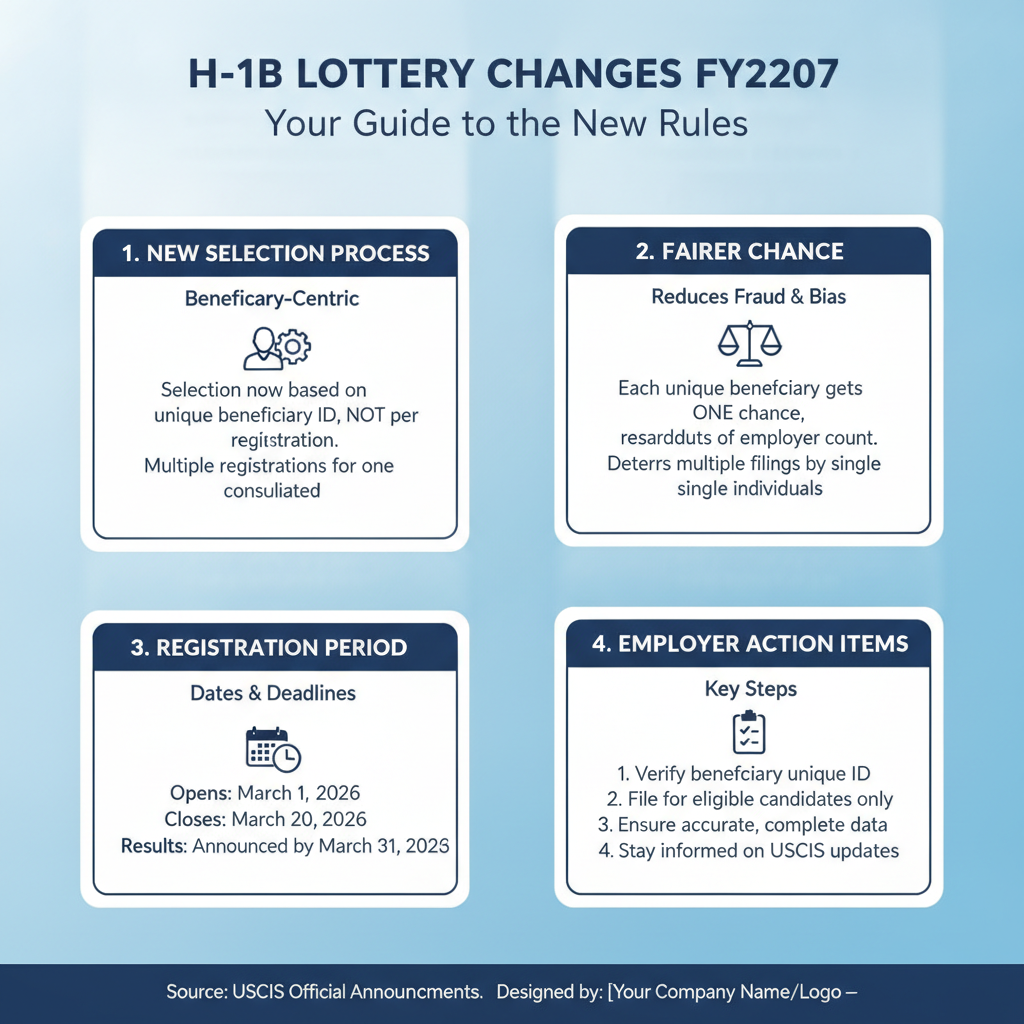
For FY2027, the big change is how this lottery works. Before, an employer could submit multiple registrations for the same person if different employers wanted to hire that person. This led to some employers submitting many registrations for one person, artificially inflating their chances and potentially reducing fairness. The new rule says that each individual person (the "beneficiary") can only have ONE registration submitted on their behalf, no matter how many employers want to hire them. USCIS will now select registrations based on the unique beneficiary, not based on the number of registrations submitted. This is a major shift designed to make the lottery fairer and reduce fraud, giving every eligible individual an equal shot at selection.
Key terms you need to know
Navigating the H-1B process requires understanding specific terminology:
- H-1B Cap: The annual limit on the number of H-1B visas issued. Congress currently sets this at 65,000 for the regular cap and an additional 20,000 for the U.S. Master's Cap.
- Cap-Subject: Refers to employers and beneficiaries who are subject to the annual H-1B cap. Certain organizations, such as universities and non-profit research institutions, are cap-exempt.
- Beneficiary: The foreign worker who is the subject of the H-1B petition. For FY2027, the lottery selection is now beneficiary-centric.
- Petitioner: The U.S. employer who files the H-1B petition on behalf of the foreign worker.
- Specialty Occupation: An occupation that requires theoretical and practical application of a body of highly specialized knowledge, and a bachelor's or higher degree in the specific specialty (or its equivalent) as a minimum for entry into the occupation.
- H-1B Registration Period: A designated window, typically in March, during which prospective petitioners submit electronic registrations for the H-1B lottery.
- Lottery Selection Process: The method USCIS uses to randomly select registrations when the number of eligible registrations exceeds the annual cap. For FY2027, this process focuses on unique beneficiaries.
- U.S. Master's Cap (or Advanced Degree Exemption): An additional 20,000 H-1B visas reserved for beneficiaries who have earned a U.S. master's or higher degree from an accredited institution.
- Labor Condition Application (LCA): Form ETA-9035. A prerequisite for filing an H-1B petition, certified by the Department of Labor, confirming that the employer will pay the H-1B worker at least the prevailing wage or the actual wage, whichever is higher, and will provide working conditions that will not adversely affect other workers.
- Duplicate Registrations: Under the new FY2027 rules, submitting more than one registration for the same beneficiary in the same fiscal year is strictly prohibited and can lead to disqualification.
- Selection Notice: The notification from USCIS to petitioners whose registrations have been selected in the lottery, allowing them to proceed with filing a full H-1B petition.
These changes are critical because they shift the strategy for both employers and beneficiaries. The emphasis is now firmly on ensuring that each individual has a fair and equal chance, eliminating practices that could have been perceived as gaming the system. This directly impacts the integrity and fairness of the H-1B program.
Current Immigration Law: The Foundation
The H-1B visa program is governed by the Immigration and Nationality Act (INA), specifically Section 214(g) regarding numerical limitations (caps) and 8 CFR Part 214.2(h) for regulatory details concerning nonimmigrant classifications. Understanding these foundational laws is crucial for navigating the H-1B process, especially with the new FY2027 changes.
Federal requirements
At its core, the H-1B visa requires that the position offered by the U.S. employer qualifies as a specialty occupation. This means the job must generally require a bachelor's degree or higher in a specific field, and the beneficiary must possess that degree or its equivalent. Key federal requirements include:
- Specialty Occupation: The job duties must be complex enough to require a specific bachelor's degree or higher. USCIS looks at the nature of the duties, the industry practice, and whether the employer normally requires a degree for the position.
- Educational Qualification: The beneficiary must hold a U.S. bachelor's or higher degree, or its foreign equivalent, or possess an unrestricted state license, or have work experience equivalent to a bachelor's degree (often calculated as three years of experience for every one year of college education missing).
- Employer-Employee Relationship: A valid employer-employee relationship must exist between the petitioner and the beneficiary, meaning the employer has the right to control the beneficiary's work.
- Labor Condition Application (LCA): Before filing an H-1B petition, the employer must obtain a certified Form ETA-9035 from the Department of Labor (DOL). This form attests that the employer will pay the H-1B worker at least the prevailing wage for the occupation in the area of intended employment or the actual wage paid to other employees with similar experience and qualifications, whichever is higher. It also ensures working conditions will not adversely affect other workers.
- Annual Cap: As mandated by INA § 214(g), there is an annual numerical limitation of 65,000 H-1B visas, with an additional 20,000 reserved for those with a U.S. master's or higher degree (the Master's Cap).
- Electronic Registration: Since FY2021, a mandatory electronic registration process precedes the H-1B cap-subject petition filing. For FY2027, this process has been significantly modified to be beneficiary-centric.
All H-1B petitions are filed using Form I-129, Petition for a Nonimmigrant Worker. This form is central to the entire process, encompassing various nonimmigrant classifications, with specific sections dedicated to H-1B petitions. It requires extensive documentation to prove eligibility for both the employer and the beneficiary. For detailed information and forms, always refer to the USCIS official website.
Florida-specific considerations
While federal law governs the H-1B program, its impact is keenly felt at the state and local levels. Florida’s economy, particularly in areas like Orlando, is a significant beneficiary of the H-1B program:
- High-Demand Industries: Florida is a hub for technology (e.g., Lake Nona's Medical City, Orlando's simulation industry), tourism and hospitality management, aerospace (Cape Canaveral region), and engineering. These sectors frequently require specialized skills that H-1B workers often possess.
- Orlando USCIS Field Office: While H-1B petitions are adjudicated at specific USCIS service centers, residents of Central Florida might interact with the Orlando USCIS Field Office for certain follow-up actions, such as biometrics appointments or interviews for related immigration processes (e.g., if transitioning from H-1B to a green card).
- Local Economic Impact: The presence of H-1B workers contributes significantly to the local economy in Orange County and surrounding areas, filling critical labor shortages and fostering innovation. The new lottery changes aim to ensure that this talent acquisition process is fairer for all Florida businesses and their prospective employees.
Employers in Florida must be particularly diligent in understanding the new FY2027 H-1B lottery rules, as non-compliance can lead to severe penalties and a loss of access to much-needed talent. For beneficiaries in Florida, especially those transitioning from F-1 OPT or other visa statuses, understanding these changes is crucial for planning their long-term immigration strategy.
How to Navigate the H-1B Visa Lottery Changes for FY2027: A Complete Step-by-Step Guide
The H-1B cap-subject process for FY2027 incorporates the significant change to a beneficiary-centric selection process. This guide outlines the steps, emphasizing the new rules.
1) Employer and Beneficiary Prepare for Registration
This initial phase is critical for ensuring eligibility and gathering necessary information well before the registration window opens.
- Employer's Role: The U.S. employer identifies a need for a specialty occupation worker and confirms that the position meets H-1B requirements. They must assess the potential beneficiary's qualifications (degree, experience) against the job requirements.
- Beneficiary's Role: The foreign worker ensures their educational credentials meet the specialty occupation criteria. They should prepare copies of degrees, transcripts, and any professional licenses. If their degree is from a foreign institution, they may need a degree evaluation from a credential evaluation service to determine its U.S. equivalency.
- Attorney Consultation: Both parties should consult an experienced immigration attorney, like Imigrar, to verify eligibility and understand the implications of the FY2027 changes. This is especially important for confirming the specialty occupation nature of the job and the beneficiary’s qualifications.
Required Documents/Information for Registration Preparation:
- Beneficiary's full legal name, date of birth, country of birth, country of citizenship, passport number.
- Beneficiary's educational background (degree, major, institution, graduation date).
- Employer's legal name, Federal Employer Identification Number (FEIN), mailing address, and contact information.
- Job title and basic description of duties for the H-1B position.
2) H-1B Electronic Registration Period
This is where the new rules become most apparent. USCIS opens an online registration system for a specific period, typically in March.
- One Registration Per Beneficiary: Under the FY2027 rules, each beneficiary can only have ONE H-1B registration submitted on their behalf by a prospective employer. If multiple employers genuinely wish to sponsor the same beneficiary, they must coordinate to ensure only one registration is submitted for that individual. Important: Submitting more than one registration for the same beneficiary in the same fiscal year by different employers will result in the disqualification of all registrations submitted for that beneficiary. USCIS will use the beneficiary's passport information to identify duplicate submissions.
- Employer or Attorney Submission: The prospective H-1B petitioner (employer) or their authorized representative (attorney) must submit the electronic registration online.
- Registration Fee: A non-refundable fee (e.g., $10 for FY2026, subject to change for FY2027) must be paid for each registration.
Required Information for Online Registration:
- Employer's legal name, FEIN, and mailing address.
- Beneficiary's full legal name, date of birth, country of birth, country of citizenship, and passport number.
- Confirmation of whether the beneficiary qualifies for the U.S. Master's Cap.
3) Lottery Selection and Notification
After the registration period closes, USCIS conducts the lottery if the number of eligible registrations exceeds the annual cap.
- Beneficiary-Centric Selection: USCIS conducts the lottery based on the unique beneficiaries. All registrations for a unique beneficiary are grouped together, and that unique beneficiary is entered into the selection process once. If selected, all petitions associated with that unique beneficiary become eligible to file.
- Selection Order: USCIS first selects registrations for the Master's Cap, then the regular cap.
- Notification: USCIS notifies selected petitioners (and their attorneys) through their online USCIS accounts. Selection notices will include instructions and the filing window for the H-1B petition. Non-selected registrations will also be notified.
Timeline Expectation: Selection notifications are typically issued by the end of March or early April.
4) Filing the H-1B Petition (Form I-129)
Only employers whose registrations have been selected can proceed to this step. A specific window will be provided for filing.
- Form I-129: The employer files Form I-129, Petition for a Nonimmigrant Worker, along with all supporting documentation.
- Certified LCA: A certified Form ETA-9035 (Labor Condition Application) from the Department of Labor must be included. This form must be filed and certified before the H-1B petition can be submitted.
- Supporting Documentation: This includes extensive evidence to prove the specialty occupation, the beneficiary's qualifications, the employer's ability to pay the required wage, and the existence of a valid employer-employee relationship.
- Filing Fees: Various fees are associated with the H-1B petition, including the base filing fee, ACWIA fee, fraud prevention and detection fee, and potentially a public law 114-113 fee for certain employers.
Required Documents for Form I-129 Petition:
- Certified Form ETA-9035 (LCA).
- Copies of beneficiary's passport, visa, I-94 record, and previous I-797 approval notices (if applicable).
- Beneficiary's educational documents (diplomas, transcripts, foreign degree evaluations).
- Beneficiary's resume/CV and letters of experience.
- Employer's business license, tax returns, financial statements.
- Letter of support from the employer detailing the specialty occupation, job duties, salary, and employment terms.
- Organizational charts, client lists, and project descriptions (for consulting companies).
- Copy of the H-1B selection notice.
5) USCIS Processing and Adjudication
After filing, USCIS reviews the petition.
- Regular Processing: USCIS service centers process petitions in the order they are received. Processing times can vary significantly (from several months to over a year). Check USCIS Processing Times for current estimates.
- Premium Processing: For an additional fee, petitioners can opt for premium processing, which guarantees a response (approval, denial, or Request for Evidence - RFE) within 15 calendar days.
- Request for Evidence (RFE): USCIS may issue an RFE if they need more information or clarification. Prompt and thorough responses are crucial.
- Approval (Form I-797): If approved, USCIS issues an Approval Notice (Form I-797). If the beneficiary is already in the U.S., this typically includes an I-94 card reflecting the change of status to H-1B.
6) Visa Interview (for those outside U.S.) / Change of Status (for those inside U.S.)
The final step depends on the beneficiary's location.
- Change of Status (U.S. Residents): If the beneficiary is already in the U.S. and their Form I-129 petition included a request for change of status, and it was approved, their status automatically changes to H-1B on October 1st (for cap-subject petitions).
- Consular Processing (Outside U.S.): If the beneficiary is outside the U.S., or if the petition did not include a change of status request, they must apply for an H-1B visa stamp at a U.S. embassy or consulate in their home country. This involves scheduling an interview, paying visa fees, and attending the interview. The U.S. Department of State provides country-specific guidance.
Reminder: The new FY2027 rules are specifically designed to ensure fairness and reduce fraud in the registration phase. Adhering to these new regulations is paramount for a successful H-1B application.
Need expert guidance for the FY2027 H-1B lottery? Imigrar's team, serving Orlando and clients nationwide, is here to help. Call +1 786-791-3106 for a free consultation. Se Habla Español.
Practical Steps You Can Take Today to Prepare for the H-1B Lottery
Preparation is key, especially with the new beneficiary-centric lottery. Here’s an actionable checklist to help you get ready for FY2027:
- Verify Eligibility (Beneficiary & Position):
- For Beneficiaries: Ensure your degree (U.S. or foreign evaluated) and professional experience align perfectly with a specialty occupation. Gather all academic transcripts, diplomas, and any professional licenses. If you have a foreign degree, consider getting a credential evaluation done early.
- For Employers: Clearly define the H-1B position's duties and ensure they meet USCIS criteria for a specialty occupation. Verify that your company can pay the prevailing wage.
- Identify Sponsoring Employer(s): For beneficiaries, start networking and seeking job offers from U.S. employers who are willing to sponsor an H-1B visa. For employers, identify potential candidates and be prepared to act quickly. Remember, only one registration per beneficiary is allowed.
- Gather Essential Documents:
- Beneficiary: Valid passport, birth certificate, marriage certificate (if applicable), all academic records, resume, any previous U.S. visa documents (I-20, DS-2019, I-797, I-94), and professional references.
- Employer: FEIN, business registration documents, financial statements, and a detailed job description for the H-1B role.
- Understand the New Rules for FY2027: Familiarize yourself with the beneficiary-centric selection process. If you have multiple job offers, communicate clearly with all prospective employers about the "one registration per beneficiary" rule. Decide which employer will submit the single registration on your behalf.
- Consult an Experienced Immigration Attorney: This is perhaps the most crucial step. An attorney can assess your eligibility, advise on the new lottery rules, help prepare documentation, and represent you throughout the process. They can also help coordinate with multiple employers if necessary.
- Budget for Costs: Be aware of the various fees involved: registration fee, LCA filing fee, Form I-129 filing fee, ACWIA fee, fraud prevention fee, and potentially premium processing fees and legal fees.
- Prepare for Potential RFEs: Even with a strong initial petition, RFEs are common. Having all supporting documents meticulously organized and easily accessible will facilitate a prompt and thorough response if an RFE is issued.
Timeline Expectations:
- October - February (Pre-Registration): Employers identify needs, beneficiaries seek job offers, both parties gather documents and consult attorneys.
- Early March (e.g., March 6-22, 2026 for FY2027): H-1B Electronic Registration Period opens. This is a crucial 180-day window from the start of the fiscal year, but the registration itself is much shorter. Employers/attorneys submit registrations for unique beneficiaries.
- Late March - Early April: USCIS conducts the lottery and announces selections. Selected petitioners receive a notification with a filing window.
- April - June (e.g., April 1 - June 30, 2026): Filing window for selected H-1B petitions. Employers must file Form I-129 and supporting documents within this 90-day window.
- May - September: USCIS processes petitions. RFEs may be issued. Premium processing can expedite this.
- October 1, 2026: For approved petitions, the earliest start date for H-1B employment for FY2027.
Warning: Missing any deadline, especially the registration and petition filing windows, can result in your application being rejected for the entire fiscal year.

How Imigrar Helps Immigrants in Orlando Navigate H-1B Visa Changes
At Imigrar, we understand the complexities and anxieties that come with the H-1B visa process, especially with significant rule changes like those for FY2027. Our mission, "Keep Families Together," extends to ensuring professionals can pursue their careers in the U.S. and contribute to our vibrant communities in Orlando and nationwide.
Our experienced immigration attorneys specialize in employment-based visas, including the H-1B program. We are meticulously updated on the latest USCIS regulations and policy shifts, ensuring that our clients receive accurate and timely advice. For the FY2027 H-1B lottery changes, we provide:
- Comprehensive Eligibility Assessment: We thoroughly evaluate both the employer's need and the beneficiary's qualifications to ensure they meet the stringent H-1B requirements for a specialty occupation.
- Strategic Guidance on New Rules: We provide clear, actionable advice on the beneficiary-centric selection process, helping employers and beneficiaries navigate the "one registration per beneficiary" rule to avoid disqualification.
- Metic
Related Topics
Need Legal Assistance?
Our experienced immigration attorneys are here to help with your case. Contact Imigrar today for a free consultation and let us guide you through the legal process with confidence.
📍 Orlando, Florida • Serving clients nationwide
📧 info@imigrar.com