
Navigate Naturalization Test Changes in 2026 with Imigrar
Upcoming changes to the U.S. Naturalization Test in 2026 can impact your path to citizenship. Learn what's new, how to prepare, and get expert guidance from Imigrar in Orlando, Florida.

The journey to U.S. citizenship is a significant milestone for many immigrants and their families. It represents the culmination of years of hard work, dedication, and a commitment to building a new life in America. A crucial step in this journey is passing the Naturalization Test, which assesses an applicant’s knowledge of U.S. history and government (civics) and their ability to read, write, and speak English.
As an immigration law firm dedicated to keeping families together, Imigrar understands the importance of staying informed about changes in immigration policy and procedures. With news circulating about upcoming modifications to the Naturalization Test in 2026, it's more critical than ever for prospective citizens to understand what these changes entail and how to prepare effectively.
The reporting that sparked this guide:
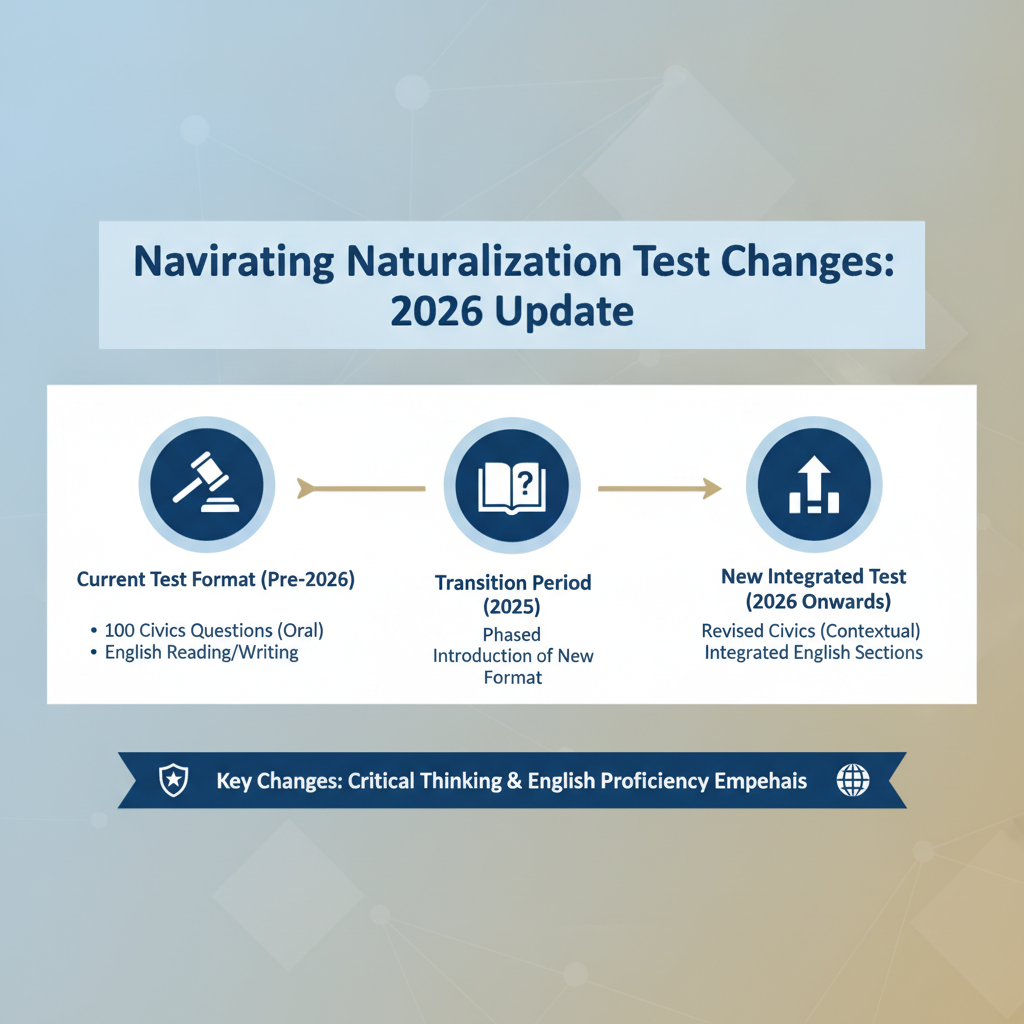
Naturalization Test Changes Coming in 2026 (Citizenship)
What This News Means for Immigrants in Orlando and Across Florida
The announcement regarding changes to the Naturalization Test in 2026 is significant because it directly impacts the requirements for becoming a U.S. citizen. For many immigrants in Orlando, across Florida, and nationwide, this news prompts questions about eligibility, preparation, and the overall timeline for their citizenship application.
Why this news is showing up now
Immigration policies and procedures, particularly those related to naturalization, are periodically reviewed and updated by U.S. Citizenship and Immigration Services (USCIS) to ensure they remain relevant, fair, and effective. The Naturalization Test, while largely consistent for many years, has seen revisions in the past, most notably a pilot program in 2020 which introduced a different format and question style. This current news cycle reflects USCIS's ongoing commitment to evaluating the test and potentially implementing further modifications to improve its administration or better assess an applicant's civic knowledge. The timeline for these changes typically involves a period of review, public comment, and then official announcement and implementation, often allowing applicants time to prepare. The year 2026 marks the target for these newly proposed changes to take effect, giving applicants and legal professionals a window to understand and adapt.
How it can affect Florida residents
While the Naturalization Test is a federal requirement, its changes will have direct implications for Florida residents, just as they will for applicants nationwide. For those living in Central Florida, including Orlando, Kissimmee, and communities along the I-4 corridor, these changes mean that the preparation strategies for the civics and English portions of the test may need to be adjusted. The Orlando USCIS Field Office, like all other field offices, will administer the updated test. This could involve new study materials, a different question format for the civics portion (potentially moving beyond rote memorization to more critical thinking or multiple-choice options, similar to the 2020 pilot), or even slight modifications to the English proficiency assessment.
Important: If you are already preparing for naturalization or are considering applying soon, understanding these potential shifts is crucial. For residents of Orange County and surrounding areas, this means staying informed about USCIS announcements and potentially seeking guidance from experienced immigration attorneys who can help navigate these evolving requirements. Imigrar, based in Orlando, is uniquely positioned to assist local clients in understanding how these federal changes translate to their specific application process.
Need Help? Our Orlando immigration team is ready to assist. Call +1 786-791-3106 for a free consultation, or message us online. Se Habla Español.
What Naturalization Is (and Why It Matters)
Naturalization is the process by which a lawful permanent resident (LPR), also known as a green card holder, voluntarily becomes a U.S. citizen. It’s a profound step that grants individuals full rights and responsibilities within the United States, cementing their place in American society. The Naturalization Test is a fundamental part of this process, ensuring that new citizens have a foundational understanding of the country's history, government, and values.
A plain-English definition
Simply put, naturalization is how someone who was born in another country can become a citizen of the United States. It’s not automatic; you have to apply and meet certain requirements. The Naturalization Test is a verbal exam given by a USCIS officer during your citizenship interview. It has two main parts: an English test (to check your ability to read, write, and speak basic English) and a civics test (to see if you know about U.S. history and government). Passing this test, along with meeting other eligibility criteria, is essential to becoming a U.S. citizen.
Key terms you need to know
- Naturalization: The process by which a foreign citizen or national becomes a citizen of the United States.
- Lawful Permanent Resident (LPR) / Green Card Holder: An individual who has been granted the privilege of residing permanently in the United States. This is a prerequisite for most naturalization applicants.
- Form N-400, Application for Naturalization: The official application form filed with USCIS to request U.S. citizenship.
- USCIS (U.S. Citizenship and Immigration Services): The government agency responsible for administering immigration and naturalization benefits.
- Civics Test: The portion of the Naturalization Test that assesses an applicant's knowledge of U.S. history and government. This is the part that is undergoing changes in 2026.
- English Test: The portion of the Naturalization Test that assesses an applicant's ability to read, write, and speak basic English.
- Good Moral Character: A legal requirement for naturalization, generally meaning an applicant has not committed certain crimes and has adhered to societal norms during their residency.
- Oath of Allegiance: The final step in the naturalization process, where an applicant formally pledges loyalty to the United States.
Current Immigration Law: The Foundation
The foundation for naturalization is primarily found in the Immigration and Nationality Act (INA), specifically Section 316 and subsequent sections. This federal law outlines the general requirements for becoming a U.S. citizen through naturalization. While the test content may change, the underlying legal framework for eligibility remains constant.
Federal requirements
To be eligible for naturalization, most applicants must meet the following federal requirements as stipulated by the INA:
- Age: Be at least 18 years old at the time of filing Form N-400.
- Lawful Permanent Residency: Be a Lawful Permanent Resident (LPR) for a specific period (generally 5 years, or 3 years if married to a U.S. citizen and meeting certain conditions).
- Continuous Residence and Physical Presence: Maintain continuous residence in the U.S. for at least half of the required LPR period and be physically present in the U.S. for a certain number of days (e.g., at least 30 months out of 5 years, or 18 months out of 3 years).
- Residence in USCIS District or State: Reside for at least 3 months immediately preceding the filing of Form N-400 in the state or USCIS district where the application is filed.
- Good Moral Character: Demonstrate good moral character for the statutory period (typically 5 or 3 years) leading up to the filing of the application and up to the Oath of Allegiance.
- Attachment to the Principles of the U.S. Constitution: Show attachment to the principles of the U.S. Constitution and be well-disposed to the good order and happiness of the United States.
- English Language Proficiency: Be able to read, write, and speak basic English. There are certain exceptions for older applicants or those with medical conditions.
- Civics Knowledge: Demonstrate knowledge and understanding of the fundamentals of U.S. history and government. This is where the 2026 test changes will be most apparent.
- Oath of Allegiance: Take an Oath of Allegiance to the United States.
These requirements are all assessed during the naturalization process, primarily through the information provided on Form N-400 and during the interview with a USCIS officer. For comprehensive details on eligibility, applicants should always refer to the USCIS official website.
Florida-specific considerations
While the naturalization requirements are set at the federal level and apply uniformly across the nation, certain practical considerations are specific to Florida residents. The process for filing Form N-400 is the same for everyone, regardless of state. However, your naturalization interview will be conducted at a local USCIS Field Office. For many in Central Florida, this means the Orlando USCIS Field Office at 5449 South Semoran Boulevard. Understanding local procedures, typical wait times for this specific office, and any regional nuances can be beneficial.
For example, while the civics test questions themselves are federal, the way local offices communicate changes or provide resources might vary. Residents of Orange County, Seminole County, Osceola County, and other parts of Florida will utilize the same federal forms and eligibility criteria. However, having an attorney familiar with the local USCIS field office can provide a smoother experience, as they understand the local staff and processes. Imigrar, being based in Orlando, has extensive experience navigating the local USCIS ecosystem, offering tailored advice for Florida residents.
Need Help? Our Orlando immigration team is ready to assist. Call +1 786-791-3106 for a free consultation, or message us online. Se Habla Español.
How to Prepare for the Naturalization Test Changes: A Complete Step-by-Step Guide
Preparing for naturalization, especially with upcoming test changes, requires careful planning and attention to detail. This guide outlines the essential steps, with a focus on how to adapt to the 2026 modifications.
1) Determine Your Eligibility and Gather Initial Documents
Before you even think about the test, you must confirm you meet all the basic naturalization requirements. This includes age, continuous residence, physical presence, and good moral character. Use the USCIS website or consult an attorney to verify your eligibility.
- Eligibility Check:
- Are you 18 or older?
- Have you been a Lawful Permanent Resident for 5 years (or 3 years if married to a U.S. citizen)?
- Have you been physically present in the U.S. for at least half of that time?
- Have you resided in your current state/USCIS district for at least 3 months?
- Do you meet the good moral character requirements?
- Initial Documents Checklist:
- Your Green Card (Form I-551)
- State-issued identification (Driver's License or State ID)
- Your Social Security Card
- Travel records (passports, entry/exit stamps for all trips outside the U.S. since becoming an LPR)
- Marriage certificate (if applying under the 3-year rule)
- Divorce decrees or death certificates for previous spouses (if applicable)
- Birth certificates of your children (if applicable)
- Evidence of selective service registration (for males 18-26)
2) Complete and File Form N-400, Application for Naturalization
This is the core application form. It is extensive and requires detailed personal, residential, employment, travel, marital, and criminal history information. Accuracy is paramount, as any misrepresentation can lead to denial.
- Filling Out Form N-400:
- Read all instructions carefully.
- Answer every question accurately and completely.
- Use black ink if filling out by hand.
- If a question does not apply, write "N/A" (Not Applicable).
- If you need more space, attach a separate sheet, clearly marking the part and item number.
- Review all answers thoroughly before signing.
- Required Documents to Submit with Form N-400:
- Two identical passport-style photos (if required by instructions; check current USCIS guidelines as this can change).
- Copy of the front and back of your Green Card.
- Copy of your marriage certificate (if applicable).
- Evidence of termination of prior marriages (if applicable).
- Copies of court disposition documents for any arrests or citations (even minor ones, traffic violations excluded unless alcohol/drug related or resulted in arrest).
- Fee payment (check or money order payable to "U.S. Department of Homeland Security" or pay online). Check current fees on USCIS Forms page.
- Submission: Mail your completed Form N-400 and supporting documents to the USCIS Lockbox facility specified in the form instructions.
3) Attend Your Biometrics Appointment
After USCIS accepts your application, you will receive an appointment notice (Form I-797C, Notice of Action) for a biometrics (fingerprinting) appointment at an Application Support Center (ASC). This appointment is mandatory.
- At the Biometrics Appointment:
- Bring your appointment notice and a valid photo ID (Green Card, driver's license, or passport).
- Your fingerprints, photograph, and signature will be collected.
- This data is used for background checks and to verify your identity.
- No interview or test takes place at this appointment.
4) Prepare for the Interview and Naturalization Tests (English & Civics)
This step is where the 2026 changes will have the most impact. You will be tested on your English proficiency and knowledge of U.S. civics. Preparation is key, especially with an evolving civics test.
- English Test Preparation:
- Speaking: The USCIS officer will assess your ability to speak English during the interview itself. Practice answering common interview questions in English.
- Reading: You will need to read one out of three sentences correctly. Practice reading aloud from the official USCIS vocabulary list.
- Writing: You will need to write one out of three sentences correctly. Practice writing sentences dictated by another person, focusing on proper spelling and grammar.
- Utilize free resources like USCIS study materials, ESL classes, or language exchange partners.
- Civics Test Preparation (Adapting to 2026 Changes):
- Current Test (Pre-2026): The current test consists of 100 civics questions. You will be asked up to 10 questions, and you must answer 6 correctly to pass. The questions are publicly available on the USCIS website.
- Preparing for 2026 Changes:
- Stay Informed: Regularly check the USCIS official website for official announcements regarding the new test format, content, and study materials.
- Focus on Concepts, Not Just Memorization: If the new test mirrors the 2020 pilot, it might emphasize understanding key concepts rather than just memorizing facts. Study the "why" behind government structures and historical events.
- Utilize New Study Guides: As soon as USCIS releases updated study guides, flashcards, or practice tests, use them exclusively. Do not rely on outdated materials.
- Practice Critical Thinking: Engage with sample questions that require more than a one-word answer. Discuss U.S. government principles with others.
- Consider Professional Help: An immigration attorney or specialized tutor can provide guidance on interpreting the new test requirements and developing effective study strategies.
5) Attend Your Naturalization Interview
This is the most critical step. You will meet with a USCIS officer who will review your application, test your English and civics knowledge, and ask questions about your eligibility.
- Before the Interview:
- Review your entire Form N-400 application.
- Gather all original documents that you submitted copies of with your application, plus any additional documents requested by USCIS.
- Bring your Green Card, passports, and the interview notice.
- Dress professionally.
- Arrive on time at the Orlando USCIS Field Office (or your assigned location).
- During the Interview:
- The officer will place you under oath.
- They will ask questions to verify the information on your Form N-400.
- You will take the English reading, writing, and speaking tests.
- You will take the civics test.
- Answer honestly and directly. If you don't understand a question, ask the officer to repeat or rephrase it.
6) Receive a Decision and Attend the Oath of Allegiance Ceremony
After your interview, the officer will usually give you a decision on the spot or mail it to you.
- Possible Outcomes:
- Recommended for Approval: You passed the tests and met all eligibility requirements.
- Continued: You may need to provide additional documents, take another test, or clarify information.
- Denied: If you did not meet eligibility requirements or failed to provide requested information.
- Oath of Allegiance Ceremony:
- If approved, you will receive a notice for your Oath Ceremony (Form N-445).
- This is the final step where you formally become a U.S. citizen.
- You will surrender your Green Card at the ceremony.
- You will receive your Certificate of Naturalization, which is proof of your U.S. citizenship.
- Once you become a citizen, you can apply for a U.S. passport.
Practical Steps You Can Take Today
Even with changes on the horizon, there are many proactive steps you can take now to ensure you are well-prepared for your naturalization journey. For those living in Orlando and Central Florida, starting early is always the best strategy.
Actionable Checklist:
- Verify Eligibility: Double-check all naturalization requirements against your personal history. If you are close to meeting the residency requirements, start preparing now.
- Gather Documents Systematically: Begin collecting all necessary documents (Green Card, travel history, tax returns, marriage/divorce certificates, etc.). Organize them in a binder or digital folder.
- Improve English Proficiency: Regardless of test changes, strong English skills are beneficial. Enroll in ESL classes, practice speaking with native speakers, read English newspapers, and watch English-language media.
- Start Civics Study with Current Materials: While new materials are coming, a strong foundation in current civics questions will still be valuable. The core principles of U.S. government are unlikely to change drastically. Focus on understanding concepts rather than just memorizing answers.
- Monitor USCIS Announcements: Bookmark the USCIS official website and regularly check for news releases specifically about the Naturalization Test. Sign up for USCIS email updates.
- Consult an Immigration Attorney: An attorney can assess your unique situation, advise on eligibility, help complete Form N-400, and guide you through the evolving test requirements. This is especially crucial for complex cases or if you have any criminal history.
- Maintain Good Moral Character: Avoid any actions that could jeopardize your eligibility, such as committing crimes, failing to pay taxes, or making false statements.
Document Preparation Guidance:
When gathering documents, always aim for originals or certified copies. Make photocopies of everything you submit to USCIS for your records. Organize your documents logically, perhaps by the sections of Form N-400 they pertain to. For example, have a section for travel, a section for marriage, a section for employment, etc. This organized approach will not only simplify the application process but also make your interview smoother, as you can quickly present requested documents to the officer.
Reminder: For any documents not in English, you must provide a certified English translation along with a copy of the original document. The translator must certify that they are competent to translate and that the translation is accurate.
Timeline Expectations:
The naturalization process can take time, often ranging from 6 months to over a year, depending on the USCIS field office workload and the complexity of your case. You can check estimated processing times for Form N-400 at your local field office (e.g., Orlando USCIS Field Office) on the USCIS Processing Times page. Biometrics appointments are usually scheduled within 3-5 weeks after filing. The interview notice typically arrives several months later. The Oath Ceremony can follow quickly after a successful interview or may take several weeks, depending on scheduling. Factor in additional time for preparing for the new civics test once details are released in 2026.
How Imigrar Helps Immigrants in Orlando
Navigating the naturalization process, especially with upcoming test changes, can be daunting. Imigrar is an immigration law firm based in Orlando, Florida, dedicated to providing expert legal guidance and support to immigrants and their families nationwide. Our tagline, "Keep Families Together," reflects our core mission and commitment to our clients.
Our experienced team understands the intricacies of U.S. immigration law and stays abreast of all policy updates, including the anticipated Naturalization Test changes in 2026. We pride ourselves on offering personalized, compassionate, and effective legal solutions. Whether you're in Orlando, anywhere else in Central Florida, or across the country, we are here to assist you.
We can help you:
- Assess your eligibility for naturalization.
- Accurately complete and file Form N-400 and all supporting documentation.
- Prepare thoroughly for the English and civics tests, including adapting to the new 2026 test format.
- Coach you for your naturalization interview, ensuring you feel confident and prepared.
- Address any potential challenges, such as criminal history, long absences from the U.S., or previous immigration issues.
- Represent you at your interview if necessary.
We offer a free consultation to discuss your specific situation and outline the best path forward. Our team is fluent in both English and Spanish, ensuring clear communication and understanding. Se Habla Español.
Need Help? Our Orlando immigration team is ready to assist. Call +1 786-791-3106 for a free consultation, or message us online. Se Habla Español.
Frequently Asked Questions
Q: What exactly are the Naturalization Test changes coming in 2026?
A: While the precise details of the 2026 Naturalization Test changes have not been fully released by USCIS as of late 2026, the discussion revolves around revisions to the civics portion of the test. These changes are expected to move beyond simple memorization, potentially incorporating more critical thinking questions, multiple-choice formats, or requiring a deeper understanding of U.S. government principles and history. The 2020 pilot test, which was later rescinded, offered a glimpse into potential directions, featuring more complex questions. USCIS aims to ensure the test accurately assesses an applicant's knowledge while remaining fair and accessible. We advise all applicants to monitor the USCIS official website for the most up-to-date information and new study materials once they are published.
Q: Will the eligibility requirements for naturalization also change in 2026?
A: No, the fundamental eligibility requirements for naturalization, as outlined in the Immigration and Nationality Act (INA), are not expected to change with the revisions to the civics test. These core requirements—such as age, continuous residency, physical presence, good moral character, and attachment to the U.S. Constitution—are established by federal law and are separate from the content of the Naturalization Test. The 2026 changes specifically target the method and content of assessing civic knowledge, not the underlying criteria for who can apply for citizenship. However, it is always wise to consult an immigration attorney to ensure you meet all current eligibility standards, especially if you have complex immigration or personal history.
Q: How will the new test impact my current immigration status if I'm a green card holder?
A: The changes to the Naturalization Test themselves will not directly impact your current Lawful Permanent Resident (LPR) status. Your green card remains valid as long as you continue to meet its terms. However, if you are eligible for naturalization and plan to apply, these changes mean you will need to prepare for the updated test format and content. Failing the naturalization test does not revoke your green card status. It simply means your naturalization application may be denied, and you would need to reapply and re-take the test. The goal of the changes is to ensure new citizens are adequately prepared, not to create barriers for existing LPRs.
Q: What is the expected timeline for these changes to be fully implemented, and how will I know what to study?
A: The news indicates that the Naturalization Test changes
Related Topics
Need Legal Assistance?
Our experienced immigration attorneys are here to help with your case. Contact Imigrar today for a free consultation and let us guide you through the legal process with confidence.
📍 Orlando, Florida • Serving clients nationwide
📧 info@imigrar.com