
H-1B Lottery Changes FY2027: Your Guide for Florida Immigrants
Understand the critical H-1B visa lottery changes for FY2027, including beneficiary-centric selection and enhanced integrity measures. Imigrar guides Orlando and Florida residents through these new rules.

The landscape of U.S. immigration law is constantly evolving, and for those aspiring to work in a specialty occupation, few developments are as impactful as changes to the H-1B visa program. As of November 11, 2026, we're seeing significant new rules affecting H-1B visa applications for Fiscal Year 2027 (FY2027). These changes are designed to enhance the integrity of the lottery process and ensure fairness for eligible beneficiaries.
At Imigrar, an immigration law firm based in Orlando, Florida, we are committed to keeping families together by providing clear, accurate, and actionable guidance on these complex issues. Our team serves clients nationwide, offering expert legal assistance in both English and Spanish (Se Habla Español).
The reporting that sparked this guide
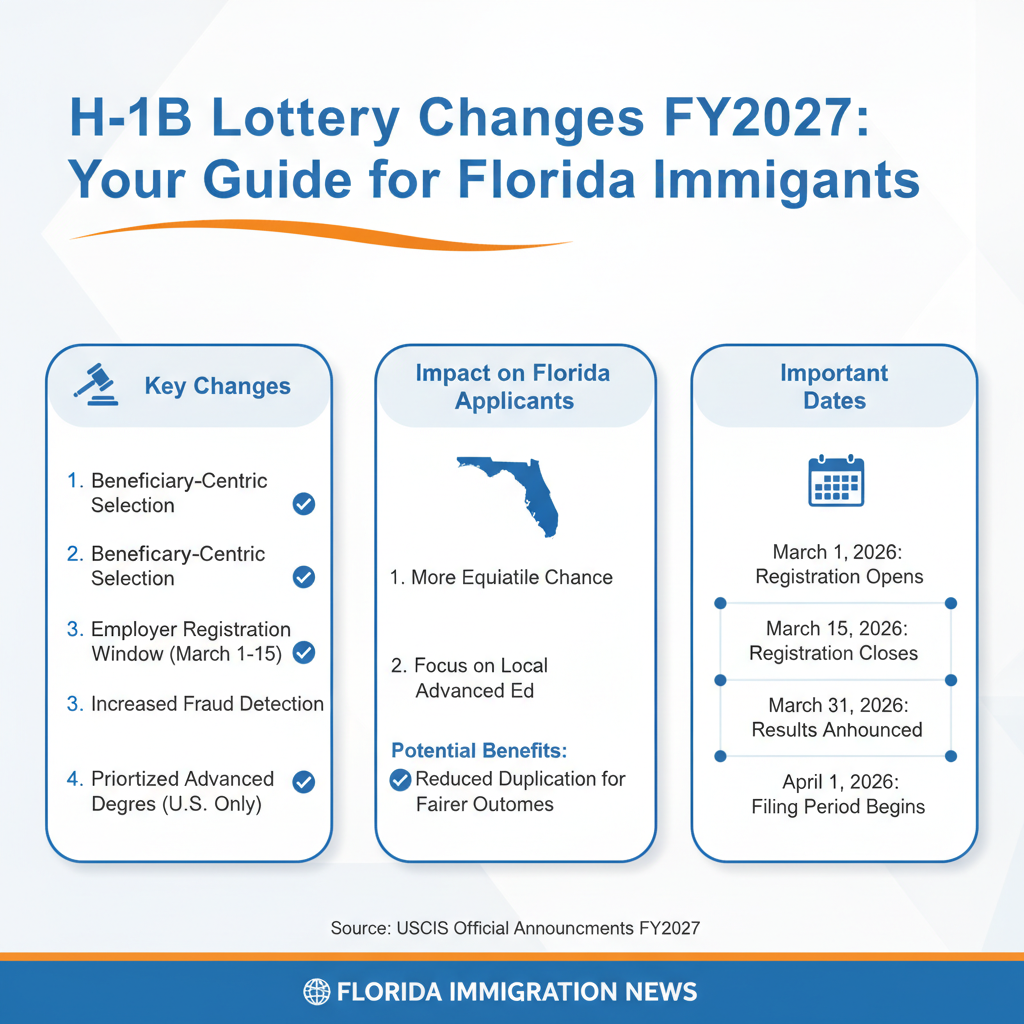
Our insights are informed by the latest legal news and official updates, ensuring you receive the most current information. The recent discussions and policy announcements surrounding the H-1B visa lottery changes for FY2027 have been a significant focus in the immigration community.
H-1B Visa Lottery Changes for FY2027 (Legal News)
What This News Means for Immigrants in Orlando and Across Florida
The H-1B visa program is a cornerstone for many highly skilled foreign professionals seeking to work in the United States. For residents of Orlando, Central Florida, and indeed, across the entire state, these changes carry substantial implications for both individuals and employers.
Why this news is showing up now
The U.S. Citizenship and Immigration Services (USCIS) consistently reviews and refines its processes to address challenges such as high demand, potential for fraud, and the need for greater efficiency. The H-1B visa program, with its annual cap and overwhelming demand, is particularly susceptible to these pressures. The changes for FY2027 are the culmination of ongoing efforts by the Department of Homeland Security (DHS) and USCIS to strengthen the integrity of the H-1B registration process. Specifically, these updates aim to prevent abuses where multiple registrations were submitted for the same beneficiary by different, often related, entities, thereby unfairly increasing their chances of selection. The goal is to ensure that every eligible beneficiary has an equitable chance in the lottery.
How it can affect Florida residents
Florida is a vibrant hub for many industries that heavily rely on H-1B talent, including technology, aerospace, healthcare, tourism, and higher education. Cities like Orlando, Tampa, and Miami attract significant numbers of international professionals. For Florida residents and those considering moving to the state, these changes mean:
- Increased Fairness: The new beneficiary-centric selection process aims to level the playing field, making it more equitable for all eligible individuals, regardless of how many employers register them. This is a positive development for genuine candidates.
- Reduced Fraud: Employers and beneficiaries in Florida will benefit from a system designed to deter fraudulent registrations, leading to a more legitimate and transparent lottery.
- Strategic Planning for Employers: Florida-based companies seeking to sponsor H-1B workers must fully understand and comply with the new rules to ensure their registrations are valid and maximize their chances of securing talent.
- Impact on Educational Institutions: Universities across Florida, which often sponsor international researchers and faculty, will need to adapt their registration strategies to the new framework.
- Local Economy: A fairer H-1B process can help Florida businesses attract and retain top global talent, contributing to the state's economic growth and innovation. For instance, the tech corridor along I-4, including Orlando, heavily depends on these highly skilled workers.
Understanding these shifts is crucial for anyone involved in the H-1B process in Florida. Imigrar is here to help navigate these complexities.
Navigating H-1B Changes? Our Orlando immigration team is ready to assist. Call +1 786-791-3106 for a free consultation, or message us online. Se Habla Español.
What H-1B Visa Lottery Changes for FY2027 Is (and Why It Matters)
The H-1B visa program is a highly competitive nonimmigrant visa category that allows U.S. employers to temporarily employ foreign workers in specialty occupations. Due to the annual cap on the number of H-1B visas issued, demand often far exceeds supply, necessitating a lottery system. The changes for FY2027 are a significant update to how this lottery operates, directly impacting the integrity and fairness of the selection process.
A plain-English definition
Simply put, the H-1B visa allows U.S. companies to hire foreign professionals for jobs that require at least a bachelor's degree in a specific field. Think software engineers, doctors, architects, or accountants. Because there are more applicants than available visas each year, USCIS conducts a random lottery to select which registrations can proceed to file a full petition. For FY2027, the "changes" primarily refer to a fundamental shift in how this lottery selection is conducted. Instead of selecting registrations based on each individual registration submitted, the lottery now selects based on each unique beneficiary. This means that if one person (beneficiary) has multiple registrations submitted on their behalf by different employers, they still only have one chance of being selected in the lottery, rather than having their chances multiplied by each registration. This beneficiary-centric approach is a major step towards combating fraud and ensuring a truly fair random selection.
Key terms you need to know
Understanding these terms is vital for anyone involved in the H-1B process:
- H-1B Visa: A nonimmigrant visa that allows U.S. employers to temporarily employ foreign workers in specialty occupations.
- Specialty Occupation: An occupation that requires theoretical and practical application of a body of highly specialized knowledge, and a bachelor's or higher degree in the specific specialty (or its equivalent) as a minimum for entry into the occupation in the United States.
- H-1B Cap: The annual statutory limit on the number of H-1B visas issued. Currently, this is 65,000 for the regular cap and an additional 20,000 for those with a U.S. Master's degree or higher (the "Master's Cap").
- H-1B Lottery (or Selection Process): The random selection process conducted by USCIS when the number of eligible H-1B registrations exceeds the annual cap.
- Beneficiary: The foreign national worker who is seeking the H-1B visa.
- Petitioner: The U.S. employer who files the H-1B petition on behalf of the beneficiary.
- Fiscal Year (FY): The U.S. government's fiscal year runs from October 1 to September 30. H-1B visas become available on October 1 of the fiscal year for which they are requested. For example, FY2027 visas become available on October 1, 2026.
- USCIS (U.S. Citizenship and Immigration Services): The government agency responsible for administering immigration and naturalization benefits.
- DHS (Department of Homeland Security): The federal department that USCIS operates under.
- H-1B Registration: The electronic process where prospective petitioners (employers) or their authorized representatives submit basic information about the company and the prospective H-1B worker to USCIS. This must be done before the lottery.
- Beneficiary-Centric Selection: The core of the new FY2027 changes. Under this system, selections are based on unique beneficiaries rather than individual registrations. If a beneficiary has multiple eligible registrations submitted on their behalf, they are entered into the lottery only once. This significantly reduces the incentive for fraudulent multiple registrations.
These changes matter because they directly impact the fairness and transparency of the H-1B program. For legitimate employers and highly skilled individuals, these reforms aim to create a more level playing field and reduce the prevalence of bad actors attempting to game the system. For those in Orlando and across Florida, this means a clearer path to securing essential talent or pursuing professional opportunities.
Current Immigration Law: The Foundation
The H-1B visa program is governed by specific sections of the Immigration and Nationality Act (INA) and regulations promulgated by the Department of Homeland Security (DHS). Understanding these legal foundations is critical for compliance.
The H-1B nonimmigrant classification is found in Section 101(a)(15)(H)(i)(b) of the Immigration and Nationality Act (INA). The annual numerical limitations (the H-1B cap) are established under INA Section 214(g). These statutes, along with corresponding federal regulations (e.g., 8 CFR Part 214.2(h)), define the eligibility criteria, application process, and limitations of the program.
Federal requirements
To qualify for an H-1B visa, both the employer (petitioner) and the employee (beneficiary) must meet specific federal requirements:
- Specialty Occupation: The job offered must qualify as a specialty occupation. This means it typically requires a bachelor's degree or higher in a specific field, or its equivalent, for entry. USCIS examines the job duties, the nature of the employer's business, industry standards, and the employer's past hiring practices.
- Educational Requirements: The beneficiary must hold a bachelor's degree or its equivalent (e.g., a foreign degree evaluated as equivalent to a U.S. bachelor's degree, or a combination of education and work experience equivalent to a bachelor's degree) directly related to the specialty occupation.
- Employer-Employee Relationship: A valid employer-employee relationship must exist between the petitioner and the beneficiary, as defined by USCIS. This is particularly important for third-party placements.
- Labor Condition Application (LCA): Before filing an H-1B petition, the employer must file and have certified by the U.S. Department of Labor (DOL) a Form ETA-9035, Labor Condition Application (LCA). The LCA attests that the employer will pay the H-1B worker at least the prevailing wage for the occupation in the area of employment or the actual wage paid to other employees with similar experience and qualifications, whichever is higher, and will provide working conditions that will not adversely affect other workers.
- Annual Cap: As mentioned, the H-1B program is subject to an annual cap of 65,000 visas, with an additional 20,000 reserved for beneficiaries holding a U.S. master's degree or higher. Certain employers are cap-exempt (e.g., institutions of higher education, non-profit organizations affiliated with higher education, or government research organizations).
- Period of Admission: An H-1B visa is initially granted for up to three years and can be extended for a maximum total of six years. Exceptions apply for those with pending permanent residency applications.
The primary form used for filing an H-1B petition is Form I-129, Petition for a Nonimmigrant Worker. Employers seeking expedited processing can file Form I-907, Request for Premium Processing Service, for an additional fee.
For official information, always refer to the USCIS official website.
Florida-specific considerations
While H-1B requirements are federal, their practical application often has local nuances. For residents and employers in Florida:
- Prevailing Wage Determinations: The prevailing wage for an occupation can vary significantly by geographic area. For example, a software developer's prevailing wage in Orlando might differ from that in Silicon Valley. Employers must ensure they are meeting the specific prevailing wage requirements for their Florida location.
- Orlando USCIS Field Office: While H-1B petitions are processed by USCIS service centers, the Orlando USCIS Field Office may be involved in certain ancillary matters or interviews if a beneficiary is undergoing a change of status and other applications are involved.
- Local Economy & Demand: Florida's growing tech sector, particularly in Central Florida, means high demand for H-1B workers. Employers in Orange County and along the I-4 corridor are frequent H-1B petitioners. Understanding local market trends can inform strategic planning for both employers and beneficiaries.
- Community Resources: Various local organizations and educational institutions in Florida offer support and resources for international professionals, which can be beneficial for H-1B holders.
Need Expert H-1B Guidance? Our Orlando immigration team provides comprehensive support. Call +1 786-791-3106 for a free consultation, or message us online. Se Habla Español.
How to Navigate the H-1B Visa Lottery Under the New FY2027 Rules: A Complete Step-by-Step Guide
The H-1B process, especially with the lottery, can be daunting. The FY2027 changes emphasize the importance of accuracy and integrity from the very first step. Here’s a detailed guide to navigating the process:
1) Employer and Employee Preparation & Eligibility Assessment
Timeline: Typically begins several months before the March registration period (e.g., October-January).
Before any registration can occur, both the employer and the prospective employee must confirm eligibility and gather foundational documents.
- For the Employer (Petitioner):
- Confirm they qualify to sponsor an H-1B worker (e.g., valid U.S. business, ability to pay prevailing wage).
- Define the specialty occupation role, ensuring it meets USCIS criteria.
- Obtain an Employer Identification Number (EIN).
- For the Employee (Beneficiary):
- Ensure they meet the educational requirements (bachelor's degree or equivalent in a related field).
- Gather academic transcripts, diplomas, and any professional licenses.
- Prepare an up-to-date resume/CV detailing relevant work experience.
- If the degree is from outside the U.S., consider obtaining a foreign credential evaluation.
Required Documents (Initial Prep):
- Employer's EIN.
- Employee's academic credentials (diplomas, transcripts).
- Employee's professional resume/CV.
- (Optional) Foreign credential evaluation.
Important: Engage an experienced immigration attorney at this stage to thoroughly assess eligibility and strategize. This is particularly crucial for complex cases or nuanced job roles.
2) H-1B Registration Period & Submission
Timeline: Typically in March (e.g., early March for roughly two to three weeks).
This is the critical step for entering the lottery. Under the new FY2027 rules, each beneficiary is entered into the lottery only once, regardless of how many employers register on their behalf. This means employers must ensure their registrations are accurate and legitimate.
- Employer Action:
- Create a USCIS online account (if not already established) to submit H-1B registrations.
- Submit electronic registrations for each prospective H-1B beneficiary.
- Pay the required $10 H-1B registration fee for each submission.
- Provide accurate information for both the petitioner and the beneficiary, including the beneficiary’s passport information.
- Beneficiary Action:
- Provide their employer(s) with accurate personal details and passport information.
- Warning: Be transparent with all employers if multiple companies are registering on your behalf. While multiple registrations from different employers for the same beneficiary are allowed, the beneficiary-centric selection ensures only one chance of selection. Any indication of fraud (e.g., related entities submitting registrations for the same beneficiary) can lead to disqualification.
Required Documents (Registration):
- Beneficiary's full legal name, date of birth, country of birth, country of citizenship.
- Beneficiary's passport number.
- Employer's legal name, EIN, and mailing address.
- Employer's authorized signatory information.
Reminder: The registration period is typically short, so prepare all information well in advance.
3) Lottery Selection and Notification
Timeline: Typically by March 27th, with results available shortly after (e.g., late March/early April).
After the registration period closes, USCIS conducts the random lottery. Under the beneficiary-centric selection, if a beneficiary is selected, all valid registrations submitted for that beneficiary will show a "Selected" status. Only one H-1B petition can be filed for a selected beneficiary.
- USCIS Action:
- Conducts the lottery, first for the Master's Cap, then for the regular cap.
- Notifies registrants of selection or non-selection through their USCIS online accounts.
- Employer/Beneficiary Action:
- Check USCIS online accounts for status updates.
- If selected, the employer must decide which selected registration they wish to proceed with if multiple were submitted for the same beneficiary. Only ONE **Form I-129** petition can be filed per selected beneficiary.
Important: A selection notification does NOT guarantee H-1B approval. It only grants the employer permission to file the full petition.
4) Filing the H-1B Petition (Form I-129)
Timeline: Typically from April 1st for a 90-day window (e.g., April 1st to June 30th).
If a registration is selected, the employer must then prepare and file the complete H-1B petition with USCIS within the specified filing window. This is the most extensive and document-heavy step.
- Employer Action:
- File and obtain a certified Form ETA-9035, Labor Condition Application (LCA) from the Department of Labor. This must be certified before the Form I-129 can be filed.
- Prepare and file Form I-129, Petition for a Nonimmigrant Worker, along with all required supporting documentation and fees.
- Clearly demonstrate that the position is a specialty occupation and the beneficiary is qualified.
- If premium processing is desired, file Form I-907, Request for Premium Processing Service, and pay the additional fee.
Required Documents (H-1B Petition):
- Certified Form ETA-9035, Labor Condition Application (LCA).
- Form I-129, Petition for a Nonimmigrant Worker, and relevant supplements.
- Copy of the H-1B registration selection notice.
- Beneficiary's educational documents (diplomas, transcripts, evaluations).
- Beneficiary's resume/CV and letters of experience.
- Beneficiary's passport biographical page, visa, **Form I-94** (if in the U.S.).
- Employer's support letter detailing the job offer, duties, salary, and why the position requires a specialty occupation worker.
- Employer's business documents (e.g., articles of incorporation, business license, financial statements, tax returns, office lease).
- Evidence of a valid employer-employee relationship (especially for third-party placements).
- Photographs (passport-style for beneficiary, if applicable).
Important: Ensure all documents are accurate, consistent, and translated if not in English. The Orlando USCIS Field Office does not accept H-1B petitions; they are filed at specific USCIS Service Centers.
5) Responding to Requests for Evidence (RFEs) (If Applicable)
Timeline: Varies, typically 60-90 days to respond to an RFE.
USCIS may issue an RFE (Request for Evidence) if they need more information or clarification to make a decision on the petition. RFEs are common and must be addressed thoroughly and promptly.
- Employer/Attorney Action:
- Carefully review the RFE to understand what specific information USCIS is requesting.
- Gather all requested documents and prepare a comprehensive response.
- Address each point of the RFE directly and provide compelling evidence.
- Submit the RFE response by the specified deadline.
Common RFE Triggers:
- Questioning if the position truly qualifies as a specialty occupation.
- Doubts about the beneficiary's qualifications for the role.
- Concerns about the employer-employee relationship, especially for third-party worksites.
- Insufficient evidence of employer's ability to pay the prevailing wage.
Recommendation: Responding to an RFE is complex and often requires legal expertise. Imigrar can help formulate a robust response.
6) Petition Approval and Visa Stamping/Change of Status
Timeline: Varies by USCIS service center processing times (can be several months without premium processing). **H-1B status typically begins October 1st.**
If the petition is approved,
Related Topics
Need Legal Assistance?
Our experienced immigration attorneys are here to help with your case. Contact Imigrar today for a free consultation and let us guide you through the legal process with confidence.
📍 Orlando, Florida • Serving clients nationwide
📧 info@imigrar.com