

The reporting that sparked this guide
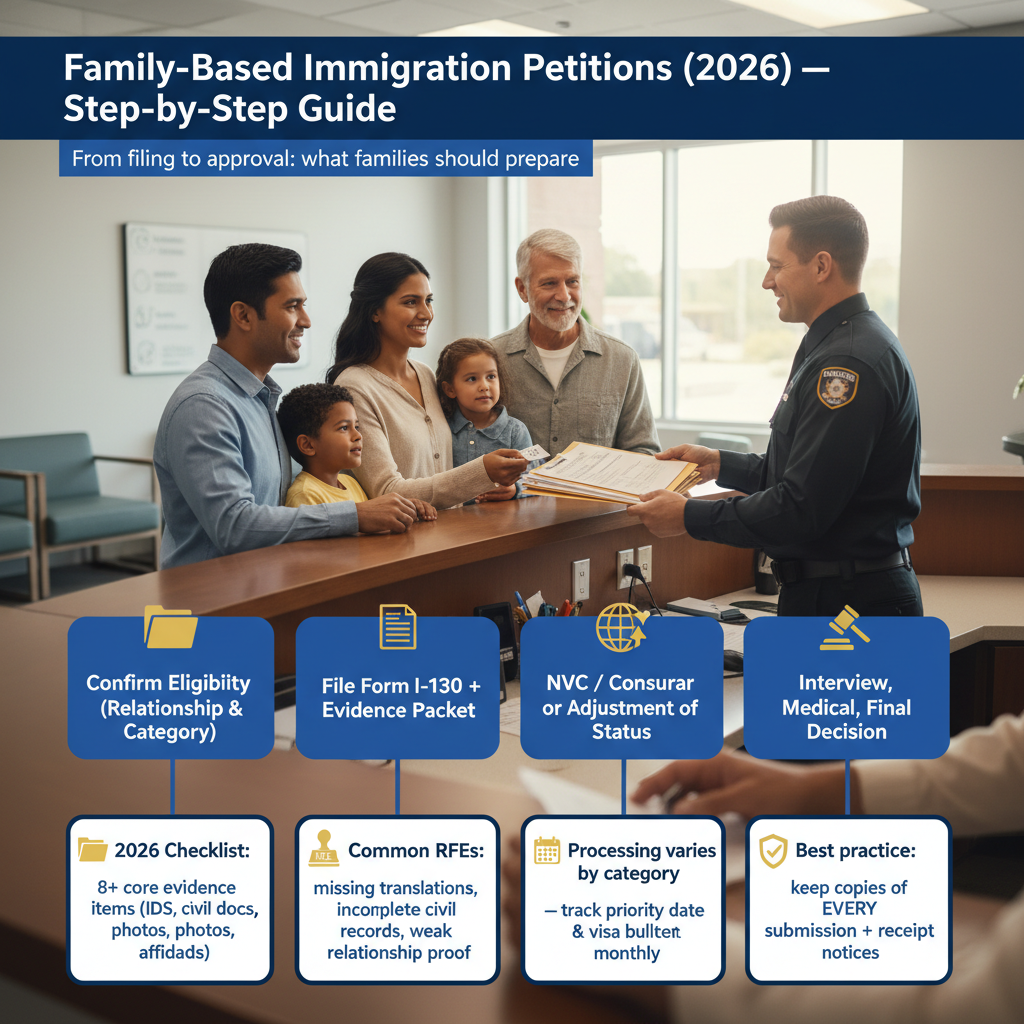
Immigration updates and practical “how-to” coverage have been trending in Google News, including: Family-Based Immigration Petition Guide (Immigration). This article turns that broader news cycle into a clear, step-by-step roadmap for families who want to start (or fix) a family-based case in 2026.
Need Help? Our Orlando immigration team is ready to assist. Call +1 786-791-3106 for a free consultation, or message us online. Se Habla Español.
What This News Means for Immigrants in Orlando and Across Florida
Why this news is showing up now
Family-based immigration is “trending” because many families are trying to plan around changing processing backlogs, higher scrutiny on documentation, and the practical reality that small mistakes can add months (or years) to a case. People are also paying closer attention to:
- USCIS processing delays and variability by form type (check USCIS Processing Times)
- Requests for Evidence (RFEs) tied to missing civil documents, unclear relationship proof, or incorrect filing fees
- Different pathways: Adjustment of Status vs. consular processing through the U.S. Department of State
- Concerns about lawful entry, overstays, prior removal orders, or court cases (see Executive Office for Immigration Review)
Reminder: “Family petition” is not one single form—most cases involve multiple stages, multiple agencies, and strict evidence rules.
How it can affect Florida residents
For families in Florida—especially in high-growth areas like Orlando, Orange County, and communities along the I-4 corridor—demand for appointments, medical exams, translations, and supporting records can create bottlenecks. If your case is in Orlando, you may interact with:
- The Orlando USCIS Field Office (commonly for interviews and Form I-485 adjudication)
- USCIS lockboxes and service centers (for initial intake of Form I-130, Form I-485, and related filings)
- The National Visa Center (NVC) for consular cases
Important: Even if two families live in the same neighborhood, their timelines can be very different depending on the category (immediate relative vs. preference), whether the beneficiary is inside the U.S., and whether there are admissibility issues (like unlawful presence).
What Family-Based Immigration Petition Guide Is (and Why It Matters)
A plain-English definition
A “family-based immigration petition” is the legal process a U.S. citizen or lawful permanent resident (green card holder) uses to request that certain relatives receive immigration benefits—usually a green card (lawful permanent residence). In most cases, the process starts with Form I-130 (Petition for Alien Relative) filed with USCIS.
The guide matters because family cases are often denied or delayed for preventable reasons: incomplete forms, weak relationship evidence, incorrect filing category, or misunderstanding whether the beneficiary can apply in the U.S. through Adjustment of Status or must finish abroad through a consulate.
Key terms you need to know
- Form I-130: The petition that establishes a qualifying family relationship.
- Form I-485: Application to Register Permanent Residence or Adjust Status (used when eligible to apply for a green card inside the U.S.).
- Adjustment of Status: The process of applying for a green card from inside the U.S. (instead of leaving for a consular interview).
- Consular processing: Finishing the immigrant visa process outside the U.S., usually at a U.S. embassy/consulate via the U.S. Department of State.
- Immediate relatives: Spouses of U.S. citizens, unmarried children under 21 of U.S. citizens, and parents of U.S. citizens (petitioner must be 21+). No annual visa cap.
- Family preference categories: Categories with annual limits and waiting lines (e.g., F2A, F2B, F3, F4).
- Priority Date: Usually the date USCIS receives the Form I-130; it determines your place in line for capped categories.
- Visa Bulletin: Monthly Department of State chart showing when a visa number is available (important for preference categories).
- RFE (Request for Evidence): USCIS asks for additional documents; responding correctly and on time is critical.
- Notice of Intent to Deny (NOID): A more serious warning that denial is likely unless you respond persuasively.
Warning: A family relationship alone does not guarantee approval. USCIS also evaluates eligibility, admissibility, and credibility (including prior immigration history).
Need Help? Our Orlando immigration team is ready to assist. Call +1 786-791-3106 for a free consultation, or message us online. Se Habla Español.
Current Immigration Law: The Foundation
Family-based immigration is governed primarily by the Immigration and Nationality Act (INA) and related regulations in Title 8 of the Code of Federal Regulations (8 CFR). USCIS and the Department of State apply these laws through forms, evidence rules, interviews, and background checks.
Federal requirements
Most family cases follow a two-part structure:
- Eligibility through a qualifying relationship (proved through Form I-130 and supporting evidence)
- Eligibility to receive the green card (through Form I-485 inside the U.S. or an immigrant visa case abroad)
Common USCIS forms in family cases (confirm the latest versions at USCIS Forms and file through the USCIS official website guidance):
- Form I-130 (Petition for Alien Relative)
- Form I-130A (Supplemental Information for Spouse Beneficiary, in spousal cases)
- Form I-485 (Adjustment of Status, when eligible)
- Form I-864 (Affidavit of Support under INA 213A)
- Form I-765 (Employment Authorization, often filed with Form I-485)
- Form I-131 (Travel Document / Advance Parole, often filed with Form I-485)
- Form I-693 (Medical Examination and Vaccination Record)
Important: If the beneficiary is in removal proceedings, the process can change significantly and may involve the immigration court system under EOIR (see Executive Office for Immigration Review). Do not assume you can simply file Form I-485 without addressing court jurisdiction.
Florida-specific considerations
Immigration law is federal, but Florida residents run into practical, local issues that affect case preparation:
- Document access: obtaining certified records (birth, marriage, divorce) from other states or countries; securing certified translations.
- Orlando-area logistics: scheduling medical exams with USCIS-designated civil surgeons and preparing for potential interviews at the Orlando USCIS Field Office.
- Address stability: frequent moves in Central Florida can cause missed USCIS notices. Update addresses promptly (AR-11) and keep copies.
- Mixed-status families: many Central Florida residents have relatives with different statuses; planning matters to avoid triggering bars.
Reminder: Always rely on official instructions and updates from the USCIS official website and, for consular cases, the U.S. Department of State.
How to File a Family-Based Petition: A Complete Step-by-Step Guide
1) Choose the correct family category and strategy (AOS vs. consular)
Start by identifying (a) who the petitioner is (U.S. citizen or green card holder), (b) who the beneficiary is, and (c) where the beneficiary is located (inside or outside the U.S.). This determines whether you can pursue Adjustment of Status or must use consular processing.
- Immediate relatives of U.S. citizens often have the most direct path and may be able to file “concurrently” (I-130 + I-485 together) if the beneficiary is eligible to adjust.
- Preference categories require waiting for a visa number. Your Priority Date must be current under the Visa Bulletin.
Documents to gather for Step 1:
- Petitioner proof of status: U.S. passport, naturalization certificate, or green card (front/back)
- Beneficiary passport biographic page (if available)
- Prior immigration documents (I-94, visas, prior USCIS notices, removal paperwork if any)
- Prior marriage termination documents (divorce decrees, annulments, death certificates)
Warning: If the beneficiary entered without inspection (EWI) or has certain criminal issues, the correct strategy may involve waivers or consular processing planning. Get legal advice before filing.
2) Prepare and file Form I-130 (and Form I-130A if applicable)
The purpose of Form I-130 is to prove the qualifying relationship (spouse, parent, child, sibling) and that the relationship is genuine. In marriage cases, USCIS expects strong proof that the marriage is bona fide (real, not for immigration).
File using the correct filing address/online method and the current edition of the form from USCIS Forms. Follow USCIS instructions on the USCIS official website.
Documents to include for Step 2 (typical):
- Completed and signed Form I-130
- Form I-130A (spouse beneficiary cases)
- Filing fee (per USCIS instructions)
- Petitioner proof of U.S. citizenship or permanent residence
- Beneficiary proof of identity (passport page, national ID if applicable)
- Evidence of relationship:
- Spouse: marriage certificate + proof of bona fide marriage (see below)
- Parent/child: birth certificate(s) showing parentage; adoption decrees if relevant
- Siblings: birth certificates showing at least one common parent
- Proof of legal name changes (if any)
- Two passport-style photos if required by instructions (varies by filing method)
Marriage evidence examples (stronger is better):
- Joint lease/mortgage, joint bank accounts, joint insurance
- Children’s birth certificates (if applicable)
- Photos over time with family/friends, travel itineraries
- Affidavits from people who know the relationship (supporting, not primary)
- Utility bills, shared memberships, beneficiary designations
Important: Incomplete relationship evidence is one of the most common reasons USCIS issues an RFE.
3) Decide whether you can file Form I-485 now (and file a “one package” case if eligible)
If the beneficiary is physically in the U.S. and eligible to adjust, you may file Form I-485 either:
- Concurrently with Form I-130 (common for immediate relatives of U.S. citizens), or
- After I-130 approval and/or when the Priority Date is current (preference categories).
Not everyone qualifies for Adjustment of Status. Eligibility can depend on lawful admission/parole, maintenance of status, and whether any bars apply. Immediate relatives often have special forgiveness for certain overstays, but not for entry without inspection in most cases.
Documents to include for Step 3 (typical I-485 package):
- Completed and signed Form I-485
- Copy of I-94 record and admission stamp (if applicable)
- Birth certificate (certified copy) + certified English translation if needed
- Passport biographic page, visa page, entry stamp pages
- Two passport-style photos (per instructions)
- Form I-864 Affidavit of Support + financial evidence (see Step 4)
- Form I-693 medical exam (often best filed per current USCIS guidance; many cases file it with I-485 to avoid delays)
- If filing: Form I-765 (work permit) and Form I-131 (advance parole)
- Certified disposition records for any arrests/citations (even if charges were dropped)
Warning: Do not travel internationally while Form I-485 is pending unless you have the correct travel authorization (advance parole) or another status that permits travel without abandoning the application. Traveling at the wrong time can cause denial.
4) Prepare the financial sponsorship: Form I-864 and supporting evidence
Most family-based green card cases require the petitioner (and sometimes a joint sponsor) to submit Form I-864, showing the immigrant will not become primarily dependent on certain government benefits. The affidavit is a binding contract and can last for years.
If the petitioner’s income is insufficient, a joint sponsor may be used if eligible. Some cases can use assets to supplement income.
Documents to include for Step 4:
- Completed and signed Form I-864 (petitioner)
- IRS tax transcripts (often preferred) and/or federal tax returns
- W-2s/1099s and recent pay stubs
- Employment letter verifying position, salary, and start date
- If using a joint sponsor: joint sponsor’s Form I-864 + proof of status + tax evidence
- If using assets: proof of ownership and value (bank statements, property appraisal, etc.)
Important: A weak or incomplete Form I-864 package frequently triggers RFEs and delays. Plan this early—especially if you are self-employed or recently changed jobs.
5) Track receipts, biometrics, RFEs, and interview preparation (Orlando-specific tips)
After filing, USCIS typically issues receipt notices and then schedules biometrics (fingerprints/photo) for the beneficiary. Next may come:
- An RFE (if something is missing)
- An interview (common for many marriage-based and family cases)
- An approval or, in some cases, a NOID/denial
If your case is in Orlando, be prepared for an interview at the Orlando USCIS Field Office. For Central Florida residents, interview scheduling can vary; keep your address updated and monitor your USCIS account.
Documents to prepare for Step 5:
- All original civil documents submitted (birth, marriage, divorce)
- Updated relationship evidence (for marriage cases): new leases, bills, insurance, photos
- Updated financial evidence (recent pay stubs, job letters)
- Government-issued IDs for both spouses
- Copies of all USCIS filings and receipt notices
Reminder: Many families underestimate the interview. Treat it like a formal legal appointment—organized binder, consistent answers, and honest explanations.
6) If the beneficiary is abroad: NVC + consular processing steps
When the beneficiary will complete the process outside the U.S., USCIS approval of Form I-130 is only the beginning. The case typically moves to the National Visa Center (NVC), where you submit fees, forms, and civil documents, then schedule a consular interview.
Consular processing is managed through the U.S. Department of State. Requirements vary by embassy/consulate.
Documents to prepare for Step 6:
- Beneficiary’s valid passport
- Civil documents per reciprocity schedule (birth, marriage, police certificates)
- Police certificates from required countries/regions
- Form I-864 and financial evidence (still required in most cases)
- Medical exam from an authorized panel physician
- Proof of relationship (updated, especially for spouses)
Warning: If the beneficiary has prior unlawful presence in the U.S., leaving the U.S. to attend a consular interview may trigger 3- or 10-year bars. Get legal screening before choosing consular processing.
7) After approval: conditional residence, green card delivery, and next steps
Approval is not always the end. Some spouses receive a “conditional” green card valid for two years if the marriage was less than two years old at the time of approval/entry. Later, you must file to remove conditions (commonly Form I-751).
Also plan for:
- Social Security number coordination (often automatic but not always)
- Driver’s license updates in Florida
- Keeping copies of approval notices and the green card
- Future naturalization planning (if eligible)
Important: If you receive a conditional green card, missing the filing window can put status at risk. Many cases require filing during a 90-day window before the card expires.
Need Help? Our Orlando immigration team is ready to assist. Call +1 786-791-3106 for a free consultation, or message us online. Se Habla Español.
Practical Steps You Can Take Today
Whether you are just starting or you already filed and feel stuck, here is a practical checklist that helps most families move faster and avoid preventable delays.
- 1) Build a “master file” now: scan passports, IDs, I-94s, prior USCIS notices, and civil documents into a single organized folder.
- 2) Request certified copies early: birth/marriage/divorce records can take weeks. If documents are abroad, plan for shipping time.
- 3) Prepare translations correctly: use certified English translations with a proper translator certification statement.
- 4) Strengthen relationship evidence monthly: add one or two items per month (joint bills, insurance, photos, travel records).
- 5) Track your case and deadlines: create calendar reminders for biometrics, RFE due dates, and medical exam timing.
- 6) Check processing times realistically: use USCIS Processing Times and understand that local interview queues can differ.
- 7) Screen for risks before filing: prior arrests, misrepresentation, removal orders, or unlawful presence can change everything.
Timeline expectations (general): Timelines vary widely by category, location, and case complexity. Many families experience months of waiting between steps. A well-prepared filing can reduce RFEs and prevent “avoidable delays,” but no attorney can ethically promise an exact approval date.
Reminder: If USCIS issues an RFE, do not wait until the last minute. Missing deadlines can result in denial. While the RFE deadline varies, always treat it like a hard deadline and send a complete, organized response with tracking.
Important: If you move, update your address with USCIS right away. Missed notices can cause interview no-shows and denials.
How Imigrar Helps Immigrants in Orlando
Imigrar is an immigration law firm based in Orlando, Florida, serving clients nationwide. Our mission is to Keep Families Together. Family-based cases look simple on paper, but real life makes them complex—prior entries, blended families, financial sponsorship complications, and timing issues with the Priority Date and the Visa Bulletin.
We help by:
- Confirming the correct category and strategy (Adjustment of Status vs. consular processing)
- Preparing a strong evidence package to reduce RFEs
- Guiding clients through biometrics and interview preparation (including for the Orlando USCIS Field Office)
- Spotting red flags early (unlawful presence, prior denials, criminal history, prior removal orders)
- Responding to RFEs/NOIDs with organized, persuasive submissions
We offer a free consultation to help you understand your options and next steps. Se Habla Español.
Frequently Asked Questions
Q: Who is eligible to file a family-based petition?
A: Generally, a U.S. citizen or lawful permanent resident can file Form I-130 for certain relatives. U.S. citizens can petition spouses, children (married or unmarried), parents (if the petitioner is 21+), and siblings. Green card holders can typically petition spouses and unmarried children. Eligibility also depends on the beneficiary’s admissibility and whether the relationship documentation is strong and consistent.
Q: Does my current immigration status affect whether I can apply inside the U.S.?
A: Yes. Adjustment of Status using Form I-485 depends on factors like lawful admission/parole, visa availability, and whether any bars apply. Some immediate relatives of U.S. citizens have flexibility for certain overstays, but entry without inspection and other issues may require different strategies. Warning: If you have a removal order or are in court, you must get legal guidance because jurisdiction and available remedies can change.
Q: How long does a family-based petition take in 2026?
A: It depends on the category (immediate relative vs. preference), whether the beneficiary is in the U.S. or abroad, and local workload. Use USCIS Processing Times for the most current estimates. Preference categories also depend on the Visa Bulletin and your Priority Date. For Central Florida residents, interview scheduling at the Orlando USCIS Field Office can also affect timing.
Q: What documents are required for Form I-130 and Form I-485?
A: At minimum, Form I-130 needs proof of the petitioner’s status and proof of the relationship (like a marriage certificate or birth certificate). Form I-485 typically needs identity documents, proof of lawful entry (when applicable), a medical exam (Form I-693), and financial sponsorship (Form I-864). Many cases also include Form I-765 and Form I-131. If any document is not in English, include a certified translation.
Q: How much does it cost to file a family-based case?
A: Costs include USCIS filing fees (which vary by form and sometimes by age/category), medical exam fees, translations, and potential travel costs for consular interviews. Always confirm current filing fees and instructions directly on the USCIS official website and USCIS Forms. Attorney fees vary depending on complexity (for example, prior denials or inadmissibility issues may require more work).
Q: What happens if my case is denied?
A: A denial does not always end the process, but your options depend on the type of filing and the reason for denial. Some cases may allow a motion to reopen/reconsider, a new filing with stronger evidence, or an appeal (certain I-130 denials can be appealed to the BIA). If the beneficiary is in removal proceedings, you may need to coordinate with immigration court (see Executive Office for Immigration Review). Important: Do not refile blindly—denials often point to specific evidence or legal issues that must be fixed first.
Q: Can I work while my Form I-485 is pending?
A: Many applicants file Form I-765 with the I-485 package and can receive an Employment Authorization Document (EAD) while waiting. However, eligibility depends on the category and whether the I-485 was properly filed. Do not work without authorization; unauthorized employment can create complications in some categories.
Common Mistakes (and How to Avoid Them)
Mistake #1: Filing the wrong process for the beneficiary’s situation
Many families assume everyone can file Form I-485 inside the U.S. That is not true. The correct approach depends on lawful admission, visa availability, and inadmissibility risks.
- How to avoid it: Confirm whether the beneficiary qualifies for Adjustment of Status before filing. If consular processing is required, plan carefully to avoid triggering bars.
Mistake #2: Weak or disorganized evidence (especially for marriage cases)
USCIS officers look for consistency and credibility. Submitting a pile of random documents without a clear explanation often leads to RFEs or tough interviews.
- How to avoid it: Create a well-labeled packet with a cover letter, table of contents, and categorized relationship evidence (housing, finances, insurance, photos, communications, affidavits).
Mistake #3: Missing deadlines or misunderstanding timing rules
Families miss RFE deadlines, biometrics appointments, or critical future filing windows (like removal of conditions).
- How to avoid it: Track every notice and deadline in a calendar. Keep your address updated. For conditional green cards, file during the 90-day window before expiration. If you receive a notice with a response deadline, treat it as a hard deadline—even a delay of a few days can be fatal.
Reminder: Some immigration benefits have strict time rules. For example, certain reinstatement or follow-to-join situations have deadlines, and in other contexts immigration law includes rules tied to 180 days of unlawful presence or other accrual periods. Timing can affect admissibility and strategy—do not guess.
Need Help? Our Orlando immigration team is ready to assist. Call +1 786-791-3106 for a free consultation, or message us online. Se Habla Español.
Official resources to rely on (bookmark these)

Closing: Keep your family case moving forward
Family petitions can be straightforward when the facts are clean and the package is prepared correctly—but even small issues can create major delays. If your case is in Orlando, if you live in Orange County or along the I-4 corridor, or if you are unsure whether to pursue Adjustment of Status or consular processing, getting a plan early can save time and reduce risk.
Need Help? Our Orlando immigration team is ready to assist. Call +1 786-791-3106 for a free consultation, or message us online. Se Habla Español.


