


The reporting that sparked this guide
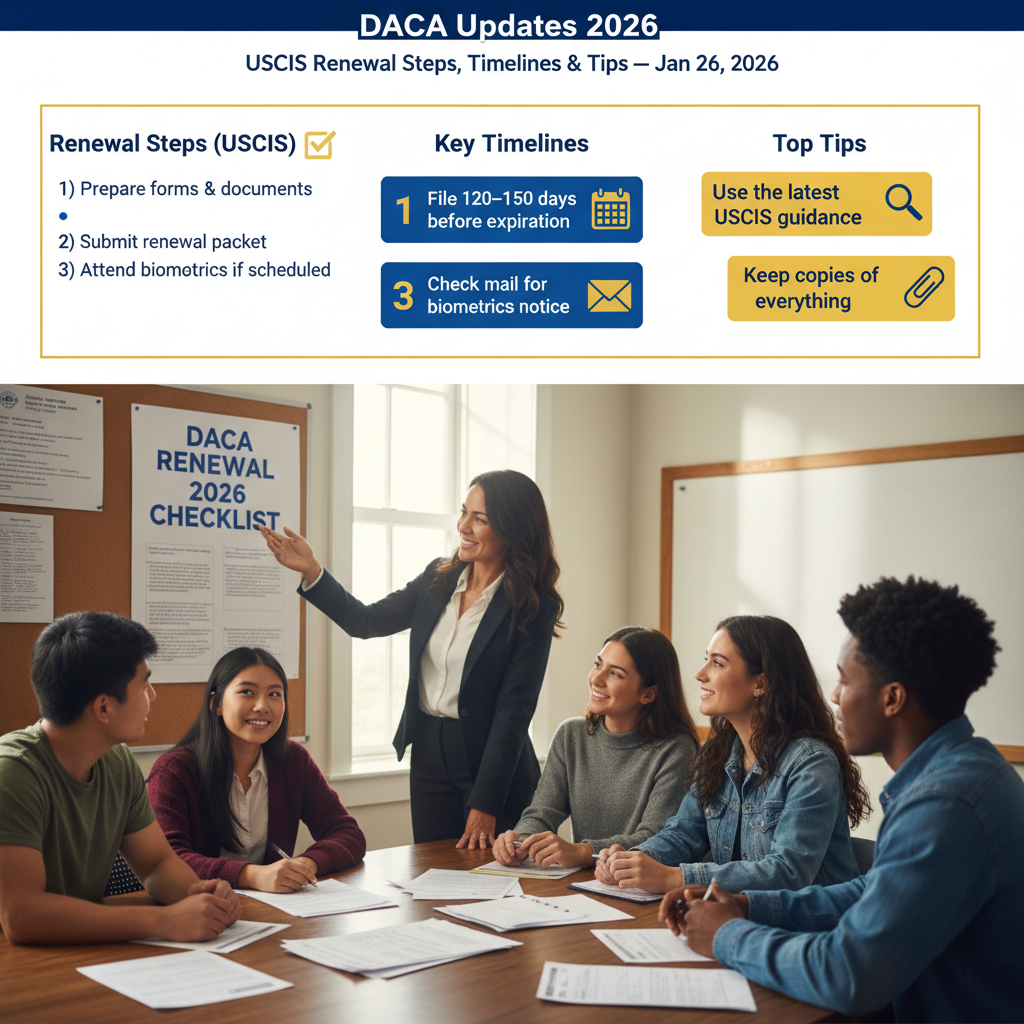
This article is based on recent coverage and public-facing updates pointing readers back to USCIS guidance for DACA renewals and related announcements. Reference link: DACA Program Updates and Renewal Information (USCIS).
Important: Online news headlines can change quickly. The most reliable, controlling source for DACA filing instructions, fees, and forms is the USCIS official website.
Need Help? Our Orlando immigration team is ready to assist. Call +1 786-791-3106 for a free consultation, or message us online. Se Habla Español.
What This News Means for Immigrants in Orlando and Across Florida
Why this news is showing up now
DACA remains one of the most closely watched immigration programs in the United States because it affects hundreds of thousands of people who grew up here and rely on DACA to maintain protection from removal and to renew their work authorization. Even when there are no brand-new program expansions, DACA “updates” trend in the news for a few recurring reasons:
- Renewal deadlines come in waves, and many recipients file around the same time.
- USCIS periodically updates form editions, filing addresses, online filing options, and processing guidance.
- Ongoing litigation and policy changes can impact eligibility for new initial filings (even if renewals continue).
- Employers and schools often ask for updated proof of employment authorization, making renewals time-sensitive.
Reminder: Most DACA recipients are focused on one practical question: “How do I renew on time so my work permit doesn’t lapse?” That is the core purpose of this guide.
How it can affect Florida residents
Florida—including Orlando, Orange County, and the I-4 corridor—has a large population of DACA recipients working in hospitality, healthcare, construction, education, logistics, and small businesses. A delayed renewal can create immediate real-world problems:
- Loss of a job due to an expired Employment Authorization Document (EAD).
- Driver’s license renewal complications if your underlying lawful presence documentation expires.
- Interrupted schooling, professional licensing, or internships requiring valid work authorization.
- Travel planning disruptions (and confusion about whether travel is allowed at all).
If your case is in Orlando or anywhere in Central Florida, timing matters because processing times can fluctuate. While many DACA renewals are handled through USCIS service centers rather than the local field office, local factors (mail reliability, address changes, biometrics scheduling, and personal emergencies) still affect outcomes.
Warning: If your DACA expires, you may lose protection from removal and work authorization. A lapse can also increase the risk of workplace issues and create stress for families trying to stay stable—especially in mixed-status households.
What DACA Program Updates and Renewal Information Is (and Why It Matters)
A plain-English definition
Deferred Action for Childhood Arrivals (DACA) is a discretionary policy that may allow certain individuals who came to the United States as children and meet specific guidelines to request:
- Deferred action (a temporary decision not to pursue removal for a set period), and
- Work authorization through an EAD (often called a “work permit”).
DACA is not the same as a green card, citizenship, or a visa. It does not by itself create lawful permanent resident status. That’s why renewal guidance matters: for most recipients, keeping DACA active is essential to maintaining employment and stability.
This guide focuses on renewals because USCIS has continued to accept and adjudicate many renewal requests even while court challenges have affected initial DACA requests. Always verify the latest posture on the USCIS official website.
Key terms you need to know
- DACA: Deferred Action for Childhood Arrivals; a discretionary, time-limited deferral of removal.
- Deferred action: A decision to defer removal action for a period; not a lawful status.
- EAD: Employment Authorization Document; proof you are authorized to work.
- USCIS: U.S. Citizenship and Immigration Services, the agency that processes DACA renewals.
- Biometrics: Fingerprints/photo/signature appointment (sometimes reused; sometimes required).
- Processing times: How long USCIS is taking to adjudicate; check USCIS Processing Times.
- Advance Parole: A separate travel permission document in certain contexts; DACA travel rules have changed over time and are highly fact-specific.
- 90-day window: A common planning benchmark many recipients use; USCIS often recommends filing earlier than you think.
- 180 days: A critical planning marker; many attorneys advise filing up to 180 days before expiration to reduce lapse risk (when permitted by USCIS guidance).
You may also hear general immigration terms like Adjustment of Status, Priority Date, Form I-130, and Form I-485. Those are not DACA renewal forms, but they matter if you might have a separate pathway through family or employment.
Current Immigration Law: The Foundation
DACA exists through executive branch policy and implementing regulations, and it has been shaped by federal court decisions. Because it is discretionary and litigated, USCIS instructions can change. Always cross-check your plan with official sources and, when needed, legal counsel.
Federal requirements
DACA requests are processed by USCIS under Department of Homeland Security (DHS) authority. Although DACA is not a statute passed by Congress, it interacts with federal immigration law, including the Immigration and Nationality Act (INA) and related regulations in Title 8 of the Code of Federal Regulations.
For renewals, USCIS typically requires a package that includes:
- Form I-821D (Consideration of Deferred Action for Childhood Arrivals)
- Form I-765 (Application for Employment Authorization)
- Form I-765WS (Worksheet)
- Correct filing fee(s) or an approved fee waiver request if applicable (fee waivers are limited and highly specific)
Always confirm the current form editions and filing instructions at USCIS Forms and the main USCIS official website.
Important: DACA recipients sometimes have other immigration options (family petitions, U visas, VAWA, asylum, etc.). Those involve different forms such as Form I-130 and Form I-485 for family-based cases and Adjustment of Status—but those are separate from DACA renewal.
Florida-specific considerations
Federal immigration law controls DACA, but Florida residents should consider practical, state-level impacts:
- Driver’s license/ID timing: Plan renewals so your EAD and DACA validity align with your Florida DHSMV renewal needs.
- Employment verification: Florida employers may re-verify work authorization when an EAD expires.
- Address stability: Frequent moves in the Orlando metro area (Orange County, Osceola County, Seminole County) can lead to missed USCIS notices if you do not update your address properly.
If your case is in Orlando, consider building extra buffer time for mail delivery and document gathering—especially if you are renewing during peak seasons (graduations, end-of-year hiring, or major holiday periods).
Need Help? Our Orlando immigration team is ready to assist. Call +1 786-791-3106 for a free consultation, or message us online. Se Habla Español.
How to Renew DACA: A Complete Step-by-Step Guide
Below is a practical renewal roadmap. It is designed for DACA recipients who have been approved before and are seeking to renew. If you have arrests, charges, a prior removal order, or any immigration court history, speak with an attorney before filing.
Warning: If you have any contact with immigration court, check the Executive Office for Immigration Review (EOIR) system for case posture and talk to counsel before filing—DACA can interact with enforcement priorities and procedural posture.
1) Confirm your eligibility and your expiration date
Start by confirming (a) that you are filing a renewal rather than an initial request, and (b) your current DACA/EAD expiration date. Many people accidentally plan around the wrong date (for example, the I-797 notice date instead of the EAD “Card Expires” date).
- Required documents to gather:
- Current/most recent EAD (front and back copy)
- Most recent DACA approval notice (I-797)
- Any prior USCIS receipts for DACA renewals
- A list of all addresses since your last filing (with dates)
Reminder: Many attorneys recommend filing as early as USCIS allows, often up to 180 days before expiration, to reduce the chance of a work authorization gap. Check USCIS’ current DACA renewal timing guidance before you submit.
2) Screen your case for “red flags” before you file
Before you submit anything, identify issues that can trigger a Request for Evidence (RFE), delay, or denial. These include arrests (even if dismissed), new charges, DUI, domestic violence allegations, fraud findings, or travel/entry complications.
- Required documents to gather (if applicable):
- Certified court dispositions for every arrest/charge (even if dropped)
- Police reports (if available)
- Proof of compliance with probation or court requirements
- Prior immigration documents (NTA, removal order, voluntary departure, etc.)
If you are unsure whether something “counts,” assume it matters and get legal advice. A quick review can prevent a filing that unintentionally puts you at risk.
3) Prepare the USCIS forms correctly (I-821D, I-765, I-765WS)
Most DACA renewals require these forms, completed consistently and accurately. Inconsistencies (like mismatched addresses, different versions of your name, or missing travel history) can cause delays.
- Required documents to gather:
- Passport biographic page (if you have one)
- Government-issued ID (if available)
- Social Security card (if you have an SSN)
- Two passport-style photos (if filing by mail and required by current instructions)
- Employment history and/or school information to support the worksheet where relevant
Important: Use the current form editions from USCIS Forms. USCIS can reject filings that use outdated editions or missing pages.
4) Pay the correct fee (and choose online vs. mail filing carefully)
USCIS fees can change. Confirm the current DACA-related fee total on USCIS before you pay. Some applicants can file online for certain form combinations; others prefer mail filing for control over the packet and exhibits.
- Required documents to gather:
- Payment method permitted by USCIS (credit card form if allowed, money order, or other accepted method)
- A cover letter (recommended) listing included forms and evidence
- Proof of any approved fee waiver request (only if applicable and allowed)
Warning: If your payment is wrong or the method is not accepted, USCIS may reject the entire package, costing you time inside your 90-day window or even beyond.
5) Submit your renewal and track it like a project
After filing, track your case using your receipt number and keep digital and paper copies of everything. If you move, update your address promptly to avoid missing biometrics notices or RFEs.
- Required documents to gather:
- Shipping confirmation and delivery proof (if filing by mail)
- USCIS receipt notice(s) once issued
- USCIS online account access details (if you used online filing or added the case)
Track estimated processing at USCIS Processing Times, but remember those are averages and can change quickly.
6) Attend biometrics (if scheduled) and respond fast to any RFE
USCIS may reuse biometrics or schedule a new appointment. If you receive a biometrics notice, attend on the scheduled date/time or follow the notice instructions to reschedule (rescheduling can cause delays).
- Required documents to gather:
- Biometrics appointment notice
- Government-issued photo ID (as listed on the notice)
- Any RFE notice and your drafted response packet (if an RFE is issued)
Reminder: RFEs have strict deadlines. Missing an RFE deadline can lead to denial.
7) Receive your approval and plan for the next renewal early
Once approved, you should receive an approval notice and your new EAD. Immediately:
- Verify your name and dates are correct.
- Update your employer’s I-9 reverification process as needed.
- Calendar your next renewal strategy well before the next expiration—often aiming for the 180 days planning mark.
- Required documents to gather:
- New EAD card (make front/back copies)
- Approval notice
- Secure storage plan (digital scan + safe physical location)
Practical Steps You Can Take Today
Whether your DACA expires in 30 days or 10 months, you can reduce risk by treating your renewal like a checklist-driven project.
- 1) Check your expiration dates right now: Look at the EAD “Card Expires” date and your DACA approval validity.
- 2) Build a renewal timeline: Many recipients aim to prepare documents by the 180 days mark and file as early as allowed.
- 3) Create a “USCIS packet folder”: Keep scans of your EAD, approvals, receipts, IDs, and prior filings.
- 4) Order certified court records early (if any arrest/charge ever happened): Some Florida courts take time to produce certified dispositions.
- 5) Stabilize your mailing address: If you are moving along the I-4 corridor (Orlando, Kissimmee, Sanford, Lake Mary, Altamonte Springs), plan where notices should go and update USCIS properly.
- 6) Track processing times weekly: Use USCIS Processing Times to set expectations.
- 7) Avoid notario fraud: Only licensed attorneys or DOJ-accredited representatives should provide legal advice.
Timeline expectations: DACA renewal processing can vary widely depending on USCIS workload, biometrics requirements, RFEs, and background checks. Some cases move quickly; others take months. Plan for delays and file early when possible.
Document preparation guidance: Use consistent names, consistent addresses, and consistent dates across all forms. If you have used different names (e.g., two last names, married name), document it clearly and consistently.
Need Help? Our Orlando immigration team is ready to assist. Call +1 786-791-3106 for a free consultation, or message us online. Se Habla Español.
How Imigrar Helps Immigrants in Orlando
At Imigrar, we focus on practical, family-centered immigration guidance aligned with our tagline: Keep Families Together. DACA renewals can look straightforward until a small issue—an arrest record, a missed notice, an old address, or a prior immigration filing—creates risk.
For Central Florida residents, we help by:
- Reviewing eligibility and timing to reduce the chance of a lapse in work authorization.
- Preparing renewal packets with consistent evidence and clean organization.
- Identifying “red flags” (criminal, immigration, or identity issues) before filing.
- Responding to RFEs and USCIS notices quickly and thoroughly.
- Exploring long-term options beyond DACA, including family-based pathways involving Form I-130 and Form I-485 (Adjustment of Status) where eligible and strategically appropriate.
If your case is in Orlando, we can also help you plan around practical realities like job reverification, school deadlines, and travel needs.
We offer a free consultation. Call +1 786-791-3106. Se Habla Español.
Frequently Asked Questions
Q: Am I still eligible to renew DACA if my current DACA is expired?
A: Sometimes, but timing matters. If your DACA expired recently, you may still be able to file a renewal request; if it has been expired too long, USCIS may treat it differently under current policy. Because these rules can shift, verify the latest USCIS guidance on the USCIS official website and speak with an attorney if you are close to or past expiration. Warning: An extended lapse can increase risk and may complicate employment and driver’s license issues.
Q: Does renewing DACA give me lawful status or a green card?
A: No. DACA is deferred action and does not by itself create lawful permanent resident status. A green card usually requires a separate legal basis such as a family petition (Form I-130) and an application to adjust status (Form I-485) through Adjustment of Status, or consular processing through the U.S. Department of State. An attorney can screen whether you have a long-term pathway while you keep DACA current.
Q: How long does a DACA renewal take in 2026?
A: Processing varies. Some renewals are approved in weeks; others take several months. Check current estimates at USCIS Processing Times. Reminder: Filing early—often around the 180 days planning point—helps reduce the risk of an EAD gap.
Q: What documents do I need to renew DACA?
A: Most renewals include Form I-821D, Form I-765, and Form I-765WS, plus copies of your current EAD, prior approval notices, IDs, and any documents related to arrests/charges (certified dispositions). Always use the latest editions from USCIS Forms. If you have any criminal history, consult counsel before filing.
Q: How much does it cost to renew DACA?
A: The filing cost can change based on USCIS fee schedules and policy updates. Confirm the current fee amount and payment methods directly on the USCIS official website. Important: Submitting the wrong fee or an unacceptable payment method can lead to rejection and lost time inside your 90-day window.
Q: What happens if my DACA renewal is denied?
A: A denial can mean loss of deferred action and work authorization, and it may increase exposure to enforcement depending on your situation. If you receive an intent to deny, RFE, or denial, speak with an immigration attorney immediately to evaluate options (including whether the denial is based on missing evidence, eligibility concerns, or discretionary factors). If you have immigration court involvement, consult the Executive Office for Immigration Review resources and get legal counsel right away.
Q: Can I travel internationally with DACA?
A: Travel is highly sensitive. DACA by itself does not guarantee re-entry after international travel. Some travel may be possible only with specific authorization and under specific rules that have changed over time. Before making any plans, consult USCIS guidance and consider speaking with an attorney. For consular-related information generally, see the U.S. Department of State. Warning: Traveling without proper authorization can have severe immigration consequences.
Q: If my case is in Orlando, do I go to the Orlando USCIS Field Office for DACA?
A: Many DACA renewals are handled through USCIS service centers and do not require a field office interview. However, biometrics (if required) are scheduled at an Application Support Center, and certain issues may require in-person appointments. The Orlando USCIS Field Office may be relevant for other benefits (like Form I-485 Adjustment of Status interviews), but DACA renewals typically proceed without a field office interview unless USCIS requests otherwise.
Common Mistakes (and How to Avoid Them)
Mistake #1: Filing too late and risking an EAD gap
Waiting until the last minute is one of the most common renewal problems. Even a “simple” renewal can be delayed by biometrics, an RFE, or processing backlogs. How to avoid it: Build a plan around the 180 days mark and aim to file as early as USCIS allows.
Mistake #2: Using outdated forms or inconsistent information
USCIS may reject packets with outdated editions or missing pages. Inconsistencies (like different addresses or name spellings than prior filings) can also slow the case. How to avoid it: Download fresh forms from USCIS Forms and cross-check every field against your last approved filing.
Mistake #3: Ignoring arrests/charges because they were “dismissed”
USCIS can still evaluate arrests and charges, even if a case was dismissed or sealed. Missing certified dispositions can lead to RFEs or denials. How to avoid it: Get certified court outcomes and talk to an attorney before filing if you have any criminal history.
Need Help? Our Orlando immigration team is ready to assist. Call +1 786-791-3106 for a free consultation, or message us online. Se Habla Español.

Closing: Protect Your DACA, Protect Your Future
DACA renewals are about more than paperwork—they protect your ability to work, support your family, and plan your life. For Florida residents, especially along the I-4 corridor, small delays can quickly become job and licensing problems. The safest strategy is to renew early, stay organized, and get legal guidance if anything in your history has changed.
Need help with a DACA renewal or exploring a long-term path through family immigration (such as Form I-130, Form I-485, and Adjustment of Status)? Call Imigrar at +1 786-791-3106 for a free consultation, or message us online. Se Habla Español.


