


The reporting that sparked this guide
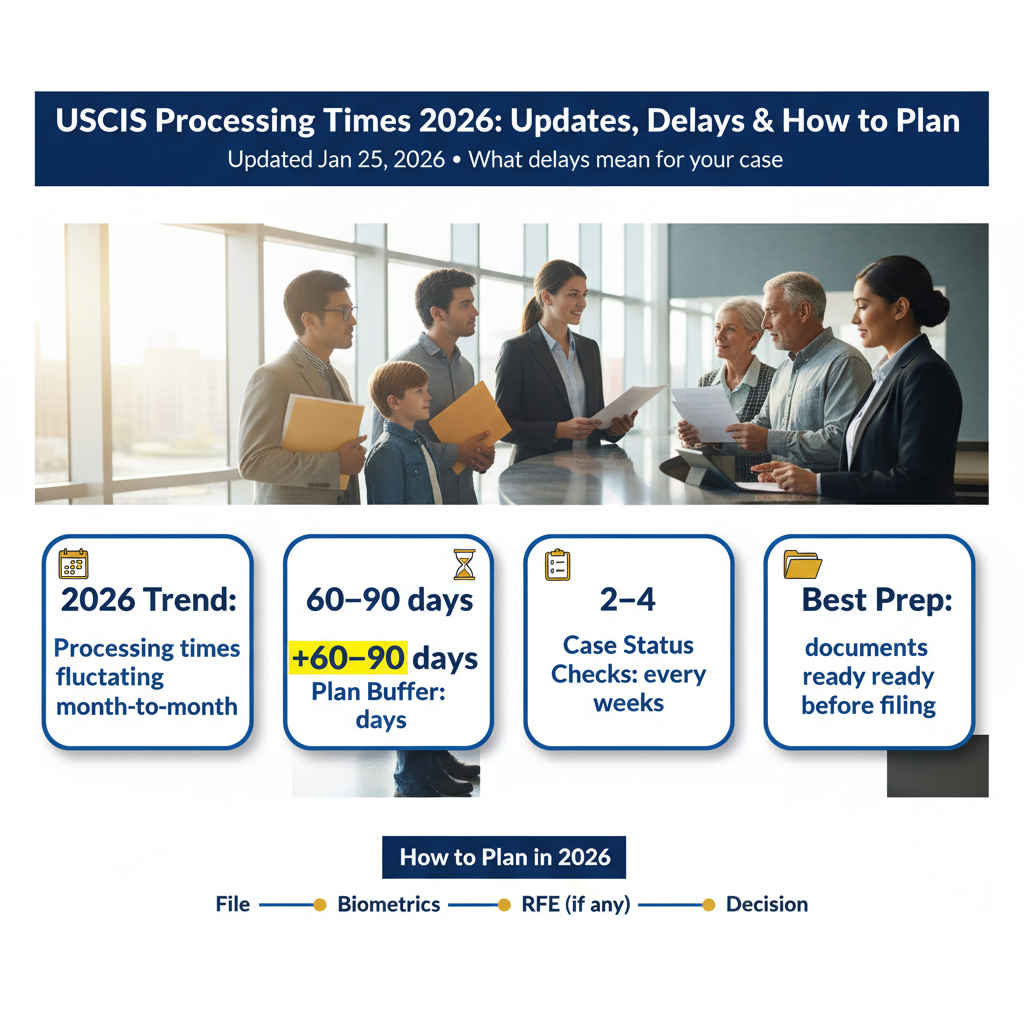
USCIS processing-time stories and updates have been trending in early 2026, with many applicants searching for what delays mean for their cases. The reporting that sparked this guide can be found here: USCIS Processing Times and Updates for 2026 (USCIS).
Reminder: USCIS processing times can change frequently by form type, service center, and field office. Always verify current estimates using USCIS Processing Times and the USCIS official website.
Need Help? Our Orlando immigration team is ready to assist. Call +1 786-791-3106 for a free consultation, or message us online. Se Habla Español.
What This News Means for Immigrants in Orlando and Across Florida
Why this news is showing up now
In 2026, “USCIS processing times” is trending because many applicants are experiencing longer-than-expected waits for interviews, work permits, travel documents, and final green card approvals. Several forces typically drive these fluctuations:
- Workload shifts between USCIS service centers and local field offices.
- Staffing and budget constraints that affect scheduling and adjudications.
- Policy and operational changes (for example, how USCIS handles interviews, Requests for Evidence, or biometrics reuse).
- Surges in filings when new programs open, fees change, or travel and employment conditions shift.
Important: USCIS does not process every case in “first in, first out” order. Case complexity, background checks, missing evidence, and local capacity can move your timeline significantly.
How it can affect Florida residents
For Florida residents—especially in high-growth metro areas—processing times can affect family unity, employment stability, and travel plans. If your case is in Orlando or along the I-4 corridor (Orange County, Osceola County, Seminole County, Polk County), you may feel delays in:
- Adjustment of Status interview scheduling at the Orlando USCIS Field Office.
- Approval times for Form I-765 (work permit) and Form I-131 (advance parole travel document) filed with Form I-485.
- Family-based immigrant visa steps when a case moves between USCIS and the U.S. Department of State.
- Naturalization timelines for Form N-400 (citizenship), including oath ceremony scheduling.
For Central Florida residents, even “small” delays can create major real-life problems: expiring driver’s licenses, job onboarding issues, lapses in work authorization, and missed travel for emergencies.
Warning: Do not assume a delay is “normal” if you have an urgent need (medical, safety, employment). Some cases qualify for expedite requests, but they must be supported with evidence and handled carefully.
What USCIS Processing Times and Updates for 2026 Is (and Why It Matters)
A plain-English definition
“USCIS processing time” is USCIS’s estimate of how long it may take to decide a specific application or petition—such as Form I-130 (family petition), Form I-485 (green card application), or Form N-400 (citizenship). In 2026, USCIS continues to publish these estimates online and updates them regularly.
Processing times matter because they affect your ability to:
- Stay lawfully employed (work authorization timing)
- Travel internationally without abandoning an application
- Plan family reunification and caregiving
- Maintain lawful status or transition to permanent residence
- Meet eligibility milestones for citizenship
Key terms you need to know
- Receipt Notice: Proof USCIS accepted your filing (often “I-797C”). Your receipt number lets you track the case.
- Biometrics: Fingerprints/photo appointment used for background checks. Sometimes USCIS reuses prior biometrics.
- RFE (Request for Evidence): USCIS asks for missing or additional documents. RFEs can add months if not answered correctly.
- NOID (Notice of Intent to Deny): USCIS plans to deny unless you respond with strong evidence—time-sensitive and serious.
- Field Office vs. Service Center: Some cases are decided at service centers; others require local field office interviews (like many Adjustment of Status cases).
- Priority Date: Your place in line in certain immigrant categories (especially family preference and employment-based). Your Priority Date controls when you can move forward if a visa number is limited.
- 90-day window: Commonly refers to time-sensitive immigration concepts (for example, certain filing windows or deadlines). Always confirm which “90 days” applies to your situation.
- 180 days: A critical threshold in several immigration contexts (for example, certain employment-based portability rules). The meaning depends on your case type.
Reminder: “Processing time” is not a guarantee. Your individual timeline can be shorter or longer depending on evidence, eligibility, security checks, and local workload.
Need Help? Our Orlando immigration team is ready to assist. Call +1 786-791-3106 for a free consultation, or message us online. Se Habla Español.
Current Immigration Law: The Foundation
USCIS processing times are an operational reality, but the legal framework behind most benefits remains grounded in federal immigration law—primarily the Immigration and Nationality Act (INA) and related federal regulations in Title 8 of the Code of Federal Regulations (8 C.F.R.). These laws define eligibility; processing times affect when you receive a decision.
Federal requirements
Here are some of the most common legal foundations relevant to 2026 processing-time concerns:
- Family-based immigration under the INA: Many families start with Form I-130 (Petition for Alien Relative). Immediate relatives of U.S. citizens generally are not subject to annual visa caps, while preference categories depend on the visa bulletin and your Priority Date.
- Adjustment of Status (green card from inside the U.S.) typically uses Form I-485. Eligibility depends on category, lawful entry (in many cases), admissibility, and visa availability where required.
- Employment authorization often uses Form I-765, which may be filed with or after Form I-485 in many categories.
- Travel permission while an I-485 is pending often uses Form I-131 (advance parole). Traveling without proper authorization can risk abandonment of an application.
- Naturalization uses Form N-400 and relies on statutory requirements like continuous residence, physical presence, good moral character, and English/civics testing (with exceptions).
Official resources you should rely on include the USCIS official website and the full catalog of forms at USCIS Forms.
Florida-specific considerations
Immigration law is federal, but Florida residents face practical, local issues that make timelines especially important:
- DMV and licensing timing: Expiring work permits or pending status can complicate driver’s license renewals.
- Local field office capacity: If your case is in Orlando, interview scheduling depends on the Orlando USCIS Field Office workload and staffing.
- High mobility along the I-4 corridor: Moves between Orange County and neighboring counties can require address updates and can change which office handles your case.
- Removal proceedings: If a person is in immigration court, timelines and strategy may also depend on the Executive Office for Immigration Review (EOIR) process, which is separate from USCIS.
Important: Always update your address with USCIS promptly after moving. Missing a notice because you moved can lead to denials or missed appointments.
How to Track and Respond to USCIS Processing Times in 2026: A Complete Step-by-Step Guide
1) Identify your case type, form number, and where it’s being processed
Start by confirming the exact form(s) you filed and the office handling them (service center or field office). Your receipt notice (Form I-797C) usually indicates where the case is routed.
Documents to gather:
- USCIS receipt notice(s) with receipt number(s)
- Copy of the full filing (what you submitted)
- Any prior notices (biometrics, interview, RFE, transfer notice)
- Passport biographic page and current immigration documents (I-94, visa, EAD)
Reminder: If you have multiple filings (e.g., Form I-130 + Form I-485 + Form I-765 + Form I-131), each has its own processing time and may be handled by different units.
2) Check the official USCIS processing-time tool (and interpret it correctly)
Use the official tool at USCIS Processing Times. Select:
- Form type (example: Form I-485)
- Category (example: family-based, employment-based, asylum-based)
- Office (example: Orlando Field Office or your service center)
USCIS often provides:
- An estimated time range
- A “case inquiry date” (the date when you can submit an “outside normal processing time” request)
Important: Many people misunderstand the “range.” A posted range does not mean your case will be decided by the earliest date. It’s a statistical estimate and can move month to month.
Documents to gather:
- Screenshot/PDF of the processing-time page you checked
- The “case inquiry date” displayed for your form and office
- Your filing date and receipt date
3) Track your case status and set up USCIS account alerts
In addition to processing times, track your individual case status using your receipt number and a USCIS online account (when available). This helps you catch issues early (RFEs, interview notices, transfers).
Documents to gather:
- Receipt number(s) for each pending form
- USCIS online account access info (if you created one)
- Copies of all status updates and notices
Warning: If you miss a biometrics appointment or interview, USCIS can deny for abandonment. If you must reschedule, act fast and keep proof of your request.
4) Respond quickly and completely to RFEs, NOIDs, and interview notices
Delays in 2026 are often made worse by incomplete responses. If USCIS issues an RFE or NOID, your response quality and organization matter.
Documents to gather (typical examples):
- RFE/NOID notice (all pages)
- Requested civil documents (birth/marriage/divorce certificates)
- Updated financial evidence (tax returns, W-2s, pay stubs) when sponsorship is at issue
- Relationship evidence for marriage cases (leases, insurance, photos, joint accounts)
- Certified dispositions for any arrests/citations (if applicable)
Important: RFEs have strict deadlines. Missing the deadline can lead to denial. If you need help, consult an attorney immediately—do not “guess” what USCIS wants.
5) Use service requests, expedite requests, and congressional help when appropriate
If your case is beyond the posted “case inquiry date,” you may be able to submit an “outside normal processing time” request. In urgent situations, an expedite request may be possible (approval is discretionary).
Documents to gather for a service request or expedite (examples):
- Proof your case is outside normal processing time (USCIS tool screenshot)
- Job offer letter and employer support letter (for urgent work authorization)
- Medical records/doctor letter (for urgent travel or humanitarian need)
- Evidence of financial loss (past-due notices, eviction notices, payroll impact)
- Proof of emergency travel needs (death certificate, hospital letter, itinerary)
If your case is in Orlando and stuck, you may also consider requesting help through your U.S. congressional representative’s office. This does not guarantee approval, but it can sometimes prompt a status review.
Reminder: Expedite is not automatic. Weak or inconsistent evidence can lead to denial of the expedite request and sometimes extra scrutiny.
6) Prepare for next-stage processing (NVC/consular or local field office interview)
Some cases move from USCIS to the National Visa Center (NVC) and then to a U.S. consulate abroad (consular processing). Others remain in the U.S. and require an interview at a field office.
For consular steps, rely on the U.S. Department of State for visa interview preparation and document requirements.
Documents to gather (typical):
- Updated civil documents (birth, marriage, divorce, police certificates as required)
- Affidavit of Support evidence (often tied to Form I-864)
- Medical exam instructions (USCIS-designated civil surgeon or panel physician)
- Proof of lawful entry and status documents (for Adjustment of Status)
If your case is in Orlando, plan logistics for the Orlando USCIS Field Office interview: time off work, childcare, transportation along the I-4 corridor, and a complete, organized evidence binder.
Need Help? Our Orlando immigration team is ready to assist. Call +1 786-791-3106 for a free consultation, or message us online. Se Habla Español.
Practical Steps You Can Take Today
Processing times in 2026 reward organized applicants. Below is a practical checklist you can start now—whether you filed yesterday or you’ve been waiting for months.
- Checklist item 1: Create a “USCIS master file” with every receipt notice, filing copy, and supporting document in one folder (digital + paper).
- Checklist item 2: Calendar every deadline (biometrics, interview, RFE due date). Treat each as mission-critical.
- Checklist item 3: Track your “case inquiry date” using USCIS Processing Times and set a reminder for that date.
- Checklist item 4: Prepare “updated evidence” monthly (recent pay stubs, bank statements, lease renewals, insurance renewals, new photos).
- Checklist item 5: Confirm your address is correct and keep proof of any USCIS address update submission.
- Checklist item 6: Avoid unnecessary travel if you have a pending Form I-485 unless you have valid advance parole or another safe travel strategy advised by counsel.
- Checklist item 7: If you have an urgent need, collect documentation now (employer letters, medical letters, financial loss evidence) in case an expedite request becomes necessary.
Timeline expectations (general guidance): In 2026, many applicants experience a “stop-and-go” timeline: quick receipt and biometrics, then a long quiet period, then fast movement once an interview or final review is scheduled. This is common and not always a sign of a problem.
Important: If you are approaching a work permit expiration or have a time-sensitive life event, do not wait until the last minute. Some benefits have automatic extensions in specific categories, but rules vary—confirm eligibility before relying on an extension.
How Imigrar Helps Immigrants in Orlando
At Imigrar, we help individuals and families navigate USCIS delays with a proactive strategy—so you’re not just “waiting,” you’re protecting your case while it’s pending. Based in Orlando and serving clients nationwide, our team focuses on solutions that reduce risk and keep your life moving forward.
- Case strategy and timeline planning based on your category, office, and risk factors.
- Front-loaded filings designed to minimize RFEs by submitting strong evidence from day one.
- RFE/NOID responses that are organized, legally supported, and deadline-driven.
- Interview preparation for Adjustment of Status and naturalization—especially helpful if your case is in Orlando.
- Delay troubleshooting including service requests, expedite packets, and guidance on congressional inquiries when appropriate.
We offer a free consultation to help you understand what the current processing-time environment means for your specific situation. Se Habla Español.
Frequently Asked Questions
Q: Am I eligible to file Form I-485 if USCIS processing times are long in 2026?
A: Eligibility for Form I-485 depends on your immigration category and whether a visa number is available (when required). Processing times do not change the legal requirements, but they do affect planning. If you are in a preference category, your Priority Date must be current under the visa bulletin process (tracked through the U.S. Department of State). If you are an immediate relative of a U.S. citizen, visa availability is generally not capped, but you still must meet admissibility and procedural requirements. Because delays increase the consequences of mistakes, it’s wise to file a complete package and avoid “thin” evidence that triggers RFEs.
Q: Will a long processing time affect my current immigration status?
A: It can, depending on what you filed and your current status. A pending application does not always grant lawful status by itself. For many people filing Adjustment of Status with Form I-485, the pending I-485 period may provide authorized stay, but rules vary and travel/work require separate authorization (often Form I-765 and Form I-131). Warning: If you are unsure whether you remain in lawful status or only have a pending application, speak with an attorney—this affects travel, employment, and future benefits.
Q: How long will my case take at the Orlando USCIS Field Office?
A: There is no single timeline that fits every case. Orlando timelines can vary by form type, category, and interview capacity. The best practice is to check your form and category using USCIS Processing Times, then compare your receipt date to the posted “case inquiry date.” If your case is outside normal processing time, you may submit a service request. For Central Florida residents, also plan for possible rescheduling delays if you miss an appointment due to work, childcare, or transportation issues along the I-4 corridor.
Q: What documents should I keep updated while I’m waiting?
A: Keep an “always current” set of documents, especially if you expect an interview or RFE. This typically includes: updated pay stubs, recent tax returns/W-2s, proof of residence (lease/mortgage), insurance policies, joint financial statements (for marriage cases), children’s birth certificates (if relevant), and copies of all immigration notices. Reminder: If USCIS issues an RFE, answer exactly what is requested and include a clear cover letter and table of contents.
Q: How much does it cost to deal with delays—expedites, service requests, or refiling?
A: USCIS service requests generally do not have a separate fee, but they require time and careful documentation. Expedite requests also typically do not require a separate USCIS fee, but they require strong evidence and are discretionary. The biggest “cost” of delays is often indirect: lost wages, missed job opportunities, or inability to travel. Refiling after a denial can be expensive because it may require new filing fees and could trigger new waiting periods. Before taking action, confirm current filing fees and instructions on the USCIS Forms page and the USCIS official website.
Q: What happens if USCIS denies my case after a long wait?
A: A denial can have serious consequences, including loss of filing fees, loss of time, and potential impacts on your ability to stay in the U.S. Next steps depend on the form type and reason for denial: you may be able to file a motion to reopen/reconsider, appeal, or refile with stronger evidence. If removal proceedings are involved, the process may intersect with immigration court under the Executive Office for Immigration Review. Important: Get legal advice immediately after a denial—deadlines can be short, and the best remedy depends on the record USCIS relied on.
Q: Can I travel while my Form I-485 is pending in 2026?
A: Many applicants should not travel internationally without advance parole (often through Form I-131) or another safe basis to reenter, depending on their status and history. Traveling without proper authorization can be treated as abandoning the Adjustment of Status application. Warning: Travel can also trigger reentry issues if you have prior unlawful presence or other inadmissibility concerns. Always get individualized legal guidance before traveling.
Common Mistakes (and How to Avoid Them)
Mistake #1: Relying on social media timelines instead of your “case inquiry date”
It’s understandable to compare your case to others, but processing varies by office, category, and background checks. Avoid panic (or false confidence) by using the official tool at USCIS Processing Times and tracking your own “case inquiry date.”
Mistake #2: Submitting incomplete evidence and triggering an avoidable RFE
RFEs often add months. A strong filing usually includes clear identity documents, complete translations, correct fees, and well-organized relationship/eligibility evidence. If you’re filing Form I-130 or Form I-485, treat the first submission as your best chance to avoid delay.
Mistake #3: Letting work authorization or travel documents expire without a plan
Waiting until the last moment can lead to job loss or inability to travel for emergencies. Build a renewal strategy early, understand whether any automatic extension applies, and keep proof of timely filing. Important: If you’re facing a gap, talk to counsel about expedite options and supporting evidence.
Need Help? Our Orlando immigration team is ready to assist. Call +1 786-791-3106 for a free consultation, or message us online. Se Habla Español.
Closing: Plan Around USCIS Processing Times in 2026—Don’t Let Delays Control Your Life
USCIS processing times in 2026 remain a moving target, but there are proven ways to reduce risk: file correctly, stay organized, respond fast to notices, and escalate appropriately when your case is truly outside normal timelines. If your case is in Orlando, Orange County, or anywhere along the I-4 corridor, local scheduling realities can make planning even more important—especially for interviews, work authorization, and travel.
Reminder: The most reliable starting points are the USCIS official website, USCIS Forms, and USCIS Processing Times. For consular steps, consult the U.S. Department of State.
Need Help? Our Orlando immigration team is ready to assist. Call +1 786-791-3106 for a free consultation, or message us online. Se Habla Español.


