


The reporting that sparked this guide
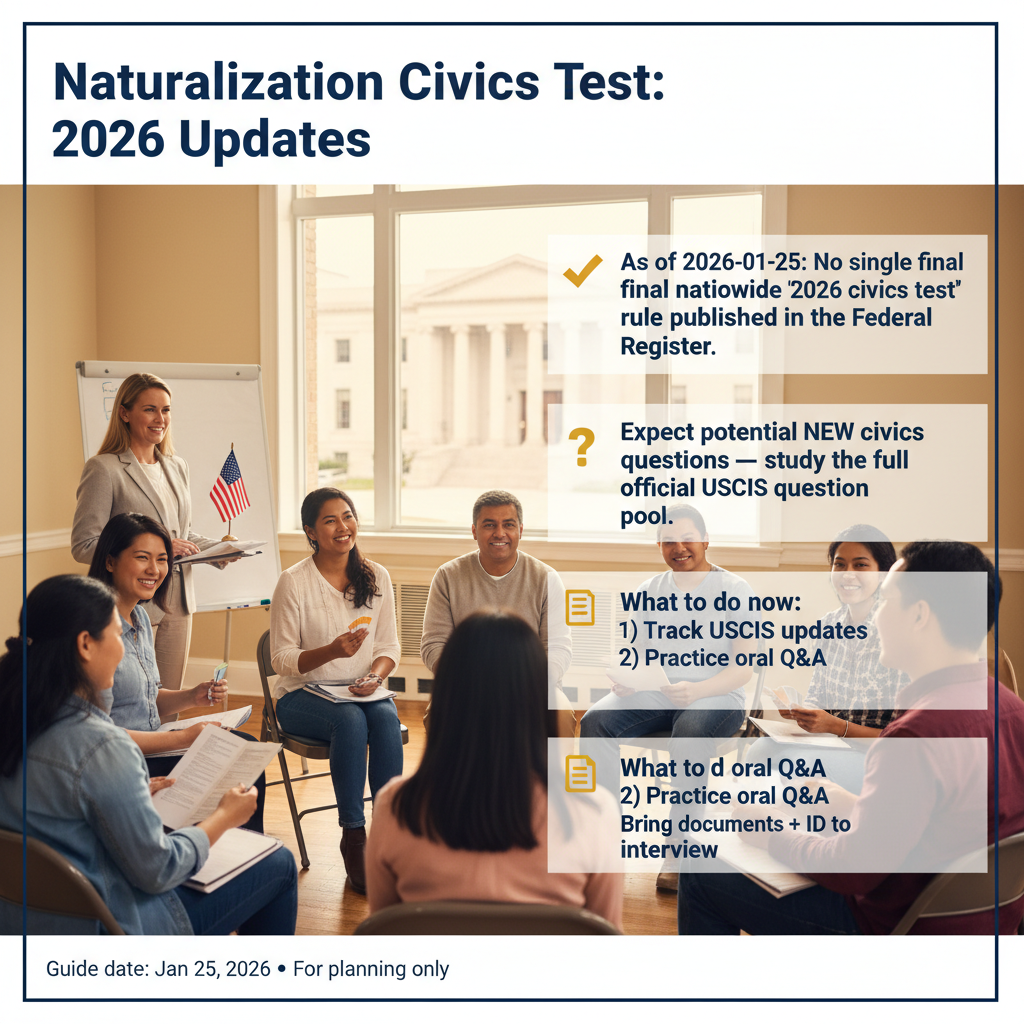
The reporting that sparked this guide: Naturalization Test Changes Coming in 2026 (Citizenship)
Important: As of today (2026-01-25), USCIS has not published a single, final nationwide “2026 civics test” rule in the Federal Register that applies to all applicants. However, credible reporting and ongoing policy discussions point to potential updates—such as refreshed question banks, changed scoring rules, or revised interview procedures. This article explains how the naturalization test works right now, what changes are being discussed, and how to prepare strategically so you are ready no matter which version applies to you.
Need Help? Our Orlando immigration team is ready to assist. Call +1 786-791-3106 for a free consultation, or message us online. Se Habla Español.
What This News Means for Immigrants in Orlando and Across Florida
Why this news is showing up now
The U.S. naturalization process is built around federal law, but USCIS can update the civics test question bank, training standards, and interview guidance over time. When updates are rumored or previewed, it often coincides with:
- Administrative transitions and new policy priorities at the federal level.
- Modernization efforts (e.g., revising questions for clarity, civic accuracy, or educational value).
- Backlog and efficiency concerns—USCIS may adjust interview workflows to reduce re-tests and continuances.
- Public feedback cycles where USCIS tests new ideas before formal adoption.
Reminder: USCIS has changed the civics test before. The 2020 civics test update, and later return to the earlier version for many applicants, showed that “which test applies” can depend on your filing date and USCIS transition rules.
How it can affect Florida residents
For Florida applicants—especially in high-volume areas like Orlando, Tampa, and Miami—test changes can impact:
- Study strategy: You may need to study a different question set or prepare for different ways questions are asked.
- Timing decisions: Some people may choose to file sooner (or wait) depending on which test version will apply.
- Interview outcomes: Even small changes (like how many questions must be answered correctly) can affect pass rates.
- Retest planning: If you fail English or civics, USCIS schedules a second chance—changes can affect what you must re-take.
If your case is in Orlando, the local experience matters too. The Orlando USCIS Field Office interview schedule, staffing, and local processing patterns can influence timelines—especially for families along the I-4 corridor (Orange County, Osceola County, Seminole County, and surrounding Central Florida communities).
What Naturalization Test Changes Coming in 2026 Is (and Why It Matters)
A plain-English definition
“Naturalization test changes” usually means USCIS may update one or more parts of the citizenship testing process:
- The civics test question bank (what questions are eligible to be asked).
- The civics test format (how many questions are asked and how many must be correct).
- The English test (reading/writing vocabulary lists and speaking evaluation).
- The interview procedure (how officers evaluate eligibility, good moral character, and inconsistencies).
In practice, most “test changes” that affect applicants are changes to the civics question bank and the pass/fail threshold. Even if the legal eligibility requirements don’t change, different testing rules can change how much preparation you need and how you should time your filing.
Key terms you need to know
- Naturalization: The process of becoming a U.S. citizen after holding lawful permanent resident status (a green card) and meeting statutory requirements.
- Form N-400: The USCIS application for naturalization (citizenship).
- Civics test: The U.S. history and government portion of the naturalization interview.
- English test: Speaking (during interview), plus reading and writing tests (unless exempt).
- 2008 civics test: The long-standing version where USCIS asks up to 10 questions and you must answer 6 correctly.
- Good Moral Character (GMC): A legal requirement tied to your statutory period (usually 5 years, or 3 years for certain spouses of U.S. citizens) and sometimes beyond.
- Continuous residence and physical presence: Requirements about where you live and how much time you spend inside the U.S.
- 90-day window: Many applicants may file up to 90 days before meeting the continuous residence requirement (if otherwise eligible).
Warning: Some applicants assume “test changes” are only about memorization. In reality, naturalization is also a legal eligibility review. Issues like taxes, selective service, criminal history, long trips abroad, or prior immigration filings can matter as much as civics preparation.
Current Immigration Law: The Foundation
Even if USCIS updates the civics test in 2026, the core naturalization rules come from federal statutes and regulations. Understanding the current legal foundation helps you prepare confidently and avoid surprises at the interview.
Federal requirements
Naturalization is primarily governed by the Immigration and Nationality Act (INA) and related regulations:
- INA § 316 (general naturalization requirements for most applicants, including 5-year permanent residence).
- INA § 319 (naturalization for certain spouses of U.S. citizens, typically 3-year rule).
- 8 CFR Part 316 and 8 CFR Part 319 (regulatory requirements and procedures).
In addition, USCIS policy is guided by the USCIS Policy Manual and official instructions available on the USCIS official website.
The naturalization test is part of the N-400 interview. Unless you qualify for an exemption or accommodation, you must demonstrate:
- Ability to read, write, and speak basic English; and
- Knowledge and understanding of U.S. history and government (civics).
Important: Some applicants qualify for age-and-residency based English exemptions (often called “50/20” or “55/15”), but they still generally must take the civics test (with language accommodations).
While this article focuses on naturalization, many readers are on a family-based path first. Common forms you may see in the broader journey include: Form I-130 (family petition) and Form I-485 (Adjustment of Status for a green card). Your Priority Date matters in many categories, though most immediate relative cases do not have visa backlogs.
Florida-specific considerations
Naturalization is federal, so Florida does not create separate citizenship rules. However, Florida residents should plan for:
- Local field office logistics: The Orlando USCIS Field Office handles interviews and may have local scheduling patterns.
- Name change requests: In some jurisdictions, name changes may be handled through judicial oath ceremonies; timing can differ.
- Travel patterns: Florida residents often travel internationally; long trips can affect continuous residence and physical presence.
- Document access: If you lived in multiple states, you may need out-of-state court dispositions or tax transcripts.
For Central Florida residents in Orange County and across the I-4 corridor, planning ahead is especially important if you anticipate travel, relocation, or a pending family petition that could interact with your eligibility.
For official forms and filing instructions, use: USCIS Forms.
Need Help? Our Orlando immigration team is ready to assist. Call +1 786-791-3106 for a free consultation, or message us online. Se Habla Español.
How to Prepare for the 2026 Naturalization Test Update: A Complete Step-by-Step Guide
Because USCIS may implement transition rules (for example, “filed before X date uses the prior test”), the safest approach is to prepare in a way that covers both: (1) the current test framework and (2) the most likely areas of change (question bank updates, format tweaks, and interview emphasis).
1) Confirm you are eligible to apply (before you study)
Before you invest months of study time, confirm the legal requirements. Many denials and delays happen because the applicant was not yet eligible or had issues that needed legal strategy.
Documents to gather:
- Front/back copy of your green card
- All passports (current and expired) used during your statutory period
- Travel history list (dates out of the U.S.)
- Marriage certificate/divorce decrees (if applicable)
- Selective Service registration proof (if applicable)
- Tax transcripts (recommended)
- Certified court dispositions for any arrests/citations (if any)
Important: If you have any criminal history—even if charges were dropped—talk to counsel before filing. Also review long trips abroad; trips of 6+ months can create continuous residence issues.
2) Choose the right filing strategy and timing (including the 90-day window)
USCIS often applies test changes based on the date you file Form N-400 or the date of your interview. If 2026 changes are implemented with a transition period, timing can determine which test applies.
Documents to gather:
- Permanent resident since date (from green card)
- Proof of marital union (if filing under 3-year rule)
- Address history and employment history
- Proof of spouse’s U.S. citizenship (if applicable)
Many applicants can file within the 90-day window before meeting the continuous residence requirement. If you are close to eligibility and concerned about a new test, a careful timing review may help.
To track typical timeframes, consult: USCIS Processing Times.
3) File Form N-400 correctly and build an “interview-ready” packet
Naturalization is not only a test—it's a sworn legal application. Inconsistencies between your N-400 and past filings (such as Form I-130 or Form I-485) can trigger delays or deeper questioning.
Documents to gather:
- Copy of your submitted N-400 (keep a complete copy)
- Two passport-style photos (only if required for your filing method)
- Fee payment confirmation or fee waiver request (if applicable)
- Evidence of legal name changes (if any)
- Evidence supporting any “yes” answers (tax payment plans, court records, etc.)
Reminder: Always use the most current edition of the form and instructions from USCIS Forms.
4) Prepare for both the civics test and the interview “eligibility exam”
If USCIS updates the civics questions in 2026, the biggest risk is studying the wrong bank or not practicing how questions are asked in real interviews. Prepare in layers:
- Layer 1: Master the current civics topics (foundational U.S. government structure, rights, history themes).
- Layer 2: Practice with official-style questions and oral responses under time pressure.
- Layer 3: Prepare your N-400 eligibility answers: travel, marriage, taxes, children, prior addresses, and any incidents.
Documents to gather:
- Your civics study notes and practice logs
- Copy of N-400 and supporting evidence for complex sections
- Interpreter/accommodation paperwork (if applicable)
Warning: The speaking portion of the English test is evaluated throughout the interview. Even strong civics knowledge can be undermined if you cannot understand and respond to officer questions.
5) Attend biometrics (if scheduled) and track your case status
Many applicants complete biometrics earlier in the process, and some are reused. If you receive an appointment, attend on time and keep proof.
Documents to gather:
- Biometrics appointment notice
- Government-issued photo ID
- Green card
- Any reschedule confirmation (if applicable)
Keep your address updated with USCIS. Missing a notice can cause serious delays.
6) Go to the interview prepared for either test version and possible same-day oath
The interview is where civics/English testing and eligibility review happen. If test changes roll out in 2026, your officer will apply the version USCIS requires for your case.
Documents to bring:
- Interview appointment notice
- Green card
- Passports and travel documents
- State ID/driver’s license
- Marriage certificate/divorce decrees (if applicable)
- Tax transcripts and proof of payment plans (if applicable)
- Court dispositions (certified) for any incidents
- Evidence of current marital union (if applying under 3-year rule)
If your case is in Orlando, plan ahead for travel time and parking near the Orlando USCIS Field Office. Arrive early and dress professionally.
Important: If you pass and are approved, you may be scheduled for an oath ceremony—sometimes the same day, sometimes later.
Practical Steps You Can Take Today
Whether USCIS changes the civics test in 2026 or not, the best preparation is a combination of legal readiness and study readiness. Below is an actionable checklist you can start today.
Actionable checklist
- 1) Audit your travel history: List every trip outside the U.S. for the last 5 years (or 3 years). Note any trip near or over 6 months.
- 2) Request IRS tax transcripts: These are often stronger than self-prepared returns and can reduce interview friction.
- 3) Get certified court records: If you ever had an arrest, citation, or court case, obtain certified dispositions now.
- 4) Build a civics study plan: 20–30 minutes/day, 5 days/week, plus weekly mock interviews.
- 5) Practice spoken English in “interview mode”: Answer common N-400 questions out loud, not just in writing.
- 6) Track USCIS updates: Monitor official announcements on the USCIS official website.
- 7) Schedule a legal screening: If there are red flags (tax debt, long trips, prior misstatements, criminal history), get advice before filing.
Document preparation guidance
Create a folder (digital + paper) with:
- Identity: green card, passports, IDs
- Residence: leases/mortgage statements, utility bills (as needed)
- Family: marriage/divorce records, children’s birth certificates
- Taxes: IRS transcripts, payment plans
- Legal: court dispositions, probation completion letters
Reminder: If you previously filed Form I-130 or Form I-485, keep copies. Consistency matters. If something was incorrect in prior filings, it may be fixable—but you should address it strategically.
Timeline expectations
Timelines vary by location and workload. Many cases take several months from filing to interview, and then additional time to oath if not same-day. Check current estimates here: USCIS Processing Times.
For Central Florida residents, scheduling at the Orlando field office may fluctuate throughout the year. Build buffer time if you have planned international travel, especially during holidays and summer.
Need Help? Our Orlando immigration team is ready to assist. Call +1 786-791-3106 for a free consultation, or message us online. Se Habla Español.
How Imigrar Helps Immigrants in Orlando
At Imigrar, our mission is simple: Keep Families Together. We are based in Orlando, Florida and serve clients nationwide. Naturalization is often the final step in a long immigration journey—and it should be handled with the same care as a green card case.
We help clients prepare for possible naturalization test changes by focusing on what USCIS actually decides cases on:
- Eligibility screening (continuous residence, physical presence, Good Moral Character)
- N-400 strategy and accuracy (reducing inconsistencies with prior filings like Form I-130 and Form I-485)
- Document assembly and evidence planning
- Mock interview preparation (English + civics + N-400 questions)
- Support for RFEs, continuances, and re-test appointments
Se Habla Español. If you feel nervous about the interview or concerned about how a 2026 civics update could affect you, we can help you build a plan.
Call +1 786-791-3106 for a free consultation or message us online at https://www.imigrar.com/contact.
Frequently Asked Questions
Q: Will the 2026 naturalization test changes affect everyone?
A: Not necessarily. When USCIS changes the civics test, it often sets transition rules based on your Form N-400 filing date, interview date, or a specific implementation date. If USCIS announces a new test, we recommend confirming which version applies to your case before you study heavily. If your case is in Orlando, also factor in local interview scheduling because it can affect whether your interview happens before or after a change.
Q: I’m eligible now—should I file before the test changes?
A: Possibly, but it depends. Filing sooner can sometimes “lock in” the current rules if USCIS uses a filing-date transition. However, filing before you are truly ready can backfire if you have unresolved eligibility issues (taxes, travel, court matters). A legal screening can help you decide whether to file now, within the 90-day window, or after you address red flags.
Q: Do test changes impact my green card or immigration status?
A: A pending N-400 generally does not cancel your lawful permanent resident status. However, the naturalization process can bring prior issues to USCIS attention. If there are concerns about fraud, abandonment of residence, or criminal grounds, USCIS may refer the case for further review. If you are worried, consult an attorney before filing.
Q: How long does the naturalization process take in Florida?
A: It varies by year and field office workload. Many cases take several months from filing to interview, then additional time to oath if not same-day. The best way to estimate is to check: USCIS Processing Times. For Central Florida residents, the Orlando USCIS Field Office timeline can fluctuate, so avoid scheduling international travel near your likely interview window.
Q: What documents should I bring to the naturalization interview?
A: Bring your interview notice, green card, passports, state ID, and documents supporting any “yes” answers on the N-400. Common examples include tax transcripts, proof of child support, marriage/divorce records, and certified court dispositions. If you applied under the 3-year marriage rule, bring proof you are still living in marital union with your U.S. citizen spouse.
Q: How much does it cost to apply for citizenship?
A: USCIS fees can change, and the total cost depends on whether you request a fee waiver or reduction and whether you choose legal representation. Always verify current fees on the USCIS official website. If cost is a concern, ask about fee waiver eligibility and payment planning for document retrieval (like certified court records).
Q: What happens if I fail the civics or English test under the new rules?
A: In most cases, USCIS will schedule a re-examination (a second chance) for the portion you failed. If the civics test changes, USCIS should apply the correct version for your case based on its transition guidance. The key is to attend the re-test and prepare with a focused plan. If you receive a denial, you may have options such as filing an administrative review (Form N-336) depending on the reason.
Q: What if USCIS denies my N-400—can I apply again?
A: Many applicants can reapply, but you should first understand the denial reason. Some denials are based on temporary issues (insufficient English/civics, missing documents). Others involve legal ineligibility (continuous residence breaks, GMC issues). If you are in removal proceedings, the forum may involve the immigration court system; see Executive Office for Immigration Review for general information. Get legal advice before refiling so you don’t repeat the same problem.
Common Mistakes (and How to Avoid Them)
Mistake #1: Studying without confirming which test applies
Applicants sometimes memorize one civics bank while USCIS applies another due to transition rules. Avoid this by monitoring USCIS announcements and confirming the test version tied to your N-400 filing date and interview date. When in doubt, prepare broadly: core civics concepts plus official-style practice questions.
Mistake #2: Underestimating the N-400 “eligibility interview”
The civics test is only part of the appointment. Officers review your entire background. Warning: Inconsistent addresses, missing trips, or unclear marital timelines can lead to delays or continuances. Fix this by preparing a clean timeline and bringing supporting records.
Mistake #3: Ignoring travel, taxes, and court records until the last minute
Certified court dispositions and IRS transcripts can take time to obtain. If your case is in Orlando and your interview is scheduled quickly, last-minute document scrambling increases risk. Build your file early, and address issues like payment plans or missing records proactively.
Additional Official Resources to Follow
To stay current on any 2026 naturalization test updates and related immigration procedures, rely on official sources:
- USCIS official website
- USCIS Forms
- USCIS Processing Times
- U.S. Department of State (passport and travel information after naturalization)
- Executive Office for Immigration Review (general information if court proceedings are involved)
Reminder: Social media and unofficial study apps can be useful—but always verify against USCIS materials and announcements.
Need Help? Our Orlando immigration team is ready to assist. Call +1 786-791-3106 for a free consultation, or message us online. Se Habla Español.

Closing: Get Ready for 2026—Without Guessing
Naturalization test changes can feel stressful, especially when you are balancing work, family, and the pressure of a high-stakes interview. The best approach is to prepare the right way: confirm eligibility, file a strong Form N-400, and study civics and English with an interview-focused plan that can adapt if USCIS updates the question bank in 2026.
If your case is in Orlando—or anywhere in Florida and nationwide—Imigrar is here to help you move forward with clarity and confidence.
Need help now? Call +1 786-791-3106 for a free consultation, or message us online. Se Habla Español.


