


The reporting that sparked this guide: USCIS Processing Times and Updates for 2026 (USCIS)
What This News Means for Immigrants in Orlando and Across Florida
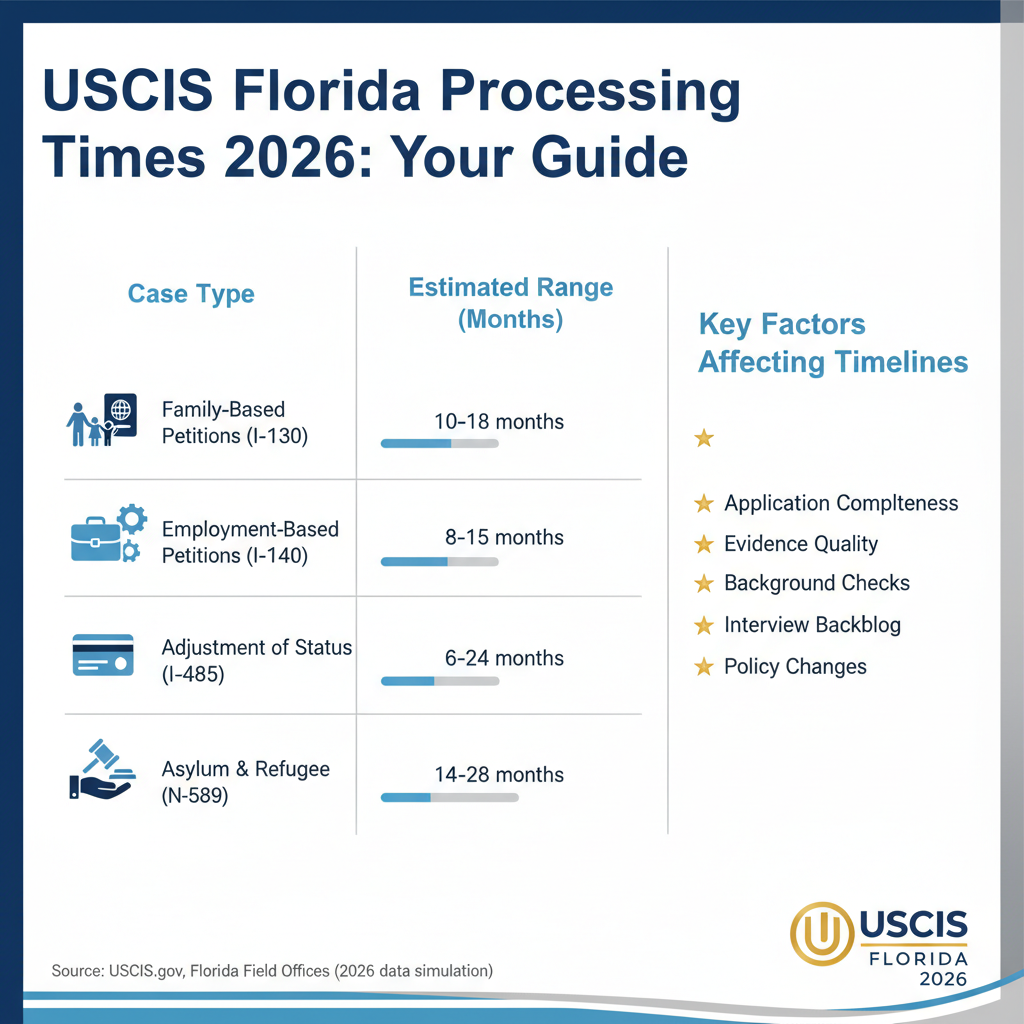
For immigrants and their families in Orlando, Central Florida, and throughout the Sunshine State, news about USCIS processing times is always critical. It directly impacts your future, your ability to work, travel, and ultimately, to keep your family together. As of early 2026, the U.S. Citizenship and Immigration Services (USCIS) continues to provide regular updates to its processing time estimates, reflecting ongoing adjustments in caseloads, staffing, and operational efficiencies. These updates are not just numbers; they represent the waiting period for critical decisions on applications like green cards, work permits, and naturalization.
Why this news is showing up now
USCIS is a dynamic agency, constantly adapting to legislative changes, shifting immigration policies, and varying application volumes. The current reporting on processing times in 2026 is a continuation of USCIS's commitment to transparency, offering applicants a realistic expectation of how long their case might take. These updates are typically influenced by several factors, including:
- Application Backlogs: The lingering effects of increased filings and operational changes can lead to accumulated cases.
- Staffing Levels: Availability of adjudicators and support staff directly impacts processing speed.
- Budgetary Constraints: USCIS primarily funds its operations through fees, and budget fluctuations can affect its capacity.
- Policy Changes: New regulations or priorities can shift resources and alter processing workflows for certain application types.
- Technological Upgrades: While intended to improve efficiency, the implementation of new systems can sometimes cause temporary delays.
Understanding these underlying reasons can help set more realistic expectations for applicants navigating the complex immigration system.
How it can affect Florida residents
Florida is a vibrant hub for immigrants from all over the world, with Orlando being a particularly diverse and growing metropolitan area. For those living in Orange County and beyond, the impact of USCIS processing times is deeply personal:
- Family Reunification: Delays in family-based petitions (e.g., Form I-130, Form I-485) mean longer waits for loved ones to join you or adjust their status. This directly challenges Imigrar's mission to "Keep Families Together."
- Employment Opportunities: Extended processing times for employment authorization documents (EADs, filed with Form I-765) can prevent individuals from starting new jobs or continuing existing ones, impacting livelihoods across the I-4 corridor.
- Travel Plans: Delays in advance parole documents (filed with Form I-131) can restrict essential international travel for those with pending green card applications.
- Uncertainty and Stress: Prolonged waits create immense emotional and financial stress for individuals and families in Central Florida, making it difficult to plan for the future.
- Local Field Office Impact: The Orlando USCIS Field Office handles interviews and certain local applications. Its specific workload and efficiency directly affect local residents. If your case is in Orlando, understanding these local dynamics is crucial.
For Central Florida residents, staying informed about these updates and understanding their implications is the first step toward effectively managing your immigration journey. Imigrar is here to help you navigate these complexities.
Need Help? Our Orlando immigration team is ready to assist. Call +1 786-791-3106 for a free consultation, or message us online. Se Habla Español.
What USCIS Processing Times Is (and Why It Matters)
When you submit an immigration application to USCIS, one of the most pressing questions is, "How long will it take?" The answer lies in understanding USCIS processing times. This isn't just a bureaucratic detail; it's a critical factor that dictates the pace of your life and the realization of your immigration goals.
A plain-English definition
In simple terms, USCIS processing times refer to the estimated duration it takes for USCIS to process a specific type of application or petition from the moment they receive it until they make a decision. These times are not guarantees but rather estimates based on historical data of how long it took to complete 80% of similar cases in a particular service center or field office. They are published online by USCIS and updated regularly to reflect current operational realities.
For example, if the processing time for a Form I-130 at the California Service Center is listed as 12 to 18 months, it means that 80% of Form I-130 petitions processed by that center were completed within that timeframe. Your individual case might fall within, below, or above this range, depending on its unique complexities and how thoroughly it was prepared.
Key terms you need to know
Navigating USCIS processing times requires familiarity with several key terms:
- Receipt Date: This is the exact date USCIS officially received your application or petition. It's usually indicated on the Form I-797C, Notice of Action, which USCIS sends you after they accept your filing. Your processing time starts from this date.
- Notice Date: The date USCIS issued a specific notice, such as a receipt notice or an approval notice. This is distinct from the receipt date.
- Priority Date: For certain visa preference categories (primarily family-sponsored and employment-based categories), the Priority Date is the date your petition was properly filed with USCIS. This date determines your place in line to receive an immigrant visa, as there are annual limits on the number of visas available. You can only move forward with your green card application (either through Adjustment of Status or Consular Processing) once your Priority Date becomes "current" according to the U.S. Department of State Visa Bulletin.
- Case Status Online: An invaluable tool on the USCIS website (USCIS Case Status Online) where you can check the real-time status of your application using your unique Receipt Number (found on Form I-797C). It will tell you if your case is received, under review, approved, or if an RFE has been issued.
- Processing Time Range: As mentioned, this is the estimated period USCIS provides for completing 80% of similar cases. It's crucial to understand that if your case falls outside this range, it might be considered "outside normal processing times," allowing you to submit an inquiry.
- Service Center/Field Office: USCIS operates several service centers (e.g., California, Nebraska, Texas, Vermont) that process mail-in applications, and numerous field offices (like the Orlando USCIS Field Office) that handle interviews, local filings, and other in-person services. The processing times vary significantly between these locations, so knowing where your application is being processed is essential.
- Adjustment of Status (AOS): This is the process for eligible individuals to apply for lawful permanent resident status (a green card) while physically present in the United States. It involves filing Form I-485, often concurrently with or after the underlying immigrant petition (e.g., Form I-130 or Form I-140).
- Consular Processing: This is the alternative to Adjustment of Status, where an individual applies for an immigrant visa through a U.S. embassy or consulate abroad to enter the U.S. as a permanent resident.
- Request for Evidence (RFE): A notice from USCIS requesting additional documents or information to support your application. Responding promptly and completely to an RFE is critical to avoid further delays or denial.
Understanding these terms empowers you to track your application more effectively and anticipate the next steps in your immigration journey. Imigrar emphasizes the importance of knowing your specific application details to accurately interpret USCIS updates.
Current Immigration Law: The Foundation
The entire U.S. immigration system, including how USCIS processes applications, is built upon a framework of federal laws and regulations. The primary legislative bedrock is the Immigration and Nationality Act (INA). Passed in 1952 and significantly amended over the decades, the INA governs virtually all aspects of immigration law, from family-based and employment-based visas to asylum and naturalization.
Federal requirements
Every application submitted to USCIS, whether it's a petition for a family member, an application for a work permit, or a request for naturalization, must adhere to specific eligibility criteria and procedural requirements outlined in the INA and its corresponding regulations (found in Title 8 of the Code of Federal Regulations). For example:
- Family-Based Immigration: Sections 201-204 of the INA define immediate relatives (spouses, minor children, and parents of U.S. citizens) and family preference categories (unmarried sons/daughters of U.S. citizens, spouses/children of LPRs, etc.). Petitions like Form I-130 are filed under these provisions.
- Employment-Based Immigration: Section 203 of the INA details the various employment-based visa categories, from extraordinary ability individuals to skilled workers and investors. Petitions like Form I-140 (Immigrant Petition for Alien Worker) fall under this section.
- Adjustment of Status: Section 245 of the INA allows eligible individuals already in the U.S. to change their nonimmigrant status to lawful permanent resident status without leaving the country, typically by filing Form I-485. There are strict eligibility rules, including lawful entry and maintenance of status, though some exceptions apply.
- Naturalization: Sections 310-337 of the INA lay out the requirements for becoming a U.S. citizen, including continuous residence, physical presence, good moral character, and demonstrating knowledge of U.S. history and government, typically through Form N-400.
- Employment Authorization: Section 274A of the INA requires employers to verify the employment authorization of their employees. Eligible non-citizens apply for an Employment Authorization Document (EAD) using Form I-765.
- Travel Documents: Section 212 of the INA deals with inadmissibility, while provisions related to advance parole and re-entry permits (Form I-131) allow certain applicants to travel internationally without jeopardizing their pending immigration applications.
These federal requirements are non-negotiable. Any application that fails to meet the statutory and regulatory criteria, or includes incomplete or inaccurate information, faces potential delays, Requests for Evidence (RFEs), or outright denial. This is why thorough preparation and adherence to all instructions on the USCIS Forms and guidelines are paramount.
Florida-specific considerations
While immigration law is federal, its practical application and impact can have state-specific nuances. For Florida residents, particularly those in Orlando, these considerations often relate to how state and local services interact with federal immigration status:
- Local Field Office Operations: The Orlando USCIS Field Office conducts interviews for Adjustment of Status, naturalization (Form N-400), and other local applications. Its specific scheduling practices, interview backlogs, and local priorities can influence processing times for Orlando and Central Florida residents, even if the initial processing was done at a service center.
- Driver's Licenses and State IDs: Florida's Department of Highway Safety and Motor Vehicles has specific requirements for non-citizens applying for driver's licenses or state IDs, often requiring proof of valid immigration status and duration. Processing delays from USCIS can impact an individual's ability to obtain or renew these vital documents.
- Public Services and Benefits: Eligibility for certain state or local public services and benefits in Florida often depends on an individual's immigration status. Delays in obtaining a green card or naturalization can prolong periods of ineligibility.
- Local Law Enforcement and Immigration: While federal agencies like ICE handle immigration enforcement, local law enforcement in Florida may interact with immigrants, and understanding one's rights and immigration status is crucial, especially during periods of uncertain or delayed status.
It's important to remember that state laws cannot supersede federal immigration law, but they can certainly affect the day-to-day lives of immigrants in Florida. Imigrar understands these local dynamics and helps clients navigate both federal requirements and their Florida-specific implications.
Need Help? Our Orlando immigration team is ready to assist. Call +1 786-791-3106 for a free consultation, or message us online. Se Habla Español.

How to Navigate USCIS Processing Times: A Complete Step-by-Step Guide
Managing expectations and staying informed about your immigration application’s progress is crucial. This guide focuses on how to effectively monitor and respond to USCIS processing times for your applications.
1) Understand Your Application Type and Relevant Processing Location
Before you can track anything, you must know exactly what you’ve filed and where it’s being processed. USCIS has various forms, and each is handled by specific service centers or field offices, which have different processing timelines. For example, a Form I-130 (Petition for Alien Relative) might be processed at the California Service Center, while your subsequent Form I-485 (Application to Register Permanent Residence or Adjust Status) might be handled by the National Benefits Center and then transferred to your local Orlando USCIS Field Office for an interview.
- Required Documents/Information:
- Your Receipt Notices (Form I-797C) for all submitted applications. These notices confirm the specific form type (e.g., Form I-130, Form I-485, Form I-765), the Receipt Number, and the USCIS service center or field office that received your case.
- The official filing date (Receipt Date) of each application.
- Your specific visa category (e.g., F1, F2A, EB-1, EB-2).
2) Check Official USCIS Processing Times Online
USCIS provides a dedicated online tool to check current processing times. This is your primary resource for estimating how long your application might take. Remember, these are estimates, not guarantees.
- Actionable Steps:
- Visit the USCIS Processing Times page.
- Select your specific "Form" (e.g., Form I-485, Application to Register Permanent Residence or Adjust Status).
- Select the "Form Category" (e.g., Family-based, Employment-based, Asylum).
- Select the "Field Office or Service Center" where your application is being processed (as indicated on your Form I-797C). For Orlando residents, this might be the Orlando Field Office for interviews or a specific service center for initial processing.
- Click "Get processing time."
- Interpretation: The tool will display a range (e.g., "6 to 12 months"). This range represents the time it took USCIS to process 80% of similar cases. Compare your Receipt Date to this range.
- Required Documents/Information:
- Internet access.
- Your specific form type, category, and processing location.
3) Monitor Your Case Status Regularly
Beyond general processing times, you can track the specific status of your individual case using the USCIS Case Status Online tool. This provides updates on specific actions taken on your application.
- Actionable Steps:
- Go to the USCIS Case Status Online page.
- Enter your unique 13-character Receipt Number (e.g., EACXXXXXXXXXX, WACXXXXXXXXXX, LINXXXXXXXXXX, SRCXXXXXXXXXX, YSCXXXXXXXXXX, MSCXXXXXXXXXX). This number is found on your Form I-797C.
- Click "Check Status."
- What to Look For: The status will tell you if your case is "Received," "Fingerprint Review Completed," "Request for Evidence Sent," "Interview Was Scheduled," or "Case Approved."
- Important: Set up email or text alerts on the USCIS website for automatic notifications whenever your case status changes.
- Required Documents/Information:
- Your Receipt Number (from Form I-797C).
- Internet access.
4) Understand Your Priority Date and Visa Bulletin (if applicable)
For family-sponsored and most employment-based green card categories, processing times are not the only factor. You must also wait for your Priority Date to become "current" in the Visa Bulletin, published monthly by the U.S. Department of State.
- Actionable Steps:
- Locate your Priority Date on your Form I-797C for your approved Form I-130 or Form I-140.
- Review the monthly Visa Bulletin to check the "Dates for Filing" and "Final Action Dates" for your specific visa category and country of chargeability.
- You can generally file your Form I-485 (if eligible for Adjustment of Status) when your Priority Date is earlier than the "Dates for Filing." Your green card can be approved only when your Priority Date is earlier than the "Final Action Date."
- Warning: Misinterpreting the Visa Bulletin can lead to significant delays or improper filings. Consult with Imigrar if you are unsure.
- Required Documents/Information:
- Your Priority Date.
- Your visa category and country of chargeability.
- Access to the latest Visa Bulletin.
5) Know When to Submit an "Outside Normal Processing Time" Inquiry
If your case has been pending longer than the upper end of the published processing time range, you may be eligible to submit an inquiry to USCIS.
- Actionable Steps:


