


The reporting that sparked this guide
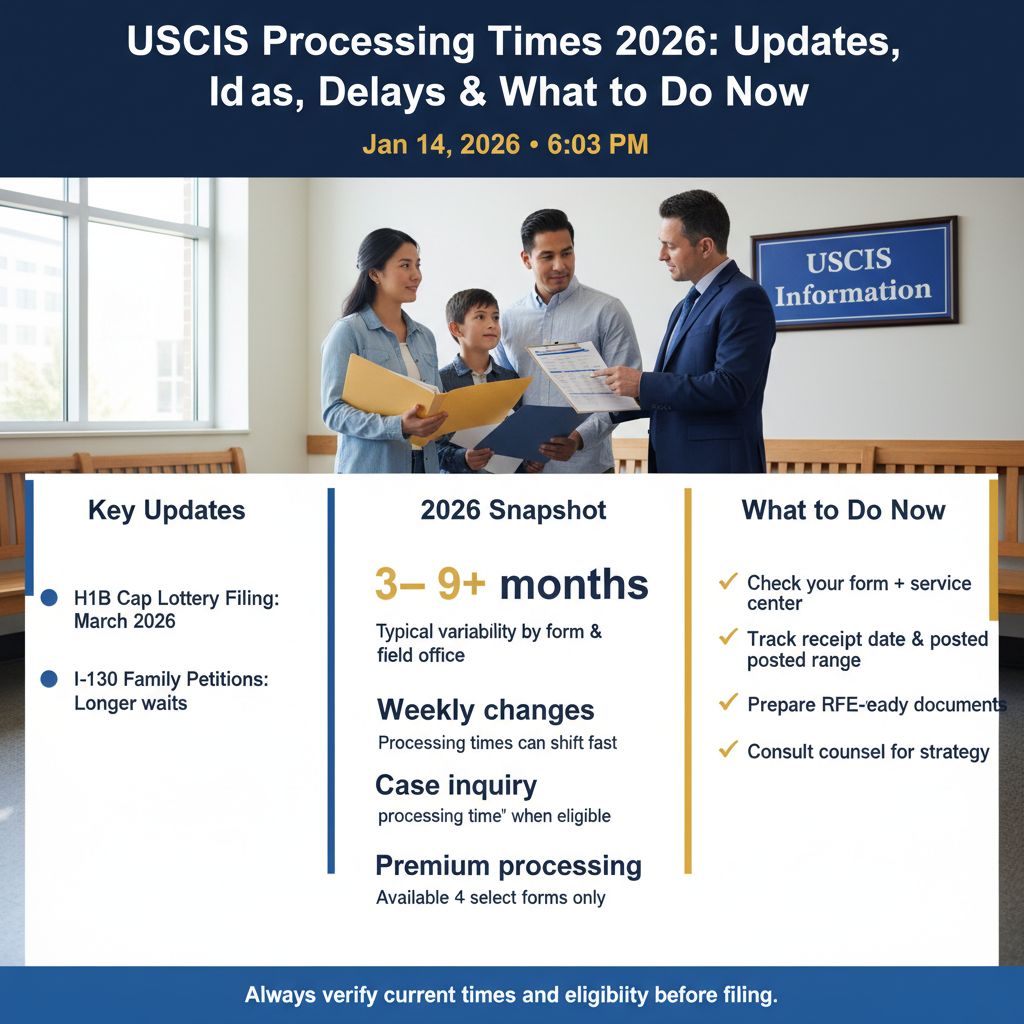
We’re tracking the latest USCIS processing time developments and public-facing updates that are being discussed in immigration news. The reporting that prompted this practical guide is: USCIS Processing Times and Updates for 2026 (USCIS).
Reminder: USCIS processing times change frequently by form type, category, and field office/service center. Always verify the most current numbers directly on USCIS Processing Times and the USCIS official website.
Need Help? Our Orlando immigration team is ready to assist. Call +1 786-791-3106 for a free consultation, or message us online. Se Habla Español.
What This News Means for Immigrants in Orlando and Across Florida
Why this news is showing up now
USCIS processing times are a recurring headline because they affect nearly every immigration benefit—family petitions, work permits, green cards, naturalization, and humanitarian cases. In 2026, processing time updates are drawing attention due to a combination of factors:
- Ongoing backlogs and shifting workloads across USCIS service centers and field offices.
- Policy and operational updates (including digitization, interview practices, and staffing changes) that can speed up some case types while slowing others.
- Higher filing volumes in certain categories (family-based filings, employment authorizations, and naturalization) which can create uneven wait times.
- Greater reliance on “processing time tools” by applicants and employers to plan travel, work start dates, and family reunification timelines.
Important: “USCIS processing time” is not a promise. It is an estimate based on recent case completions. Your timeline can be shorter or longer depending on your facts, background checks, RFEs, interviews, and whether your case is routed to a particular office.
How it can affect Florida residents
For Central Florida residents, even small changes in processing times can have real-life consequences:
- Work authorization gaps if an EAD renewal is delayed (often filed on Form I-765).
- Travel disruptions if Advance Parole (often also via Form I-131) is not approved before planned travel.
- Family separation if a consular case stalls after an Form I-130 approval due to visa availability and scheduling.
- Delayed green card interviews for Adjustment of Status cases filed on Form I-485, especially when the local field office workload fluctuates.
If your case is in Orlando, your timeline may be influenced by the Orlando-area USCIS workload and how cases are distributed between the Orlando USCIS Field Office and service centers. For Central Florida residents along the I-4 corridor (Orlando, Kissimmee, Sanford, and surrounding Orange County communities), planning ahead is essential.
What USCIS Processing Times and Updates for 2026 Is (and Why It Matters)
A plain-English definition
USCIS “processing times” are published estimates showing how long USCIS is taking to complete certain types of immigration applications or petitions. These times vary by:
- Benefit type (example: Form I-130 vs. Form I-485 vs. Form N-400)
- Case category (example: immediate relative vs. preference category)
- USCIS office (service center or field office)
- Applicant circumstances (background checks, RFEs, interview requirements)
In 2026, “updates” often refer to changes in how USCIS reports times, shifts in workloads, new internal procedures, and public guidance about how to track cases and when to request help.
Key terms you need to know
- Receipt Notice: The notice confirming USCIS received your filing (often called “I-797C”). It includes your receipt number.
- RFE (Request for Evidence): USCIS asks for missing or additional documents. RFEs almost always add time.
- NOID (Notice of Intent to Deny): A warning that USCIS plans to deny unless you respond with strong evidence.
- Biometrics: Fingerprints/photo appointment for background checks.
- Interview: Required for many benefits (often for Adjustment of Status and naturalization).
- Priority Date: The “place in line” date for certain family/employment categories where visas are capped. Your Priority Date interacts with the Visa Bulletin.
- Case outside normal processing time: A threshold USCIS uses to decide when you can submit an inquiry.
- Expedite request: A request to speed up processing based on specific criteria (severe financial loss, urgent humanitarian reasons, etc.).
Warning: Applicants sometimes confuse “processing time” with “visa availability.” Even if USCIS processes an Form I-130 quickly, a visa may not be immediately available in preference categories. For consular cases, the U.S. Department of State and the Visa Bulletin play a major role.
Current Immigration Law: The Foundation
USCIS processing times exist within a legal framework set by federal immigration statutes, regulations, and agency procedures. Understanding the foundation helps you spot what is “delay” versus what is “normal legal sequencing.”
Federal requirements
Most family- and employment-based immigration is governed by the Immigration and Nationality Act (INA), including (among others):
- INA § 201 and INA § 202: Numerical limits and per-country caps for certain immigrant visas.
- INA § 203: Preference categories and allocation rules (where Priority Date matters).
- INA § 204: Family and employment petition procedures (commonly Form I-130 and Form I-140).
- INA § 245: Adjustment of Status rules for green cards filed inside the U.S. (commonly Form I-485).
- INA § 316 and related provisions: Naturalization eligibility (commonly Form N-400).
USCIS also operates under federal regulations in Title 8 of the Code of Federal Regulations (8 C.F.R.), which govern filings, evidence, interviews, and adjudications.
Important: Processing delays do not change eligibility requirements. A slower timeline does not lower the legal standard, and a faster timeline does not reduce the need for correct evidence.
Official resources to rely on:
- USCIS official website
- USCIS Forms
- USCIS Processing Times
- U.S. Department of State
- Executive Office for Immigration Review (for immigration court/removal proceedings)
Florida-specific considerations
Immigration law is federal, but Florida residents face practical, local factors that can influence how delays affect daily life:
- Driver’s license/ID timing: Florida documentation rules can be impacted by pending immigration status and expiring documents. If your EAD or status document is delayed, it can affect renewals.
- Local field office scheduling: The Orlando USCIS Field Office workload can affect interview timing for Form I-485 and Form N-400.
- Travel from Central Florida: If you must travel for biometrics or interviews, plan around I-4 corridor traffic, parking, and rescheduling risks.
Reminder: If you are in removal proceedings, USCIS timelines may interact with immigration court schedules. Always coordinate strategy with counsel and monitor EOIR case status via the Executive Office for Immigration Review.
Need Help? Our Orlando immigration team is ready to assist. Call +1 786-791-3106 for a free consultation, or message us online. Se Habla Español.
How to Track and Respond to USCIS Processing Times in 2026: A Complete Step-by-Step Guide
1) Identify your case type, category, and office
Start by confirming exactly what you filed and where it is being processed. USCIS processing times depend heavily on the office.
Documents to gather:
- Receipt notice(s) (I-797C) for each filing
- Your receipt number(s) (example format: IOE, MSC, LIN, SRC, WAC, etc.)
- A copy of the full filing package (what you sent)
- Any prior USCIS notices (RFEs, interview notices, transfer notices)
Important: If you filed a family-based green card package, you may have multiple receipts (for Form I-130, Form I-485, Form I-765, and Form I-131). Track each one separately.
2) Check the official USCIS processing time tool the right way
Use the official tool at USCIS Processing Times. Select:
- The correct form (example: Form I-130, Form I-485)
- The correct category (example: “U.S. citizen filing for spouse” vs. other categories)
- The correct office (service center or field office)
Documents to have ready:
- Receipt notice with category information
- Any transfer notice showing the new office
- USCIS online account access (if you have one)
Reminder: The tool often shows a range and a “case inquiry date.” The key question is whether your case is past the inquiry date—not whether it is past the average.
3) Compare your timeline to the “case inquiry date” and set internal deadlines
Once you find the “case inquiry date,” create your own plan:
- Mark the inquiry date on your calendar
- Set a check-in every 30 days
- Prepare evidence now in case an RFE arrives
Warning: Waiting until a document expires can create emergencies. For example, EAD renewals can take months. When possible, file renewals early and keep proof of filing.
Documents to prepare now:
- Updated passport biographic page
- Updated state ID/driver’s license (if available)
- Current address proof (lease, utility bills)
- Updated relationship evidence (for marriage cases)
4) Respond fast and correctly to RFEs, biometrics, and interview notices
In 2026, one of the biggest causes of avoidable delays is slow or incomplete responses to USCIS notices. If USCIS issues an RFE or schedules an interview, treat it as urgent.
Documents commonly requested (examples):
- For Form I-485: updated medical exam (Form I-693), proof of lawful entry, financial sponsorship (Form I-864)
- For Form I-130: bona fide marriage evidence (joint bank statements, lease, insurance, photos)
- For Form N-400: tax transcripts, travel history, selective service proof (if applicable)
- For Form I-765: identity documents and category evidence
Important: Track RFE deadlines carefully. Missing a deadline can lead to denial. While some notices allow a response window, do not assume you have extra time.
5) Use USCIS online tools and customer service strategically (and document everything)
If your case is stuck, use a structured approach:
- Check your case status online using the receipt number
- Review your USCIS online account for notices
- If outside normal processing time, submit an e-Request (when available)
- Request a callback or schedule an InfoPass-type appointment if appropriate
Documents to keep in a “delay file”:
- Case status screenshots (with dates)
- Service request confirmation numbers
- Copies of all notices and your responses
- Mailing proof (certified mail, delivery confirmations)
For Central Florida residents, if the issue involves an interview or local adjudication, the Orlando USCIS Field Office may be the relevant office—especially for Adjustment of Status and naturalization.
6) Consider escalation options when delays cause harm
If you are well beyond the inquiry date or facing urgent harm, you may have options—depending on eligibility and evidence:
- Expedite request (urgent humanitarian reasons, severe financial loss, emergencies)
- Congressional inquiry through your U.S. representative or senator
- USCIS Ombudsman request (for systemic issues or prolonged delays)
- In limited cases, litigation strategies may be discussed with counsel
Documents to support escalation:
- Employer letters showing financial loss or job start date
- Medical records (for humanitarian expedite)
- Eviction notices, overdue bills, or other proof of hardship
- Proof your case is outside normal processing time
Warning: Expedite requests are discretionary and not guaranteed. Submitting weak expedite requests repeatedly can waste time and distract from building a strong underlying case.
7) Keep your underlying eligibility strong while you wait
Processing delays can tempt people to “move on” and forget compliance. Don’t. Continue to maintain eligibility:
- Update USCIS with address changes (typically within 10 days under INA-related requirements; use AR-11 as directed by USCIS)
- Avoid unauthorized employment if your category requires authorization
- Avoid travel without proper permission (example: Advance Parole for many pending Adjustment of Status applicants)
- Prepare for interview questions and gather updated evidence
Documents to continuously update:
- New pay stubs and employment letters
- New joint documents for marriage cases
- Updated tax filings and transcripts
- Travel log (dates, destinations, purpose)
Need Help? Our Orlando immigration team is ready to assist. Call +1 786-791-3106 for a free consultation, or message us online. Se Habla Español.
Practical Steps You Can Take Today
Processing times may be outside your control, but preparation is not. Here’s a practical, Florida-friendly checklist to reduce delays and stress—especially if your case is in Orlando or anywhere along the I-4 corridor.
- 1) Build a “USCIS master file”: One folder (digital + paper) with every receipt, notice, and the exact copy of what you filed.
- 2) Track every case number: If you filed Form I-130 and Form I-485 together, track Form I-765 and Form I-131 too.
- 3) Pre-collect RFE-prone documents: Marriage evidence, tax transcripts, proof of status, translations, and certified copies.
- 4) Plan for biometrics and interviews: Keep your schedule flexible; rescheduling can add months.
- 5) Use the “case inquiry date”: Don’t panic before it—but act promptly once you pass it.
- 6) Keep identity documents valid: Renew passports when possible, and keep copies of all pages with stamps/visas.
- 7) Prepare for the medical exam timing: If USCIS requests Form I-693, use a designated civil surgeon and keep a copy of what you submit.
Timeline expectations (general planning guidance): In 2026, many applicants should plan for multi-month to multi-year timelines depending on the benefit type, category, and office. A family-based Adjustment of Status case can involve separate timelines for:
- Receipt notices: typically within weeks after filing (varies)
- Biometrics: often within weeks to a few months (varies)
- EAD/Advance Parole: can take several months (varies by category and workload)
- Interview/decision: can take many months or longer depending on the local field office
Important: If you are counting on an EAD renewal, don’t wait until the last minute. Some categories may benefit from automatic extension rules when filed timely, but eligibility depends on the category and current USCIS rules. We can review your specific category and timing.
How Imigrar Helps Immigrants in Orlando
At Imigrar, our mission is to Keep Families Together. We help clients in Orlando, throughout Central Florida (including Orange County), and nationwide navigate USCIS delays with a plan—not guesswork.
- Case strategy built around timelines: We map out what should happen next and when to escalate appropriately.
- Front-loaded filings: Strong initial submissions reduce RFEs and avoidable delays.
- Interview preparation: Especially for marriage-based Adjustment of Status and Form N-400 naturalization interviews at the Orlando USCIS Field Office.
- RFE/NOID response support: We organize evidence and legal arguments to meet the standard and deadlines.
- Delay troubleshooting: Service requests, expedite packets when appropriate, and coordinated follow-ups.
We offer a free consultation to help you understand what your processing time means in your specific case and what steps can realistically move your case forward. Se Habla Español.
Need Help? Our Orlando immigration team is ready to assist. Call +1 786-791-3106 for a free consultation, or message us online. Se Habla Español.
Frequently Asked Questions
Q: Am I eligible to file Form I-485 if processing times are long?
A: Processing times do not change eligibility. Eligibility for Adjustment of Status under INA § 245 generally depends on factors like lawful admission/parole, visa availability (if applicable), admissibility, and category-specific rules. If you’re an immediate relative of a U.S. citizen, visa numbers are typically immediately available, but other issues (unlawful presence, prior orders, certain entries) may still matter. Have an attorney review eligibility before filing—especially if there are prior immigration issues.
Q: Will a pending case protect my immigration status while I wait?
A: It depends on what you filed and your current status. A properly filed Form I-485 generally places you in a period of authorized stay while it is pending, but it does not automatically give you work authorization or travel permission. A pending Form I-130 alone usually does not grant lawful status. Warning: Do not assume you are protected—get case-specific advice.
Q: How do I know if my case is “outside normal processing time” in 2026?
A: Use the “case inquiry date” on USCIS Processing Times. If your receipt date is earlier than the posted inquiry date for your form/category/office, you may be eligible to submit an inquiry. Keep screenshots and records. If your case was transferred, make sure you’re checking the correct office.
Q: What documents should I prepare now to avoid delays later?
A: Prepare a complete identity and eligibility packet even after filing: passport copies, birth certificates with certified translations, marriage/divorce records, updated proof of shared life (for marriage cases), tax transcripts, pay stubs, and any prior immigration documents. For many green card cases, be ready for Form I-693 (medical) and Form I-864 (affidavit of support). Use the USCIS Forms page to confirm current editions and instructions.
Q: How much does it cost to deal with processing delays?
A: USCIS does not charge a fee just to wait, but delays can create indirect costs: renewing documents, obtaining updated evidence, travel changes, missed work opportunities, and legal fees if a case needs escalation or a complex RFE response. Filing fees vary by form and can change; always verify on the USCIS official website. We can also help you evaluate whether a fee waiver may apply for certain filings.
Q: What happens if USCIS denies my application after a long wait?
A: A denial can have serious consequences depending on what was filed and your current status. Some denials may be appealed or motioned (MTR), some may be refiled, and some may trigger removal risk if you lack underlying lawful status. If you are placed in removal proceedings, your case may move to immigration court under EOIR (see Executive Office for Immigration Review). Contact counsel immediately to evaluate deadlines and options.
Q: If my case is in Orlando, does the local office affect my timeline?
A: Yes. The Orlando USCIS Field Office often controls interview scheduling and final adjudication for many Form I-485 and Form N-400 cases. Local workload, staffing, and security/background check timing can affect interview availability. For Central Florida residents in Orange County and along the I-4 corridor, planning for interview notice timing and document updates is essential.
Common Mistakes (and How to Avoid Them)
Mistake #1: Assuming the posted processing time is your guaranteed finish date
USCIS times are estimates, not deadlines. Applicants sometimes make irreversible decisions—quitting jobs, booking travel, moving—based on averages.
- How to avoid it: Use the “case inquiry date” and build a buffer. Don’t travel without proper authorization (Advance Parole where required).
Mistake #2: Filing incomplete packages that trigger RFEs
Missing signatures, outdated form editions, incorrect fees, or weak evidence can cause rejection, RFE, or denial—and months of delay.
- How to avoid it: Use the current form edition from USCIS Forms, follow the instructions, and include a clear cover letter and organized exhibits.
Mistake #3: Waiting too long to renew work authorization or update USCIS
EAD delays can create job loss and driver’s license issues. Address changes not reported can cause missed notices and denials.
- How to avoid it: File renewals early when eligible, keep proof of timely filing, and update addresses promptly. Track your mail carefully and keep copies of everything.
USCIS Processing Times in 2026: What to Watch Next (Orlando + Nationwide)
While no one can predict exact timelines, these are the trends applicants should monitor throughout 2026:
- Office-by-office variance: Two identical cases can move at different speeds depending on where they are processed.
- More digitization: Online accounts and electronic notices can speed communication but also require you to check your account regularly.
- Interview practices: Some categories may see more interviews, which can add time; others may see streamlined adjudications.
- Visa availability constraints: Preference categories can be limited by the Visa Bulletin even if USCIS is ready to adjudicate.
Reminder: For consular processing cases, USCIS is only one part of the timeline. After USCIS approval, the National Visa Center (NVC) and the consulate process the case under Department of State procedures. See U.S. Department of State for official guidance.
If your case is in Orlando and you’re waiting for an interview notice, keep your documents updated and your schedule flexible. A missed interview can lead to denial or significant delays.
Need Help? Our Orlando immigration team is ready to assist. Call +1 786-791-3106 for a free consultation, or message us online. Se Habla Español.

Closing: Get a Clear Plan for Your USCIS Timeline in 2026
USCIS processing times in 2026 can feel unpredictable—but your response doesn’t have to be. The best way to protect your case is to file correctly, track strategically, respond fast to notices, and escalate only when the facts support it.
If you’re worried about delays for Form I-130, Form I-485, or work permits—and especially if your case is in Orlando, Orange County, or anywhere along the I-4 corridor—Imigrar can help you build a timeline plan and reduce the risk of avoidable setbacks.
Need help now? Call +1 786-791-3106 for a free consultation or message us online. Se Habla Español. Our team is here to help you Keep Families Together.


